Questions

5 Marks Questions

🎯

Test yourself on this topic

14 questions · timed · auto-graded

Question 15 Marks
Water is running into an inverted cone at the rate of $\pi$ cubic metres per minute. The height of the cone is 10 metres, and the radius of its base is 5m. How fast the water level is rising when the water stands 7.5m below the base.
Answer
Given, The water is running into an inverted cone at the rate of $\pi$ cubic metres per minute. The height of the cone is 10 metres, and the radius of its base is 5m.
To find how fast the water level is rising when the water stands 7.5m below the base.
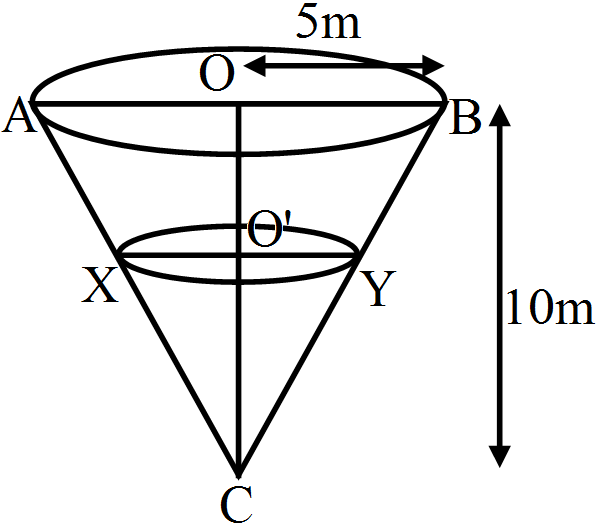
Let the height of the cone be H = 10m (given)
Let the radius of the base be R = 5m (given)
Let O’Y = r and CO’ = h
Now from the above figure,
$\triangle\text{COB}\sim\triangle\text{CO}'\text{Q}$
So,
$\frac{\text{O}'\text{Y}}{\text{OB}}=\frac{\text{CO}'}{\text{CO}}$
$\Rightarrow\frac{\text{r}}{5}=\frac{\text{h}}{10}$
$\Rightarrow\text{r}=\frac{\text{h}}{2}\ ...(\text{i})$
Let the volume of the water in the vessel at any time t be V
Then,
$\text{V}=\frac{1}{3}\pi\text{r}^2\text{h}$
$\Rightarrow\text{V}=\frac{1}{3}\pi\Big(\frac{\text{h}}{2}\Big)^2\text{h}$ (from equation (i))
$\Rightarrow\text{V}=\frac{1}{12}\pi\text{h}^3$
Now differentiate the above equation with respect to t, we get
$\frac{\text{dV}}{\text{dt}}=\frac{\text{d}\big(\frac{1}{12}\pi\text{h}^3\big)}{\text{dt}}$
$\Rightarrow\frac{\text{dV}}{\text{dt}}=\frac{1}{12}\pi\times3\text{h}^2\frac{\text{dh}}{\text{dt}}$
But given the water is running at the rate of $\pi\text{m}^3/\text{ min},\text{i.e., }\frac{\text{dv}}{\text{dt}}=\pi$
So, the above equation becomes,
$\Rightarrow\pi=\frac{1}{12}\pi\times13\text{h}^2\frac{\text{dh}}{\text{dt}}$
$\Rightarrow1=\frac{1}{4}\text{h}^2\frac{\text{dh}}{\text{dt}}$
$\Rightarrow\frac{\text{dh}}{\text{dt}}=\frac{4}{\text{h}^2}$
So, when the water stands 7.5 m below the base.
So, h = 10 - 7.5 = 2.5m, the rate becomes.
$\Rightarrow\frac{\text{dh}}{\text{dt}}=\frac{4}{\text{h}^2}$
$\Rightarrow\frac{\text{dh}}{\text{dt}}=\frac{4}{(2.5)^2}$
$\frac{\text{dh}}{\text{dt}}=64\text{m/ min}$
Hence the rate of water level rising when the water stands 7.5m below the base is 0.64 metres per min.
View full question & answer
Question 25 Marks
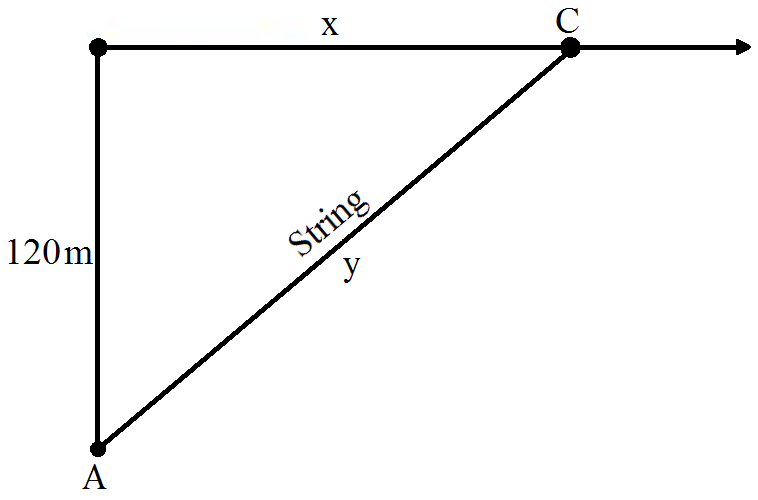
A kite is 120m high and 130m of string is out. If the kite is moving away horizontally at the rate of 52m/ sec, find the rate at which the string is being paid out.
Answer


Let C be the position of kite and AC be the string.
Here, $\text{y}^2=\text{x}^2+(120)^2\ \dots\text{(i)}$
$2\text{y}\frac{\text{dy}}{\text{dt}}=2\text{x}\frac{\text{dx}}{\text{dt}}$
$\text{y}\frac{\text{dy}}{\text{dt}}=\text{x}\frac{\text{dx}}{\text{dt}}$
$\frac{\text{dy}}{\text{dt}}=\frac{\text{x}}{\text{y}}(52)\ \dots(\text{ii})$ $\Big[\therefore\frac{\text{dx}}{\text{dt}}=52\text{m}/\sec\Big]$
From equation (i),
$y^2 = x^2 + (120)^2$
$(130)^2 = x^2 + (120)^2$
$x^2= 2500$
$x = 50$
Using equation (ii),
$\frac{\text{dy}}{\text{dt}}=\frac{\text{x}}{\text{y}}(52)$
$=\frac{50}{130}(52)$
$=20\text{m}/\sec$
So, string is being paid out at the rate of $20\text{m}/\sec.$
View full question & answer
Question 35 Marks
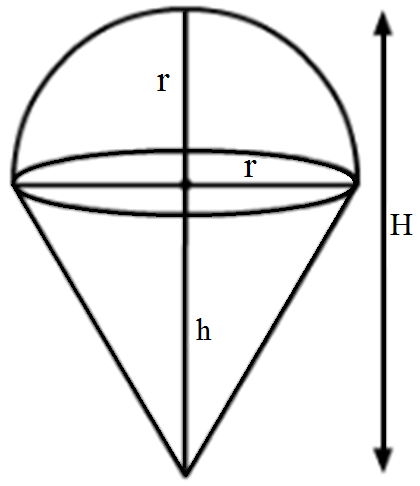
A balloon in the form of a right circular cone surmounted by a hemisphere, having a diametre equal to the height of the cone, is being inflated. How fast is its volume changing with respect to its total height h, when h = 9cm.
Answer
Let r be the radius of the hemisphere, h be the height and V be the volume of the cone.
Then, $\text{H}=\text{h}+\text{r}$ $\Rightarrow\text{H}=3\text{r}$ $[\therefore\text{h}=2\text{r}]$ $\Rightarrow\frac{\text{dH}}{\text{dt}}=3\frac{\text{dr}}{\text{dt}}$ When $\text{H}=\text9\text{cm},\text{r}=3\text{cm}$ Volume $=\frac{1}{3}\pi\text{r}^2\text{h}+\frac{2}{3}\pi\text{r}^3$ Substituting $\text{h}=2\text{r}$ $\Rightarrow\text{V}=\frac{2}{3}\pi\text{r}^3+\frac{2}{3}\pi\text{r}^3$ $\Rightarrow\text{V}=\frac{4}{3}\pi\text{r}^3$ $\Rightarrow\frac{\text{dV}}{\text{dt}}4\pi\text{r}^2\frac{\text{dr}}{\text{dt}}$ $\Rightarrow\frac{\text{dV}}{\text{dt}}=\frac{4\pi\text{r}^2}{3}\frac{\text{dH}}{\text{dt}}$ $\Rightarrow\frac{\text{dV}}{\text{dH}}=\frac{4\pi(3)^2}{3}$ $\Rightarrow\frac{\text{dV}}{\text{dH}}=12\pi\text{ cm}^3/\sec$
View full question & answer
Question 45 Marks
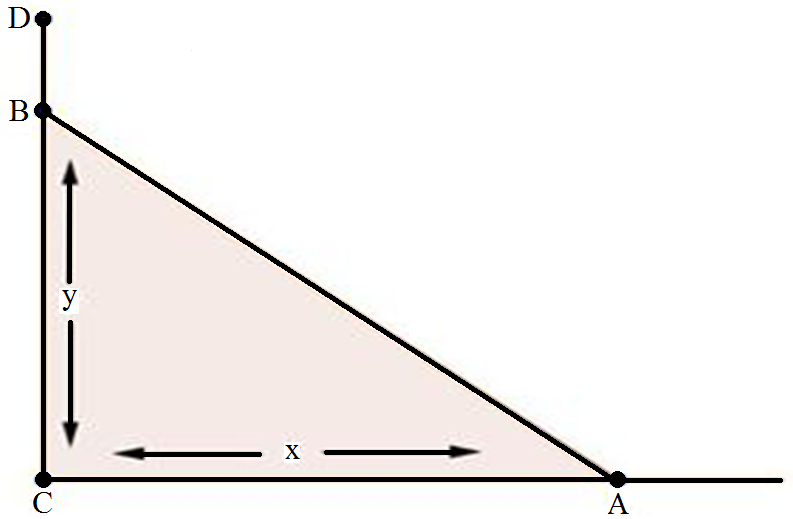
The top of a ladder 6 metres long is resting against a vertical wall on a level pavement, when the ladder begins to slide outwards. At the moment when the foot of the ladder is 4 metres from the wall, it is sliding away from the wall at the rate of 0.5m/ sec. How fast is the top-sliding downwards at this instance?
How far is the foot from the wall when it and the top are moving at the same rate?
Answer

Let CD be the wall and AB is the ladder
Here, AB = 6 meter and $\big(\frac{\text{dx}}{\text{dt}}\big)_\text{x-4}=0.5\text{m}/\sec.$
From figure,
$AB^2 = x^2 + y^2$
$(6)^2 = x^2 + y^2$
$36 = x^2 + y^2$
Differentiating it with respect to t,
$0=2\text{x}\frac{\text{dx}}{\text{dt}}+2\text{y}\frac{\text{dy}}{\text{dt}}$
$\frac{\text{dy}}{\text{dt}}=-\frac{\text{x}}{\text{y}}\frac{\text{dx}}{\text{dt}}$
$\big(\frac{\text{dx}}{\text{dt}}\big)_\text{x-4}=\frac{4(0.5)}{\sqrt{36-\text{x}}}$
$=-\frac{2}{\sqrt{36-16}}$
$=-\frac{2}{2\sqrt{5}}$
$=-\frac{2}{\sqrt{5}}\text{m}/\sec.$
So, ladder top is sliding at the rate of $\frac{2}{\sqrt{5}}\text{m}/\sec.$
Now, to find x when $\frac{\text{dx}}{\text{dt}}=-\frac{\text{dy}}{\text{dt}}$
From equation (i),
$\frac{\text{dy}}{\text{dt}}=-\frac{\text{x}}{\text{y}}\frac{\text{dx}}{\text{dt}}$
$-\frac{\text{dy}}{\text{dt}}=-\frac{\text{x}}{y}\frac{\text{dx}}{\text{dt}}$
x = y
Now,
$36 = x^2 + y^2$
$36 = x^2 + x^2$
$2x^2 = 36$
$x^2 = 18$
$\text{x}=3\sqrt{2}\text{m}$
When foot and top are moving at the same rate, foot wall is $=3\sqrt{2}$ meters away from the wall.
View full question & answer
Question 55 Marks
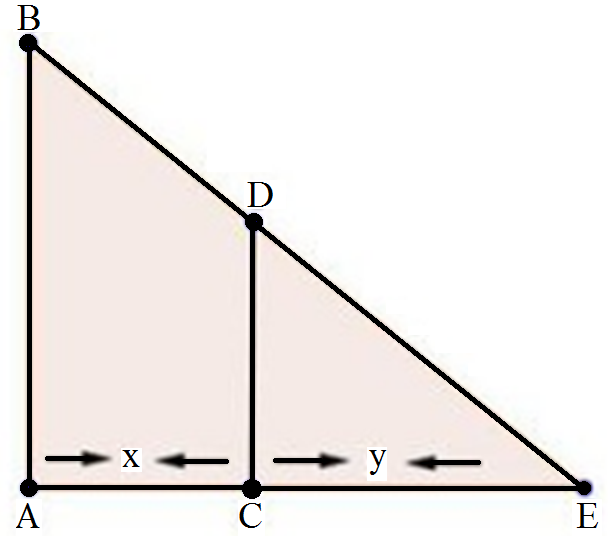
A man 2 metres high walks at a uniform speed of 6km/h away from a lamp-post 6 metres high. Find the rate at which the length of his shadow increases.
Answer
The diagram of the problem is shown below.

Let AB be the lamp-post. suppose at time t, the man CD is at a distance x m. from the lamp-post and y m be the length of the shadow CE.
Here, $\frac{\text{dx}}{\text{dt}}=6\text{km}/\text{hr}$
Here, $\triangle\text{ABE}$ and $\triangle\text{CDE}$ are similar
So, $\frac{\text{AB}}{\text{CD}}=\frac{\text{AE}}{\text{CE}}$
$\frac{6}{2}=\frac{\text{x}+\text{y}}{\text{y}}$
$3\text{y}=\text{x}+\text{y}$
$2\text{y}=\text{x}$
$2\frac{\text{dy}}{\text{dt}}=\frac{\text{dx}}{\text{dt}}$
$2\frac{\text{dy}}{\text{dt}}=6$
$2\frac{\text{dy}}{\text{dt}}=3\text{km}/\text{hr}$
so, length nof his shadow increases at the rate of $3\text{km}/\text{hr}.$
View full question & answer
Question 65 Marks
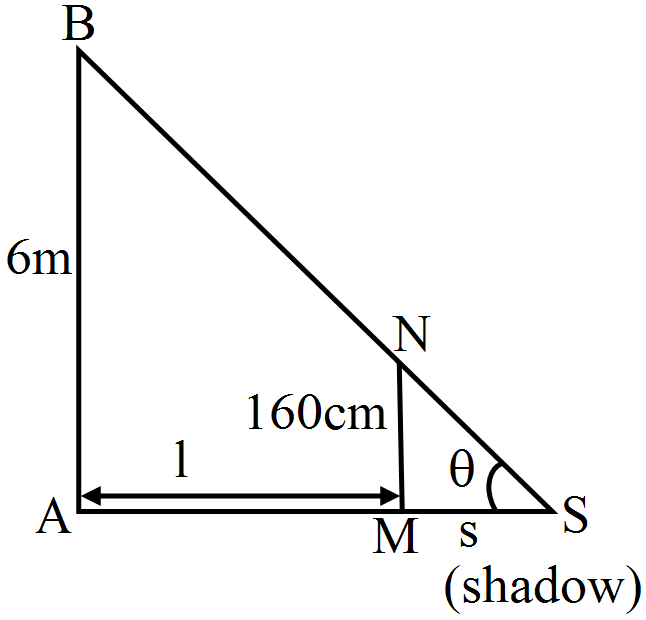
A man 160cm tall, walks away from a source of light situated at the top of a pole 6m high, at the rate of 1.1m/ sec. How fast is the length of his shadow increasing when he is 1m away from the pole?
Answer

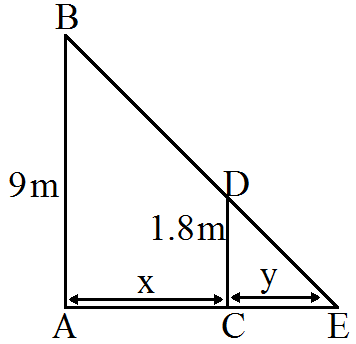
Let AB be the height of pole. suppose at times t, the man CD is at a distance of x meters from the lamp-post and y meters be the lenght of his shadow CE, then
$\frac{\text{dx}}{\text{dt}}=1.1\text{m}/\sec$
$\triangle\text{ABE}$ is simialar to $\triangle\text{CDE},$
$\frac{\text{AB}}{\text{CD}}=\frac{\text{AE}}{\text{CE}}$
$\frac{600}{160}=\frac{\text{x}+\text{y}}{\text{y}}$
$\frac{15}{4}=\frac{\text{x}+\text{y}}{\text{y}}$
$15\text{y}=4\text{x}+4\text{y}$
$11\text{y}=4\text{x}$
$11\frac{\text{dy}}{\text{dx}}=4\frac{\text{dx}}{\text{dt}}$
$\frac{\text{dy}}{\text{dx}}=\frac{4}{11}(1.1)$
$\frac{\text{dy}}{\text{dx}}=0.4\text{m}/\sec$
Rate of increasing of shadow $=0.4\text{m}/\sec.$
View full question & answer
Question 75 Marks
The volume of metal in a hollow sphere is constant. If the inner radius is increasing at the rate of 1cm/ sec, find the rate of increase of the outer radius when the radii are 4cm and 8cm respectively.
Answer
Let V be volume of sphere with miner radius r and centre radius R, Then.
$\text{V}=\frac{4}{3}\pi(\text{R}^3-\text{r}^3)$
$\frac{\text{dv}}{\text{dt}}=\frac{4}{3}\pi\Big(3\text{R}^2\frac{\text{dR}}{\text{dt}}-3\text{r}^2\frac{\text{dr}}{\text{dt}}\Big)$
$0=\frac{4\pi}{3}\Big(\text{R}^2\frac{\text{dR}}{\text{dt}}-\text{r}^2\frac{\text{dr}}{\text{dt}}\Big)$ [since volume V is constant]
$\text{R}^2\frac{\text{dR}}{\text{dt}}-\text{r}^2\frac{\text{dr}}{\text{dt}}$
$(8)^2\frac{\text{dR}}{\text{dt}}=(4)^2(1)$
$\frac{\text{dR}}{\text{dt}}=\frac{16}{64}$
$\frac{\text{dR}}{\text{dt}}=\frac{1}{4}\text{cm}/\sec$
Rate of increasing of outer radius $=\frac{1}{4}\text{cm}/\sec.$
View full question & answer
Question 85 Marks
A particle moves along the curve $\text{y}=\big(\frac{2}{3}\big)\text{x}^3+1.$ Find the points on the curve at which the y-coordinate is changing twice as fast as the x-coordinate.
Answer
Here,
$\frac{\text{dy}}{\text{dt}}=2\frac{\text{dx}}{\text{dt}}\ \dots(\text{i})$
and $\text{y}=\big(\frac{2}{3}\big)\text{x}^3+1$
$\frac{\text{dy}}{\text{dt}}=\frac{2}{3}3\text{x}^2\frac{\text{dx}}{\text{dt}}$
$2\frac{\text{dx}}{\text{dt}}=2\text{x}^2\frac{\text{dx}}{\text{dt}}$ [Using equation (i)]
$2=2\text{x}^2$
$\Rightarrow\text{x}=\pm1$
$\text{y}=\big(\frac{2}{3}\big)\text{x}^3+1$
put $\text{x}=1,$ $\text{y}=\frac{2}{3}+1=\frac{5}{3}$
put $\text{x}=-1,$ $\text{y}=\frac{2}{3}(-1)+1=\frac{1}{3}$
So, required point $\Big(1,\frac{5}{3}\Big)\text{and }\Big(-1,\frac{1}{3}\Big).$
View full question & answer
Question 95 Marks
The radius of a cylinder is increasing at the rate 2cm/ sec. and its altitude is decreasing at the rate of 3cm/ sec. Find the rate of change of volume when radius is 3cm and altitude 5cm.
Answer
Let r be the radius, h be the height and V be the volume of the cylinder at any time t. Then,
$\text{V}=\pi\text{r}^2\text{h}$
$\Rightarrow\frac{\text{dV}}{\text{dt}}=2\pi\text{rh}\frac{\text{dV}}{\text{dt}}+\pi\text{r}^2\frac{\text{dh}}{\text{dt}}$
$\Rightarrow\frac{\text{dV}}{\text{dt}}=\pi\text{r}\Big(2\text{h}\frac{\text{dr}}{\text{dt}}+\text{r}\frac{\text{dh}}{\text{dt}}\Big)$
$\Rightarrow\frac{\text{dV}}{\text{dt}}=\pi\times3(2\times5\times2+3\times-3)$
$\Rightarrow\frac{\text{dV}}{\text{dt}}=3\pi(20-9)$
$\Rightarrow\frac{\text{dV}}{\text{dt}}=33\pi\text{ cm}^3/\sec$
View full question & answer
Question 105 Marks
A particle moves along the curve $y = x^2 + 2x$. At what point(s) on the curve are the x and y coordinates of the particle changing at the same rate?
Answer
Here,
$\text{y}=\text{x}^2+2\text{x}$
$\Rightarrow\frac{\text{dy}}{\text{dt}}=(2\text{x}+2)\frac{\text{dx}}{\text{dt}}$ $\Big[\therefore\frac{\text{dy}}{\text{dt}}=\frac{\text{dx}}{\text{dt}}\Big]$
$\Rightarrow2\text{x}+2=1$
$\Rightarrow2\text{x}=-1$
$\Rightarrow\text{x}=\frac{-1}{2}$
Substituting $\text{x}=\frac{-1}{2}$ in $\text{y}=\text{x}^2+2\text{x},$ we get.
$\text{y}=\frac{-3}{4}$
Hence, the coordinates of the point are $\Big(\frac{-1}{2},\frac{-3}{4}\Big)$
View full question & answer
Question 115 Marks
The surface area of a spherical bubble is increasing at the rate of $2cm^2/s$. When the radius of the bubble is 6cm, at what rate is the volume of the bubble increasing?
Answer
Given, the surface area of a spherical bubble is increasing at the rate of $0.2cm^2/$sec
To find rate of increase of its volume, when the radius is 6cm
Let the radius of the given spherical bubble be r cm at any instant time.
It is given that the surface area of a spherical bubble is increasing at the rate of $0.2cm^2/$sec
So the surface area of the bubble will be,
$\text{SA}=4\pi\text{r}^2$
Now differentiating the above equation with respect to time we get,
$\frac{\text{d(SA)}}{\text{dt}}=\frac{\text{d}(4\pi\text{r}^2)}{\text{dt}}$
$\Rightarrow\frac{\text{d(SA)}}{\text{dt}}=4\pi\times2\text{r}\frac{\text{dr}}{\text{dt}}$
This is the rate of surface area increasing $= 0.2cm^2$/sec, hence the rate at which the radius of the bubble is increasing becomes,
$\Rightarrow\frac{\text{dr}}{\text{dt}}=\frac{\text{d(SA)}}{\text{dt}}\times\frac{1}{8\pi\text{r}}$
$\Rightarrow\frac{\text{dr}}{\text{dt}}=0.2\times\frac{1}{8\pi\text{r}}\ ...(\text{i})$
Then the volume of the spherical bubble at any time t will be,
$\text{V}=4\pi\text{r}^3\text{cm}^3$
Applying derivative with respect to time on both sides we get,
$\frac{\text{dV}}{\text{dt}}=\frac{\text{d}\big(4\pi\text{r}^3\big)}{\text{dt}}$
$\Rightarrow\frac{\text{dV}}{\text{dt}}=4\pi\frac{\text{d(r)}^3}{\text{dt}}$
$\Rightarrow\frac{\text{dV}}{\text{dt}}=4\pi\times3\text{r}^2\frac{\text{dr}}{\text{dt}}$
$\Rightarrow\frac{\text{dV}}{\text{dt}}=12\pi\text{r}^2\times0.2\times\frac{1}{8\pi\text{r}}$ [from equation (i)]
$\Rightarrow\frac{\text{dV}}{\text{dt}}=0.3\text{r}$
So, when the radius is 6cm, the rate of volume will become,
$\Rightarrow\frac{\text{dV}}{\text{dt}}=0.3(6)$
$\Rightarrow\frac{\text{dV}}{\text{dt}}=18\text{cm}^3/\sec.$
Hence the rate of increase of its volume, when the radius is 6cm is $1.8cm^3/sec.$
View full question & answer
Question 125 Marks
A man 180cm tall walks at a rate of 2m/ sec. away, from a source of light that is 9m above the ground. How fast is the length of his shadow increasing when he is 3m away from the base of light?
Answer
Let AB be the lamp post. suppose at any time t, the man CD is at a distance x km from the lamp post and y m is the length of his shadow CE.
$\Rightarrow\frac{9}{1.8}=\frac{\text{x}+\text{y}}{\text{y}}$ $\Rightarrow\frac{\text{x}}{\text{y}}=\frac{9}{1.8}-1$ $\Rightarrow\frac{\text{x}}{\text{y}}=\frac{7.2}{1.8}$ $\Rightarrow\text{x}=4\text{y}$ $\Rightarrow\frac{\text{dy}}{\text{dt}}=\frac{1}{4}\Big(\frac{\text{dx}}{\text{dt}}\Big)$ $\Rightarrow\frac{\text{dy}}{\text{dt}}=\frac{1}{4}\times2$ $\Big(\therefore\frac{\text{dx}}{\text{dt}}=2\Big)$ $\Rightarrow\frac{\text{dy}}{\text{dt}}=0.5\text{m}/\sec$
View full question & answer
Question 135 Marks
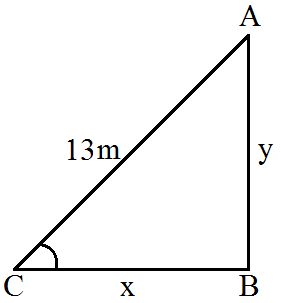
A ladder 13m long leans against a wall. The foot of the ladder is pulled along the ground away from the wall, at the rate of 1.5m/ sec. How fast is the angle $\theta$ between the ladder and the ground is changing when the foot of the ladder is 12m away from the wall.
Answer
Let the bottom of the ladder be at a distance of x m from the wall and its top be at a height of y m from the ground.
Then, $\tan\theta=\frac{\text{y}}{\text{x}}$ and $\text{x}^2+\text{y}^2=(13)^2$ $\Rightarrow\text{x}^2(1+\tan^2\theta)=169$ $\Rightarrow\sec^2\theta=\frac{169}{\text{x}^2}$ $\Rightarrow2\sec^2\theta=\tan\theta\frac{\text{d}\theta}{\text{dt}}=169\Big(\frac{-2}{\text{x}^2}\Big)\frac{\text{dx}}{\text{dt}}$ $\Rightarrow\frac{\text{d}\theta}{\text{dt}}=\frac{-338\times1.5}{(12)^32\sec^2\theta\tan\theta}\ \dots(1)$ When $\text{x}=12,\text{y}=\sqrt{169-144}=5\text{m}$ So, $\sec\theta=\frac{13}{12}\text{ and }\theta=\frac{12}{5}$ From eq. (1), we get $\frac{\text{d}\theta}{\text{dt}}=\frac{-338\times1.5}{(12)^3\times2\times\big(\frac{13}{12}\big)^2\times\frac{5}{12}}$ $=\frac{-338\times1.5}{10\times169}=-0.3\text{ rad}/\sec$
View full question & answer
Question 145 Marks
The length x of a rectangle is decreasing at the rate of 5cm/ minute and the width y is increasing at the rate of 4cm/ minute. When x = 8cm and y = 6cm, find the rates of change of:
  1. The perimeter.
  2. The area of the rectangle.
Answer
  1. Let P be the perimeter of the rectangle at any time t. Then,
$\text{P}=2(\text{x}+\text{y})$

$\Rightarrow\frac{\text{dP}}{\text{dt}}=12\Big(\frac{\text{dx}}{\text{dt}}+\frac{\text{dy}}{\text{dt}}\Big)$

$\Rightarrow\frac{\text{dP}}{\text{dt}}=2(-5+4)$

$\Big[\therefore\frac{\text{dx}}{\text{dt}}=-5\text{cm}/\text{min}\text{ and }\frac{\text{dy}}{\text{dt}}=4\text{cm}/\text{min}\Big]$

$\Rightarrow\frac{\text{dP}}{\text{dt}}=-2\text{cm}/\text{min}$
  1. Let A be the area of the rectangle at any time t. Then,
$\text{A}=\text{x}\text{y}$

$\Rightarrow\frac{\text{dA}}{\text{dt}}=\text{x}\frac{\text{dy}}{\text{dt}}+\text{y}\frac{\text{dx}}{\text{dt}}$

$\Rightarrow\frac{\text{dA}}{\text{dt}}=8(4)+6(-5)$

$\Big[\therefore\text{x}=8\text{cm},\text{y}=6\text{cm}\frac{\text{dx}}{\text{dt}}=-5\text{cm}/\text{min}\text{ and }\frac{\text{dy}}{\text{dt}}=4\text{cm}/\text{min}\Big]$

$\Rightarrow\frac{\text{dA}}{\text{dt}}=32-30$

$\Rightarrow\frac{\text{dA}}{\text{dt}}=2\text{cm}^2/\text{min}.$
View full question & answer
5 Marks Questions - MATHS STD 12 Science Questions - Vidyadip