Question 15 Marks
A wire of length 28m is to be cut into two pieces. One of the pieces is to be made into a square and the other into a circle. What should be the lengths of the two pieces so that the combined area of the circle and the square is minimum?
AnswerSuppose the wire, which is to be made into a square and a circle, is cut into two pieces of length 'x' m and 'y' m, respectively. Then,
x + y = 28 .....(i)
Perimeter of square, 4(side) = x
⇒ side $=\frac{\text{x}}{4}$
⇒ Area of square $=\Big(\frac{\text{x}}{4}\Big)^{2}=\frac{\text{x}^{2}}{16}$
Circumference of circle, $2\pi\text{r}=\text{y}$
$\Rightarrow \text{r}=\frac{\text{y}}{2\pi}$
Area of circle $=\pi\text{x}^{2}=\pi\Big(\frac{\text{y}}{2\pi}\Big)=\frac{\text{y}^{2}}{4\pi}$
Now, z = Area of square + Area of circle
$\Rightarrow \text{z}=\frac{\text{x}^{2}}{16}+\frac{\text{y}^{2}}{4\pi}$
$\Rightarrow \text{z}=\frac{\text{x}^{2}}{16}+\frac{(28-\text{x})^{2}}{4\pi}$
$\Rightarrow \frac{\text{dz}}{\text{dx}}=\frac{\text{2}\text{x}}{16}-\frac{2(28-\text{x})}{4\pi}$
For maximum or minimum value of z, We must have $\frac{\text{dz}}{\text{dx}}=0$
$\Rightarrow \frac{2\text{x}}{16}-\frac{2(28-\text{x})}{4\pi}=0$ [From eq.(i)]
$\Rightarrow \frac{\text{x}}{4}=\frac{(28-\text{x})}{\pi}$
$ \Rightarrow \frac{\text{x}\pi}{4}+\text{x}=28$
$\Rightarrow \text{x}\Big(\frac{\pi}{4}+1\Big)=28$
$\Rightarrow \text{x}=\frac{28}{\Big(\frac{\pi}{4}+1\Big)}$
$\Rightarrow \text{y}=28-\frac{112}{\pi+4}$ [From eq.(i)]
$\Rightarrow \text{y}=\frac{28\pi}{\pi+4}$
$\frac{\text{d}^{2}\text{z}}{\text{dx}^{2}}=\frac{1}{8}+\frac{1}{2\pi}>0$
Thus, z is minimum when $\text{x}=\frac{112}{\pi+4}$ and $\text{y}=\frac{28\pi}{\pi+4}$.
Hence, the length of the two pieces of with are $\frac{112}{\pi+4}$ and $\frac{28\pi}{\pi+4}$ m respectively.
View full question & answer→Question 25 Marks
Find the points of local maxima or local minima and corresponding local maximum and local minimum values of the following functions. Also, find the points of inflection,
$\text{f}(\text{x})=\text{x}+\sqrt{1-\text{x}},\text{x}\leq 1$
AnswerGiven, $\text{f}(\text{x})=\text{x}+\sqrt{1-\text{x}}$
$\text{f}'(\text{x})=1-\frac{1}{2\sqrt{1-\text{x}}}$
for the local maxima or minima, We must have f'{x} = 0
$\Rightarrow1-\frac{1}{2\sqrt{1-\text{x}}}=0$
$\Rightarrow\sqrt{1-\text{x}}=\frac{1}{2} $
$\Rightarrow{1-\text{x}}=\frac{1}{4} $
$\Rightarrow\text{x}=\frac{3}{4} $
Thus, $\text{x}=\frac{3}{4}$ is the point of local maximum.
The local maximum value is given by
$\text{f}\Big(\frac{3}{4}\Big)+\sqrt{1-\frac{3}{4}}=\frac{5}{4}$
View full question & answer→Question 35 Marks
A beam is supported at the two ends and is uniformly loaded. The bending moment M at a distance x from one end is given by
$\text{M}=\frac{\text{WL}}{2}\text{x}-\frac{\text{W}}{2}\text{x}^{2}$
Find the point at which M is maximum in each case.
AnswerGiven, $\text{M}=\frac{\text{WL}}{2}\text{x}-\frac{\text{W}}{2}\text{x}^{2}$
$\Rightarrow\frac{\text{dM}}{\text{dx}}=\frac{\text{WL}}{2}\text{x}-2\times\frac{\text{W}\text{x}}{2}$
$\Rightarrow\frac{\text{dM}}{\text{dx}}=\frac{\text{WL}}{2}-{W\text{x}}$
For maximum or minimum values of M, We must have $\frac{\text{dM}}{\text{dx}}=0$
$\Rightarrow\frac{\text{WL}}{2}-{\text{W}\text{x}}=0$
$\Rightarrow\frac{\text{WL}}{2}=\text{Wx}$
$\Rightarrow\text{x}=\frac{\text{L}}{2}=0$
Now, $\frac{\text{d}^{2}\text{M}}{\text{dx}^{2}}=-\text{W}<0$
So, M is maximum at $\text{x}=\frac{\text{L}}{2}$.
View full question & answer→Question 45 Marks
Find the points of local maxima or local minima and corresponding local maximum and local minimum values of the following functions. Also, find the points of inflection,
$f(x) = (x - 1)(x - 2)^2$
AnswerGiven, $f(x) = (x - 1)(x - 2)^2$
$=(x - 1)( x^2 - 4x + 4)$
$=x^3- 4x^2 + 4x - x^2 + 4x - 4$
$= x^3- 5x^2 + 8x - 4$
$\Rightarrow f'(x) = 3x^2 - 10x + 8$
For the local maxima or minima, We must have $f'(x) = 0$
$\Rightarrow 3x^2 - 10x + 8 = 0$
$\Rightarrow 3x^2 - 6x - 4x + 8 = 0$
$\Rightarrow (x - 2)(3x - 4) = 0$
$\Rightarrow\text{x}=2\ \text{and} \ \frac{4}{3}$
Thus, $x = 2$ and $\text{x}=\frac{4}{3}$ are the possible point of local maxima or local minima.
Now, $f''(x) = 6x - 10$
At $x = 2$
$f''(2) = 6(2) - 10 = 2 > 0$
So, $x = 2$ is the point local minimum.
The local minimum value is given by
$f(2) = (2 - 1)(2 - 2)^2 = 0$
At $\text{x}=\frac{4}{3}$
$\text{f}''\Big(\frac{4}{3}\Big)=6\Big(\frac{4}{3}\Big)-10=-2<0$
So, $\text{x}=\frac{4}{3}$ is the point of local maximum.
The local maximum value is given by
$\text{f}\Big(\frac{4}{3}\Big)=6\Big({\frac{4}{3}-1}\Big)\Big(\frac{4}{3}-2\Big)^{2}=\frac{1}{3}\times\frac{4}{9}=\frac{4}{27}$
View full question & answer→Question 55 Marks
A tank with rectangular base and rectangular sides, open at the top is to the constructed so that its depth is 2m and volume is $8m^3$. If building of tank cost 70 per square metre for the base and Rs 45 per square matre for sides, what is the cost of least expensive tank?
AnswerLet l, b, and h repersent the length, breadth, and height of the respectively.
Then, We have height $(h) = 2m^3$
Volume of the tank $= 8m^3$
Volume of the tank $= l × b × h$
$\therefore 8 = l × b × 2$
$⇒ lb = 4$
$\Rightarrow \frac{4}{\text{l}}$
Now, area of the base $⇒ lb = 4$
Area of the Walls $(A) = 2h(l + b)$
$\therefore \text{A}=4\Big(\text{l}+\frac{4}{\text{l}}\Big)$
$\therefore \frac{\text{dA}}{\text{d}\text{l}}=4\Big(l-\frac{4}{\text{l}^{2}}\Big)$
Now, $\frac{\text{dA}}{\text{d}l}=0$
$\Rightarrow 1-\frac{4}{l^{2}}=0$
$\Rightarrow \text{l}^{2}=4$
$\Rightarrow \text{l}= \pm2$
However, the length cannot be negative.
Therefore, We have $l = 4$
$\therefore \text{b}=\frac{4}{l}=\frac{4}{2}=2$
Now, $\frac{\text{d}^{2}\text{A}}{\text{d}l^{2}}=\frac{32}{l^{3}}$
When,$ l = 2, \frac{\text{d}^{2}\text{A}}{\text{d}l^{2}}=\frac{32}{8^{3}} =4>0$
Thus, by second derivative test, the area is the minimum, when $l = 2.$
We have $l = b = h = 2.$
$\therefore$ Cost of building the base $= Rs. 70 × (lb) = Rs. 70 × (4) = Rs 280$
Cost of building the walls $= Rs. 2h(l + b) × 45 = Rs. 90 × (2) (2 + 2)$
$= Rs. 8(90) = Rs. 720$
Required total cost $= Rs. (280 + 720) = Rs. 1000$
Hence, the total cost of the tank will be Rs. $1000.$
View full question & answer→Question 65 Marks
Find the points of local maxima or local minima and corresponding local maximum and local minimum values of the following functions. Also, find the points of inflection,
$\text{f}(\text{x})=\text{x}\sqrt{32-\text{x}^{2}}, -5\leq\text{x}\leq5$
AnswerWe have, $\text{f}(\text{x})=\text{x}\sqrt{32-\text{x}^{2}}, -5\leq\text{x}\leq5$
$\text{f}'(\text{x})=\sqrt{32-\text{x}^{2}}+\frac{\text{x}}{2\sqrt{32-\text{x}^{2}}}\text{x}(-2\text{x})$
$=\frac{2({32-\text{x}^{2}})-2\text{x}^{2}}{2\sqrt{32-\text{x}}^{2}}$
$=\frac{64-4\text{x}^{2}}{2\sqrt{32-\text{x}}^{2}}$
and, $\text{f}''(\text{x})=\frac{2\sqrt{32-\text{x}^{2}}\times(-8\text{x})\frac{-2(64-4\text{x}^{2})}{2\sqrt{32-\text{x}^{2}}}\times(-2\text{x})}{4(32-\text{x}^{2})}$
$=\frac{-4({32-\text{x}^{2}})\times(8\text{x})+4\text{x}(64-\text{x}^{2})}{8(32-\text{x}^{2})^\frac{3}{2}}$
For maxima and minima, $\text{f}'(\text{x})=0$
$\Rightarrow\frac{4(16-\text{x}^{2})}{2\sqrt{32-\text{x}^{2}}}=0$
$\Rightarrow\text{x}=\pm4$
Now, $\text{f}''(4)=\frac{4\times4(64-16-8\times32+8\times16)}{8(32-16)^\frac{3}{2}}<0$
$\text{x}=4$ is point of maxima.
Local maximum value $\Rightarrow\text{f}(\text{x})$
$=4\sqrt{32-4^{2}}$
$=4\sqrt{32-16}$
$=4\sqrt{16}$
$=16$
Local minimum at $\text{x}=-4$
Local minimum value $=\text{f}(-4)$
$=4\sqrt{32-(-4)^{2}}$
$=-4\sqrt{32-16^{2}}$
$=-4\sqrt{16}$
$=-16$
View full question & answer→Question 75 Marks
A rectangle is inscribed in a semi-circle of radius r with one of its sides on diameter of semi-circle. Find the dimension of the rectangle so that its area is maximum. Find also the area.
AnswerLet the dimensions of the rectangle be x and y. Then,
$\frac{\text{x}^{2}}{4}+\text{y}^{2}=\text{r}^{2}$
$\Rightarrow\text{x}^{2}+4\text{y}^{2}=4\text{r}^{2}$
$ \Rightarrow\text{x}^{2}=4(\text{r}^{2}-\text{y}^{2})\ ...(\text{i})$
Area of rectangle = xy
$\Rightarrow A^2 = x^2y^2$
$\Rightarrow Z = 4y^2(r^2 - y^2)$ [From eq. (i)]
$\Rightarrow\frac{\text{dz}}{\text{dy}}=8\text{yr}^{2}-16\text{y}^{3}$
For the maximum or minimum values of Z, We must have $\frac{\text{dz}}{\text{dy}}=0$
$\Rightarrow 8\text{yr}^{2}-16\text{y}^{3}=0$
$\Rightarrow 8\text{r}^{2}=16\text{y}^{2}$
$\Rightarrow\text{y}^{2}=\frac{\text{r}^{2}}{2}$
$\Rightarrow\text{y}=\frac{\text{r}}{\sqrt{2}}$
Substituting the valures of y in eq. (i), We get
$\Rightarrow \text{x}^{2}=4\Big(\text{r}^{2}-(\frac{\text{r}}{\sqrt{2}})^{2}\Big)$
$\Rightarrow \text{x}^{2}=4\Big(\text{r}^{2}-\frac{\text{r}^{2}}{2}\Big)$
$\Rightarrow \text{x}^{2}=4\Big(\frac{\text{r}^{2}}{2}\Big)$
$\Rightarrow \text{x}^{2}=2\text{r}^{2}$
$\Rightarrow \text{x}=\text{r}\sqrt{2}$
Now, $\frac{\text{d}^{2}\text{z}}{\text{dy}^{2}}=8\text{r}^{2}-48\text{y}^{2}$
$\Rightarrow\frac{\text{d}^{2}\text{z}}{\text{dy}^{2}}=8\text{r}^{2}-48\Big(\frac{\text{r}^{3}}{2}\Big)$
$\Rightarrow\frac{\text{d}^{2}\text{z}}{\text{dy}^{2}}=-16\text{r}^{2}<0$
So, the eare is maximum when $ \text{x}=\text{r}\sqrt{2}$ and $\text{y}=\frac{\text{r}}{\sqrt{2}}$.
Area = xy
$\Rightarrow\text{A}=\text{r}\sqrt{2}\times\frac{\text{r}}{\sqrt{2}}$
$\Rightarrow \text{A}=\text{r}^{2}$
View full question & answer→Question 85 Marks
Show that the cone of the greatest volume which can be inscribed in a given spher has an altitude equal to 2/3 of the diameter of the sphere.
AnswerWe have a cone, which is inscribed in a spher.
Let V be the volume of grwatest cone ABC. if is obvious that, for maximum volume the axis of the cone must be along the diameter of sphere.
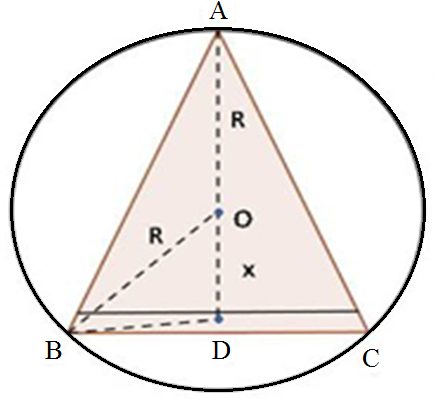
Let OD = x and AO = OB = R
$\Rightarrow \text{BD}=\sqrt{\text{R}^{2}-\text{x}^{2}}$ and AD = R + x
Now, $\text{V}=\frac{1}{3}\pi\text{r}^{2}\text{h}$
$=\frac{1}{3}\pi\text{BD}^{2}\times\text{AD}$
$=\frac{1}{3}\pi\Big(\text{R}^{2}-\text{x}^{2}\Big)\times(\text{R}+\text{x})$
$\frac{\text{dv}}{\text{dx}}=\frac{\pi}{3}[-2\text{x}(\text{R}+\text{x})+\text{R}^{2}-\text{x}^{2}]$
$=\frac{\pi}{3}[\text{R}^{2}-2\text{x}\text{R}-3\text{x}^{2}]$
For maximum and minimum $\frac{\text{dV}}{\text{dx}}=0$
$=\frac{\pi}{3}[\text{R}^{2}-2\text{x}\text{R}-3\text{x}^{2}]=0$
$=\frac{\pi}{3}[(\text{R}-3\text{x})(\text{R}+\text{x})]=0$
$\Rightarrow \text{R}-3\text{x}=0 $ or $\text{x}=-\text{R}$
$\Rightarrow \text{x}=\frac{\text{R}}{3}$
Now, $\frac{\text{d}^{2}\text{V}}{\text{dx}^{2}}=\frac{\pi}{3}[-2\text{R}-6\text{x}]$
At, $\text{x}=\frac{\text{R}}{3}, \frac{\text{d}^{2}\text{V}}{\text{dx}^{2}}=\frac{\pi}{3}[-2\text{R}-2\text{R}]$
$=\frac{-4\pi\text{R}}{3}<0$
$\therefore \text{x}=\frac{\text{R}}{3}$ is the point of local maxima.
Thus, Altitude = $\text{AD}=\text{x}+\text{R}=\frac{\text{R}}{3}+\text{R}=\frac{4}{3}\text{R}$
$\Rightarrow \text{AD}=\frac{2}{3}\times\text{d}$ where x = 2R. View full question & answer→Question 95 Marks
Find the points of local maxima or local minima and corresponding local maximum and local minimum values of the following functions. Also, find the points of inflection,
$\text{f}(\text{x})=\text{x}\sqrt{2-\text{x}^{2}}-\sqrt{2}\leq\text{x}\leq\sqrt{2}$
Answer$\text{f}(\text{x})=\text{x}\sqrt{2-\text{x}^{2}}$
$\text{f}'(\text{x})=\sqrt{2-\text{x}^{2}}-\frac{2\text{x}^{2}}{2\sqrt{2-\text{x}^{2}}}$
$=\frac{2(2-\text{x}^{2})-2\text{x}^{2}}{2\sqrt{2-\text{x}^{2}}}$
$=\frac{2-2\text{x}^{2}}{\sqrt{2-\text{x}^{2}}}$
$\text{f}''(\text{x})=\frac{\sqrt{2-\text{x}^{2}}(-4\text{x})+\frac{(2-2\text{x}^{2})}{\sqrt{2-\text{x}^{2}}}}{(\sqrt{2-\text{x}}^{2})^\frac{3}{2}}$
$=\frac{-(2-\text{x}^{2})4\text{x}+4\text{x}-4\text{x}^{3}}{(2-\text{x}^{2})^\frac{3}{2}}$
For the local maxima or minima, We must have f'(x) = 0
$\Rightarrow\frac{2(1-\text{x}^{2})}{\sqrt{2-\text{x}^{2}}}=0$
$\text{x}=\pm1$
Now, f''(1) < 0
⇒ x = 1 is point of local maxima.
f''(-1) > 0
⇒ x = -1 is point of local minima.
Hence, local maximum value = f(1) = 1
local minimum value = f(-1) = -1
View full question & answer→Question 105 Marks
Prove that the semi-vertical angle of the right circular cone of given volume and least curved surface is $\cos^{-1}(\sqrt{2})$ .
Answer
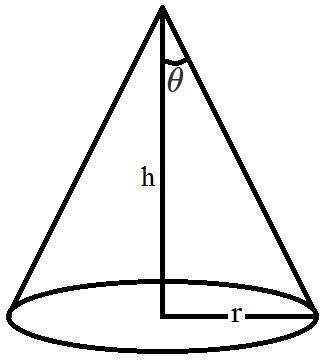 Let, Radius of the base = r,
Height = h,
Slant height = l,
Volume = v,
Curved surface area = c,
As, Volume, $\text{V}=\frac{1}{3}\pi\text{r}^{2}\text{h}$
$\Rightarrow \text{h}=\frac{3V}{\pi\text{r}^{2}}$
Also, the slant height, $\text{l} = \sqrt{\text{h}^{2}+\text{r}^{2}}$
$=\sqrt{\Big(\frac{3\text{V}}{\pi\text{r}^{2}}\Big)^{2}+\text{r}^{2}}$
$=\sqrt{\frac{9\text{V}}{\pi^{2}\text{r}^{4}}^{2}+\text{r}^{2}}$
$=\sqrt{\frac{9\text{V}+\pi^{2}\text{r}^{6}}{\pi^{2}\text{r}^{4}}^{2}}$
$\sqrt{\frac{9\text{V}^{2}+\pi^{2}\text{r}^{6}}{\pi\text{r}^{2}}}$
Now, CSA, $\text{C}=\pi\text{rl}$
$\Rightarrow \text{C}(\text{r})=\pi\text{r}\sqrt{\frac{9\text{V}^{2}+\pi^{2}\text{r}^{6}}{\pi\text{r}^{2}}}$
$\Rightarrow \text{C}(\text{r})=\sqrt{\frac{9\text{V}^{2}+\pi^{2}\text{r}^{6}}{\text{r}}}$
$\Rightarrow \text{C}''(\text{r})=\frac{\text{r}\times\frac{6\pi^{2}\text{r}^{6}}{2\sqrt{9\text{V}^{2}+\pi^{2}}\text{r}^{6}}-\sqrt{9\text{V}^{2}+\pi^{2}}\text{r}^{6}}{\text{r}^{2}}$
$\Rightarrow\frac{\frac{3\pi^{2}\text{r}^{6}-(9\text{v}^{2}+\pi^{2}\text{r}^{6})}{\sqrt{9\text{v}^{2}+\pi^{2}\text{r}^{6}}}}{\text{r}^{2}}$
$\Rightarrow\frac{3\pi^{2}\text{r}^{6}-9\text{v}^{2}+\pi^{2}\text{r}^{6}}{\text{r}^{2}\sqrt{9\text{v}^{2}+\pi^{2}\text{r}^{6}}}$
$\Rightarrow\frac{2\pi^{2}\text{r}^{6}-9\text{v}^{2}}{\text{r}^{2}\sqrt{9\text{v}^{2}+\pi^{2}\text{r}^{6}}}$
For maxima or minima, C''(r) = 0
$\Rightarrow\frac{2\pi^{2}\text{r}^{6}-9\text{v}^{2}}{\text{r}^{2}\sqrt{9\text{v}^{2}+\pi^{2}\text{r}^{6}}}=0$
$\Rightarrow2\pi^{2}\text{r}^{6}-9\text{v}^{2}=0$
$\Rightarrow2\pi^{2}\text{r}^{6}-9\text{v}^{2}$
$\Rightarrow\text{V}^{2}=\frac{2\pi^{2}\text{r}^{6}}{9}$
$\Rightarrow\text{V}=\sqrt\frac{2\pi^{2}\text{r}^{6}}{9}$
$\Rightarrow\text{V}=\frac{\pi\text{r}^{3}\sqrt{2}}{3}$ or $\text{r}=\Big(\frac{3\text{V}}{\pi\sqrt{2}}\Big)^\frac{1}{3}$
So, $\text{h}=\frac{3}{\pi\text{r}^{2}}\times\frac{\pi\text{r}^{3}\sqrt{2}}{3}$
$\Rightarrow \text{h}=\text{r}\sqrt{2}$
$\Rightarrow \frac{\text{h}}{\text{r}}=\sqrt{2}$
$\Rightarrow\cot\theta=\sqrt{2}$
$\therefore \theta=\cot^{-1}(\sqrt{2})$
Also, Since, for $\text{r}<\Big(\frac{3\text{V}}{\pi\sqrt{2}}\Big)^\frac{1}{3},$ C''(r) < 0 and for $\text{r}<\Big(\frac{3\text{V}}{\pi\sqrt{2}}\Big)^\frac{1}{3},$ C''(r) > 0
So, the curved surface for $\text{r}<\Big(\frac{3\text{V}}{\pi\sqrt{2}}\Big)^\frac{1}{3},$ or $\text{V}=\frac{\pi\text{r}^{3}\sqrt{2}}{3}$ is the least. View full question & answer→Question 115 Marks
Of all the closed cylindrical cans (right circular), which enclose a given volume of $100cm^3,$ which has the minimum surface area ?
AnswerLet, r and h be the radius and height of the cylinder respectively.
Then, volume (v) of the cylinder is given by,
$\text{v}=\pi\text{r}^{2}\text{h}=100$ (given)
$\therefore\text{h}=\frac{100}{\pi\text{r}^{2}}$
Surface area (s) of the cylinder is given by,
$\text{S}=2\pi\text{r}^{2}+2\pi\text{rh}=2\pi\text{r}^{3}+\frac{200}{\text{r}}$
$\therefore\frac{\text{ds}}{\text{dr}}=4\pi\text{r}-\frac{200}{\text{r}^{2}}, \frac{\text{d}^{2}\text{S}}{\text{dr}^{2}}=4\pi+\frac{400}{\text{r}^{3}}$
$\frac{\text{ds}}{\text{dr}}=0 \ \Rightarrow4\pi\text{r}=\frac{200}{\text{r}^{2}}$
$ \Rightarrow\text{r}^{3}=\frac{200}{4\pi}=\frac{50}{\pi}$
$\Rightarrow\text{r}^{3}=\Big(\frac{50}{\pi}\Big)^\frac{1}{3}$
Now, it is observed that when, $\text{r}^{3}=\Big(\frac{50}{\pi}\Big)^\frac{1}{3}, \frac{\text{d}^{2}\text{s}}{\text{dr}^{2}}>0$.
$\therefore$ By second derivative test, the surface area is the minimum when the radius of the cilinder is $\Big(\frac{50}{\pi}\Big)^\frac{1}{3}\text{cm}$
When $\text{r}=\Big(\frac{50}{\pi}\Big)^\frac{1}{3},\text{h}=\frac{100}{\pi\Big(\frac{50}{\pi}\Big)^\frac{2}{3}}=\frac{2\times50}{(50)^\frac{2}{3}(\pi)^\frac{1-2}{3}}=2\Big(\frac{50}{\pi}\Big)^\frac{1}{3} \text{cm}$
View full question & answer→Question 125 Marks
An isosceles triangle of vertical angle 2θ is inscribed in a circle of radius a. Show that the area of the triangle is maximum when $\theta = \frac{\pi}{6}.$
Answer
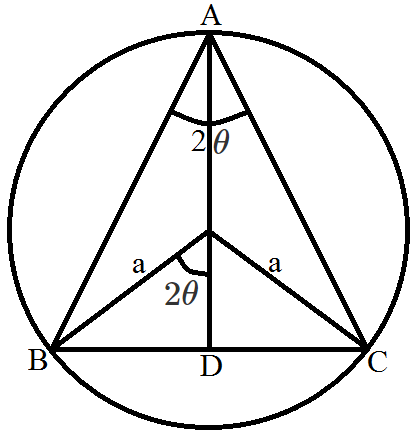 Let ABC be an issosceles triangle inscribed in the cricle with radius a such that AB = AC.
AD = AO + OD
$=\text{a}+\text{a}\cos2\theta$
$=\text{a}(1+\cos2\theta)$ and
$\text{BC}=2\text{BD}=2\text{a}\sin2\theta$
As, area of the triangle ABC, $\text{A}=\frac{1}{2}\text{BC}\times\text{AD}$
$\Rightarrow\text{A}(\theta)=\frac{1}{2}\times2\text{a}\sin2\theta\times\text{a}(1+\cos2\theta)$
$={{a}^{2}\sin2\theta}(1+\cos2\theta)$
$={{a}^{2}\sin2\theta}+\text{a}^{2}\sin2\theta\cos2\theta$
$\Rightarrow\text{A}(\theta)={{a}^{2}\sin2\theta}+\frac{\text{a}^{2}\sin4\theta}{2}$
$\Rightarrow\text{A}'(\theta)={{2a}^{2}\cos2\theta}+\frac{4\text{a}^{2}\cos4\theta}{2}$
$\Rightarrow\text{A}'(\theta)={{2a}^{2}\cos2\theta}+{{2a}^{2}\cos4\theta}$
$\Rightarrow\text{A}'(\theta)={{2a}^{2}(\cos2\theta}+{\cos4\theta})$
For maxima or minima, $\text{A}'(0)=0$
$\Rightarrow{{2a}^{2}(\cos2\theta}+{\cos4\theta})=0$
$\Rightarrow \cos2\theta+\cos4\theta=0$
$\Rightarrow \cos2\theta=-\cos4\theta$
$\Rightarrow \cos2\theta=\cos4(\pi-4\theta)$
$\Rightarrow 2\theta=(\pi-4\theta)$
$\Rightarrow6\theta=\pi$
$\Rightarrow\theta=\frac{\pi}{6}$
Also, $\text{A}'(\theta)$ $=2\text{a}^{2}(-\sin2\theta-\sin4\theta)$
$=2\text{a}^{2}(\sin2\theta+\sin4\theta)<0$ at $\theta=\frac{\pi}{6}$.
So, the area of the triangle is maximum at $\theta=\frac{\pi}{6}$. View full question & answer→Question 135 Marks
A window in the form of a rectangle is surmounted by a semi-circular opening. The total perimeter of the window is 10m. Find the dimension of the rectangular of the window to admit maximum light through the whole opening.
AnswerLet the dimensions of the rectangular part be x and y.
Radius of semi-circular $=\frac{\text{x}}{2}$
Total perimeter = 10
$\Rightarrow(\text{x}+2\text{y})+\pi\Big(\frac{\text{x}}{2}\Big)=10$
$\Rightarrow 2\text{y}=\Big[10-\text{x}-\pi\Big(\frac{\text{x}}{2}\Big)=10\Big] $
$\Rightarrow \text{y}=\frac{1}{2}\Big[10-\text{x}\Big(1+\frac{\pi}{2}\Big)\Big]....(\text{i})$
Now, $\text{A}=\frac{\pi}{2}\Big(\frac{\text{x}}{2}\Big)^{2}+\text{xy}$
$\Rightarrow\text{A}=\frac{\pi\text{x}^{2}}{8}+\frac{\text{x}}{2}[10-\text{x}(1+\frac{\pi}{2})$ [From eq.(i)]
$\Rightarrow\text{A}=\frac{\pi\text{x}^{2}}{8}+\frac{10\text{x}}{2}-\frac{\text{x}^{2}}{2}(1+\frac{\pi}{2})$
$\Rightarrow \frac{\text{dA}}{\text{dx}}=\frac{\pi\text{x}}{8}+\frac{10\text{x}}{2}-\frac{2\text{x}}{2}(1+\frac{\pi}{2})$
For maximum or minimum values of A, We must have $\frac{\text{dA}}{\text{dx}}=0$
$\Rightarrow\frac{\pi\text{x}}{8}+\frac{10\text{x}}{2}-\frac{2\text{x}}{2}(1+\frac{\pi}{2})=0$
$\Rightarrow\text{x}[\frac{\pi}{4}-1-\frac{\pi}{2}]=-5$
$\Rightarrow\text{x}=\frac{-5}{(\frac{4+\pi}{4})}$
$\Rightarrow \text{x}=\frac{20}{\pi+4}$
Substituting the value of x in eq.(i), We get
$\Rightarrow\text{y}=\frac{1}{2}\Big[10-\Big(\frac{20}{\pi+4}\Big)\big(1+\frac{\pi}{2}\big)\Big]$
$\Rightarrow\text{y}=5-\frac{10(\pi+2)}{2(\pi+4)}$
$\Rightarrow\text{y}=\frac{5\pi+20-5\pi-10}{(\pi+4)}$
$\Rightarrow\text{y}=\frac{10}{(\pi+4)}$
$\frac{\text{d}^{2}\text{A}}{\text{dx}^{2}}=\frac{\pi}{4}-\frac{\pi}{2}-1$
$\Rightarrow\frac{\text{d}^{2}\text{A}}{\text{dx}^{2}}=\frac{\pi-2\pi-4}{4}$
$\Rightarrow\frac{\text{d}^{2}\text{A}}{\text{dx}^{2}}=\frac{\pi-4}{4}<0$
Thus, the area is maximum when $ \text{x}=\frac{20}{\pi+4}$ and $\text{y}=\frac{10}{(\pi+4)}$.
So, the required dimensions are given below.
Length $ =\frac{20}{\pi+4}\text{m}$
Breadth $=\frac{10}{(\pi+4)}\text{m}$.
View full question & answer→Question 145 Marks
A wire of length 20m is to be cut into two pieces. One of the pieces will be bent into shape of a square and the other into shape of an equilateral triangle. Where the we should be cut so that the sum of the areas of the square and triangle is minimum ?
AnswerLet the wire of length 20m be cut into x cm and y cm and bent into a squre and equliateral triangle,
so that the sum of area of square and triangle is minimum.
Now, $x + y = 20....(i)$ Area of equilateral = $=\frac{\sqrt{3}}{4}(\text{a})^{2}$
Area of square $= ($side$)^2$
$\text{s}=\frac{\sqrt{3}}{4}\Big(\frac{\text{x}}{3}\Big)^{2}=\Big(\frac{20-\text{x}}{4}\Big)^{2}$
$\frac{\text{ds}}{\text{dx}}=\frac{\sqrt{3}}{4}\times\frac{1}{3^{2}}\times2\text{x}+2\Big(\frac{20-\text{x}}{4}\Big)\times \frac{-1}{4}$
$=\frac{2\sqrt{3}\text{x}}{36}-\frac{1}{8}(20-\text{x})=0$ $=\frac{2\sqrt{3}\text{x}}{36}-\frac{20}{8}+\frac{\text{x}}{8}=0$
$=\frac{4\sqrt{3}\text{x}+9\text{x}}{72}=\frac{20}{8}$ $=\frac{180}{4\sqrt{3}+9}$
Then, $20-\text{x}=20-\frac{180}{4\sqrt{3}+9}$
$=\frac{80\sqrt{3}+180-180}{3\sqrt{3}+9}$ $20-\text{x}=\frac{80\sqrt{3}}{4\sqrt{3}+9}$.
View full question & answer→Question 155 Marks
Find the points of local maxima or local minima and corresponding local maximum and local minimum values of the following functions. Also, find the points of inflection,
$\text{f}(\text{x})=\text{x}+\frac{\text{a}^{2}}{\text{x}}$
Answer$\Rightarrow\text{f}'(\text{x})=1-\frac{\text{a}^{2}}{\text{x}^{2}}$
For the local maxima or minima, We must have f'(x) = 0
$\Rightarrow1-\frac{\text{a}^{2}}{\text{x}^{2}}=0$
At $\text{x}=\text{a}$
$\text{f}''(\text{a})=\frac{\text{a}^{2}}{(\text{a}^{3})}=\frac{1}{\text{a}}>0$
So, x = a is the point of local minimum.
The local minimum value is given by
$\text{f}(\text{a})=\text{x}+\frac{\text{a}^{2}}{\text{x}}=\text{a}+\text{a}=2\text{a}$
At $\text{x}=-\text{a}$
$\text{f}''(\text{a})=\frac{\text{a}^{2}}{(-\text{a})^{3}}=-\frac{1}{\text{a}}<0$
So, $\text{x}=-\text{a}$ is the point of local maximum.
The local maximum value is given by
$\text{f}(\text{-a})=\text{x}+\frac{\text{a}^{2}}{\text{x}}=-\text{a}-\text{a}=-2\text{a}$
$\Rightarrow1-\frac{\text{a}^{2}}{\text{x}} =0$
$\Rightarrow\text{x}^{2}=\text{a}^{2}$
$\Rightarrow\text{x}=\pm\text{a}$
Thus, x = a and x = -a are the possible points of local maxima or local minima.
Now, $\text{f}''\text{x}=\frac{\text{a}^{2}}{\text{x}^{3}}$
View full question & answer→Question 165 Marks
How should we choose two numbers, each greater than or equal to −2, whose sum so that the sum of the first and the cube of the second is minimum?
Question 175 Marks
Find the points of local maxima or local minima and corresponding local maximum and local minimum values of the following functions. Also, find the points of inflection,
$f(x) = x^3 - 2ax^3 + a^2x$
Answer$f(x) = x^3- 2ax^2+ a^2x$
$\Rightarrow f'(x) = 3x^2- 4ax + a^2$
For the local maxima or minima, We must have $f'(x) = 0$
$\Rightarrow 3x^2 - 4ax + a^2 = 0$
$\Rightarrow 3x^2 - 3ax - ax + a^2 = 0$
$\Rightarrow 3x(x - a) - a(x - a) = 0$
$\Rightarrow (3x - a)(x - a) = 0$
$\Rightarrow \text{x}=\text{a} \ \text{and}\ \frac{\text{a}}{3}$
Thus, x = 0 and $\text{x}=\frac{\text{a}}{3}$ are the possible point of local maxima or local minima.
Now, $f''(x) = 6x - 4a$
At $x = a$
$f''(x) = 6(a) - 4a = 2a > 0$
So, x = a is the point of local minimum.
The local minimum value is given by
$f(a) = a^3 - 2a(a)^2 + a^2(a) = 0$
At $\text{x}=\frac{\text{a}}{3}$
$\text{f}''(\frac{\text{a}}{3})=6(\frac{\text{a}}{3})-4\text{a}=-2\text{a}<0$
So, $\text{x}=\frac{\text{a}}{3}$ is the point of local maximum.
The local maximum value is given by
$\Big(\frac{\text{a}}{3}\Big)^{3}-2\text{a}\Big(\frac{\text{a}}{3}\Big)^{2}+\text{a}^{2}\Big(\frac{\text{a}}{3}\Big)=\frac{\text{a}^{3}}{27}-\frac{2\text{a}^{3}}{9}+\frac{\text{a}^{3}}{3}=\frac{4\text{a}^{3}}{27}$
View full question & answer→Question 185 Marks
A rectangular sheet of tin $45$cm by $24$cm is to be made into a box without top, in cutting off squares from each corners and folding up the flaps. What should be the side of the square to be cut off so that the volume of the box is maximum possible?
AnswerSuppose square of side measuring xcm is cut off.
Then, the length, breadth and height of the will be $(45 - x), (24 - 2x$) and $x, $ respectively.
⇒ volume of the box, $V = (45 - x), (24 - 2x)x$
$\Rightarrow \frac{\text{dV}}{\text{dx}}=(45-2\text{x})(24-2\text{x})-2\text{x}(45-2\text{x})-2\text{x}(24-2\text{x})$
For maximum or minimum value of V, We must have
$\Rightarrow \frac{\text{dV}}{\text{dx}}=(45-2\text{x})(24-2\text{x})-2\text{x}(45-2\text{x})-2\text{x}(24-2\text{x})$
For maximum or minimum value of V, We must have
$\Rightarrow 12x^3 - 276x + 1080 = 0$
$\Rightarrow x^2- 23x + 90 = 0$
$\Rightarrow x^2- 18x - 5x + 90 = 0$
$\Rightarrow x(x - 18) - 5(x - 18) = 0$
$\Rightarrow x - 18 = 0$ or $x - 5 = 0$
$\Rightarrow x = 18$ orc$ x = 5$
Now, $\frac{\text{d}^{2}\text{V}}{\text{dx}^{2}}=24\text{x}-276$
$\Big[\frac{\text{d}^{2}\text{V}}{\text{dx}^{2}}\Big]_\text{x=5}=120-276=-156<0$
$\Big[\frac{\text{d}^{2}\text{V}}{\text{dx}^{2}}\Big]_\text{x=18}=432-276=-156>0$
Thus, volume of the box is maximum when x = 5cm.
Hence, the side of the square to be cut off measures 5cm.
View full question & answer→Question 195 Marks
Prove that a conical tent of given capacity will require the least amount of canvas when the height is √2 times the radius of the base.
AnswerLet the surface area of conical tent be $\text{S}=\pi\text{r}\sqrt{\text{r}^{2}+\text{h}^{2}}$
Let the volume of the conical tent $\text{V}=\frac{1}{3}\pi\text{r}^{2}\text{h}$
$\Rightarrow \text{h}=\frac{3\text{V}}{\pi\text{r}^{2}}$
$\therefore\text{S}=\pi\text{r}\sqrt{\text{r}^{2}+\Big(\frac{3\text{V}}{\pi\text{r}^{2}}\Big)^{2}}$
$\Rightarrow\text{S}=\frac{1}{\text{r}}\sqrt{\pi^{2}\text{r}^{6}+9\text{V}^{6}}$
Now, differentiating with respect to r We get,
$\Rightarrow\frac{\text{ds}}{\text{dr}}=\frac{\text{d}}{\text{dr}}\Big[\frac{1}{\text{r}}\sqrt{\pi^{2}\text{r}^{6}+9\text{V}^{6}}\Big]$
$\Rightarrow\frac{1}{\text{r}}\frac{6\pi^{2}\text{r}^{5}}{2\Big(\sqrt{\pi^{2}\text{r}^{6}+9\text{V}^{6}}\Big)}-\frac{\sqrt{\pi^{2}\text{r}^{6}+9\text{V}^{6}}}{\text{r}^{2}}$
For minima putting $\frac{\text{dS}}{\text{dr}}=0$ we get,
$2\pi^{2}\text{r}^{6}=9\Big(\frac{1}{3}\pi\text{r}^{2}\text{h}\Big)^{2}$
$\Rightarrow2\pi^{2}\text{r}^{6}=\pi^{2}\text{r}^{4}\text{h}^{2}$
$\Rightarrow 2\text{r}^{2}=\text{h}^{2}$
$\therefore \text{h}=\sqrt{2}\text{r}$
View full question & answer→Question 205 Marks
Divide 15 into two parts such that the square of one multiplied with the cube of the other is minimum.
AnswerLet the two number be $x$ and $y.$ Then,
$x + y = 15$
Now, $z = x^2y^3$
$\Rightarrow z = x^2(15 - x)^3[$From eq. $(i)]$
$\Rightarrow\frac{\text{dz}}{\text{dx}}=2\text{x}(15-\text{x})^{3}-3\text{x}^{2}(15-\text{x})^{2}=0$
For maximum or minimum values of z, We must have $\Rightarrow\frac{\text{dz}}{\text{dx}}=0$
$\Rightarrow2\text{x}(15-\text{x}^{3})-3\text{x}^{2}(15-\text{x})^{2}=0$
$\Rightarrow2\text{x}(15-\text{x})=3\text{x}^{2}$
$ \Rightarrow30\text{x}=5\text{x}^{2}$
$\Rightarrow\text{x}=6\ \text{and} \ \text{y}=9$
$\frac{\text{d}^{2}\text{z}}{\text{dx}^{2}}=2(15-\text{x}^{3})-6\text{x}(15-\text{x}^{2})-6\text{x}(15-\text{x}^{2})+6\text{x}^{2}(15-\text{x})$
At $\text{x}=6$
$\frac{\text{d}^{2}\text{z}}{\text{dx}^{2}}=2(9)^{3}-36(9)^{2}+36(9)^{2}+6(36)(9)$
$\Rightarrow\frac{\text{d}^{2}\text{z}}{\text{dx}^{2}}=-2430<0$
Thus, z is maximum when $x =6$ and $y = 9.$
So, the required two parts into which $15$ should be divided are $6$ and $9.$
View full question & answer→Question 215 Marks
Show that the height of the cylinder of maximum volume that can be inscribed a sphere of radius R is $\frac{2\text{R}}{\sqrt{3}}$ .
AnswerA sphere of fixed redius (R) is given.
Let r and h be the radius and the height of the cylinder respectively.
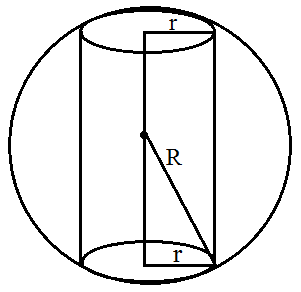
From the given figure
We have $\text{h}=2\sqrt{\text{R}^{2}-\text{r}^{2}}$
The volume (V) of the cylinder is given by,
$\text{V}=\pi\text{r}^{2}\text{h}=2\pi\text{r}^{2}\sqrt{\text{R}^{2}-\text{r}^{2}}$
$\frac{\text{dV}}{\text{dr}}=4\pi\text{r}\sqrt{\text{R}^{2}-\text{r}^{2}}+\frac{2\pi\text{r}^{2}(-2\text{r})}{2\sqrt{\text{R}^{2}-\text{r}^{2}}}$
$=4\pi\text{r}\sqrt{\text{R}^{2}-\text{r}^{2}}-\frac{2\pi\text{r}^{3}}{\sqrt{\text{R}^{2}-\text{r}^{2}}}$
$=\frac{4\pi\text{r}(\text{R}^{2}-\text{r}^{2})-2\pi\text{r}^{3}}{\sqrt{\text{R}^{2}-\text{r}^{2}}}$
$=\frac{4\pi\text{r}\text{R}^{2}-6\pi\text{r}^{3}}{\sqrt{\text{R}^{2}-\text{r}^{2}}}$
Now, $\frac{\text{dV}}{\text{dr}}=0$
$\Rightarrow4\pi\text{r}\text{R}^{2}-6\pi\text{r}^{3}=0$
$\Rightarrow \text{r}^{3}=\frac{2\text{R}^{2}}{3}$
Now, $\frac{\text{d}^{2}\text{V}}{\text{dr}^{3}}=\frac{\sqrt{\text{R}^{2}-\text{r}^{2}}(4\pi\text{R}^{2}-18\pi\text{r}^{2})-(4\pi\text{r}\text{R}^{2}-6\pi\text{r}^{3})\frac{(-2\text{r})}{2\sqrt{\text{R}^{2}-\text{r}^{2}}}}{(\text{R}^{2}-\text{r}^{2})}$
$=\frac{({\text{R}^{2}-\text{r}^{2})}(4\pi\text{R}^{2}-18\pi\text{r}^{2})+\text{r}(4\pi\text{r}\text{R}^{2}-6\pi\text{r}^{3})}{(\text{R}^{2}-\text{r}^{2})^\frac{3}{2}}$
$=\frac{4\pi\text{R}^{4}-22\pi\text{r}^{2}\text{R}^{2}+12\pi\text{r}^{4}+4\pi\text{r}^{2}\text{R}^{2}}{(\text{R}^{2}-\text{r}^{2})^\frac{3}{2}}$
Now, it can be observed that at $ \text{r}^{3}=\frac{2\text{R}^{2}}{3},\frac{\text{d}^{2}\text{V}}{\text{dr}^{2}}<0$
$\therefore$ The volume is the maximum when $ \text{r}^{3}=\frac{2\text{R}^{2}}{3}$
When $ \text{r}^{3}=\frac{2\text{R}^{2}}{3}$, the height of the cylinder is $2\sqrt{\text{R}^{2}-\frac{2\text{R}^{2}}{3}}=2\sqrt{\frac{\text{R}^{2}}{3}}=\frac{2\text{R}}{\sqrt{3}}$
Hence, the volume of the cylindre is the maximum when the height of the cylinder is $\frac{2\text{R}}{\sqrt{3}}$. View full question & answer→Question 225 Marks
A beam is supported at the two ends and is uniformly loaded. The bending moment M at a distance x from one end is given by
$\text{M}=\frac{\text{WL}}{2}\text{x}-\frac{\text{W}}{3}\frac{\text{x}^{3}}{\text{L}^{2}}$
Find the point at which M is maximum in each case.
AnswerGiven, $\text{M}=\frac{\text{Wx}}{3}-\frac{\text{W}\text{x}}{3}-\frac{\text{Wx}^{3}}{3\text{L}^{2}}$
$\Rightarrow\frac{\text{dM}}{\text{dx}}=\frac{\text{W}}{3}-3\times\frac{\text{W}\text{x}^{2}}{3\text{L}^{2}}$
$\Rightarrow\frac{\text{dM}}{\text{dx}}=\frac{\text{W}}{3}-\frac{\text{Wx}^{2}}{\text{L}^{2}}$
For maximum or minimum values of M, We must have $\frac{\text{dM}}{\text{dx}}=0$
$\Rightarrow\frac{\text{W}}{3}-\frac{\text{Wx}^{2}}{\text{L}^{2}}=0$
$\Rightarrow\frac{\text{W}}{3}=\frac{\text{Wx}^{2}}{\text{L}^{2}}$
$\Rightarrow\text{x}=\frac{\text{L}}{\sqrt{3}}$
Now, $\frac{\text{d}^{2}\text{M}}{\text{dx}^{2}}=-\frac{2\text{Wx}}{\text{L}^{2}}<0$
So, M is maximum at $\text{x}=\frac{\text{L}}{\sqrt{3}}$.
View full question & answer→Question 235 Marks
Prove that the least perimeter of an isosceles triangle in which a circle of radius r can be inscribed is $6\sqrt{3}\text{ r}$.
Answer
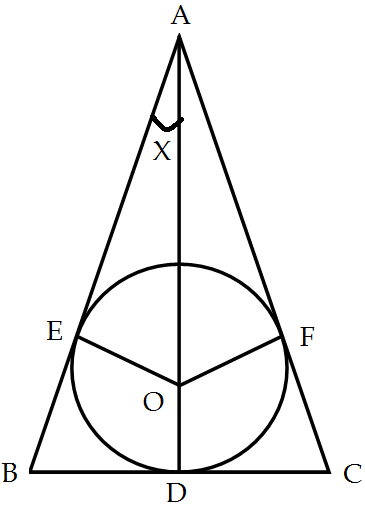 AD is the altitude of the is triangle ABC.
Let 'r' be the radius of the inscribed circle.
So, OD = OE = OF = r, where O is the center of the inscribed circle.
BD = DC ...(i)
BD = BE and CD = CF ...(ii)
from eq. (i) and (ii),
BD = BE = DC = CF ...(iii)
AE = AF ...(iv)
perimeter of the triangle = AB + BC + AC
= AE + AF + BE + BD + DC + CF
= 2AE + 4BE ...(iv)
In right triangle OEA, $\text{AE}=\frac{\text{OE}}{\tan\text{x}}=\frac{\text{r}}{\tan\text{x}}\ ...(\text{v})$
In right triangle ABD, $\text{BD}=\text{AD}\tan\text{x}$
$\Rightarrow \text{BD}=\text{AD}\tan\text{x}=(\text{AO}+\text{OD}\tan\text{x})$
$=\Big(\frac{\text{r}}{\sin\text{x}}+\text{r}\Big)\tan\text{x}\ ...(\text{vi})$
$=2\text{AE}+4\text{BE}=\frac{2\text{r}}{\tan\text{x}}+4\Big(\frac{\text{r}}{\sin\text{x}}+\text{r}\Big)\tan\text{x}$
$\Rightarrow \text{p}(\text{x})=\text{r}(2\cot\text{x}+4\sec\text{x}+4\tan\text{x}\Big)$
To, find the first to zero,
$\Rightarrow \text{p}(\text{x})=\text{r}(2\cot\text{x}+4\sec\text{x}+4\tan\text{x}\Big)=0$
$\Rightarrow\text{r}\Big(-\frac{2}{\sin^{2}\text{x}}+\frac{4\sin\text{x}}{\cos^{2}}+\frac{4}{\cos^{2}}\Big)=0$
$\Rightarrow \text{r}\Big(\frac{-2\cos^{2}\text{x}+4\sin^{2}\text{x}+4\sin^{2}\text{x}}{\sin\text{x}^{2}\cos^{2}\text{x}}\Big)=0$
$\Rightarrow -2(1-\sin^{2}\text{x})+4\sin^{3}\text{x}+4\sin^{2}\text{x}=0$
$\Rightarrow 2\sin^{3}\text{x}+3\sin^{2}\text{x}-1=0$
Hence, $\sin{\text{x}}+1$ is a $2\sin^{3}\text{x}+3\sin^{2}\text{x}-1$
So, $2\sin^{3}\text{x}+3\sin^{2}\text{x}-1 =0$
$\Rightarrow(\sin\text{x}+1)(2\sin^{2}\text{x}+\sin\text{x}-1) =0$
At, $\sin\text{x}=\frac{1}{2}$, the first from -ve to +ve.
Hence,
$=\text{r}\Big(2\sqrt{3}+4\times\frac{2}{\sqrt{3}}+4\times\frac{1}{\sqrt{3}}\Big)$
$=\text{r}\Big(\frac{18}{\sqrt{3}}\Big)=6\sqrt{3}$ View full question & answer→Question 245 Marks
Find the largest possible area of a right angled triangle whose hypotenuse is 5cm long.
AnswerLet the base of right angled triangle be x and its height be y, Then,
$\text{x}^{2}+\text{y}^{2}=5^{2}$
$\Rightarrow\text{y}^{2}=25-\text{x}^{2}$
$\Rightarrow\text{y}=\sqrt{25-\text{x}^{2}}$
As, thr area of the triangle, $\text{A}=\frac{1}{2}\times\text{x}\times\text{y}$
$\Rightarrow\text{A}(\text{x})=\frac{1}{2}\times\text{x}\times\sqrt{25-\text{x}^{2}}$
$\Rightarrow\text{A}(\text{x})=\frac{\text{x}\sqrt{25-\text{x}^{2}}}{2}$
$\Rightarrow\text{A}'(\text{x})=\frac{\sqrt{25-\text{x}^{2}}}{2}+\frac{\text{x}(-2\text{x})}{4\sqrt{25-\text{x}^{2}}}$
$\Rightarrow\text{A}'(\text{x})=\frac{\sqrt{25-\text{x}^{2}}}{2}+\frac{\text{x}^{2}}{2\sqrt{25-\text{x}^{2}}}$
$\Rightarrow\text{A}'(\text{x})=\frac{25-\text{x}^{2}-\text{x}^{2}}{2\sqrt{25-\text{x}^{2}}}$
$\Rightarrow\text{A}'(\text{x})=\frac{25-2\text{x}^{2}}{2\sqrt{25-\text{x}^{2}}}$
For maxima or minima, We must have f'(x) = 0
A'(x) = 0
$\Rightarrow\frac{25-2\text{x}^{2}}{2\sqrt{25-\text{x}^{2}}}=0$
$\Rightarrow 25-2\text{x}^{2}=0$
$\Rightarrow 2\text{x}^{2}=25$
$\Rightarrow \text{x}=\frac{5}{\sqrt{2}}$
So, $\text{y}=\sqrt{25-\frac{25}{2}}$
$=\sqrt{\frac{50-25}{2}}$
$=\sqrt{\frac{25}{2}}$
$={\frac{5}{\sqrt{2}}}$
Also, $\text{A}'(\text{x})=\frac{\Bigg[-4\text{x}\sqrt{25-\text{x}^{2}}-\frac{(25-2\text{x}^{2})(-2\text{x})}{2\sqrt{25-\text{x}^{2}}}\Bigg]}{25-\text{x}^{2}}$
$=\frac{\Bigg[\frac{-4\text{x}(25-\text{x}^{2})+(25\text{x}-2\text{x}^{3})}{\sqrt{25-\text{x}^{2}}}\Bigg]}{25-\text{x}^{2}}$
$=\frac{-100\text{x}+4\text{x}^{3}+25\text{x}-2\text{x}^{3}}{(25-\text{x}^{2})\sqrt{25-\text{x}^{2}}}$
$=\frac{-75\text{x}+2\text{x}^{3}}{(25-\text{x}^{3})\sqrt{25-\text{x}^{2}}}$
$\Rightarrow\text{A}''\Big(\frac{5}{\sqrt{2}}\Big)=\frac{-75\Big(\frac{5}{\sqrt{2}}\Big)+2\Big(\frac{5}{\sqrt{2}}\Big)^{3}}{\Bigg(25-\Big(\frac{5}{\sqrt{2}}\Big)^{2}\Bigg)^\frac{3}{2}}<0$
So, $\text{x}=\Big(\frac{5}{\sqrt{2}}\Big)$ is point of maxima.
$\therefore$ The largest possible area of triangle $=\frac{1}{2}\times\Big(\frac{5}{\sqrt{2}}\Big)\times\Big(\frac{5}{\sqrt{2}}\Big)=\frac{25}{4}$ square units.
View full question & answer→Question 255 Marks
Find the points of local maxima or local minima and corresponding local maximum and local minimum values of the following functions. Also, find the points of inflection,$f(x) = -(x - 1)^3(x + 1), x < 1$
AnswerGiven,$ f(x) = -(x - 1)^3(x + 1)^2$
$\Rightarrow f'(x) = -[3(x - 1)^2(x + 1)^2 +2(x + 1)(x - 1)^3]$
For thr local maxima or minima, we must have $f'(x) = 0$
$\Rightarrow -3(x - 1)^2(x + 1)^2 - 2(x + 1)(x - 1)^3 = 0$
$\Rightarrow (x - 1)^2(x + 1)[-3(x + 1) - 2(x - 1) = 0$
$\Rightarrow (x - 1)^2(x + 1)[-3x - 3 - 2x + 2] = 0$
$\Rightarrow (x - 1)^2(x + 1) [-5x - 1] = 0$
$\Rightarrow x = 1, -1$ and $\frac{-1}{5}$
Thus, $x = 1, x = -1 $ and $\text{x} =\frac{-1}{5}$ are the possible points of local maxima or local minima.
Now, f$''(x) = -[3{2(x - 1)(x - 1)^2 + 2(x + 1)(x - 1)^2} + 2{(x - 1)(x - 1)^2} + 2{(x - 1)^3 + 3(x - 1)^2(x + 1)}]$
$= -6(x - 1)(x + 1)^2 + 6(x + 1)(x - 1)^2- 2(x - 1)^3 - 6(x - 1)^2(x + 1)$
At $x = 1$
$= -6(1 - 1)(1 + 1)^2 + 6(1 + 1)(1 - 1)^2- 2(1 - 1)^3 - 6(1 - 1)^2(1 + 1) = 0$
So, it is a point of inflexion.
At $x = -1$
$= -6(-1 - 1)(-1 + 1)^2 + 6(-1 + 1)(-1 - 1)^2- 2(-1 - 1)^3 - 6(-1 - 1)^2(-1 + 1) = 0$
So, x = -1 is the point of local minimum.
The local minimum value is given by
$f(-1) = -1(1-1)3(-1 + 1)2 = 0$
At $\text{x}=-\frac{1}{5}$
$\Rightarrow\text{f}''-\Big(-\frac{1}{5}-1\Big)^{3}\Big(-\frac{1}{5}+1\Big)^{2}+6\Big(-\frac{1}{5}+1\Big)\Big(-\frac{1}{5}-1\Big)^{2}$
$+2\Big(-\frac{1}{5}-1\Big)^{3}-6\Big(-\frac{1}{5}-1\Big)^{2}\Big(-\frac{1}{5}+1\Big)$
$=\frac{576}{125}+\frac{384}{125}-\frac{432}{125}-\frac{864}{125}=\frac{-336}{125}<0$
So, $\text{x}=-\frac{1}{5}$ is the point of local maximum.
The local maximum value is given by
$\text{f}\Big(-\frac{1}{5}\Big)=\Big(-\frac{1}{5}-1\Big)^{3}\Big(-\frac{1}{5}+1\Big)^{2}=-\Big(\frac{-216}{125}\Big)\Big(\frac{16}{25}\Big)=\frac{3465}{3125}$
View full question & answer→Question 265 Marks
Show that the height of the cone of maximum volume that can be inscribed in a sphere of radius 12cm is 16cm.
AnswerLet l, b and V be the length breadth and volume of the rectangle, respectively. Then, 2(l + b) = 36
⇒ l = 18 - b ....(i)
Volume of the cylinder when revolved about the breadth, $\text{V}=\pi{l}^{2}\text{b}$
$\Rightarrow \text{V}=\pi(18-\text{b})^{2}\text{b}$ [From eq.(i)]
$\Rightarrow \text{V}=\pi(324\text{b}+\text{b}^{3}-36\text{b}^{2})$
$\Rightarrow \frac{\text{dV}}{\text{db}}=\pi(324+3\text{b}^{3}-72\text{b})$
For the maximum or minimum values of V, we must have $\frac{\text{dV}}{\text{db}}=0$
$\Rightarrow\pi(324+3\text{b}^{2}-72\text{b)}=0$
$\Rightarrow324+3\text{b}^{2}-72\text{b}=0$
$\Rightarrow \text{b}^{2}-24\text{b}+108=0$
$\Rightarrow \text{b}^{2}-6\text{b}+18\text{b}+108=0$
$\Rightarrow (\text{b}-6)(\text{b}-18)=0$
$\Rightarrow \text{b}=6,18$
Now, $\frac{\text{d}^{2}\text{V}}{\text{db}^{2}}=\pi(6\text{b}-72)$
At, b = 6
$\frac{\text{d}^{2}\text{V}}{\text{db}^{2}}=\pi(6\times6-72)$
$\frac{\text{d}^{2}\text{V}}{\text{db}^{2}}=-36\pi<0$
At, b = 18
$\frac{\text{d}^{2}\text{V}}{\text{db}^{2}}=\pi(6\times18-72)$
$\frac{\text{d}^{2}\text{V}}{\text{db}^{2}}=-36\pi>0$
Substituting the value of b in eq.(i), we get
l = 18 - 6 = 12
So, the volume is maximum when l = 12cm and b = 6cm.
View full question & answer→Question 275 Marks
Find the points of local maxima or local minima and corresponding local maximum and local minimum values of the following functions. Also, find the points of inflection,$f'(x) = (x - 1)(x + 2)^2$
AnswerGiven, $f(x) = (x - 1)(x + 2)^2$
$\Rightarrow (x - 1)(x^2 + 4x +4)$
$\Rightarrow x^3 + 4x^2 + 4x - x^2- 4x - 4$
$\Rightarrow x^3 + 3x^2 - 4$
$\Rightarrow f'(x) = 3x^2+ 6x$
For the local maxima or minimum we must have $f'(x) = 0$
$\Rightarrow 3x^2 + 6x = 0$
$\Rightarrow 3x(x + 2) = 0$
$\Rightarrow x = 0$ and $-2$
Thus, $x = 0$ and $x = -2$ are the possible of local maxima or local minima.
Now, $f"(x) = 6x + 6$
At $x = 0, f"(x) = 6(0)+6 = 6 > 0$
So, x = 0 is the point local minimum.
The local minimum value is given by $f(0) = (0 - 1)(0 + 2)^2 = -4$
At$ x = 2$
$f"(-2) = 6(-2) + 6 = -6 > 0$
So, $x = -2$ is the point of local maximum value is given by
$f(-2) = (-2 - 1)(-2 + 2)^2 = 0$
View full question & answer→Question 285 Marks
Find the points of local maxima or local minima and corresponding local maximum and local minimum values of the following functions. Also, find the points of inflection,
$\text{f}(\text{x})=\frac{\text{x}}{2}+\frac{2}{\text{x}}, \text{x}>0$
AnswerGiven, $\text{f}(\text{x})=\frac{\text{x}}{2}+\frac{2}{\text{x}}$
$\Rightarrow\text{f}'(\text{x})=\frac{1}{2}-\frac{2}{\text{x}^{2}}$
For the local maxima or minima, We must have
$f"(x) = 0$
$\Rightarrow\frac{1}{2}-\frac{2}{\text{x}^{2}}=0$
$\Rightarrow x^2 = 4 $
$\Rightarrow x = 2$ and $-2$
Thus, $x = 2$ and $x = -2$ and $x = -2$ are the possible points of local maxima or a local minima.
Since $x > 0\ x = 2$
Now,$\text{ f}'' (\text{x)} = \frac{4}{\text{x}^{2}}$
At $ x = 2 \text{f}''(2) =\frac{4}{\text{x}^{2}}=\frac{1}{2}>0$
So, $x = 2$ is the point of local minimum.
The local minimum value is given by
$\text{f}(2)=\frac{\text{x}}{2}+\frac{2}{\text{x}}$
$=1 + 1 = 2$
View full question & answer→Question 295 Marks
Find the dimensions of the rectangle of perimeter $36$cm which will sweep out a volume as large as possible when revolved about one of its sides.
AnswerLet $l, b$ and $V$ be the lenght, breadth and volume of the rectangle, respctively.
Then, $2(l + b) = 36 $
$\Rightarrow l = 18 - b ...(i)$
Volume of the cyliner when revolved about the breadth,
$\text{V}=\pi{\text{l}}^{2}\text{b}$
$\Rightarrow \text{V}=\pi(18-\text{b})^{2}\text{b}$
$\Rightarrow \text{V}=\pi(324\text{b}+\text{b}^{3}-36\text{b}^{2})$
$\Rightarrow \frac{\text{dv}}{\text{db}}=\pi(324+3\text{b}^{2}-72\text{b})$
For the maximum or minimum values od V,
we must have $\frac{\text{dv}}{\text{db}}=0$
$\Rightarrow \pi(324+3\text{b}^{2}-72\text{b})=0$
$\Rightarrow 324 + 3b^2 - 72b = 0 $
$\Rightarrow b^2 - 24b + 108 = 0$
$ \Rightarrow b^2- 6b - 18b + 108 = 0 $
$\Rightarrow (b - 6)(b - 18) = 0$
$ \Rightarrow b = 6, 18$
Now, $\frac{\text{d}^{2}\text{V}}{\text{db}^{2}}=\pi(6\text{b}-72)$
At $b = 6 \frac{\text{d}^{2}\text{V}}{\text{db}^{2}}=\pi(6\times6-72)$
$\frac{\text{d}^{2}\text{V}}{\text{db}^{2}}=-36\pi<0$
At $b = 18 \frac{\text{d}^{2}\text{V}}{\text{db}^{2}}=\pi(6\times18-72)$
$\Rightarrow\frac{\text{d}^{2}\text{V}}{\text{bd}^{2}}=36\pi<0$
Substituting the value of b in eq.$(i),$
we get $l = 18 - 6 = 12$
So, the volue is maximum when $l = 12cm$ and $b = 6cm.$
View full question & answer→Question 305 Marks
Find the points of local maxima or local minima and corresponding local maximum and local minimum values of the following functions. Also, find the points of inflection,
$\text{f}'(\text{x})=\text{x}^{4}-62\text{x}^{2}+120\text{x}+9$
AnswerGiven, $f(x) = x^4- 62x^2+ 120x + 9$
$\Rightarrow f'(x) = 4x3 - 124x + 120$
For the local maxima and minima, we must have $f'(x)=0$
$\Rightarrow 4x^3 - 124x + 120 = 0$
$\Rightarrow x^3- 31x + 30 = 0$
$\Rightarrow (x -1)(x + 6)(x - 5) = 0$
$\Rightarrow x = 1, 5 and -6$
Thus, $x=1, x=5$, and $x=6$ are the possible points of local maxima or local minima.
Now, $f^{\prime \prime}(x)=0$
At, $x=1$
So, $x=1$ is the point of local maximum.
The local maximum value is given by
$f(1)=14-62(1)^2+120 \times 1+9=68$
At $x=5$
$f^{\prime \prime}(5)=12(5)^2-124=176>0$
So, $x=5$ is the point of local minimum.
The local minimum value is given by
$f^{\prime \prime}(5)=54-62(5)^2+120 \times 9=-316$
$\text { At } x=-6$
$f^{\prime \prime}(x)=12(-6)^2-124=308>0$
So, $x=-6$ is the point of local maximum.
The local minimum value is given by
$f(-6)=(-6)^4-62(-6)^2+120 \times(-6)+9=-1647$
View full question & answer→Question 315 Marks
Find the points of local maxima or local minima and corresponding local maximum and local minimum values of the following functions. Also, find the points of inflection,
$f(x) = xe^x$
AnswerWe have, $\text{f}(\text{x})=\text{x}\text{e}^{\text{x}}$
$\therefore \text{f }(\text{x})=\text{e}^{\text{x}}+\text{xe}^{\text{x}} =\text{e}^{\text{x}}(\text{x}+1)$
$ \text{f}''(\text{x})=\text{e}^{\text{x}}(\text{x}+1)+\text{e}^\text{x}$
$=\text{e}^\text{x}(\text{x}+2)$
For maxima and minima,
$f'(x) = 0$
$\Rightarrow\text{e}^{\text{x}}(\text{x}+1)=0$
$⇒ x = -1$
Now, $\text{f}''(-1) =\text{e}-1 =\frac{1}{\text{e}}>0$
$\therefore \text{x} =-1$ is point of local minima.
Hence, local minimum value $= \text{f}(-1) = \frac{-1}{\text{e}}$
View full question & answer→Question 325 Marks
A given quantity of metal is to be cast into a half cylinder with a rectangular base and semicircular ends. Show that in order that the total surface area may be minimum the ratio of the length of the cylinder to the diameter of its semi-circular ends is $\pi:(\pi+2)$.
AnswerLet h be the height of the cylinder and r be the radius of the semicircular of the ends.
Let V be the volume of the half, therefore
$\text{V}=\frac{1}{2}\pi\text{r}^{2}\text{h}\ ...(\text{i})$
here we have V is constant.
S = area of the rectangular base + area of the two semi circular ends + area of the curved
$\text{S}=\text{h}^{*}2\text{r}+2^{*}\frac{1}{2}\pi\text{r}^{2}+\frac{1}{2}^{*}2\pi\text{rh} $
$\text{S}=2\pi\text{h}=+\pi\text{r}^{2}+\pi\text{rh}\ ...(\text{ii})$
Since V is constant, the values of h terms of V from
$\text{h}=\frac{2\text{r}}{\pi\text{r}^{2}}$
$\text{S}=2\text{r}^{*}\frac{2\text{V}}{\pi\text{r}^{2}}+\pi\text{r}^{2}+\pi\text{r}\frac{2\text{V}}{\pi\text{r}^{2}}$
$\text{S}=\frac{4\text{V}}{\pi\text{r}}+\pi\text{r}^{2}+\frac{2\text{V}}{\text{r}}\ ..(\text{iii})$
Differntiating eq.(iii)
$\frac{\text{dS}}{\text{dr}}=\frac{4\text{V}}{\pi}\Big(-\frac{1}{\text{r}^{2}}\Big)+2\pi\text{r}+{2\text{V}}\Big(\frac{-1}{\text{r}^{2}}\Big)$
$\frac{\text{dS}}{\text{dr}}=2\pi\text{r}-\frac{1}{\text{r}^{2}}\Big(\frac{4\text{V}}{\pi}+2\text{V}\Big) \ ...(\text{iv})$
Now, differentiating (iv)
$\frac{\text{d}^{2}{\text{S}}}{\text{dr}^{2}}=2\pi\text{r}-\Big(\frac{4\text{V}}{\pi}+2\text{V}\Big)\Big(-\frac{2}{\text{r}^{3}}\Big)$
$\frac{\text{dS}}{\text{dr}}=2\pi+\frac{2}{\text{r}^{3}}\Big(\frac{4\text{V}}{\pi}+2\text{V}\Big)\ ...(\text{v})$
for S to be minimum $\frac{\text{ds}}{\text{dr}}=0$
$2\pi\text{r}-\frac{1}{\text{r}^{2}}\Big(\frac{4\text{V}}{\pi}+2\text{V}\Big)=0$
$2\pi\text{r}=\frac{1}{\text{r}^{2}}\Big(\frac{4\text{V}}{\pi}+2\text{V}\Big)$
Then,
$\text{r}^{3}=\frac{1}{2\pi}\Big(\frac{4\text{V}}{\pi}+2\text{V}\Big)=\frac{2\text{V}}{\pi^{2}}+\frac{\text{V}}{\pi}$
Is positive, this for this value S is minimum therefore,
$\text{r}^{3}=\frac{\text{V}}{\pi^{2}}(2+\pi)$
$\text{r}^{3}=\frac{1}{\pi^{2}}^{*}\frac{1}{2}\pi\text{r}^{2}\text{h}(2+\pi)$
$\text{r}=\frac{\text{h}}{2\pi}(2+\pi)$
$\Rightarrow \frac{\text{h}}{2\text{r}}=\frac{\pi}{\pi+2}$
Which is the required ratio of the length half dimametre of its semi circular ends.
View full question & answer→Question 335 Marks
Find the points of local maxima or local minima and corresponding local maximum and local minimum values of the following functions. Also, find the points of inflection,$f'(x) = x^4- 62x^2 + 9x + 15$
AnswerWe have,$ f(x) = x^3 - 6x^2 + 9x + 15 f'(x) = 3x^2 - 12x + 9 = 3(x^2 - 4x + 3) f"(x) = 6x - 12$
For maxima and minima, $f'(x) = 0$
$\Rightarrow 3(x^2 - 4x + 3) = 0$
$\Rightarrow 3(x - 3)(x - 1) = 0$
$\Rightarrow x = 3, 1$
Now, $f"(3) = 6 > 0 x = 3$ is point of local minima $f"(1) = -6 > 0 x = 3 $is point of local minima
$\therefore$ local maximum value =$ f(1) = 19local$
minimum value$ = f(3) = 15.$
View full question & answer→Question 345 Marks
Find the points of local maxima or local minima and corresponding local maximum and local minimum values of the following functions. Also, find the points of inflection,
$\text{f}(\text{x})=(\text{x}+1)(\text{x}+2)^\frac{1}{3}$
AnswerGiven, $\text{f}(\text{x})=(\text{x}+1)(\text{x}+2)^\frac{1}{3}$
$\Rightarrow\text{f}'(\text{x})=(\text{x}+2)^\frac{1}{3}+\frac{1}{3}(\text{x}+1)(\text{x}+2)^\frac{-2}{3}$
For the local maxima or minima, We must have f"(x) = 0
$\Rightarrow(\text{x}+2)^\frac{1}{3}+\frac{1}{3}(\text{x}+1)(\text{x}+2)^\frac{-2}{3}=0$
$\Rightarrow\frac{1}{3}(\text{x}+1)=-(\text{x}+2)^\frac{1}{3}\times(\text{x}+2)^\frac{2}{3}$
$\Rightarrow\frac{1}{3}(\text{x}+1)=-(\text{x}+2)$
$\Rightarrow\text{x}+1=-3\text{x}-6$
$\Rightarrow\text{x}=\frac{-7}{4}$
Thus, $\text{x}=\frac{-7}{2}$ and the possible points of local maxima or a local minima.
Now, $\text{f}"\Big(\frac{-7}{4}\Big)=\frac{2}{3}(\text{x}+2)^\frac{-2}{3}-\frac{2}{9}(\text{x}+1)(\text{x}+2)^\frac{-5}{3}$
At $\text{x}=\frac{-7}{4}$
$\text{f}''\Big(\frac{-7}{4}\Big)=\frac{2}{3}\Big(\frac{-7}{4}+2\Big)^\frac{-2}{3}-\frac{2}{9}\Big(\frac{-7}{2}+1\Big)\Big(\frac{-7}{2}+2\Big)^\frac{-5}{3}$
$=\frac{2}{3}\Big(\frac{1}{4}\Big)^\frac{-2}{3}+\frac{1}{18}\Big(\frac{1}{4}\Big)^\frac{-5}{2}>0$
So, $\text{x}=\frac{-7}{2}$ is point of local minimum.
The local minimum value is given by
$\text{f}''\Big(\frac{-7}{4}\Big)=\Big(\frac{-7}{4}+1\Big)\Big(\frac{-7}{4}+2\Big)^\frac{1}{3}=\frac{-3}{4}\Big(\frac{1}{4}\Big)^\frac{1}{3}=\frac{-3}{4^{\frac{4}{3}}}$
View full question & answer→Question 355 Marks
Show that the maximum volume of the cylinder which can be inscribed in a sphere of radius $5\sqrt{3}\text{cm}$ is $500\pi\text{cm}^{3}$ .
AnswerLet the height, radius of base and volume of a cylinder be h, r and V, respectively. Then,
$\frac{\text{h}^{2}}{4}+\text{r}^{2}=\text{R}^{2}$
$\Rightarrow \text{h}^{2}=4(\text{R}^{2}-\text{r}^{2})$
$\Rightarrow \text{r}^{2}=\text{R}^{2}-\frac{\text{h}^{2}}{4}\ ...(\text{i})$
Now, $\text{V}=\pi\text{r}^{2}\text{h}$
$\Rightarrow \text{V}=\pi(\text{hR}^{2}-\frac{\text{h}^{2}}{4})$
$\Rightarrow \frac{\text{dV}}{\text{dh}}=\pi(\text{R}^{2}-\frac{3\text{h}^{2}}{4})$
For maximum or minimum values of V, we must have $\frac{\text{dV}}{\text{dh}}=0$
$\Rightarrow \pi(\text{R}^{2}-\frac{3\text{h}^{2}}{4})=0$
$\Rightarrow (\text{R}^{2}-\frac{3\text{h}^{2}}{4})=0$
$\Rightarrow \text{R}^{2}-\frac{3\text{h}^{2}}{4}$
$\Rightarrow \text{h}=\frac{2\text{R}}{\sqrt{3}}$
$\frac{\text{d}^{2}\text{V}}{\text{dh}^{2}}=\frac{-3\pi\text{h}}{2}$
$\frac{\text{d}^{2}\text{V}}{\text{dh}^{2}}=\frac{-3\pi}{2}\times\frac{2\text{R}}{\sqrt{3}}$
$\frac{\text{d}^{2}\text{V}}{\text{dh}^{2}}=\frac{-3\pi\text{R}}{2}<0$
So, the volume is maximum when $ \text{h}=\frac{2\text{R}}{\sqrt{3}}$
Maximum volume $=\pi\text{h}(\text{R}^{2}-\frac{\text{h}^{2}}{4})$
$=\pi\times\frac{2\text{R}}{\sqrt{3}}(\text{R}^{2}-\frac{4\text{R}^{2}}{12})$
$=\frac{2\pi\text{R}}{\sqrt{3}}\times\frac{8\text{R}^{2}}{12}$
$=\frac{4\pi\text{R}^{3}}{3\sqrt{3}}$
$=\frac{4\pi(5\sqrt{3})^{3}}{3\sqrt{3}}$
$=500\pi \text{cm}^{3}$
View full question & answer→Question 365 Marks
Given the sum of the perimeters of a square and a circle, show that the sum of there areas is least when one side of the square is equal to diameter of the circle.
AnswerLet the length of a side of the square and radius of the circle be x and r, respectively.
It is given that the sum of the perimeters of square and circle is constant.
$\Rightarrow 4\text{x}+2\pi\text{x}=\text{k}$ (Where K is some constant)
$\Rightarrow \text{x}=\frac{(\text{k}-2\pi\text{r})}{4}...(\text{i})$
Now, $\Rightarrow \text{A}=\text{x}^{2}+\pi\text{r}^{2}$
$\Rightarrow \text{A}=\frac{(\text{k}-2\pi\text{r})^{2}}{4}+\pi\text{r}^{2}$ [From eq.(i)]
$\Rightarrow \frac{\text{dA}}{\text{dr}}=\frac{(\text{k}-2\pi\text{r}^{2})}{16}+\pi\text{r}^{2}$
$\Rightarrow \frac{\text{dA}}{\text{dr}}=\frac{2(\text{k}-2\pi\text{r})-2\pi}{16}+2\pi\text{r}$
$\Rightarrow \frac{\text{dA}}{\text{dr}}=\frac{(\text{k}-2\pi\text{r})-\pi}{4}+2\pi\text{r}$
$\Rightarrow \frac{(\text{k}-2\pi\text{r})-\pi}{4}+2\pi\text{r}=0 $
$\Rightarrow \frac{(\text{k}-2\pi\text{r})\pi}{4}=2\pi\text{r}$
$\Rightarrow \text{K}-2\pi\text{x}=8\text{r} .....(\text{ii})$
$\frac{\text{d}^{2}\text{A}}{\text{dx}^{2}}=\frac{\pi^{2}}{2}+2\pi>0$
So, the sum of the areas, A is least when $\text{K}-2\pi\text{r}=8\pi$
From eq. (i) and (ii), We get
$\text{x}=\frac{(\text{k}-2\pi\text{r})}{4}$
$\Rightarrow\text{x}=\frac{8\text{r}}{4}$
$\Rightarrow\text{x}=2\text{r}$
$\therefore$ Side of the squre = Diamete of thr circle.
View full question & answer→Question 375 Marks
Find the points of local maxima or local minima and corresponding local maximum and local minimum values of the following functions. Also, find the points of inflection,
$\text{f}(\text{x})=\frac{2}{\text{x}}-\frac{2}{\text{x}^{2}}, \text{x}>0$
AnswerGiven, $\text{f}(\text{x})=\frac{2}{\text{x}}-\frac{2}{\text{x}^{2}}=2\text{x}^{-1}-2\text{x}^{-2}$$\Rightarrow \text{f}'(\text{x})=-2\text{x}^{-2}=4\text{x}^{-3}=\frac{4}{\text{x}^{3}}-\frac{2}{\text{x}^{2}}$
For the local maxima or minima, We must have f'(x) = 0
$\Rightarrow\frac{4}{\text{x}^{3}}-\frac{2}{\text{x}^{2}}=0$
⇒ 4 - 2x = 0
⇒ x = 2
Thus, x = 2 and is the possible of local maxima or local minima.
Now, $\text{f}'(\text{x})=\frac{-12}{\text{x}^{4}}+\frac{4}{\text{x}^{3}}$
At x = 2, $\text{f}'(2)=\frac{-12}{16}+\frac{4}{8}=\frac{-12+8}{16}=\frac{-1}{4}<0$
So, x = 2 is the point local minimum.
The local minimum value is given by
$\text{f}(2)=\frac{2}{2}-\frac{2}{2^{2}}=1-\frac{1}{2}=\frac{1}{2}$
View full question & answer→Question 385 Marks
A straight line is drawn through a given point $P(1, 4)$. Determine the least value of the sum of the intercepts on the coordinate axes.
AnswerWe know that
$y - y_1 = m(x - x_1)$
Given, $(x_1, y_1) = (1, 4)$
$⇒ y - 4 = m(x - 1)$
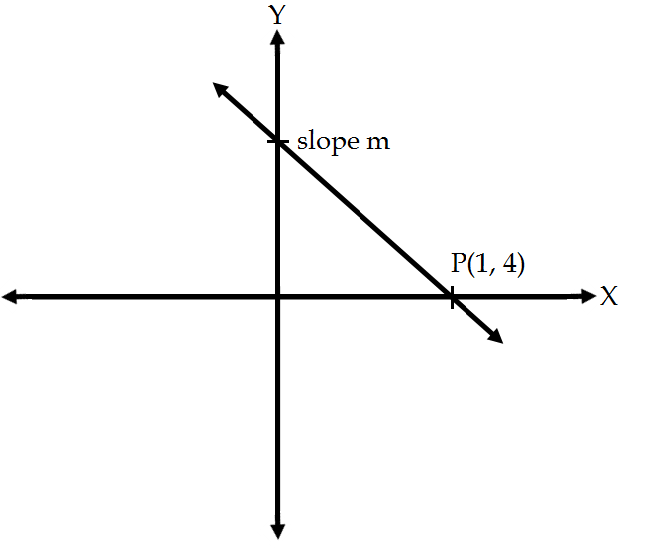
On y-intercept,$ x = 0$
$\Rightarrow y - 4 = m(-1)$
$\Rightarrow y - 4 = -m$
$\Rightarrow y = 4 - m$
On x-intercept, $y = 0$
$\Rightarrow 0 - 4 = m(x - 1)$
$\Rightarrow -4 = mx - m$
$\Rightarrow \text{x }=\frac{\text{ m} - 4}{\text{m}}$
Then,
$S = x + y$
$\text{S}=\Big(\frac{\text{m}-4}{\text{m}}\Big)\ +\ (4-\text{m})\ \ ....(1)$
On diff. (1) w.r.t m, we get
$\frac{\text{dS}}{\text{dm}}=\Big(0+\frac{4}{\text{m}^2}-1\Big)=0$
$\Rightarrow\ \frac{4}{\text{m}^2}=1$
$\text{m} = \pm2$
On diff. again (1) w.r.t. m, we get
$\frac{\text{d}^2\text{S}}{\text{dm}^2}=-\frac{8}{\text{m}^3}$
At Maxima, m = 2
$\Rightarrow\frac{\text{d}^2\text{S}}{\text{dm}^2}=\frac{-8}{8}=-1<0$
At Minima, m = -2
$\Rightarrow\frac{\text{d}^2\text{S}}{\text{dm}^2}=\frac{-8}{-8}=1>0$
Now,
$\Rightarrow \text{x }=\frac{\text{ m} - 4}{\text{m}}$
$\Rightarrow\frac{-2-4}{-2}=3$
And
$\text{y}=4-\text{m}\Rightarrow4+2=6$
The points x and y are 3 and 6
We konw that,
$S = x + y$
$S = 3 + 6$
$S = 9$ View full question & answer→Question 395 Marks
An open tank is to be constructed with a square base and vertical sides so as to contain a given quantity of water. Show that the expenses of lining with lead with be least, if depth is made half of width.
AnswerLet x be side of the sqqre base and h be the depth of the given tank of volume V.
$\therefore V = x^2h$ $\Rightarrow \text{h}=\frac{\text{V}}{\text{x}^{2}} \ ...(\text{i})$
Surface area of the cost per sqqre unit of material and C be the total cost.
$\text{C}=(\text{x}^{2}+4\text{xh})\text{p}=\Big(\text{x}^{2}+\frac{4\text{V}}{\text{x}}\Big)\text{p}$. Where p is constant'
$\frac{\text{dC}}{\text{dx}}=\text{p}\Big(2\text{x}-\frac{4\text{V}}{\text{x}^{2}}\Big)$
Now, $\frac{\text{dC}}{\text{dx}}=0$ gives us,
$=\text{p}\Big(2\text{x}-\frac{4\text{V}}{\text{x}^{2}}\Big)=0$ or $2\text{x}-\frac{4\text{V}}{\text{x}^{2}}=0$
$\therefore x^{_3} - 2V = 0 \Rightarrow x^3 = 2V$
$\frac{\text{d}^{2}\text{C}}{\text{dx}^{2}}=\text{p}\Big(2+\frac{8\text{V}}{\text{x}^{2}}\Big)=\text{p}\Big(2+\frac{8}{\text{x}^{3}}.\frac{\text{x}^{3}}{2}\Big)$
=p(2 + 4) = 6p > 0
Now, $\text{h}=\frac{\text{V}}{\text{x}^{2}}=\frac{\frac{\text{x}^{3}}{2}}{\text{x}^{2}}=\frac{\text{x}}{2}$
$\therefore$ depth of tank = half of its width.
View full question & answer→Question 405 Marks
Find the maximum and the minimum values, if any, without using derivaives of the following functions:$f(x) = 16x^2 - 16x + 28$ on $R$.
Answer$\text{f}(\text{x})=16\text{x}^{2}-16\text{x}+28$
$=16\text{x}^{2}-16\text{x}+4+24$
$=(4\text{x}+2)^{2}+24$
Now, $(4\text{x}-2)^{2}\geq0$ for all $\text{x}\in\text{R}$
$\Rightarrow(4\text{x}-2)^{2}+24\geq24$ for all $\text{x}\in\text{R}$
$\Rightarrow\text{f}(\text{x})\geq\text{f}\Big(\frac{1}{2}\Big)$
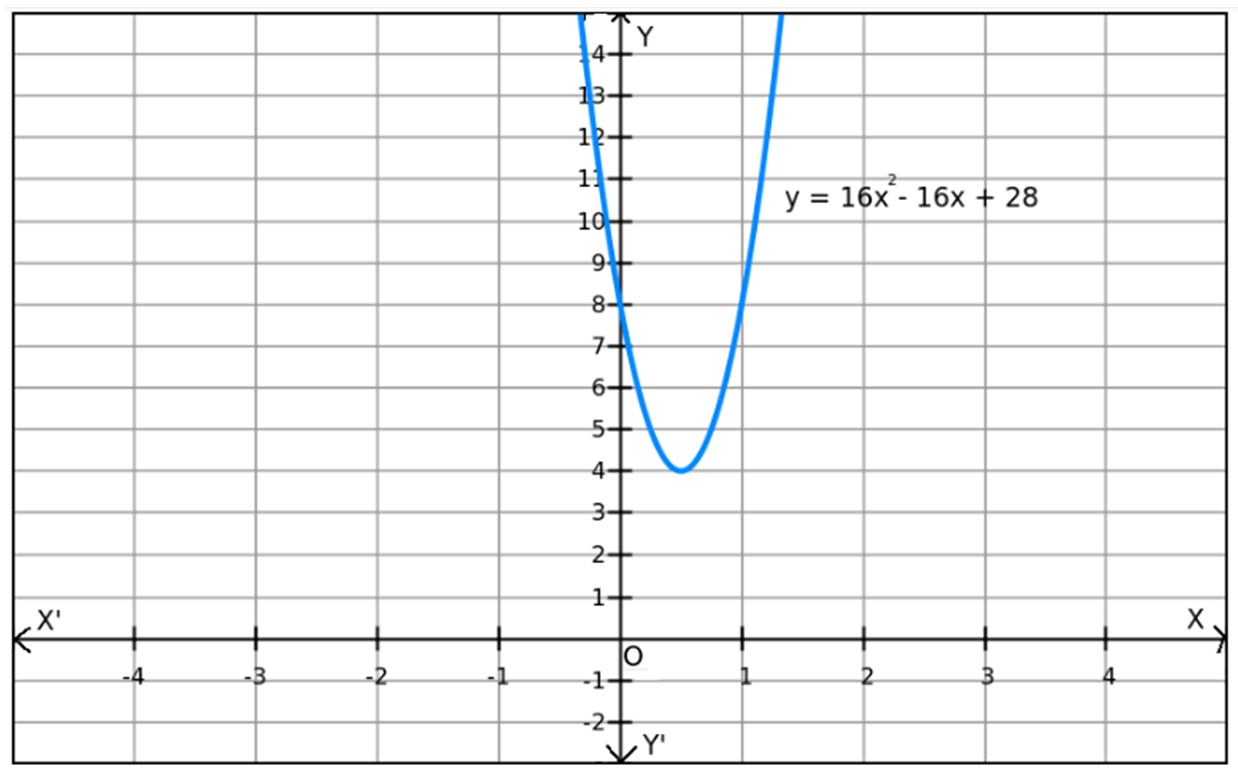
Thus, the minimumvalue of f(x) is 24 at $\text{x}=\frac{1}{2}$
since, f(x) can be made as large as possible by giving difference value to x.
Thus, maximum value does not exist. View full question & answer→Question 415 Marks
Find the maximum and the minimum values, if any, without using derivaives of the following functions:f(x) = |sin4x + 3| on R.
Answer $\text{f}(\text{x})=|\sin4\text{x}+3|$
We know that $-1\leq\sin4\text{x}+\leq1$
$\Rightarrow2\leq\sin4\text{x}+3\leq4$
$\Rightarrow2\leq|\sin4\text{x}+3|\leq4$
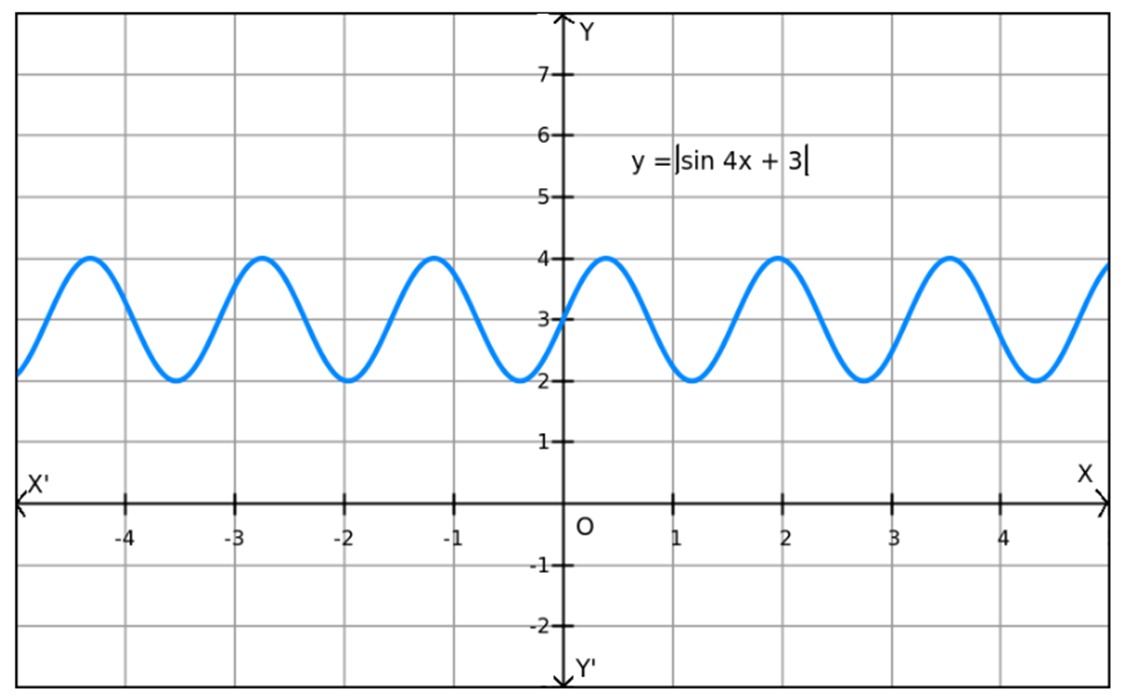
Hence, the maximum and minimum values of f are 4 and 2 respectively. View full question & answer→Question 425 Marks
A square piece of tin of side $18\ cm$ is to be made into a box without top by cutting a square from each corner and folding up the flaps to form a box. What should be the side of the square to be cut off so that the volume of the box is maximum? Find this maximum volume.
AnswerLet the side of the square to be cut off be xcm.
Then, the length and the breadth of the box will be (18 - 2x)cm each and height of the box will be xcm.
Volume of the box, $V(x) = x(18 − 2x)^2$
$V'(x) = (18 - 2x)^2 - 4x(18 - 2x)$
$=(18 - 2x)(18 - 2x - 4x)$
$=(18 - 2x)(18 - 6x)$
$=12(9 - x)(3 - x)$
$V''(x) = 12( - (9 - x) - (3 - x))$
$= -12(9 - x + 3 - x)$
$= -24(6 - x)$
For maximum and minimum value of V, We must have V'(x) = 0
$\Rightarrow x = 9$ or $x = 3$
If x = 9, then length and breadh will become 0.
$\therefore x = 9$
Now,$ v''(3) = -24(6 - 3) = -72 < 0$
$\therefore$ x = 3 is the point of maxima.
$V(x) = 3(18 - 6)2 = 3 \times 144 = 432cm^3$
Hence, if we remove a square of side $3\ cm$ from each corner of the square tin and make a box from the remaining sheet, then the volume of the box so obtained would be the largest, i.e.$ 432cm^3.$
View full question & answer→Question 435 Marks
Find the maximum and the minimum values, if any, without using derivaives of the following functions:$f(x) = (x - 1)^2+ 2$ on R.
AnswerThe given function is $\text{f}(\text{x})=(\text{x}-1)^{2}+2$
It can be observed that $(\text{x}-1)^{2}\geq0$ for every $\text{x}\in\text{R}$
Therefore, $\text{f}(\text{x})=-(\text{x}-1)^{2}+2\leq2$ for every $\text{x}\in\text{R}$
The maximum value of f is attined when $(\text{x}-1)=0$
$(\text{x}-1)=0$
$\Rightarrow\text{x}=1$
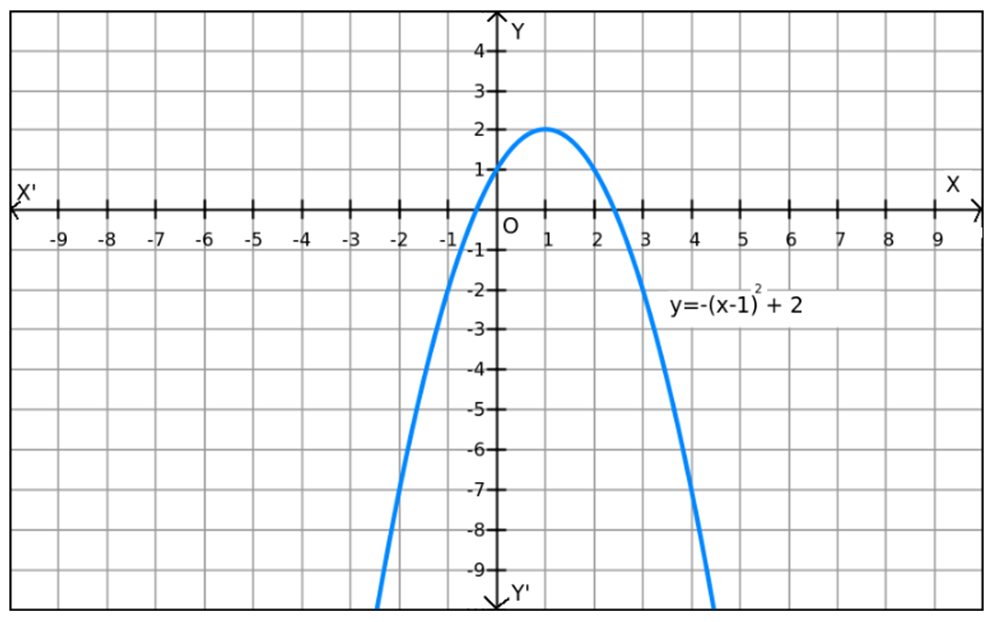
$\therefore$ maximum value of $f = f(1)= -(1 - 1)^2+ 2 = 2$
Hence, function f does have a minimum value. View full question & answer→Question 445 Marks
Find the absolute maximum and the absolute minimum value of the following functions in the given intervals:
$f(x) = 3x^4 - 8x^3 + 12x^2 - 48x + 25$ in $[0,3]$
AnswerGiven, $f(x) = 3x^4 - 8x^3 + 12x^2 - 48 + 25$
$\Rightarrow f'(x) = 12x^3- 24x^2 + 24x - 28$
For a local maximum or a local minimum, We must have $f'(x) = 0$
$\Rightarrow 12x^3- 24x^2 + 24x - 48 = 0$
$\Rightarrow x^3 - 2x^2+ 2x - 4 = 0$
$\Rightarrow x^2(x - 2) + 2(x - 2) = 0$
$\Rightarrow (x - 2)(x^2 + 2) = 0$
$\Rightarrow x - 2 = 0$ or $(x^2 + 2) = 0$
$\Rightarrow x = 2$
No, real root exists for $ (x^2 + 2) = 0$
Thus, the critical points of $f$ are $0, 2$ and $3.$
Now, $f(0) = 3(0)^4 - 8(0)^3+ 12(0)^2 - 48(0) + 25 = 25$
$f(2) = 3(2)^4 - 8(2)^3 + 12(2)^2 - 48(2) + 25 = -39$
$f(3) = 3(3)^4 - 8(3)^3+ 12(3)^2 - 48(3) + 25 = 1$
Hence, the absolute maximum value when $x = 0$ is $25$ and the absolute minimum value when $x = 2$ is $−39.$
View full question & answer→Question 455 Marks
Find the points o local maxima or local minima, if any, of the following functions, using the first derivatives test. Also, find the local maximum or local minimum values, as the case may be:
$\text{f}(\text{x})=\sin\text{x}-\cos(\text{x}), 0\leq\text{x}\leq2\pi$
AnswerGiven, $\sin\text{x}-\cos\text{x}, 0\leq\text{x}\leq2\pi $
$\therefore\text{f}'(\text{x})=\cos\text{x}+\sin\text{x}$
$\Rightarrow\text{f}'(\text{x})=0=-1$
$\Rightarrow-\cos\text{x}=-\sin{\text{x}}$
$\Rightarrow\tan\text{x}$
$\Rightarrow\text{x}=\frac{3\pi}{4},\frac{7\pi}{4}\in(0,2\pi)$
$\Rightarrow\text{f}'(\text{x})=-\sin\text{x}+\cos\text{x}$
$\Rightarrow\text{f}'(\text{x})=-\sin\text{x}+\cos\text{x}$
$\Rightarrow\text{f}'\Big(\frac{3\pi}{4}\Big)=-\sin\frac{3\pi}{4}+\cos\frac{3\pi}{4}\\=-\frac{1}{\sqrt{2}}-\frac{1}{\sqrt{2}}=-\sqrt{2}\leq0$
$\Rightarrow\text{f}'\Big(\frac{7\pi}{4}\Big)=-\sin\frac{7\pi}{4}+\cos\frac{7\pi}{4}\\=-\frac{1}{\sqrt{2}}+\frac{1}{\sqrt{2}}=\sqrt{2}\geq0$
Therefore, by second derivative test, $\text{x}=\frac{3\pi}{4}$ is a point of local maxima and local maximum value of f at $\text{x}=\frac{3\pi}{4}$ is $\text{f}'\Big(\frac{3\pi}{4}\Big)=-\sin\frac{3\pi}{4}+\cos\frac{3\pi}{4}=\frac{1}{\sqrt{2}}+\frac{1}{\sqrt{2}}=\sqrt{2}.$ However, $\text{x}=\frac{7\pi}{4}$ is point of local minima and the local minimum value of f at $\text{x}=\frac{7\pi}{4}$ is $\text{f}'(\frac{7\pi}{4})=\sin\frac{7\pi}{4}-\cos\frac{7\pi}{4}=\frac{1}{\sqrt{2}}-\frac{1}{\sqrt{2}}=\sqrt{2}.$
View full question & answer→Question 465 Marks
Find the coordinates of a point on the parabola $y = x^2+ 7x + 2$ which is closest to the strainght line $y = 3x -3$.
AnswerLet coordinates of a point on the parabola be (x, y). Then,
$y = x^2 + 7x + 2$ ...(i)
Let the distance of a point $(x, (x^2 + 7x + 2))$ from the line $y = 3x - 3$ be S. Then
$\text{S}=\frac{-3\text{x}+(\text{x}^{2}+7\text{x}+2)+3}{\sqrt{10}}$
$\Rightarrow \frac{\text{dS}}{\text{dt}}=\frac{-3+2\text{x}+7}{\sqrt{10}}$
For maximum or minimum values of S, we must have $\frac{\text{dS}}{\text{dt}}=0$
$\Rightarrow \frac{-3+2\text{x}+7}{\sqrt{10}} = 0$
$\Rightarrow 2\text{x}=-4$
$\Rightarrow \text{x}=-2$
Now, $\frac{\text{d}^{2}\text{S}}{\text{dt}^{2}}=\frac{2}{\sqrt{10}}>0$
So, the neaerst point is $(x, (x^2 + 7x + 2))$.
$\Rightarrow (-2,4-14+2)$
$\Rightarrow (-2,-8)$
View full question & answer→Question 475 Marks
The spaces described in time t by a particle moving in a straight line is given by $s = t^5 = 4t^3+ 30t^2 + 80t - 250$. Find the minimum value of acceleration.
AnswerGiven,
$\Rightarrow \text{s}=\text{t}^{5}-40\text{t}^{3}+30\text{x}^{2}+80\text{t}-250$
$\Rightarrow\frac{\text{ds}}{\text{dt}}=5\text{t}^{4}-120\text{t}^{4}+60\text{t}+80$
Acceleration, $\text{a}=\frac{\text{d}^{2}\text{s}}{\text{dt}^{2}}=20\text{t}^{2}+240\text{t}+60$
$\Rightarrow\frac{\text{da}}{\text{dt}}=60\text{t}^{2}+240\text{t}$
For maximum or minimum values of a, we must have $\frac{\text{da}}{\text{dt}}=0$
$\Rightarrow60\text{t}^{2}+240=0$
$\Rightarrow60\text{t}^{2}=240$
$\Rightarrow\text{t}=2$
Now, $\frac{\text{d}^{2}\text{a}}{\text{dt}^{2}}=120\text{t}$
$\Rightarrow\frac{\text{d}^{2}\text{a}}{\text{dt}^{2}}=120\text{t}>0$
So, acceleration is minimum at t = 2
$\Rightarrow \text{a}_\text{min}=20(2)^{3}-240(2)+60$
$=160-480+60=-260$
$\therefore$ At t = 2
a = -260
View full question & answer→Question 485 Marks
Find the maximum and minimum values of $\text{y}=\tan \text{x}-2\text{x}$
AnswerWe have, $\text{y}=\tan \text{x}-2\text{x}$
$\therefore\ \text{y}=\sec^{2}\text{x}-2$
$ \text{y}=2\sec^{2}\text{x}\tan \text{x}$
For maximum and minimum value, y' = 0
$\Rightarrow\sec^{2}\text{x}=2$
$\Rightarrow\sec\text{x}=\pm\sqrt{2}$
$\Rightarrow\text{x}=\frac{\pi}{4},\frac{3\pi}{4}$
$\therefore \ \text{y}''\Big(\frac{\pi}{4}\Big)=-4<0$
$\therefore \text{x}=\frac{\pi}{4}$ is point of minima.
$ \text{y}''\Big(\frac{3\pi}{4}\Big)=-4<0$
$\text{x}=\frac{3\pi}{4}$ is point of maxima.
Hence, max value
$=\text{f}\Big(\frac{3\pi}{4}\Big)=-1-\frac{3\pi}{2}$
min value
$=\text{f}\Big(\frac{\pi}{4}\Big)=-1-\frac{\pi}{2}$.
View full question & answer→Question 495 Marks
Find the point on the curve $x^2= 8y$ which is nearest to the point $(2,4)$.
AnswerLet (x, y) be the point on $x^2= 8y$ which is nearest to the point (2,4).
$\therefore$ (x, y) lies on the curve $=\frac{\text{x}^{2}}{8}$ point is $\Big(\text{x},\frac{\text{x}^{2}}{8}\Big)$
Let be the distance between (2, 4) and $\Big(\text{x},\frac{\text{x}^{2}}{8}\Big)$
$\therefore\text{d}=\sqrt{(\text{x}-2)^{2}+\Big(\frac{\text{x}^{2}}{8}-4\Big)^{2}}$
$\Rightarrow\text{d}^{2}={(\text{x}-2)^{2}+\Big(\frac{\text{x}^{2}}{8}-4\Big)^{2}}$
$\therefore \text{D}={(\text{x}-2)^{2}+\Big(\frac{\text{x}^{2}}{8}-4\Big)^{2}}$
Now d is maximum or minimum when D is maximum or minimum.
$\frac{\text{dD}}{\text{dx}}=2(\text{x}-2)+2\Big(\frac{\text{x}^{2}}{8}-4\Big).\frac{2\text{x}}{8}=2\text{x}-4+\frac{\text{x}^{3}}{16}-2\text{x}$
$=-4+\frac{\text{x}^{3}}{16}$
$\frac{\text{d}^{2}\text{D}}{\text{dx}^{2}}=\frac{3\text{x}^{2}}{16}$
At x = 4
$\frac{\text{d}^{2}\text{D}}{\text{dx}^{2}}=\frac{3\times{16}}{16}=3>0$
$\therefore $ point is (4, 2)
View full question & answer→Question 505 Marks
Determine the points on the curve $x^2 = 4y$ which are nearest to the point $(0, 5)$.
AnswerLet the point (x, y) on the curve $x^2 = 4y$ be nearest to $(0, 5)$, Then
$x^2 = 4y$
$\Rightarrow\text{y}^{2}=\frac{\text{x}^{2}}{\text{a}}\ ...(\text{i})$
Also, $\text{d}^{2}=(\text{x})^2+(\text{y}-5)^{2}$ [using distance formula]
Now, $\text{Z}=\text{d}^{2}=(\text{x})^{2}+(\text{y}-5)^{2}$
$\text{Z}=(\text{x})^{2}+\Big(\frac{\text{x}^{2}}{\text{a}}-5\Big)$
$\text{Z}=\text{x}^{2}+\frac{\text{x}^{4}}{16}+25-\frac{5\text{x}^{2}}{2}$
$\Rightarrow \frac{\text{dZ}}{\text{dy}}=2\text{x}+\frac{4\text{x}^{3}}{16}-5\text{x}$
For maximum or minimum value of Z, we must have $\frac{\text{dZ}}{\text{dy}}=0$
$\Rightarrow 2\text{x}+\frac{4\text{x}^{3}}{16}-5\text{x}=0$
$\Rightarrow \frac{4\text{x}^{3}}{16}=3\text{x}$
$\Rightarrow \text{x}=\pm2\sqrt{3}$
Substiting the value of x in eq.(i), we get y = 3
Now, $\frac{\text{d}^{2}\text{Z}}{\text{dy}^{2}}=2+\frac{12\text{x}^{2}}{16}-5$
$\frac{\text{d}^{2}\text{Z}}{\text{dy}^{2}}=9-6$
= 6 > 0
So, the required nearest point is $(\pm2\sqrt{3}, 3)$
View full question & answer→