MCQ 511 Mark
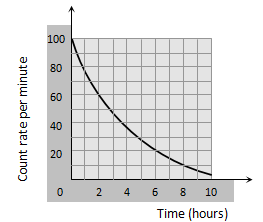
The count rate of 10g of radioactive material was measured at different times and this has been shown in the figure. The half life of material and the total counts (approximately) in the first half life period, respectively are
MCQ 521 Mark
For a substance the average life for a-emission is 1620 years and for b emission is 405 years. After how much time the 1/4 of the material remains after a and b emission
MCQ 531 Mark
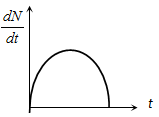
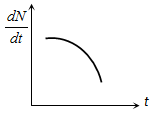
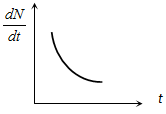
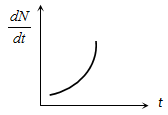
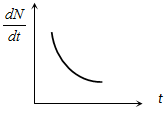
Radioactive element decays to form a stable nuclide, then the rate of decay of reactant $\left(\frac{\mathrm{dN}}{\mathrm{dt}}\right)$ will vary with time (t) as shown in figure
Answer(c)
View full question & answer→MCQ 541 Mark
The half life period of a radioactive element X is same as the mean life time of another radioactive element Y. Initially both of them have the same number of atoms. Then
- A
X and Y have the same decay rate initially
- B
X and Y decay at the same rate always
- ✓
Y will decay at a faster rate than X
- D
X will decay at a faster rate than Y
AnswerCorrect option: C. Y will decay at a faster rate than X
(c) Y will decay at a faster rate than X
View full question & answer→MCQ 551 Mark
A freshly prepared radioactive sample of half- life 1 hour emits radiations that are 128 times as intense as the permissible safe limit. The minimum time after which this sample can be safely used is
MCQ 561 Mark
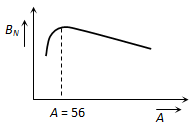
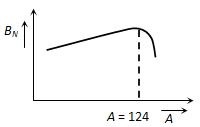
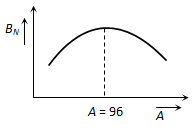
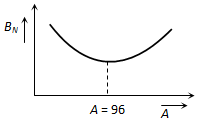
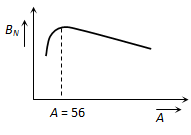
The dependence of binding energy per nucleon, $\mathrm{B}_{\mathrm{N}}$ on the mass number, A, is represented by
Answer(a)
View full question & answer→MCQ 571 Mark
A radioactive material decays by simultaneous emission of two particles with respective half lives 1620 and 810 years. The time (in years) after which one- fourth of the material remains is
MCQ 581 Mark
From a newly formed radioactive substance (Half life 2 hours), the intensity of radiation is 64 times the permissible safe level. The minimum time after which work can be done safely from this source is
MCQ 591 Mark
α - particles of energy 400 KeV are bombarded on nucleus of $82^{\mathrm{Pb}}$. In scattering of α - particles, its minimum distance from nucleus will be
View full question & answer→MCQ 601 Mark
Consider an electron $\left(\mathrm{m}=9.1 \times 10^{-31} \mathrm{~kg}\right)$ confined by electrical forces to move between two rigid walls separated by $1.0 \times 10^{-9}$ metre, which is about five atomic diameters. The quantised energy value for the lowest stationary state is
- A
$12 \times 10^{-20}$ Joule
- ✓
$6.0 \times 10^{-20}$ Joule
- C
$6.0 \times 10^{-18}$ Joule
- D
AnswerCorrect option: B. $6.0 \times 10^{-20}$ Joule
(b) $6.0 \times 10^{-20}$ Joule
View full question & answer→MCQ 611 Mark
The half life of radioactive Radon is 3.8 days. The time at the end of which 1/20 th of the Radon sample will remain undecayed is (Given $\log _{10} e=0.4343$)
View full question & answer→MCQ 621 Mark
A nucleus with mass number 220 initially at rest emits an a-particle. If the Q value of the reaction is 5.5 MeV, calculate the kinetic energy of the a-particle
MCQ 631 Mark
The rest mass of an electron as well as that of positron is 0.51 MeV. When an electron and positron are annihilate, they produce gamma-rays of wavelength(s)
MCQ 641 Mark
For uranium nucleus how does its mass vary with volume
- ✓
$m \propto V$
- B
$m \propto 1 / V$
- C
$m \propto \sqrt{V}$
- D
$m \propto V^2$
AnswerCorrect option: A. $m \propto V$
$m \propto V$
View full question & answer→MCQ 651 Mark
A heavy nucleus at rest breaks into two fragments which fly off with velocities in the ratio 8 : 1. The ratio of radii of the fragments is
MCQ 661 Mark
The rest energy of an electron is 0.511 MeV. The electron is accelerated from rest to a velocity 0.5 c. The change in its energy will be
MCQ 671 Mark
The binding energy per nucleon of $0^{16}$ is 7.97 MeV and that of $O ^{17}$ is 7.75 MeV . The energy (in MeV ) required to remove a neutron from $O ^{17}$ is
- A
$3.52$
- B
$3.64 $
- ✓
$4.23$
- D
$7.86$
AnswerCorrect option: C. $4.23$
$4.23$
View full question & answer→MCQ 681 Mark
The sun radiates energy in all directions. The average radiations received on the earth surface from the sun is 1.4 kilowatt $/ \mathrm{m}^2$.The average earth- sun distance is $1.5 \times 10^{11}$ metres. The mass lost by the sun per day is (1 day = 86400 seconds)
- A
$4.4\times 10^9 \mathrm{~kg}$
- B
$7.6 \times 10^{14} \mathrm{~kg}$
- C
$3.8 \times 10^{12}\mathrm{~kg}$
- ✓
$3.8 \times 10^{14}\mathrm{~kg}$
AnswerCorrect option: D. $3.8 \times 10^{14}\mathrm{~kg}$
(d) $3.8 \times 10^{14}\mathrm{~kg}$
View full question & answer→MCQ 691 Mark
If the atom $100^{ Fm ^{257}}$ follows the Bohr model and the radius of $100^{ Fm ^{257}}$ is n times the Bohr radius, then find n
- A
$100$
- B
$200$
- C
$4$
- ✓
$\frac{1}{4}$
AnswerCorrect option: D. $\frac{1}{4}$
$\frac{1}{4}$
View full question & answer→MCQ 701 Mark
The wavelengths involved in the spectrum of deuterium $\left(\frac{2}{1}\right) D$ are slightly different from that of hydrogen spectrum, because
- A
The attraction between the electr on and the nucleus is different in the two cases
- B
The size of the two nuclei are different
- C
The nuclear forces are different in the two cases
- ✓
The masses of the two nuclei are different
AnswerCorrect option: D. The masses of the two nuclei are different
The masses of the two nuclei are different
View full question & answer→MCQ 711 Mark
Which of the following atoms has the lowest ionization potential
- A
$_8^{16}O$
- B
$_7^{14} {~N}$
- ✓
$_{55}^{133}{Cs}$
- D
$_{18}^{40}{Ar}$
AnswerCorrect option: C. $_{55}^{133}{Cs}$
(c) $_{55}^{133}{Cs}$
View full question & answer→MCQ 721 Mark
In the Bohr model of the hydrogen atom, let R, v and E represent the radius of the orbit, the speed of electron and the total energy of the electron respectively. Which of the following quantity is proportional to the quantum number n
MCQ 731 Mark
An electron passing through a potential difference of 4.9 V collides with a mercury atom and transfers it to the first excited state. What is the wavelength of a photon corresponding to the transition of the mercury atom to its normal state
MCQ 741 Mark
The transition from the state n = 4 to n = 3 in a hydrogen-like atom results in ultraviolet radiation. Infrared radiation will be obtained in the transition
MCQ 751 Mark
Imagine an atom made up of a proton and a hypothetical particle of double the mass of the electron but having the same charge as the electron. Apply the Boh’r atom model and consider all possible transitions of this hypothetical particle to the first excited level. The longest wavelength photon that will be emitted has wavelength l (given in terms of the Rydberg constant R for the hydrogen atom) equal to
MCQ 761 Mark
A neutron with velocity V strikes a stationary deuterium atom, its kinetic energy changes by a factor of
- A
$\frac{15}{16}$
- B
$\frac{1}{2}$
- C
$\frac{2}{1}$
- ✓
View full question & answer→MCQ 771 Mark
The ionisation potential of H-atom is 13.6 V. When it is excited from ground state by monochromatic radiations of $970.6 \mathring A$ the number of emission lines will be (according to Bohr’s theory)
View full question & answer→MCQ 781 Mark
A double charged lithium atom is equivalent to hydrogen whose atomic number is 3. The wavelength of required radiation for emitting electron from first to third Bohr orbit in $Li^{++}$ will be (Ionisation energy of hydrogen atom is 13.6eV)
- A
$182.51 \mathring A$
- B
$177.17 \mathring A$
- C
$142.25 \mathring A$
- ✓
$113.74 \mathring A$
AnswerCorrect option: D. $113.74 \mathring A$
$113.74 \mathring A$
View full question & answer→MCQ 791 Mark
If in Rutherford’s experiment, the number of particles scattered at 90° angle are 28 per min, then number of scattered particles at an angle 60° and 120° will be
MCQ 801 Mark
What is the radius of iodine atom (at. no. 53, mass number 126)
- ✓
$2.5 \times 10^{-11} m$
- B
$2.5 \times 10^{-9} m$
- C
$7 \times 10^{-9} m$
- D
$7 \times 10^{-6} m$
AnswerCorrect option: A. $2.5 \times 10^{-11} m$
(a) $2.5 \times 10^{-11} m$
View full question & answer→MCQ 811 Mark
In a hypothetical Bohr hydrogen, the mass of the electron is doubled. The energy $E_0$ and the radius $r_0$ of the first orbit will be ($a_0$ is the Bohr radius)
- ✓
${E}_0=-27.2 {eV} ; {r}_0={a}_0 / 2$
- B
$E_0=-27.2{eV} ; r_0=a_0$
- C
$E_0=-13.6 {eV} ; r_0=a_0 / 2$
- D
${E}_0=-13.6{eV} ; {r}_0={a}_0$
AnswerCorrect option: A. ${E}_0=-27.2 {eV} ; {r}_0={a}_0 / 2$
(a) ${E}_0=-27.2 {eV} ; {r}_0={a}_0 / 2$
View full question & answer→MCQ 821 Mark
A radioactive material has a half-life of 8 years. The activity of the material will decrease to about 1/8 of its original value in
MCQ 831 Mark
The number of revolutions per second made by an electron in the first Bohr orbit of hydrogen atom is of the order of 3
- A
$10^{20}$
- B
$10^{19}$
- C
$10^{17}$
- ✓
$10^{15}$
AnswerCorrect option: D. $10^{15}$
(d) $10^{15}$
View full question & answer→MCQ 841 Mark
Hydrogen (H), deuterium (D), singly ionized helium ($He^+$) and doubly ionized lithium (Li) all have one electron around the nucleus. Consider n =2 to n = 1 transition. The wavelengths of emitted radiations are $\lambda 1,\lambda 2, \lambda 3$ and $\lambda 4$ respectively. Then approximately
- ✓
$\lambda_1=\lambda_2=4 \lambda_3=9 \lambda_4$
- B
${ }_4 \lambda_1=2 \lambda_2=2 \lambda_3=\lambda_4$
- C
$\lambda_1=2 \lambda_2=2 \sqrt{2} \lambda_3=3 \sqrt{2} \lambda_4$
- D
$\lambda_1=\lambda_2=2 \lambda_3=3 \sqrt{2} \lambda_4$
AnswerCorrect option: A. $\lambda_1=\lambda_2=4 \lambda_3=9 \lambda_4$
(a) $\lambda_1=\lambda_2=4 \lambda_3=9 \lambda_4$
View full question & answer→MCQ 851 Mark
A hydrogen atom in its ground state absorbs 10.2 eV of energy. The orbital angular momentum is increased by (Given Planck constant $h=6.6 \times 10^{-34} \mathrm{~J}-\mathrm{sec}$)
- ✓
$1.05 \times 10^{-34} \mathrm{~J}-\mathrm{sec}$
- B
$3.16 \times 10^{-34} \mathrm{~J}-\mathrm{sec}$
- C
$2.11 \times 10^{-34} \mathrm{~J}-\mathrm{sec}$
- D
$4.22 \times 10^{-34} \mathrm{~J}-\mathrm{sec}$
AnswerCorrect option: A. $1.05 \times 10^{-34} \mathrm{~J}-\mathrm{sec}$
(a) $1.05 \times 10^{-34} \mathrm{~J}-\mathrm{sec}$
View full question & answer→MCQ 861 Mark
A hydrogen atom in its ground state absorbs 10.2 eV of energy. The orbital angular momentum is increased by
- ✓
$1.05 \times 10^{-34} \mathrm{~J}-\mathrm{sec}$
- B
$3.16 \times 10^{-34} \mathrm{~J}-\mathrm{sec}$
- C
$2.11 \times 10^{-34} \mathrm{~J}-\mathrm{sec}$
- D
$4.22 \times 10^{-34} \mathrm{~J}-\mathrm{sec}$
AnswerCorrect option: A. $1.05 \times 10^{-34} \mathrm{~J}-\mathrm{sec}$
(a) $1.05 \times 10^{-34} \mathrm{~J}-\mathrm{sec}$
View full question & answer→MCQ 871 Mark
An energy of 24.6 eV is required to remove one of the electrons from a neutral helium atom. The energy (in eV) required to remove both the electrons from a neutral helium atom is
MCQ 881 Mark
A sodium atom is in one of the states labeled 'Lowest excited levels'. It remains in that state for an average time of $10^{-8} \mathrm{sec}$, before it makes a transition back to a ground state. What is the uncertainty in energy of that excited state
- ✓
$ 6.56 \times 10^{-8} \mathrm{eV} $
- B
$ 2 \times 10^{-8} \mathrm{eV} $
- C
$ 10^{-8} \mathrm{eV} $
- D
$ 8 \times 10^{-8} \mathrm{eV}$
AnswerCorrect option: A. $ 6.56 \times 10^{-8} \mathrm{eV} $
$ 6.56 \times 10^{-8} \mathrm{eV} $
View full question & answer→MCQ 891 Mark
In hydrogen atom, electron makes transition from n=4 to n=1 level. Recoil momentum of the H atom will be
- A
$3.4 \times 10^{-27} \mathrm{~N}-\mathrm{sec}$
- ✓
$6.8 \times 10^{-27} \mathrm{~N}-\mathrm{sec}$
- C
$3.4 \times 10^{-24} \mathrm{~N}-\mathrm{sec}$
- D
$6.8 \times 10^{-24} \mathrm{~N}-\mathrm{sec}$
AnswerCorrect option: B. $6.8 \times 10^{-27} \mathrm{~N}-\mathrm{sec}$
(b) $6.8 \times 10^{-27} \mathrm{~N}-\mathrm{sec}$
View full question & answer→MCQ 901 Mark
The ratio of the speed of the electrons in the ground state of hydrogen to the speed of light in vacuum is
MCQ 911 Mark
An a-particle of 5 MeV energy strikes with a nucleus of uranium at stationary at an scattering angle of $180^{\circ}$. The nearest distance upto which a-particle reaches the nucleus will be of the order of
- A
- B
$10^{-10} \mathrm{~cm}$
- ✓
$10^{-12} \mathrm{~cm}$
- D
$10^{-15} \mathrm{~cm}$
AnswerCorrect option: C. $10^{-12} \mathrm{~cm}$
(c) $10^{-12} \mathrm{~cm}$
View full question & answer→MCQ 921 Mark
In a sample of radioactive material, what fraction of the initial number of active nuclei will remain undisintegrated after half of a half-life of the sample
- A
$\frac{1}{4}$
- B
$\frac{1}{2 \sqrt{2}}$
- ✓
$\frac{1}{\sqrt{2}}$
- D
$2\sqrt{2}$
AnswerCorrect option: C. $\frac{1}{\sqrt{2}}$
(c)$\frac{1}{\sqrt{2}}$
View full question & answer→MCQ 931 Mark
In a radioactive reaction $92^{ X ^{232}} \rightarrow 82^{ Y ^{204}}$ , the number of α - particles emitted is
View full question & answer→MCQ 941 Mark
If half life of radium is 77 days. Its decay constant in day will be
AnswerCorrect option: B. $9 \times 10^{-3} /$ day
(b) $9 \times 10^{-3} /$ day
View full question & answer→MCQ 951 Mark
The phenomenon of radioactivity is
- A
Exothermic change which increases or decreases with temperature
- B
Increases on applied pressure
- ✓
Nuclear process does not depend on external factors
- D
AnswerCorrect option: C. Nuclear process does not depend on external factors
(c) Nuclear process does not depend on external factors
View full question & answer→MCQ 961 Mark
$86^{\mathrm{A}^{222}} \rightarrow 84^{\mathrm{B}^{210}}$ In this reaction how many α and β particles are emitted
View full question & answer→MCQ 971 Mark
Mean life of a radioactive sample is $100$ seconds. Then its half life $($in minutes$)$ is
- A
$ 0.693$
- B
$1$
- C
$10^{-4}$
- ✓
$1.155$
AnswerCorrect option: D. $1.155$
$1.155$
View full question & answer→MCQ 981 Mark
$C^{14}$ has half life 5700 years. At the end of 11400 years, the actual amount left is
- A
- ✓
- C
- D
0.0625 of original amount
Answer(b) 0.25 of original amount
View full question & answer→MCQ 991 Mark
Nuclear fusion is common to the pair
- A
Thermonuclear reactor, uranium based nuclear reactor
- B
Energy production in sun, uranium based nuclear reactor
- ✓
Energy production in sun, hydrogen bomb
- D
Disintegration of heavy nuclei, hydrogen bomb
AnswerCorrect option: C. Energy production in sun, hydrogen bomb
(c) Energy production in sun, hydrogen bomb
View full question & answer→MCQ 1001 Mark
The particle that possesses half integral spin as