Questions · Page 2 of 2

1 Marks Question

Question 511 Mark
What happens to the power dissipation if the value of electric current passing through a conductor of constant resistance is doubled?
Answer
$\text{Power P}=\text{I}^2\text{Rt}\propto\text{I}^2$
Clearly if current is doubled, the power dissipated becomes 4 times.
View full question & answer
Question 521 Mark
In a TV tube, electrons are accelerated from the rear to the front. What is the direction of the current?
Answer
Direction of current is in opposite direction of electron moving thus the current is from front to rear.
View full question & answer
Question 531 Mark
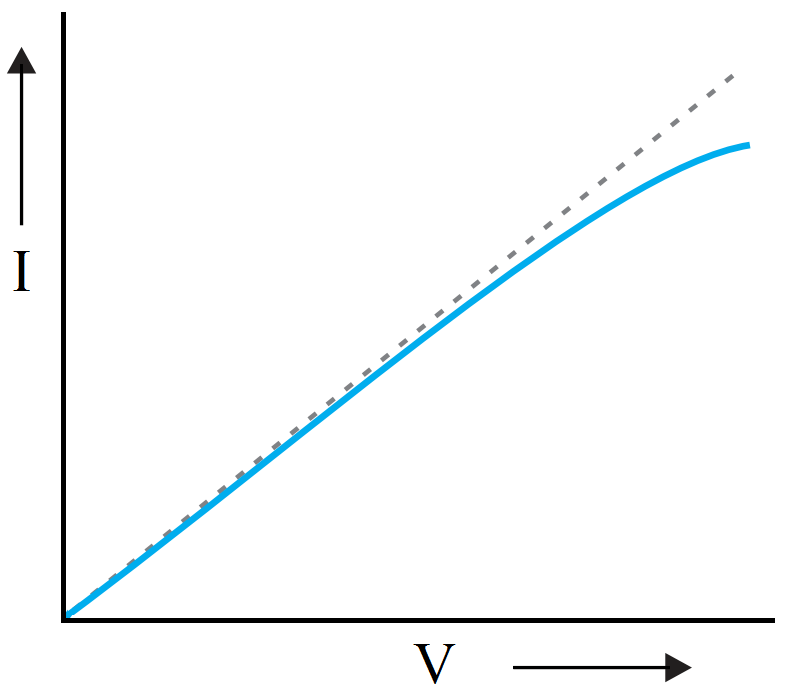
The I-V characteristics of a resistor are observed to deviate from a straight line for higher values of current as shown in the adjoining figure why?
Answer
At higher value of current, sufficient heat is produced which raises the temperature of resistor and so causes increase in resistance.
View full question & answer
Question 541 Mark
Is it possible that the terminal potential difference across the cell be zero? If yes, state the condition.
Answer
Yes, terminal potential difference V = IR. If external resistance R = 0, V = 0; i.e. terminal potential difference is zero, when cell is short circuited.
View full question & answer
Question 551 Mark
A steady current is flowing in a cylindrical conductor. Does electric field exist within the conductor?
Answer
Yes, electric field exists within the conductor because it is the electric field which imparts acceleration to electrons for the flow of current.
View full question & answer
Question 561 Mark
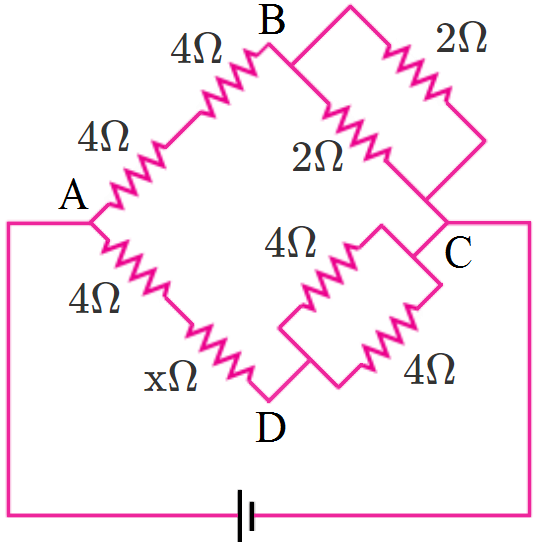
The given circuit represents a balanced Wheatstone’s bridge. Calculate the value of resistance x.
Answer
In the balanced condition,
$\frac{\text{P}}{\text{Q}}=\frac{\text{R}}{\text{S}}$
$\therefore\frac{4+4}{1}=\frac{4\text{+}\text{x}}{2}$
$\Rightarrow\text{x}=12\Omega$
View full question & answer
Question 571 Mark
The resistance of the platinum wire of a platinum resistance thermometer at the ice point is $5 \Omega$ and at steam point is $5.23 \Omega$. When the thermometer is inserted in a hot bath, the resistance of the platinum wire is $5.795 \Omega$. Calculate the temperature of the bath.
Answer
$R_0=5 \Omega, R_{100}=5.23 \Omega$ and $R_t=5.795 \Omega$
Now,
$t=\frac{R_t-R_0}{R_{100}-R_0} \times 100, R_t=R_0(1+\alpha t)$
$=\frac{5.795-5}{5.23-5} \times 100$
$=\frac{0.795}{0.23} \times 100$
$=345.65^{\circ} C$
View full question & answer