Questions · Page 2 of 2

2 Marks Questions

Question 512 Marks
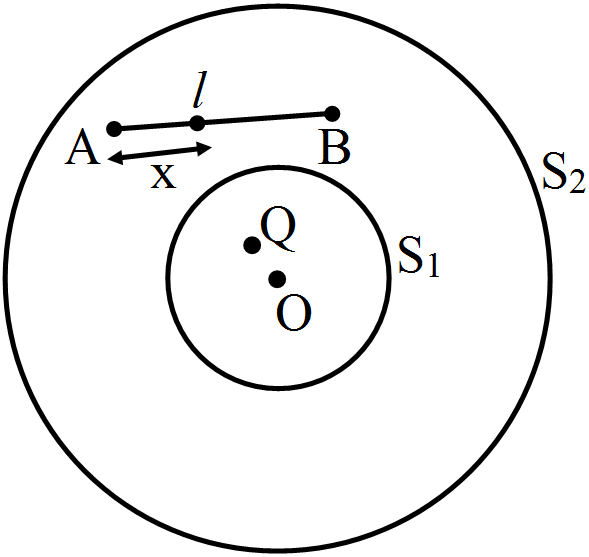
In the figure shown, calculate the total flux of the electrostatic field through the spheres $S_1$ and $S_2$. The wire AB shown here has a linear charge density $\lambda$ given by $\lambda=\text{kx}$ where x is distance measured along the wire, from the end A.
Answer
Total charge on wire AB$\text{Q}_\text{AB}=\int\limits^\text{l}_{0}\lambda\text{dx}=\int\limits^\text{l}_{0}\text{kx dx}=\text{k}\Big[\frac{\text{x}^2}{2}\Big]^\text{l}_0=\frac{1}{2}\text{kl}^2$
By Gauss theorem, Total flux through $\text{S}_1=\frac{\text{Q}}{\in_0}$ Total flux through $\text{S}_2=\frac{\text{Q}+\text{Q}_\text{AB}}{\in_0}=\bigg(\frac{\text{Q}+\frac{1}{2}\text{kl}^2}{\in_0}\bigg)$
View full question & answer
Question 522 Marks
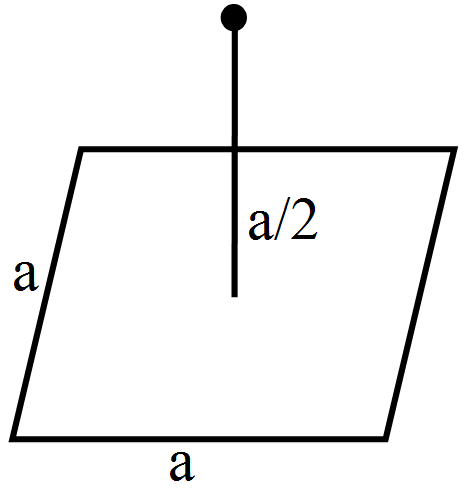
A charge Q is placed at a distance $\frac{\text{a}}{2}$ above the centre of a horizontal, square surface of edge a as shown in figure. Find the flux of the electric field through the square surface.
Answer
Given: Edge length of the square surface = a Distance of the charge Q from the square surface $=\frac{\text{a}}2{}$ Area of the plane $= a^2$ Assume that the given surface is one of the faces of the imaginary cube. Then, the charge is found to be at the centre of the cube. A charge is placed at a distance of about $a^2a^2$ from the centre of the surface.
The electric field due to this charge is passing through the six surfaces of the cube. Hence flux through each surface,$\phi=\frac{\text{Q}}{\in_0}\times\frac{1}{6}=\frac{\text{Q}}{6\in_0}$
Thus, the flux through the given surface is $\frac{\text{Q}}{6\in_0}.$
View full question & answer
Question 532 Marks
Consider a gold nucleus to be a sphere of radius 6.9 fermi in which protons and neutrons are distributed. Find the force of repulsion between two protons situated at largest separation. Why do these protons not fly apart under this repulsion?
Answer

Let two protons be at a distance be 13.8 femi,
$\text{F}=\frac{1}{4\pi\in_0}\frac{\text{q}_1\text{q}_2}{\text{r}^2}$
$\text{F}=\frac{9\times10^9\times1.6\times10^{-38}}{(14.8)^2\times10^{-30}}$
$\text{F}=1.2\text{N}$
View full question & answer
Question 542 Marks
It is said that the separation between the two charges forming an electric dipole should be small. Small compared to what?
Answer
The separation between the two charges forming an electric dipole should be small compared to the distance of a point from the centre of the dipole at which the influence of the dipole field is observed.
View full question & answer
Question 552 Marks
  1. Explain the meaning of the statement ‘electric charge of a body is quantised’.
  2. Why can one ignore quantisation of electric charge when dealing with macroscopic i.e., large scale charges?
Answer
  1. Electric charge of a body is quantized. This means that only integral (1, 2, …., n) number of electrons can be transferred from one body to the other. Charges are not transferred in fraction. Hence, a body possesses total charge only in integral multiples of electric charge.
  2. In macroscopic or large scale charges, the charges used are huge as compared to the magnitude of electric charge. Hence, quantization of electric charge is of no use on macroscopic scale. Therefore, it is ignored and it is considered that electric charge is continuous.
View full question & answer
Question 562 Marks
In 1959 Lyttleton and Bondi suggested that the expansion of the Universe could be explained if matter carried a net charge. Suppose that the Universe is made up of hydrogen atoms with a number density N, which is maintained a constant. Let the charge on the proton be: $e_p= -(1 + y)e$ where e is the electronic charge.
Show that the velocity of expansion is proportional to the distance from the centre.
Answer
Net force experience bt the hydrogen atom is given by$\text{F}=\text{F}_\text{C}-\text{F}_\text{G}=\frac{1}{3}\frac{\text{Ny}^2\text{e}^2\text{R}}{\in_0}-\frac{4\pi}{3}\text{Gm}_\text{p}^2\text{NR}$
Because of this net force, the hydrogen atom experiences an acceleration such that$\text{m}_\text{p}\frac{\text{d}^2\text{R}}{\text{dt}^2}=\text{F}=\frac{1}{3}\frac{\text{Ny}^2\text{e}^2\text{R}}{\in_0}-\frac{4\pi}{3}\text{Gm}_\text{p}^2\text{NR}$
$=\Big(\frac{1}{3}\frac{\text{Ny}^2\text{e}^2}{\in_0}-\frac{4\pi}{3}\text{Gm}_\text{p}^2\text{N}\Big)\text{R}$
$\therefore\ \frac{\text{d}^2\text{R}}{\text{dt}^2}=\frac{1}{\text{m}_\text{p}}\bigg[\frac{1}{3}\frac{\text{Ny}^2\text{e}^2}{\in_0}-\frac{4\pi}{3}\text{Gm}_\text{p}^2\text{N}\bigg]$
$\Rightarrow\ \frac{\text{d}^2\text{R}}{\text{dt}^2}=\alpha^2\text{R}\ .....(\text{iv})$
where, $\alpha^2=\frac{1}{\text{m}_\text{p}}\bigg[\frac{1}{3}\frac{\text{NY}^2\text{e}^2}{\in_0}-\frac{4\pi}{3}\text{Gm}_\text{p}^2\text{N}\bigg]$ The solution of Eq. (iv) is given by $\text{R}=\text{Ae}^{\alpha\text{t}}+\text{Be}^{-\alpha\text{t}}$. We are looking for expansion, here, so B = 0 and $\text{R}=\text{Ae}^{\alpha\text{t}}$. ⇒ velocity of expansion,$\text{v}=\frac{\text{dR}}{\text{dt}}=\text{Ae}^{\alpha\text{t}}(\alpha)=\alpha\text{Ae}^{\alpha\text{t}}=\alpha\text{R}$
Hence, $\text{v}\propto\text{R}$, i.e., velocity of expansion is proportional to the distance from the centre.
View full question & answer
Question 572 Marks
How much positive and negative charge is there in a cup of water?
Answer
Let us assume that the mass of one cup of water is $250 g$. The molecular mass of water is $18 g$. Thus, one mole $\left(=6.02 \times 10^{23}\right.$ molecules) of water is $18 g$. Therefore the number of molecules in one cup of water is $(250 / 18) \times 6.02 \times 10^{23}$.
Each molecule of water contains two hydrogen atoms and one oxygen atom, i.e., 10 electrons and 10 protons. Hence the total positive and total negative charge has the same magnitude. It is equal to $(250 / 18) \times 6.02 \times 10^{23} \times 10 \times 1.6 \times 10^{-19} C =1.34 \times 10^7 C$
View full question & answer
2 Marks Questions - Page 2 - Physics STD 12 Science Questions - Vidyadip