MCQ 1011 Mark
According to the electromagnetic wave theory, light consists of electric and magnetic fields which are $.........$
AnswerLight consists of electric and magnetic field that are perpendicular $90^\circ $ to each other.
$\text{APPOACH}$ by example
Electric field inside plates. The magnetic field this given rise to via the displacement current is along the perimeter of the circle parallel to capauatates plates.
So $B$ and $E$ are perpendicular in this case.
View full question & answer→MCQ 1021 Mark
The angular frequency of emf wave will be (in $\frac{\text{rad}}{\text{s}}$)
- ✓
$8_p \times 107$
- B
$4_p \times 106$
- C
$2 p \times 105$
- D
$\pi \times 104$
AnswerCorrect option: A. $8_p \times 107$
a. $8_p \times 107$
Explanation:
Frequency of wave $f =40 \times 106 Hz$
Angular frequency, $\omega=2\pi\text{v}$
$\omega=2\pi\times40\times10^6$
$\Rightarrow\omega=8\pi\times10^7\frac{\text{rad}}{\text{s}}$
View full question & answer→MCQ 1031 Mark
An electromagnetic wave is propagating along $Y-$axis. Then.
- A
oscillating electric field is along $X-$axis and oscillating magnetic field is along $Y-$axis
- ✓
oscillating electric field is along $Z-$axis and oscillating magnetic field is along $X-$axis
- C
both oscillating electric and magnetic fields are along $Y-$axis, but phase difference between them is $90^{\circ}$
- D
both oscillating electric and magnetic fields are mutually perpendicular in arbitrary direction
AnswerCorrect option: B. oscillating electric field is along $Z-$axis and oscillating magnetic field is along $X-$axis
electromagnetic radiation consists of electromagnetic waves, which are synchronized oscillations of electric and magnetic fields that propagate at the speed of light through a vaccum. The oscillations of the two fields are perpendicular to each other and perpendicular to the direction of energy and wave propagation, forming a transverse wave. so if propogation is along $Y-$direction ,Electric field will be along $X$ or $Z$, if it is along $Z -$direction than Magnetic field has to be in $X -$direction.
View full question & answer→MCQ 1041 Mark
The electric field intensity produced by the radiations coming from $100W$ bulb at a $3 m$ distance is $E$. The electric field intensity produced by the radiations coming from $50W$ bulb at the same distance is:
AnswerCorrect option: D. $\sqrt{2}\text{E}.$
We know the electric field intensity on a surface due to incident rediation is,
$\text{I}_\text{av}\propto\text{E}_0^2$
$\frac{\text{P}_\text{av}}{\text{A}}\propto\text{E}_0^2$
Here $\text{P}_\text{av}\propto\text{E}_0^2$ [$\because A$ is same in both cases$]$
We know that, $\text{E}_0\propto\sqrt{\text{P}_\text{av}}$
$\therefore\ \frac{(\text{E}_0)_1}{(\text{E}_0)_1}=\sqrt{\frac{(\text{P}_\text{av})_1}{(\text{P}_\text{av})_2}}\ .....(\text{i})$
$\Rightarrow\ \frac{\text{E}}{(\text{E}_0)_2}=\sqrt{\frac{1000}{5}}$
$(\text{E}_0)_2=\frac{\text{E}}{\sqrt{2}}$
Nowa according to question, $P' = 50W, P = 100W$
$\therefore$ Putting these value in Eq. $(i),$ we get
$\frac{\text{E}'}{\text{E}}=\frac{50}{100}\Rightarrow\ \frac{\text{E}'}{\text{E}}=\frac{1}{2}\Rightarrow\ \text{E}'=\frac{\text{E}}{2}$
View full question & answer→MCQ 1051 Mark
Which among the following is an application of microwaves?
AnswerMicrowave ovens are an application of microwaves. In microwave ovens, the frequency of microwave produced is matched with the natural frequency of water molecules so that resonance occurs and water molecules in the material vibrate at the higher amplitude and transfer energy to nearby food molecules, results in heating the food.
View full question & answer→MCQ 1061 Mark
For television broadcasting the frequency employed is normally:
- ✓
$30-300 \ MHz$
- B
$30-300 \ GHz$
- C
$30-300 \ kHz$
- D
$30-300 \ Hz$
AnswerCorrect option: A. $30-300 \ MHz$
View full question & answer→MCQ 1071 Mark
The part of the spectrum of the electromagnetic radiation used to cook food is then:
AnswerMicrowaves are used to cook food. Microwave oven is a domestic application of these waves.
View full question & answer→MCQ 1081 Mark
Generation, propagation and detection of electromagnetic waves is the basis of:
AnswerThe communication and broadcasting following the base on generation, propagation, and detection of electromagnetic waves.
The electromagnetic spectrum describes a different range of electromagnetic waves. These $\text{EM}$ waves are a special type of wave that can travel without a medium.
Electromagnetic waves are named like this due to the fact that they have both an electric and a magnetic component. In a vacuum, $\text{EM}$ waves always travel at the same speed i.e. the speed of light. So, other $\text{EM}$ waves besides light are infrared, ultraviolet, radio waves, and microwaves.
Therefore radio and television both are based on $\text{EM}$ wave properties. Other options like lasers, reactors, and computers are not guided by $\text{EM}$ waves.
View full question & answer→MCQ 1091 Mark
If a source is transmitting electro$-$magnetic waves of frequency $8.196 \times 10^6 \ Hz$, then the wavelength of the electromagnetic waves transmitted from the source will be:
- A
$5090\ cm$
- B
$4050\ cm$
- C
$4230\ cm$
- ✓
$3660\ cm$
AnswerCorrect option: D. $3660\ cm$
Given, frequency of $EM$ waves
$v=8.196 \times 10^6 Hz$
velocity of EM waves $(v)=3 \times 10^8 m / s$
Wavelength of $EM$ waves $\lambda=\frac{ v }{ v }$
$=\frac{3 \times 10^8}{8.196 \times 10^6}$
$=36.60 m$
$=3660 \ cm$
View full question & answer→MCQ 1101 Mark
An electromagnetic wave propagating along north has its electric field vector upwards. Its magnetic field vector point towards.
AnswerElectric field and magnetic field vectors for an electromagnetic wave are cross $-$ field vectors.
So, the direction of an electromagnetic wave is given by the product of electric field vector and magnetic field vector.
According to the question, electric field vector is directed upwards and $\text{EM}$ wave is directed towards North. So, according to the right $-$ hand thumb rule, the magnetic field vector points towards the East.
View full question & answer→MCQ 1111 Mark
A metal block is exposed to beams of $X-$ray of different wavelength. $X-$rays of which wavelength penetrate most?
- ✓
$2\mathring{\text{A}}$
- B
$4\mathring{\text{A}}$
- C
$6\mathring{\text{A}}$
- D
$8\mathring{\text{A}}$
AnswerCorrect option: A. $2\mathring{\text{A}}$
Penetrating power is greater for lower wavelength.
View full question & answer→MCQ 1121 Mark
The frequency of electromagnetic wave in free space is $2 MHz.$ When it passes through a region of relative permittivity $\in_\text{r}=4.0,$ then its wave length $......... \&$ frequency $.........$
- A
Becomes double, becomes half
- B
Becomes double, remains constant
- C
Become half, become double
- ✓
Becomes half, remains constant
AnswerCorrect option: D. Becomes half, remains constant
View full question & answer→MCQ 1131 Mark
The propagation constant of a photon of wavelength $6284 A^{\circ}$.
- A
$6284$ meter $^{-1}$
- ✓
$105 cm^{-1}$
- C
$105$ meter $^{-1}$
- D
$10^7 cm^{-1}$
AnswerCorrect option: B. $105 cm^{-1}$
The propagation constant can be written as
$\text{K}=\frac{2pi}{\lambda}=\frac{60284}{6284\times10^{-8}}=10^5\text{cm}^{-1}$
View full question & answer→MCQ 1141 Mark
The oscillating electric and magnetic vectors of an electromagnetic wave are oriented along:
AnswerCorrect option: C. Mutually perpendicular directions and are in phase
$\overrightarrow{E}$ and $\overrightarrow{B}$ are mutually perpendicular to each other and are in phase i.e., they become zero and minimum at the same place and at the same time.
View full question & answer→MCQ 1151 Mark
When light propagates in vaccum there is an electric field and a magnetic field. Which of the following is not true about these field?
- ✓
They are constant in time
- B
They have zero average value
- C
They are perpendicular to the direction of propagation of light
- D
They are mutually perpendicular
AnswerCorrect option: A. They are constant in time
They vary with time following a wave function $($sinuosoidal$)$ and average value of these function is zero and also we can see in figure they are mutually perpendicular and also perpendicular to direction of propagation.
View full question & answer→MCQ 1161 Mark
A plane electromagnetic wave is incident on a material surface. The wave delivers momentum $p$ and energy $E.$
- A
$\text{p}=0,\text{ E}\neq0$
- B
$\text{p}\neq0,\text{ E}=0$
- ✓
$\text{p}\neq0,\text{ E}\neq0$
- D
$\text{p}=0,\text{ E}=0$
AnswerCorrect option: C. $\text{p}\neq0,\text{ E}\neq0$
When an electromagnetic wave strikes a material surface, it transports the momentum, as well as the energy, to the surface. The striking electromagnetic wave exerts pressure on the surface. The total energy transferred to the surface by the electromagnetic wave is given by $\text{E}=\text{pc}$ Therefore, $\text{p}\neq0,\text{ E}\neq0$
View full question & answer→MCQ 1171 Mark
In electromagnetic spectrum, the frequencies $\gamma-$rays, $X-$rays and ultraviolet rays are denoted by $n_1, n_2$ and $n_3$ respectively then:
- ✓
$n _1 > n _2 > n _3$
- B
$n_1 < n_2 < n_3$
- C
$n _1 > n _2 < n _3$
- D
$n _1 < n _2 > n _3$
AnswerCorrect option: A. $n _1 > n _2 > n _3$
From electromagnetic spectrum, frequencies of $\gamma-$rays is greater than frequency of $X-$rays. Frequency of Xrays is greater than frequency of ultraviolet rays.
View full question & answer→MCQ 1181 Mark
If the wavelength of electromagnetic radiation is doubled, what will happen to the energy of photons?
AnswerEnergy of a photon,
$\text{E} = \text{hv} = \frac {\text{hc}}{\lambda}.$
$\text{E}\propto\frac{1}{\lambda}.$
When the wavelength of electromagnetic radiation is doubled, the energy of the photons is halved.
View full question & answer→MCQ 1191 Mark
Consider the following two statements regarding a linearly polarised, plane electromagnetic wave:
- The electric field and the magnetic field have equal average values.
- The electric energy and the magnetic energy have equal average values.
- ✓
Both $A$ and $B$ are true.
- B
$A$ is false but $B$ is true.
- C
$B$ is false but $A$ is true
- D
Both $A$ and $B$ are false.
AnswerCorrect option: A. Both $A$ and $B$ are true.
For a linearly polarised, plane electromagnetic wave,
$E = E _0 \sin \omega\left( t -\frac{ x }{ c }\right)$
$B = B _0 \sin \omega\left( t -\frac{ x }{ c }\right)$
The average value of either $E$ or Bover a cycle is zero $($average of $\sin (\theta)$ over a cycle is zero$).$
Also the electric energy density $\left(U_E\right)$ and magnetic energy density $\left(U_B\right)$ are equal.
$u _{ E }=\frac{1}{2} \in_0 E ^2=\frac{ B ^2}{2 \mu_0}= u _{ B }$
Energy can be found out by integrating energy density over the entire volume of full space. As the energy of the electromagnetic wave is equally shared between electric and magnetic field so their average values will also be equal.
View full question & answer→MCQ 1201 Mark
Identify the electromagnetic wave which is also known as heatwaves.
AnswerInfrared waves are heat radiations also known as heatwaves. These waves are produced by hot bodies and molecules. They do heating because water molecules present in most of the materials readily absorb infrared waves and their thermal motion increases, so they heat themselves and also heat their surroundings.
View full question & answer→MCQ 1211 Mark
In electromagnetic wave, according to Maxwell, changing electric field gives.
- A
Stationary magnetic field
- B
- C
- ✓
AnswerBy Maxwell
$I _{ d }=\frac{ EdE }{ dt }$
$d E$ is electric field
$I_d$ is displacement current per unit area.
Hence changing electric field gives displacement current.
View full question & answer→MCQ 1221 Mark
The ratio of contributions made by the magnetic field and electric field components to the intensity of an $EM$ wave is:
- ✓
$1:1$
- B
$c:1$
- C
$c^2: 1$
- D
$\sqrt{\text{c}}:1$
AnswerThe ratio of contributions made by the magnetic field and electric field components to the intensity of an $EM$ wave is $1:1.$
View full question & answer→MCQ 1231 Mark
Which of the following has zero average value in a plane electromagnetic wave?
AnswerCorrect option: D. Both $(b)$ and $(©)$
The average of $\sin\theta$ and $\cos\theta$ for whole cycle is is zero.
Step $1:$ Analyzing the average value of Kinetic energy.
Kinetic Energy is always a positive quantity, therefore its average will also be a positive quantity.
Step $2:$ Finding the average of electric and the magnetic field.
The equations for the electric field and the magnetic field are given as
View full question & answer→MCQ 1241 Mark
The electric field intensity at a point in vacuum is equal to:
- A
- B
Force a proton would experience there.
- C
Force an electron would experience there.
- ✓
Force a unit positive charge would experience there.
AnswerCorrect option: D. Force a unit positive charge would experience there.
The electric field intensity at a point in a vacuum is equal to force experienced by a unit positive charge placed at that point.
View full question & answer→MCQ 1251 Mark
An electromagnetic wave travelling along $z-$axis is given as: $\text{E}=\text{E}_0\cos(\text{kz}-\omega\text{t})$. Choose the correct options from the following;
- ✓
The associated magnetic field is given as $\text{B}=\frac{1}{\text{c}}\text{k}\times\text{E}=\frac{1}{\omega}(\hat{\text{k}}\times\text{E})$.
- B
The electromagnetic field can be written in terms of the associated magnetic field as $\text{E}=\text{c}(\text{B}\times\hat{\text{k}})$.
- C
$\hat{\text{k}}.\text{E}=0,\hat{\text{k}}.\text{B}=0.$
- D
$\hat{\text{k}}\times\text{E}=0,\hat{\text{k}}\times\text{B}=0.$
AnswerCorrect option: A. The associated magnetic field is given as $\text{B}=\frac{1}{\text{c}}\text{k}\times\text{E}=\frac{1}{\omega}(\hat{\text{k}}\times\text{E})$.
- The associated magnetic field is given as $\text{B}=\frac{1}{\text{c}}\text{k}\times\text{E}=\frac{1}{\omega}(\hat{\text{k}}\times\text{E})$.
- The electromagnetic field can be written in terms of the associated magnetic field as $\text{E}=\text{c}(\text{B}\times\hat{\text{k}})$.
- $\hat{\text{k}}.\text{E}=0,\hat{\text{k}}.\text{B}=0.$
Solution:
- The direction of propagation of an eletromagnetic wave is always along the direction of vector product $\vec{\text{E}}\times\vec{\text{B}}$. Refer to Figure.
$\vec{\text{B}}=\text{B}\hat{\text{j}}=\text{B}(\hat{\text{k}}\times\hat{\text{i}})=\frac{\text{E}}{\text{C}}(\hat{\text{k}}\times\hat{\text{i}})$
$=\frac{1}{\text{c}}[\text{k}\times\text{E}\hat{\text{i}}]=\frac{1}{\text{c}}[\hat{\text{k}}\times\vec{\text{E}}]\bigg(\text{as}\frac{\text{E}}{\text{B}}=\text{c}\bigg)$
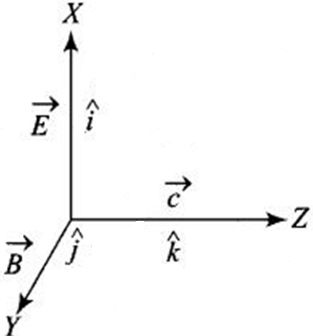
- $\vec{\text{E}}=\text{E}\hat{\text{i}}=\text{cB}(\hat{\text{j}}\times\hat{\text{k}})=\text{c}(\text{B}\hat{\text{j}}\times\text{k})=\text{c}(\vec{\text{B}}\times\hat{\text{k}})$
- $\hat{\text{k}}.\vec{\text{E}}=\hat{\text{k}}.(\text{E}\hat{\text{i}})=0,\vec{\text{k}}.\vec{\text{B}}=\vec{\text{k}}.(\text{B}\hat{\text{j}})=0$
- $\hat{\text{k}}\times\vec{\text{E}}=\hat{\text{k}}\times(\text{E}\hat{\text{i}})=\text{E}(\hat{\text{k}}\times\hat{\text{i}})=\text{E}\hat{\text{j}}$ and $\hat{\text{k}}\times\vec{\text{B}}=\hat{\text{k}}\times(\text{B}\hat{\text{j}})=\text{B}(\hat{\text{k}}\times\hat{\text{j}})=-\text{B}\hat{\text{i}}$.
View full question & answer→MCQ 1261 Mark
An electromagnetic wave going through vacuum is described by $\text{E}=\text{E}_0\sin(\text{kx}-\omega\text{t}),\text{ B}=\text{B}_0\sin(\text{kx}-\omega\text{t})$ Then:
- ✓
$\text{E}_0\text{k}=\text{B}_0\omega$
- B
$\text{E}_0\text{B}_0=\omega\text{k}$
- C
$\text{E}_0\omega=\text{B}_0\text{k}$
- D
AnswerCorrect option: A. $\text{E}_0\text{k}=\text{B}_0\omega$
The relation between $E _0$ and $B _0$ id given by $\frac{\text{E}_0}{\text{B}_0}=\text{c}\ ....(\text{i})$
Here, $c =$ Speed of the electromagnetic wave,
The relation between $\omega ($the angular frequency$)$ and $k\ ($wave number$),$
$\frac{\omega}{\text{k}}=\text{c}\ ...(\text{ii})$
Therefore, from $(i)$ and $(ii),$ we get
$\frac{\text{E}_0}{\text{B}_0}=\frac{\omega}{\text{k}}=\text{c}$
$\text{E}_0\text{k}=\text{B}_0\omega$
View full question & answer→MCQ 1271 Mark
An electromagnetic wave radiates outwards from a dipole antenna, with $E _0$ as the amplitude of its electric field vector. The electric field $B _0$ which transports significant energy from the source falls off as:
- A
$\frac{1}{\text{r}^3}$
- B
$\frac{1}{\text{r}^2}$
- ✓
$\frac{1}{\text{r}}$
- D
AnswerCorrect option: C. $\frac{1}{\text{r}}$
An antenna that produces the Electromagnetic wave are radiated outwards. The amplitude of electric field vector $(E _0)$. This electric field vector transports the energy from the source through the medium.
The electric field intensity of the wave from the source at a distance is inversely proportional to the distance between the source and the point.
$\text{E}_0=\frac{1}{\text{r}}$
View full question & answer→MCQ 1281 Mark
A charged particle oscillates about its mean equilibrium position with a frequency of $10^9\ Hz$. The frequency of electromagnetic waves produced by the oscillator is:
- A
$10^6\ Hz$
- B
$10^7\ Hz$
- C
$10^8\ Hz$
- ✓
$10^9\ Hz$
AnswerCorrect option: D. $10^9\ Hz$
The frequency of the electromagnetic wave is same as that of oscillating charged particle about its equilibrium position, which is $10^9\ Hz$
View full question & answer→MCQ 1291 Mark
According to Maxwell's hypothesis, changing of electric filed give rise to.
AnswerAccording to Maxwell's hypothesis, changing of electric field gives rise to Magnetic field.
We know that $F = qE$,, where $F$ is force and $E$ is electric field.
We can relate magnetic field and force by $F = qvB$, where $v$ is velocity and $B$ is the magnetic field.
Therefore we can obtain magnetic field by changing electric field.
View full question & answer→MCQ 1301 Mark
Two waves having same velocity enter electric and magnetic fields respectively. If $\lambda_1$ and $\lambda_2$ are their wavelengths as they move in the fields, then.
- A
$\lambda_1,\lambda_2$ are constants
- ✓
$\lambda_1$ and $\lambda_2$ are variable
- C
$\lambda_1$ is variable $\lambda_2$ is constant
- D
$\lambda_2$ is variable, $\lambda_1$ is constant
AnswerCorrect option: B. $\lambda_1$ and $\lambda_2$ are variable
Velocity of a wave is given by:
$\text{v}=\frac{\text{E}}{\text{B}}$
Hence wave velocity change in both the cases.
Frequency of the wave remains the same.
Using $\text{v}=\text{f}\lambda,$ it can be concluded that both $\lambda_1$ and $\lambda_2$ are variable.
View full question & answer→MCQ 1311 Mark
When an electromagnetic wave enters an ionised layer of earth’s atmosphere present in ionosphere:
AnswerCorrect option: D. The electron cloud will oscillate in the electric field of wave with a phase retardation of $90^\circ $ for a sinusoidal electromagnetic wave.
View full question & answer→MCQ 1321 Mark
According to Maxwell's hypothesis, a changing electric field gives rise to.
- A
- B
electric displacement current
- ✓
- D
View full question & answer→MCQ 1331 Mark
If the wavelength of red light in air is $7500 A$, then the frequency of light in air is.
- A
$7.5 \times 10^{10}\ Hz$
- B
$3 \times 10^{14}\ Hz$
- ✓
$4 \times 10^{14}\ Hz$
- D
$5 \times 10^{14}\ Hz$
AnswerCorrect option: C. $4 \times 10^{14}\ Hz$
Velocity of wave $=$ wavelength $\times $ frequency
$\text{v}=3\times10^8\frac{\text{m}}{\text{s}}$
$\lambda=7500\text{A}=7500\times10^{-10}\text{m}$
$\text{f}=\frac{3\times10^8}{7500\times10^{-10}}=4\times10^{14}\text{Hz}$
View full question & answer→MCQ 1341 Mark
An electromagnetic wave going through vacuum is described by $\text{E}=\text{E}_0\sin(\text{kx}- \omega\text{t});\text{B}=\text{B}_0\sin(\text{kx}- \omega\text{t}).$ Which of the following equation is true?
- ✓
$\text{E}_0\text{k}=\text{B}_0\omega$
- B
$\text{E}_0\omega=\text{B}_0\text{k}$
- C
$\text{E}_0\text{B}_0=\omega\text{k}$
- D
AnswerCorrect option: A. $\text{E}_0\text{k}=\text{B}_0\omega$
$\frac{\text{E}_0}{\text{B}_0}=\text{c},$ also $\frac{2\pi}{\lambda}$ and $\omega=2\pi\text{v}.$
$\Rightarrow\frac{\text{E}_0}{\text{B}_0}=\frac{\omega}{\text{k}}$
$\text{E}_0\text{k}=\text{B}_0\omega$
View full question & answer→MCQ 1351 Mark
$X−$ray falling on a material.
AnswerThe emitted $X-$rays transfer energy to the material on which it is falling.
View full question & answer→MCQ 1361 Mark
If $\overrightarrow{\text{E}}$ and $\overrightarrow{\text{B}}$ are the electric and magnetic field vectors of electromagnetic waves then the direction of propagation of electromagnetic wave is along the direction of:
- A
$\overrightarrow{\text{E}}$
- B
$\overrightarrow{\text{B}}$
- ✓
$\overrightarrow{\text{E}}\times\overrightarrow{\text{B}}$
- D
$\text{None of the above}$
AnswerCorrect option: C. $\overrightarrow{\text{E}}\times\overrightarrow{\text{B}}$
The direction of propagation of electromagnetic wave is perpendicular to the variation of electric field $\overrightarrow{\text{E}}$ as well as to the magnetic field $\overrightarrow{\text{B}}$
View full question & answer→MCQ 1371 Mark
Which of the following conclusion can be drawn from the result $\oint\overline{\text{B}}\cdot\text{d}\overline{\text{A}}=0$
- A
Magnetic field is zero everywhere
- ✓
Magnetic monopole cannot exist
- C
Magnetic lines of force do not intersect each other
- D
A current produces magnetic field
AnswerCorrect option: B. Magnetic monopole cannot exist
Flux of certain closed surface is zero and so it tells that net magnetic charge is equal to zero. This is possible when there are two equal and opposite poles.
View full question & answer→MCQ 1381 Mark
Beyond which frequency, the ionosphere bands any incident electromagnetic radiation but do not reflect it back towards the earth?
- A
$50MHz$
- ✓
$40MHz$
- C
$30MHz$
- D
$20MHz$
AnswerCorrect option: B. $40MHz$
The ionosphere can reflect electromagnetic waves of frequency less than $40MHz$ but not of frequency more than $40MHz.$
View full question & answer→MCQ 1391 Mark
The ratio of amplitude of a magnetic field to the amplitude of electric field for an electromagnetic wave propagating in vacuum is equal to:
- A
The speed of light in vacuum
- ✓
Reciprocal of speed of light in vacuum
- C
The ration of magnetic permeability to the electric susceptibility of vacuum.
- D
AnswerCorrect option: B. Reciprocal of speed of light in vacuum
Both electric field and magnetic field are vector quantities.
They both are components of electromagnetic waves.
We know that,
$\text{c}=\frac{\text{E}_0}{\text{B}_0}$
$\frac{\text{B}_0}{\text{E}_0}=\frac{1}{\text{c}}$
View full question & answer→MCQ 1401 Mark
Which is the frequency range of gamma rays from the following?
- A
$1 \times 10^{18}$ to $3 \times 10^{22} Hz$
- B
$3 \times 10^{-18} \text { to } 5 \times 10^{22} Hz$
- ✓
$3 \times 10^{18} \text { to } 5 \times 10^{22} Hz$
- D
$3 \times 10^{-18} \text { to } 5 \times 10^{-22} Hz$
AnswerCorrect option: C. $3 \times 10^{18} \text { to } 5 \times 10^{22} Hz$
The frequency range of Gamma rays is $3 \times 10^{18}$ to $5 \times 10^{22} Hz$. These rays have a wavelength of $6 \times 10^{-13}$ to $10^{-10} m$. Gamma rays are produced in nuclear reactions and are also emitted by radioactive nuclei.
View full question & answer→MCQ 1411 Mark
The absorption of radio waves by the atmosphere depends upon:
- ✓
- B
- C
Their distance from the transmitter
- D
View full question & answer→MCQ 1421 Mark
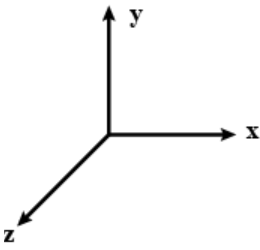
Light wave is travelling along $y -$ direction. If the corresponding $E$ vector at any time along the $x -$ axis, the direction of $B$ vector at that time is along.
- A
$y -$ axis
- B
$x -$ axis
- ✓
$z -$ axis
- D
$-z -$ axis
AnswerCorrect option: C. $z -$ axis
Light wave is an electromagnetic wave in which $E$ and $B$ are at right angles to each other as well as at right angles to the direction of wave propagation. So from the given information in the question, the direction of $B$ vector is in positive $z$ direction.
View full question & answer→MCQ 1431 Mark
Waves in decreasing order of their wavelength are:
- A
$X-$rays, infrared rays, visible rays, radio waves
- B
radio waves, visible rays, infrared rays, $X-$rays.
- ✓
radio waves, infrared rays, visible rays, $X-$rays.
- D
radio waves, ultraviolet rays, visible rays, $X-$rays.
AnswerCorrect option: C. radio waves, infrared rays, visible rays, $X-$rays.
View full question & answer→MCQ 1441 Mark
If a variable frequency ac source is connected to a capacitor then with decrease in frequency the displacement current will:
- A
- ✓
- C
- D
First decrease then increase
View full question & answer→MCQ 1451 Mark
Maxwell in his famous equations of electromagnetism introduced the concept of:
MCQ 1461 Mark
The displacement current flows in the dielectric of a capacitor when the potential difference across its plates.
- A
- B
has assumed a constant value
- ✓
- D
AnswerAccording to Maxwell's hypothesis, a displacement current will flow through a capacitor when the potential difference across its plates is varying. Thus a varying electric field will exist between the plates and this displacement current is same in magnitude to the current flowing in outer circuit. When a $D.C$ voltage applied across its plates, constant voltage appears across its plates and so there will be no displacement current flowing through the capacitor. Thus the displacement current will flow when the potential is increasing with time.
View full question & answer→MCQ 1471 Mark
On what basis is the classification of electromagnetic waves done?
AnswerThe classification of electromagnetic waves done according to the frequency called the electromagnetic spectrum. The basic difference various type of electromagnetic waves lies in their wavelength or frequency since all of them travel through vacuum at the same speed and also, the waves differ in their mode of interaction with matter.
View full question & answer→MCQ 1481 Mark
Wavelength of, monochromatic light is $5000 A^o$. It's wave number is:
AnswerCorrect option: C. $2 \times 106 m^{-1}$
Wave number $=\frac{1}{\text{wavelength}}$
$=\frac{1}{5000\times10^{-10}}$
$=2\times10^6\text{m}^{-1}$
View full question & answer→MCQ 1491 Mark
Ultraviolet spectrum can be studied by using a:
MCQ 1501 Mark
Which one of the following has the shortest wavelength?