Questions · Page 2 of 2

2 Marks Questions

Question 512 Marks
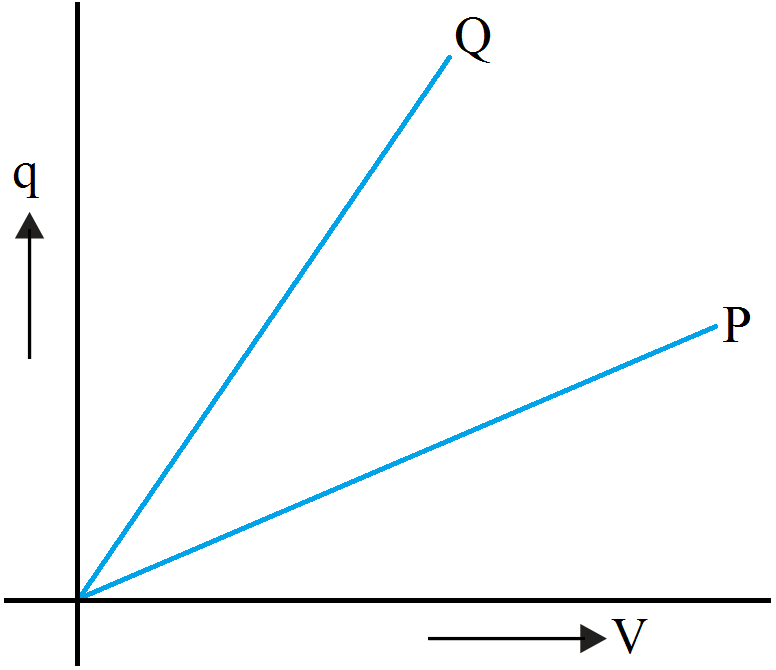
The given graph shows the variation of charge $q$ versus potential difference $V$ for two capacitors $C_1$ and $C_2$. The two capacitors have same plate separation but the plate area of $C_2$ is double than that of $C_1$. Which of the two graphs $P$ and $Q$ correspond to capacitors $C_1$ and $C_2$ and why?
Answer
$Q$ represents $C_2$ and $P$ represents $C_1$,
Reason: From the graph the slope $\frac{\mathrm{q}}{\mathrm{V}}$ Capacitance is greater for Q .
Also according to given conditions the capacitance $\frac{\varepsilon \mathrm{A}}{\mathrm{d}}$ is larger for the $\mathrm{C}_2$ because the area of its plates is large and $d$ for the two capacitors is same. Hence, $Q$ represents $C_2$.
View full question & answer
Question 522 Marks
Can the potential function have a maximum or minimum in free space?
Answer
No, the potential function does not have a maximum or minimum in free space, it is because the absence of atmosphere around conductor prevents the phenomenon of electric discharge or potential leakage.
View full question & answer
Question 532 Marks
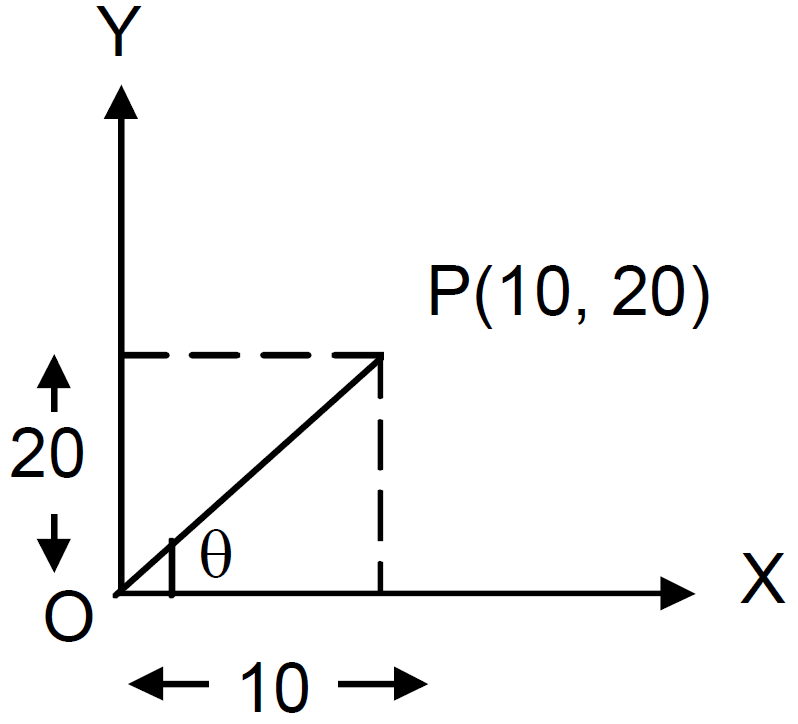
An electric field $\vec{\text{E}}=\vec{\text{i}}\text{Ax}$ exists in the space, where $A= 10Vm^{-2}$. Take the potential at (10m, 20m) to be zero. Find the potential at the origin.
Answer

$\text{E}=\vec{\text{i}}\times\text{Ax}=100\vec{\text{i}}$
$\int\limits_\text{v}^0\text{dv}=-\int\limits\text{E}\times\text{d}\ell$
$\text{V}=-\int\limits_0^{10}10\text{x}\times\text{dx}$
$=-\int\limits^{10}_0\frac{1}{2}\times10\times\text{x}^2$
$0-\text{V}=-\Big[\frac{1}{2}\times1000\Big]$
$=-500$
$\Rightarrow\text{V}=500\text{ Volts}$
View full question & answer
Question 542 Marks
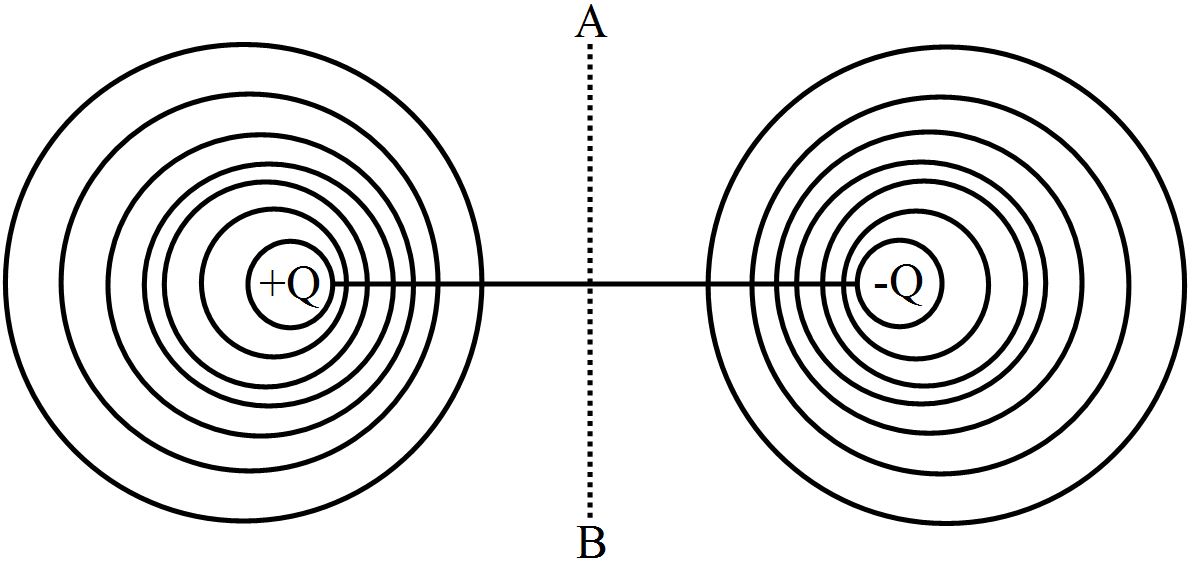
Show that the equipotential surfaces are closed together in the regions of strong field and far apart in the regions of weak field. Draw equipotential surfaces for an electric dipole.
Answer
Equipotential surfaces are closer together in the regions of strong field and farther apart in the regions of weak field.$\text{E}=-\frac{\text{dV}}{\text{dr}}$
E = negative potential gradient, For same change in dV, $\text{E}=-\frac{\text{dV}}{\text{dr}}$ where ‘dr’ represents the distance between equipotential surfaces.
View full question & answer
Question 552 Marks
Two conducting spheres of radii $R_1$ and $R_2$ are kept widely separated from each other. What are their individual capacitances? If the spheres are connected by a metal wire, what will be the capacitance of the combination? Think in terms of series-parallel connections.
Answer
$\text{C}=\frac{\text{q}}{\text{V}},$ Now $\text{V}=\frac{\text{kq}}{\text{R}}$So, $\text{C}_1=\frac{\text{q}}{\Big(\frac{\text{Kq}}{\text{R}_1}\Big)}=\frac{\text{R}_1}{\text{K}}=4\pi\in_0\text{R}_1$
Similarly, $\text{c}_2=4\pi\in_0\text{R}_2$
The combination is necessarily parallel.
Hence $\text{C}_{\text{eq}}=4\pi\in_0\text{R}_1+4\pi\in_0\text{R}_2=4\pi\in_0(\text{R}_1+\text{R}_2)$
View full question & answer
Question 562 Marks
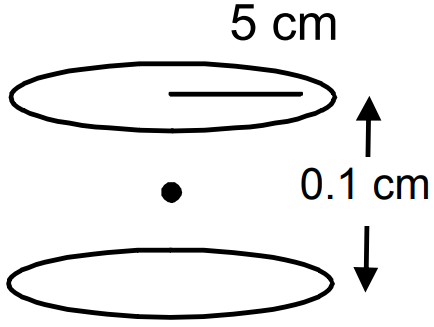
The plates of a parallel-plate capacitor are made of circular discs of radii 5.0cm each. If the separation between the plates is 1.0mm, what is the capacitance?
Answer

$\text{A}=\pi\text{r}^2=25\pi\text{m}^2$
$\text{d}=0.1\text{cm}$
$\text{c}=\frac{\in_0\text{A}}{\text{d}}$
$=\frac{8.854\times10^{-12}\times25\times3.14}{0.1}$
$=6.95\times10^{-5}\mu\text{F}$
View full question & answer
Question 572 Marks
A point charge is taken from a point A to a point B in an electric field. Does the work done by the electric field depend on the path of the charge?
Answer
Electrostatic field is a conservative field. Therefore, work done by the electric field does not depend on the path followed by the charge. It only depends on the position of the charge, from which and to which the charge has been moved.
View full question & answer
Question 582 Marks
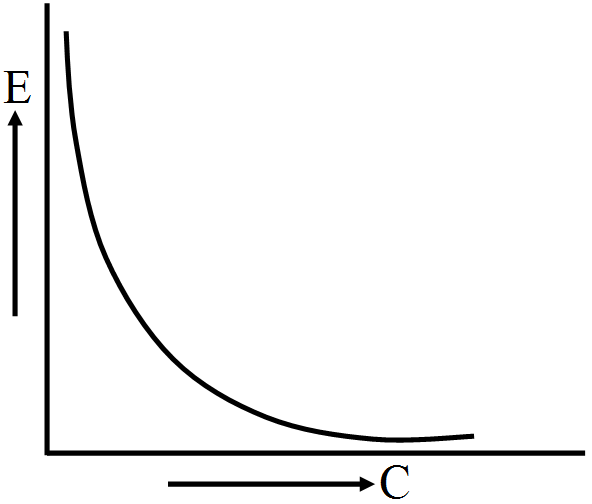
The graph shown here shows the variation of total energy (E) stored in a capacitor against the value of the capacitance (C) itself. Which of the two: the charge on capacitor or the potential used to charge it, is kept constant for this graph?
Answer
The given graph represents, $\text{E}\propto\frac{1}{\text{C}}$
This is satisfied by the expression, $\text{E}=\frac{\text{q}^2}{2\text{C}}\propto\frac{1}{\text{C}}$ for constant q.
That is, the charge (q) is kept constant.
View full question & answer
Question 592 Marks
A very thin plate of metal is placed exactly in the middle of the two plates of a parallel plate capacitor. What will be the effect on the capacitance of the system?
Answer
For a metal $\text{K}=\infty$ and so when t << d, the capacitance,$\text{C}=\frac{\varepsilon_0\text{A}}{\text{d}-\text{t}\Big(1-\frac{1}{\text{K}}\Big)}=\frac{\varepsilon_0\text{A}}{\text{d}-\text{t}\Big(1-\frac{1}{\infty}\Big)}=\frac{\varepsilon_0\text{A}}{\text{d}-\text{t}}$
$\text{As}\ \text{t}<<\text{dC}=\frac{\varepsilon_0\text{A}}{\text{d}},$ i.e., capacitance will remain unchanged.
View full question & answer
Question 602 Marks
Two protons are brought nearer; what will be the effect on potential energy of system?
Answer
A repulsive force acts between protons, if they are brought nearer, work must be done by external force; hence the potential energy of system increases.
View full question & answer
Question 612 Marks
A slab of material of dielectric constant $K$ has the same area as the plates of a parallel$-$plate capacitor but has a thickness $(3 / 4) d$, where $d$ is the separation of the plates. How is the capacitance changed when the slab is inserted between the plates?
Answer
Let $E_0=V_0 / d$ be the electric field between the plates.
when there is no dielectric and the potential difference is $V_0$.
If the dielectric is now inserted,
the electric field in the dielectric will be $E=E_0 / K$.
The potential difference will then be
$V=E_0\left(\frac{1}{4} d\right)+\frac{E_0}{K}\left(\frac{3}{4} d\right)$
$=E_0 d\left(\frac{1}{4}+\frac{3}{4 K}\right)$
$=V_0 \frac{K+3}{4 K}$
The potential difference decreases by the factor $(K+3) / 4 K$
while the free charge $Q_0$ on the plates remains unchanged.
The capacitance thus increases
$C=\frac{Q_0}{V}$
$=\frac{4 K}{K+3} \frac{Q_0}{V_0}$
$=\frac{4 K}{K+3} C_0$
View full question & answer
Question 622 Marks
A molecule of a substance has a permanent electric dipole moment of magnitude $10^{-29} C m$. A mole of this substance is polarised (at low temperature) by applying a strong electrostatic field of magnitude $10^6 V m ^{-1}$. The direction of the field is suddenly changed by an angle of $60^{\circ}$. Estimate the heat released by the substance in aligning its dipoles along the new direction of the field. For simplicity, assume $100 \%$ polarisation of the sample.
Answer
Here, dipole moment of each molecules $=10^{-29} C m$ As 1 mole of the substance contains $6 \times 10^{23}$ molecules, total dipole moment of all the molecules, $p=6 \times 10^{23} \times 10^{-29} C m$
$
=6 \times 10^{-6} C m
$
Initial potential energy, $U_i=-p E \cos \theta=-6 \times 10^{-6} \times 10^6 \cos 0^{\circ}=-6 J$ Final potential energy (when $\theta=60^{\circ}$ ), $U_f=-6 \times 10^{-6} \times 10^6 \cos 60^{\circ}=-3 J$ Change in potential energy $=-3 J -(-6 J )=3 J$
So, there is loss in potential energy. This must be the energy released by the substance in the form of heat in aligning its dipoles.
View full question & answer
Question 632 Marks
(a) Calculate the potential at a point $P$ due to a charge of $4 \times 10^{-7} C$ located $9 cm$ away.
(b) Hence obtain the work done in bringing a charge of $2 \times 10^{-9} C$ from infinity to the point P. Does the answer depend on the path along which the charge is brought?
Answer
$
\begin{aligned}
(a) V & =\frac{1}{4 \pi \varepsilon_0} \frac{Q}{r}=9 \times 10^9 Nm ^2 C ^{-2} \times \frac{4 \times 10^{-7} C }{0.09 m } \\
& =4 \times 10^4 V
\end{aligned}
$
$
\begin{aligned}
(b) W & =q V=2 \times 10^{-9} C \times 4 \times 10^4 V \\
& =8 \times 10^{-5} J
\end{aligned}
$
No, work done will be path independent. Any arbitrary infinitesimal path can be resolved into two perpendicular displacements: One along $r$ and another perpendicular to $r$. The work done corresponding to the later will be zero.
View full question & answer
2 Marks Questions - Page 2 - Physics STD 12 Science Questions - Vidyadip