Questions · Page 1 of 14

M.C.Q (1 Marks)

🎯

Test yourself on this topic

50 questions · timed · auto-graded

MCQ 11 Mark
Assertion : A parallel plate capacitor is connected across battery through a key. A dielectric slab of constant K is introduced between the plates. The energy which is stored becomes K times.
Reason : The surface density of charge on the plate remains constant or unchanged.
  • A
    If both assertion and reason are true and the reason is the correct explanation of the assertion.
  • B
    If both assertion and reason are true but reason is not the correct explanation of the assertion.
  • If assertion is true but reason is false.
  • D
    If the assertion and reason both are false.
Answer
Correct option: C.
If assertion is true but reason is false.
View full question & answer
MCQ 21 Mark
Assertion : The tyres of aircraft's are slightly conducting.
Reason : If a conductor is connected to ground, the extra charge induced on conductor will flow to ground.
  • A
    If both assertion and reason are true and the reason is the correct explanation of the assertion.
  •  If both assertion and reason are true but reason is not the correct explanation of the assertion.
  • C
    If assertion is true but reason is false.
  • D
     If the assertion and reason both are false.
Answer
Correct option: B.
 If both assertion and reason are true but reason is not the correct explanation of the assertion.
(b) If both assertion and reason are true but reason is not the correct explanation of the assertion.
View full question & answer
MCQ 31 Mark
Assertion : Circuit containing capacitors should be handled cautiously even when there is no current.
Reason : The capacitors are very delicate and so quickly break down..
  • A
     If both assertion and reason are true and the reason is the correct explanation of the assertion.
  • B
     If both assertion and reason are true but reason is not the correct explanation of the assertion.
  • If assertion is true but reason is false.
  • D
     If the assertion and reason both are false.
Answer
Correct option: C.
If assertion is true but reason is false.
(c) If assertion is true but reason is false.
View full question & answer
MCQ 41 Mark
Assertion : The lightening conductor at the top of high building has sharp pointed ends.
Reason : The surface density of charge at sharp points is very high resulting in setting up of electric wind.
  •  If both assertion and reason are true and the reason is the correct explanation of the assertion.
  • B
     If both assertion and reason are true but reason is not the correct explanation of the assertion.
  • C
     If assertion is true but reason is false.
  • D
     If the assertion and reason both are false.
Answer
Correct option: A.
 If both assertion and reason are true and the reason is the correct explanation of the assertion.
(a) If both assertion and reason are true and the reason is the correct explanation of the assertion.
View full question & answer
MCQ 51 Mark
Assertion : The force with which one plate of a parallel plate capacitor is attracted towards the other plate is equal to square of surface density per e per unit area.
Reason : The electric field due to one charged plate of the capacitor at the location of the other is equal to surface density per e.
  • A
     If both assertion and reason are true and the reason is the correct explanation of the assertion.
  • B
     If both assertion and reason are true but reason is not the correct explanation of the assertion.
  • C
     If assertion is true but reason is false.
  • If the assertion and reason both are false. 
Answer
Correct option: D.
If the assertion and reason both are false. 
(d) If the assertion and reason both are false.
View full question & answer
MCQ 61 Mark
Assertion : At a point in space, the electric field points towards north. In the region, surrounding this point the rate of change of potential will be zero along the east and west.
Reason : Electric field due to a charge is the space around the charge
  • A
    If both assertion and reason are true and the reason is the correct explanation of the assertion.
  • If both assertion and reason are true but reason is not the correct explanation of the assertion.
  • C
    If assertion is true but reason is false.
  • D
    If the assertion and reason both are false.
Answer
Correct option: B.
If both assertion and reason are true but reason is not the correct explanation of the assertion.
(b) If both assertion and reason are true but reason is not the correct explanation of the assertion.
View full question & answer
MCQ 71 Mark
Assertion : Conductors having equal positive charge and volume, must also have same potential.
Reason : Potential depends only on charge and volume of conductor.
  • A
     If both assertion and reason are true and the reason is the correct explanation of the assertion.
  • B
     If both assertion and reason are true but reason is not the correct explanation of the assertion.
  • C
     If assertion is true but reason is false.
  •  If the assertion and reason both are false.
Answer
Correct option: D.
 If the assertion and reason both are false.
(d) If the assertion and reason both are false.
View full question & answer
MCQ 81 Mark
Assertion : The whole charge of a conductor cannot be transferred to another isolated conductor.
Reason : The total transfer of charge from one to another is not possible
  • A
    If both assertion and reason are true and the reason is the correct explanation of the assertion.
  • B
    If both assertion and reason are true but reason is not the correct explanation of the assertion.
  • C
    If assertion is true but reason is false.
  • If the assertion and reason both are false.
Answer
Correct option: D.
If the assertion and reason both are false.
(d) If the assertion and reason both are false.
View full question & answer
MCQ 91 Mark
Assertion : On going away from a point charge or a small electric dipole, electric field decreases at the same rate in both the cases.
Reason : Electric field is inversely proportional to square of distance from the charge or an electric dipole.
  • A
    If both assertion and reason are true and the reason is the correct explanation of the assertion.
  • B
    If both assertion and reason are true but reason is not the correct explanation of the assertion.
  • C
    If assertion is true but reason is false.
  • If the assertion and reason both are false.
Answer
Correct option: D.
If the assertion and reason both are false.
(d) If the assertion and reason both are false.
View full question & answer
MCQ 101 Mark
Assertion : The surface charge densities of two spherical conductors of different radii are equal. Then the electric field intensities near their surface are also equal.
Reason : Surface charge density is equal to charge per unit area.
  • A
    If both assertion and reason are true and the reason is the correct explanation of the assertion.
  • If both assertion and reason are true but reason is not the correct explanation of the assertion.
  • C
    If assertion is true but reason is false.
  • D
    If the assertion and reason both are false.
Answer
Correct option: B.
If both assertion and reason are true but reason is not the correct explanation of the assertion.
(b) If both assertion and reason are true but reason is not the correct explanation of the assertion.
View full question & answer
MCQ 111 Mark
Assertion : If a point charge q is placed in front of an infinite grounded conducting plane surface, the point charge will experience a force.
Reason : This force is due to the induced charge on the conducting surface which is at zero potential.
  • If both assertion and reason are true and the reason is the correct explanation of the assertion.
  • B
    If both assertion and reason are true but reason is not the correct explanation of the assertion.
  • C
    If assertion is true but reason is false.
  • D
    If the assertion and reason both are false.
Answer
Correct option: A.
If both assertion and reason are true and the reason is the correct explanation of the assertion.
(a) If both assertion and reason are true and the reason is the correct explanation of the assertion.
View full question & answer
MCQ 121 Mark
Assertion : Charge is quantized
Reason : Charge, which is less than 1 C is not possible
  • A
    If both assertion and reason are true and the reason is the correct explanation of the assertion.
  • B
    If both assertion and reason are true but reason is not the correct explanation of the assertion.
  • If assertion is true but reason is false.
  • D
    If the assertion and reason both are false.
Answer
Correct option: C.
If assertion is true but reason is false.
(c) If assertion is true but reason is false.
View full question & answer
MCQ 131 Mark
Assertion : Mass of ion is slightly differed from its element.
Reason : Ion is formed, when some electrons are removed or added so mass changes
  •  If both assertion and reason are true and the reason is the correct explanation of the assertion.
  • B
    If both assertion and reason are true but reason is not the correct explanation of the assertion.
  • C
    If assertion is true but reason is false.
  • D
     If the assertion and reason both are false.
Answer
Correct option: A.
 If both assertion and reason are true and the reason is the correct explanation of the assertion.
(a) If both assertion and reason are true and the reason is the correct explanation of the assertion.
View full question & answer
MCQ 141 Mark
Assertion : Charge is invariant.
Reason : Charge does not depends on speed of frame of reference.
  • If both assertion and reason are true and the reason is the correct explanation of the assertion.
  • B
    If both assertion and reason are true but reason is not the correct explanation of the assertion.
  • C
    If assertion is true but reason is false.
  • D
    If the assertion and reason both are false.
Answer
Correct option: A.
If both assertion and reason are true and the reason is the correct explanation of the assertion.
(a) If both assertion and reason are true and the reason is the correct explanation of the assertion.
View full question & answer
MCQ 151 Mark
Assertion : A charged capacitor is disconnected from a battery. Now if its plate are separated farther, the potential energy will fall.
Reason : Energy stored in a capacitor is equal to the work done in charging it.
  • A
    If both assertion and reason are true and the reason is the correct explanation of the assertion.
  • B
    If both assertion and reason are true but reason is not the correct explanation of the assertion.
  • C
    If assertion is true but reason is false.
  • If assertion is false but reason is true.
Answer
Correct option: D.
If assertion is false but reason is true.
(d) If assertion is false but reason is true.
View full question & answer
MCQ 161 Mark
Assertion : The capacity of a given conductor remains same even if charge is varied on it.
Reason : Capacitance depends upon nearly medium as well as size and shape of conductor.
  • If both assertion and reason are true and the reason is the correct explanation of the assertion.
  • B
    If both assertion and reason are true but reason is not the correct explanation of the assertion.
  • C
    If assertion is true but reason is false.
  • D
    If the assertion and reason both are false.
Answer
Correct option: A.
If both assertion and reason are true and the reason is the correct explanation of the assertion.
(a) If both assertion and reason are true and the reason is the correct explanation of the assertion.
View full question & answer
MCQ 171 Mark
Assertion : Annihilation of electron and positron is an example of decay of charges.
Reason : In the process of annihilation an electron and a positron combine to give a gamma particle.
  • A
    If both assertion and reason are true and the reason is the correct explanation of the assertion.
  • B
    If both assertion and reason are true but reason is not the correct explanation of the assertion.
  • C
    If assertion is true but reason is false.
  •  If assertion is false but reason is true.
Answer
Correct option: D.
 If assertion is false but reason is true.
(d) If assertion is false but reason is true.
View full question & answer
MCQ 181 Mark
Assertion : When charges are shared between any two bodies, no charge is really lost, but some loss of energy does occur.
Reason : Some energy disappears in the form of heat, sparking etc.
  • A
    If both assertion and reason are true and the reason is the correct explanation of the assertion.
  • If both assertion and reason are true but reason is not the correct explanation of the assertion.
  • C
    If assertion is true but reason is false.
  • D
    If the assertion and reason both are false.
Answer
Correct option: B.
If both assertion and reason are true but reason is not the correct explanation of the assertion.
(b) If both assertion and reason are true but reason is not the correct explanation of the assertion.
View full question & answer
MCQ 191 Mark
Assertion : Dielectric breakdown occurs under the influence of an intense light beam.
Reason : Electromagnetic radiations exert pressure.
  • A
    If both assertion and reason are true and the reason is the correct explanation of the assertion.
  • If both assertion and reason are true but reason is not the correct explanation of the assertion.
  • C
    If assertion is true but reason is false.
  • D
    If the assertion and reason both are false.
Answer
Correct option: B.
If both assertion and reason are true but reason is not the correct explanation of the assertion.
(b) If both assertion and reason are true but reason is not the correct explanation of the assertion.
View full question & answer
MCQ 201 Mark
Assertion : If a proton and an electron are placed in the same uniform electric field. They experience different acceleration.
Reason : Electric force on a test charge is independent of its mass.
  • A
    If both assertion and reason are true and the reason is the correct explanation of the assertion.
  • If both assertion and reason are true but reason is not the correct explanation of the assertion.
  • C
    If assertion is true but reason is false.
  • D
    If the assertion and reason both are false.
Answer
Correct option: B.
If both assertion and reason are true but reason is not the correct explanation of the assertion.
(b) If both assertion and reason are true but reason is not the correct explanation of the assertion.
View full question & answer
MCQ 211 Mark
Assertion : Electric lines of force cross each other.
Reason : Electric field at a point superimpose to give one resultant electric field.
  • A
    If both assertion and reason are true and the reason is the correct explanation of the assertion.
  • B
    If both assertion and reason are true but reason is not the correct explanation of the assertion.
  • C
    If assertion is true but reason is false.
  • If assertion is false but reason is true.
Answer
Correct option: D.
If assertion is false but reason is true.
(d) If assertion is false but reason is true.
View full question & answer
MCQ 221 Mark
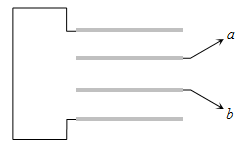
Four metallic plates each with a surface area of one side A are placed at a distance d from each other. The plates are connected as shown in the circuit diagram. Then the capacitance of the system between a and b is
       
  • A
    $\frac{3 \varepsilon_0 A}{d}$
  • B
    $\frac{2 \varepsilon_0 \mathrm{~A}}{\mathrm{~d}}$
  • C
    $\frac{2 \varepsilon_0 \mathrm{~A}}{3 \mathrm{~d}}$
  • $\frac{3 z_0 \mathrm{~A}}{2 \mathrm{~d}}$
Answer
Correct option: D.
$\frac{3 z_0 \mathrm{~A}}{2 \mathrm{~d}}$
(d)$\frac{3 z_0 \mathrm{~A}}{2 \mathrm{~d}}$
View full question & answer
MCQ 231 Mark
Assertion : If three capacitors of capacitance $C_1 < C_2 < C_3$ are connected in parallel then their equivalent capacitance $C_p > C_s$
Reason :$\frac{1}{C_P}=\frac{1}{C_1}+\frac{1}{C_2}+\frac{1}{C_3}$
  • A
    If both assertion and reason are true and the reason is the correct explanation of the assertion.
  • B
    If both assertion and reason are true but reason is not the correct explanation of the assertion.
  • If assertion is true but reason is false.
  • D
    If the assertion and reason both are false.
Answer
Correct option: C.
If assertion is true but reason is false.
(c) If assertion is true but reason is false.
View full question & answer
MCQ 241 Mark
Assertion : A metallic shield in form of a hollow shell may be built to block an electric field.
Reason : In a hollow spherical shield, the electric field inside it is zero at every point.
  •  If both assertion and reason are true and the reason is the correct explanation of the assertion.
  • B
     If both assertion and reason are true but reason is not the correct explanation of the assertion.
  • C
     If assertion is true but reason is false.
  • D
     If the assertion and reason both are false.
Answer
Correct option: A.
 If both assertion and reason are true and the reason is the correct explanation of the assertion.
(a) If both assertion and reason are true and the reason is the correct explanation of the assertion.
View full question & answer
MCQ 251 Mark
Assertion : Electrons move away from a low potential to high potential region.
Reason : Because electrons has negative charge
  •     If both assertion and reason are true and the reason is the correct explanation of the assertion.
  • B
      If both assertion and reason are true but reason is not the correct explanation of the assertion.
  • C
      If assertion is true but reason is false.
  • D
    If the assertion and reason both are false.
Answer
Correct option: A.
    If both assertion and reason are true and the reason is the correct explanation of the assertion.
(a) If both assertion and reason are true and the reason is the correct explanation of the assertion.
View full question & answer
MCQ 261 Mark
Assertion : If the distance between parallel plates of a capacitor is halved and dielectric constant is made three times, then the capacitor becomes 6 times.
Reason : Capacity of the capacitor does not depend upon the nature of the material.
  • A
    If both assertion and reason are true and the reason is the correct explanation of the assertion.
  • If both assertion and reason are true but reason is not the correct explanation of the assertion.
  • C
    If assertion is true but reason is false.
  • D
    If the assertion and reason both are false.
Answer
Correct option: B.
If both assertion and reason are true but reason is not the correct explanation of the assertion.
(b) If both assertion and reason are true but reason is not the correct explanation of the assertion.
View full question & answer
MCQ 271 Mark
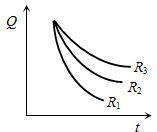
Three identical capacitors are given a charge Q each and they are then allowed to discharge through resistance $R_1, R_2$ and $R_3$. Their charges, as a function of time shown in the graph below. The smallest of the three resistance is
  • A
    $\mathrm{R}_3$
  • B
    $\mathrm{R}_2$
  • $\mathrm{R}_1$
  • D
    Cannot be predicted
Answer
Correct option: C.
$\mathrm{R}_1$
(c) $\mathrm{R}_1$
View full question & answer
MCQ 281 Mark
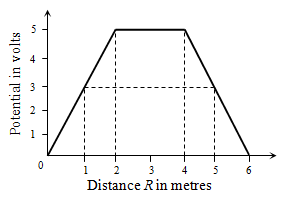
The variation of potential with distance R from a fixed point is as shown below. The electric field at R = 5 m is


  •  2.5 volt/m
  • B
     -2.5 volt/m
  • C
     2/5 volt/m
  • D
     -2/5 volt/m
Answer
Correct option: A.
 2.5 volt/m
(a) 2.5 volt/m
View full question & answer
MCQ 291 Mark
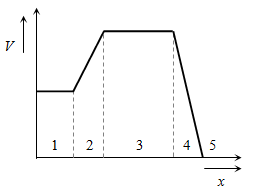
The figure gives the electric potential V as a function of distance through five regions on x-axis. Which of the following is true for the electric field E in these regions
  • A
    $\mathrm{E}_1>\mathrm{E}_2>\mathrm{E}_3>\mathrm{E}_4>\mathrm{E}_5$
  • $E_1=E_3=E_5$ and $E_2$
  • C
    $\mathrm{E}_2=\mathrm{E}_4=\mathrm{E}_5$ and $\mathrm{E}_1<\mathrm{E}_3$
  • D
    $\mathrm{E}_1<\mathrm{E}_2<\mathrm{E}_3<\mathrm{E}_4<\mathrm{E}_5$
Answer
Correct option: B.
$E_1=E_3=E_5$ and $E_2$
View full question & answer
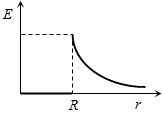
MCQ 301 Mark
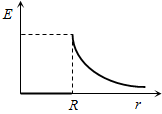
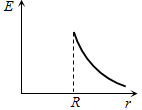
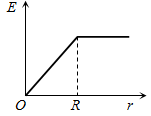
Which of the following graphs shows the variation of electric field E due to a hollow spherical conductor of radius R as a function of distance from the centre of the sphere
  • B
  • C
  • D
Answer
Correct option: A.
(a)
View full question & answer
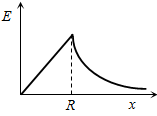
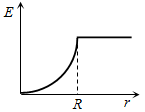
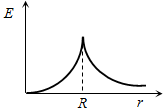
MCQ 311 Mark
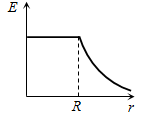
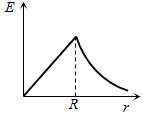
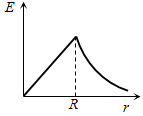
The electric field due to a uniformly charged sphere of radius R as a function of the distance from its centre is represented graphically by
  • A
  • C
  • D
Answer
Correct option: B.
(b)
View full question & answer
MCQ 321 Mark
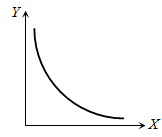
What physical quantities may X and Y represent ? (Y represents the first mentioned quantity)


  • A
    Pressure v/s temperature of a given gas (constant volume)
  • B
    Kinetic energy v/s velocity of a particle
  • C
    Capacitance v/s charge to give a constant potential
  • Potential v/s capacitance to give a constant charge
Answer
Correct option: D.
Potential v/s capacitance to give a constant charge
(d) Potential v/s capacitance to give a constant charge
View full question & answer
MCQ 331 Mark
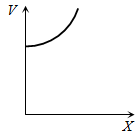
Between the plates of a parallel plate capacitor a dielectric plate is introduced just to fill the space between the plates. The capacitor is charged and later disconnected from the battery. The dielectric plate is slowly drawn out of the capacitor parallel to the plates. The plot of the potential difference across the plates and the length of the dielectric plate drawn out is
  • A
  • C
  • D
Answer
Correct option: B.
(b)
View full question & answer
MCQ 341 Mark
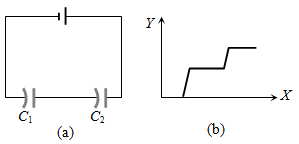
Figure $(a)$ shows two capacitors connected in series and joined to a battery. The graph in figure $(b)$ shows the variation in potential as one moves from left to right on the branch containing the capacitors, if


  • A
    $\mathrm{C}_1>\mathrm{C}_2$
  • B
    $C_1=C_2$
  • $C_1$
  • D
    The information is not sufficient to decide the relation between $C_1$ and$C_2$
Answer
Correct option: C.
$C_1$
$C_1$
View full question & answer
MCQ 351 Mark
A $4 \ mF$ capacitor, a resistance of $2.5 \ MW$ is in series with $12 V$ battery. Find the time after which the potential difference across the capacitor is $3$ times the potential difference across the resistor. $[$Given ln$(2)= 0.693]$
  • $13.86 s$
  • B
    $6.93 s$
  • C
    $7 s$
  • D
    $14 s$
Answer
Correct option: A.
$13.86 s$
$13.86 s$
View full question & answer
MCQ 361 Mark
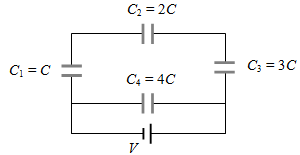
A network of four capacitors of capacity equal to $C_1=C, C_2=2 C, C_3=3 C$ and $C_4=40$ are conducted in a battery as shown in the figure. The ratio of the charges on $\mathrm{C}_2$ and $\mathrm{C}_4$ is
  • A
    $\frac{22}{3}$
  • $\frac{3}{22}$
  • C
    $\frac{7}{4}$
  • D
    $\frac{4}{7}$
Answer
Correct option: B.
$\frac{3}{22}$
$\frac{3}{22}$
View full question & answer
MCQ 371 Mark
A fully charged capacitor has a capacitance ‘C’. It is discharged through a small coil of resistance wire embedded in a thermally insulated block of specific heat capacity ‘s’ and mass ‘m’. If the temperature of the block is raised by ‘ ∆T ’, the potential difference ‘V’ across the capacitance is
  • A
    $\frac{m s \Delta T}{C}$
  • $\sqrt{\frac{2 m s \Delta T}{C}} \quad$
  • C
    $\sqrt{\frac{2 m C \Delta T}{s}}$
  • D
    $\frac{m C \Delta T}{s}$
Answer
Correct option: B.
$\sqrt{\frac{2 m s \Delta T}{C}} \quad$
(b) $\sqrt{\frac{2 m s \Delta T}{C}} \quad$
View full question & answer
MCQ 381 Mark
The plates of a parallel plate condenser are pulled apart with a velocity v. If at any instant their mutual distance of separation is d, then the magnitude of the time of rate of change of capacity depends on d as follows
  • A
    $\frac{1}{d}$
  • $\frac{1}{\mathrm{~d}^2}$
  • C
    $\mathrm{d}^2$
  • D
    d
Answer
Correct option: B.
$\frac{1}{\mathrm{~d}^2}$
(b) $\frac{1}{\mathrm{~d}^2}$
View full question & answer
MCQ 391 Mark
The plates of a capacitor are charged to a potential difference of 320 volts and are then connected across a resistor. The potential difference across the capacitor decays exponentially with time. After 1 second the potential difference between the plates of the capacitor is 240 volts, then after 2 and 3 seconds the potential difference between the plates will be
  • A
    200 and 180 V
  • 180 and 135 V
  • C
    160 and 80 V
  • D
    140 and 20 V
Answer
Correct option: B.
180 and 135 V
(b) 180 and 135 V
View full question & answer
MCQ 401 Mark
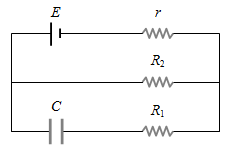
In the given figure each plate of capacitance C has partial value of charge
  • A
    $C E$
  • B
    $\frac{\mathrm{CER}_1}{\mathrm{R}_2-\mathrm{r}}$
  • $\frac{\mathrm{CER}_2}{\mathrm{R}_2+\mathrm{r}}$
  • D
    $\frac{\mathrm{CER}_1}{R_1-r}$
Answer
Correct option: C.
$\frac{\mathrm{CER}_2}{\mathrm{R}_2+\mathrm{r}}$
(c)$\frac{\mathrm{CER}_2}{\mathrm{R}_2+\mathrm{r}}$
View full question & answer
MCQ 411 Mark
A capacitor of capacitance $C_1=1 \mathrm{mF}$ can with stand maximum voltage $\mathrm{V}_1=6 \mathrm{kV} \ ($kilo $-$ volt$)$ and another capacitor of capacitance $\mathrm{C}_2=3 \mathrm{mF}$ can withstand maximum voltage $\mathrm{V}_2=4 \mathrm{kV}$. When the two capacitors are connected in series, the combined system can withstand a maximum voltage of
  • A
    $4 kV$
  • B
    $6 kV$
  • $8 kV$
  • D
    $10 kV$
Answer
Correct option: C.
$8 kV$
$8kV$
View full question & answer
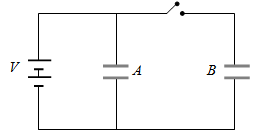
MCQ 421 Mark
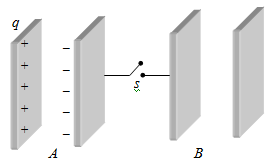
Consider the situation shown in the figure. The capacitor A has a charge q on it whereas B is uncharged. The charge appearing on the capacitor B a long time after the switch is closed is
  •  Zero
  • B
     q/2
  • C
    q
  • D
    2q
Answer
Correct option: A.
 Zero
(a) Zero
View full question & answer
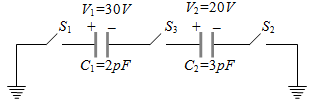
MCQ 431 Mark
For the circuit shown, which of the following statements is true
  • A
    with $S_1$ closed $V_1=15 \mathrm{~V}, \mathrm{~V}_2=20 \mathrm{~V}$
  • B
    With ${ }^{S_3}$ closed $V_1=V_2=25 V_0$
  • C
    With $S_1$ and $S_2$ closed $V_1=V_2=0$
  • with $S_1$ and ${ }^{S_3}$ closed, $V_1=30 \mathrm{~V}, V_2=20 \mathrm{~V}$
Answer
Correct option: D.
with $S_1$ and ${ }^{S_3}$ closed, $V_1=30 \mathrm{~V}, V_2=20 \mathrm{~V}$
(d) with $S_1$ and ${ }^{S_3}$ closed, $V_1=30 \mathrm{~V}, V_2=20 \mathrm{~V}$
View full question & answer
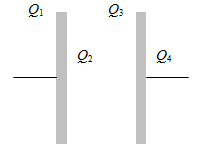
MCQ 441 Mark
In an isolated parallel plate capacitor of capacitance C, the four surface have charges $Q_1, Q_2, Q_3$ and Q_4$ as shown. The potential difference between the plates is
  • A
    $\frac{Q_1+Q_2+Q_3+Q_4}{2 C}$
  • B
    $\frac{Q_2+Q_3}{2 C}$
  • $\frac{Q_2-Q_s}{2 C}$
  • D
    $\frac{Q_1+Q_4}{2 C}$
Answer
Correct option: C.
$\frac{Q_2-Q_s}{2 C}$
(c)$\frac{Q_2-Q_s}{2 C}$
View full question & answer
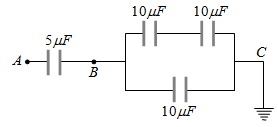
MCQ 451 Mark
In the given circuit if point C is connected to the earth and a potential of +2000 V is given to the point A, the potential at B is
  • A
    1500 V
  • B
    1000 V
  • 500 V
  • D
    400 V
Answer
Correct option: C.
500 V
(c) 500 V
View full question & answer
MCQ 461 Mark
There is a uniform electric field of strength $10^3 \mathrm{~V} / \mathrm{m}$ along y-axis. A body of mass 1g and charge $10^{-6}$ C is projected into the field from origin along the positive x-axis with a velocity 10m/s. Its speed in m/s after 10s is (Neglect gravitation)
  • A
    10
  • B
    $5^{\sqrt{2}}$
  • $10^{\sqrt{2}}$
  • D
    20
Answer
Correct option: C.
$10^{\sqrt{2}}$
(c) $10^{\sqrt{2}}$
View full question & answer
MCQ 471 Mark
Condenser A has a capacity of 15μF when it is filled with a medium of dielectric constant 15. Another condenser B has a capacity of 1 μF with air between the plates. Both are charged separately by a battery of 100 V. After charging, both are connected in parallel without the battery and the dielectric medium being removed. The common potential now is
  • A
     400 V
  •  800 V
  • C
     1200 V
  • D
     1600 V
Answer
Correct option: B.
 800 V
(b) 800 V
View full question & answer
MCQ 481 Mark
A parallel plate capacitor of capacitance C is connected to a battery and is charged to a potential difference V. Another capacitor of capacitance 2C is connected to another battery and is charged to potential difference 2V. The charging batteries are now disconnected and the capacitors are connected in parallel to each other in such a way that the positive terminal of one is connected to the negative terminal of the other. The final energy of the configuration is 
  • A
    Zero
  • B
    $\frac{25 \mathrm{CV}^2}{6}$
  • $\frac{3 \mathrm{CV}^2}{2}$
  • D
    $\frac{9 \mathrm{CV}^2}{2}$
Answer
Correct option: C.
$\frac{3 \mathrm{CV}^2}{2}$
(c) $\frac{3 \mathrm{CV}^2}{2}$
View full question & answer
MCQ 491 Mark
Figure given below shows two identical parallel plate capacitors connected to a battery with switch S closed. The switch is now opened and the free space between the plate of capacitors is filled with a dielectric of dielectric constant 3. What will be the ratio of total electrostatic energy stored in both capacitors before and after the introduction of the dielectric
  • A
     3 : 1
  • B
    5 : 1
  • 3 : 5
  • D
    5 : 3
Answer
Correct option: C.
3 : 5
(c) 3 : 5
View full question & answer
MCQ 501 Mark
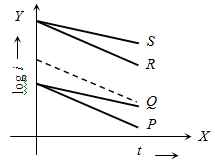
In an RC circuit while charging, the graph of in i versus time is as shown by the dotted line in the diagram figure, where i is the current. When the value of the resistance is doubled, which of the solid curve best represents the variation of in i versus time
  • A
    P
  • Q
  • C
    R
  • D
    S
Answer
Correct option: B.
Q
(b) Q
View full question & answer
M.C.Q (1 Marks) - Physics STD 12 Science Questions - Vidyadip