Questions

2 Marks Questions

🎯

Test yourself on this topic

7 questions · timed · auto-graded

Question 12 Marks
A force F is applied on a block of mass M. The block is displaced through a distance d in the direction of the force. What is the work done by the force on the block? Does the internal energy change because of this work?
Answer
If force F is applied on a block of mass M and displacement of block is d, then work done by the force is given by,
$\text{W}=\text{F.d}=\text{Fd}\ \cos(0^\circ)=\text{Fd}$
This work done does not change the internal energy of the block as the internal energy does not include the energy due to motion or location of the system as a whole.
View full question & answer
Question 22 Marks
The pressure of a gas changes linearly with volume from 10kPa, 200cc to 50kPa, 50cc.
  1. Calculate the work done by the gas.
  2. If no heat is supplied or extracted from the gas, what is the change in the internal energy of the gas?
Answer
$P_1 = 10kpa = 10 \times 10^3pa$
$P_2 = 50 \times 10^3pa$
$V_1 = 200cc$
$V_2 = 50cc$​​​​​​​
  1. Work done on the gas $=\frac{1}{2}(10+50)\times10^3\times(50-200)\times10^{-6}=-4.5\text{J}$
  2. $\text{dQ}=0\Rightarrow0=\text{du}+\text{dw}$
$\Rightarrow\text{du}=-\text{dw}=4.5\text{J}$
View full question & answer
Question 32 Marks
Can work be done by a system without changing its volume?
Answer
If the system goes through a cyclic process, then initial volume gets equal to the final volume after one cycle. But work done by the gas is non-zero. So, work can be done by a system without changing its volume.
View full question & answer
Question 42 Marks
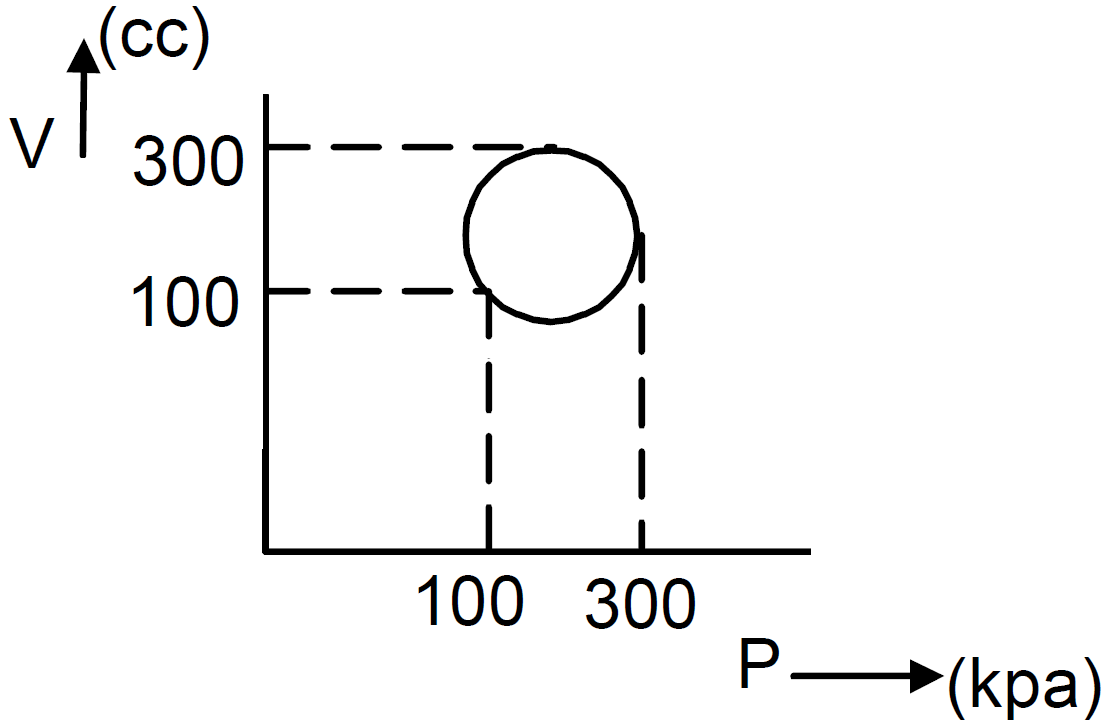
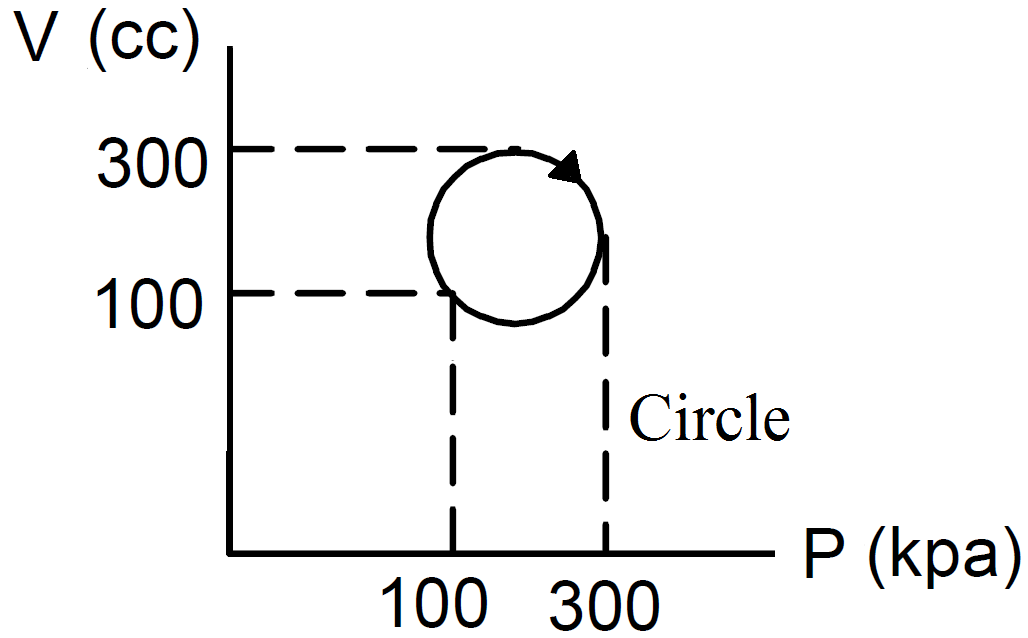
Calculate the heat absorbed by a system in going through the cyclic process shown in figure.
Answer

Heat absorbed = work done = Area under the graph
In the given case heat absorbed = area of the circle
$= \pi \times 10^4 × 10^{-6} \times 10^3 = 3.14 \times 10 = 31.4\text{J}$
View full question & answer
Question 52 Marks
A gas is enclosed in a cylindrical vessel fitted with a frictionless piston. The gas is slowly heated for some time. During the process, 10J of heat is supplied and the piston is found to move out 10cm. Find the increase in the internal energy of the gas. The area of cross section of the cylinder $= 4cm^2$ and the atmospheric pressure = 100kPa.
Answer
$dQ = 10J$
$dV = A \times 10cm^3 = 4 \times 10cm^3 = 40 \times 10^{-6}cm^3$
$dw = Pdv = 100 \times 10^3 \times 40 \times 10^{-6} = 4cm^3$
$du = ?$
$10 = du + dw$
$\Rightarrow 10 = du + 4$
$\Rightarrow du = 6J.$
View full question & answer
Question 62 Marks
An ideal gas is taken from an initial state i to a final state f in such a way that the ratio of the pressure to the absolute temperature remains constant. What will be the work done by the gas?
Answer
Initial State ‘I’ Final State ‘f’
Given $\frac{\text{P}_1}{\text{T}_1}=\frac{\text{P}_2}{\text{T}_2}$
where $P_1 →$ Initial Pressure;$ P_2 →$ Final Pressure.
$T_2, T_1 → $Absolute temp. So, $\Delta\text{V}=0$
Work done by gas $=\text{P}\Delta\text{V}=0$
View full question & answer
Question 72 Marks
The outer surface of a cylinder containing a gas is rubbed vigorously by a polishing machine. The cylinder and its gas become warm. Is the energy transferred to the gas heat or work?
Answer
As the outer surface of a cylinder containing a gas is rubbed vigorously by a polishing machine, no work is done on the cylinder. Volume of the gas remains constant and the heat energy generated due to friction between the machine and the cylinder gets transferred to the gas as heat energy. This heat energy leads to an increase in the temperature of the cylinder and its gas.
View full question & answer