Questions

M.C.Q (1 Marks)

🎯

Test yourself on this topic

10 questions · timed · auto-graded

MCQ 11 Mark
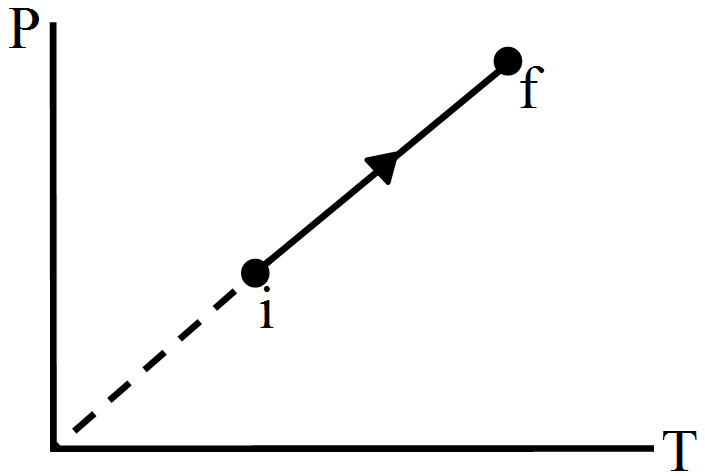
An ideal gas goes from the state i to the state fas shown in figure. The work done by the gas during the process:
  • A
    Is positive.
  • B
    Is negative.
  • Is zero.
  • D
    Cannot be obtained from this information.
Answer
Correct option: C.
Is zero.
Explanation:
Work done by the gas during the process,
$\Delta\text{W}=\text{P}\Delta\text{V}$
Here,
P = Pressure
$\Delta\text{V}$ = change in volume.
Since the process described in the figure is isochoric, P = kT. As volume remains constant $(\Delta\text{V}=0),\Delta\text{W}=0.$
View full question & answer
MCQ 21 Mark
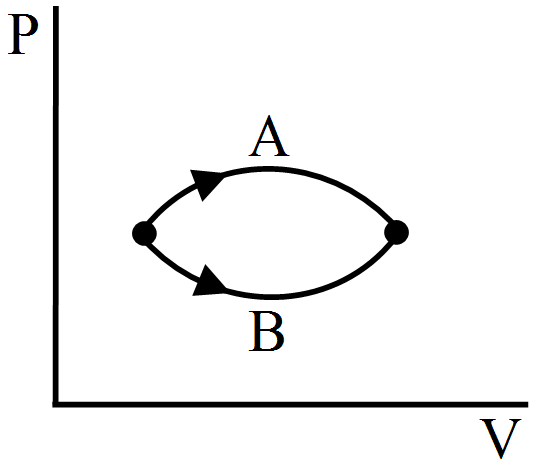
Figure. shows two processes A and B on a system. Let $\Delta\text{Q}_1$ and $\Delta\text{Q}_2$ be the heat given to the system in processes A and B respectively. Then,
  • $\Delta\text{Q}_1>\Delta\text{Q}_2$
  • B
    $\Delta\text{Q}_1=\Delta\text{Q}_2$
  • C
    $\Delta\text{Q}_1<\Delta\text{Q}_2$
  • D
    $\Delta\text{Q}_1\le\Delta\text{Q}_2$
Answer
Correct option: A.
$\Delta\text{Q}_1>\Delta\text{Q}_2$
Explanation:
Both the processes A and B have common initial and final points. So, change in internal energy, $\Delta\text{U}_1$ is same in both the cases. Internal energy is a state function that does not depend on the path followed.
In the P-V diagram, the area under the curve represents the work done on the system, $\Delta\text{W}$ Since area under curve A > area under curve B, $\Delta\text{W}_1>\Delta\text{W}_2.$
Now,
$\Delta\text{Q}_1=\Delta\text{U}+\Delta\text{W}_1$
$\Delta\text{Q}_2=\Delta\text{U}+\Delta\text{W}_2$
But $\Delta\text{W}_1>\Delta\text{W}_2$
$\Rightarrow\Delta\text{Q}_1>\Delta\text{Q}_2$
Here, $\Delta\text{Q}_1$ and $\Delta\text{Q}_2$ denote the heat given to the system in processes A and B, respectively.
View full question & answer
MCQ 31 Mark
The first law of thermodynamics is a statement of:
  • A
    Conservation of heat.
  • B
    Conservation of work.
  • C
    Conservation of momentum.
  • Conservation of energy.
Answer
Correct option: D.
Conservation of energy.
Explanation:
Heat is a form of energy. Since the first law of thermodynamics deals with the conservation of heat, it actually refers to the conservation of energy in the broader sense.
The first law of thermodynamics is just the restatement of the law of conservation of energy. We observe that the energy supplied to a system will contribute to change in its internal energy and the amount of work done by the system on its surroundings.
View full question & answer
MCQ 41 Mark
Consider the following two statements.
  1. If heat is added to a system, its temperature must increase.
  2. If positive work is done by a system in a thermodynamic process, its volume must increase.
  • A
    Both $A$ and $B$ are correct.
  • B
    $A$ is correct but $B$ is wrong.
  • $B$ is correct but $A$ is wrong.
  • D
    Both $A$ and $B$ are wrong.
Answer
Correct option: C.
$B$ is correct but $A$ is wrong.
If heat is added to a system in an isothermal process, then there'll be no change in the temperature.
Work done by a system, $\Delta\text{W}=\text{P}\Delta\text{V}$
$\Rightarrow\Delta\text{W}=\text{positive}$
$\Rightarrow\Delta\text{V}=\text{positive}$
Here,
$P =$ Pressure
$\Delta\text{V} =$ change in volume.
View full question & answer
MCQ 51 Mark
A system can be taken from the initial state $\mathrm{p}_1, \mathrm{~V}_1$ to the final state $\mathrm{p}_2, \mathrm{~V}_2$ by two different methods. Let $\Delta\text{Q}$ and $\Delta\text{W}$ represent the heat given to the system and the work done by the system. Which of the following must be the same in both the methods?
  • A
    $\Delta\text{Q}$
  • B
    $\Delta\text{W}$
  • C
    $\Delta\text{Q}+\Delta\text{W}$
  • $\Delta\text{Q}-\Delta\text{W}$
Answer
Correct option: D.
$\Delta\text{Q}-\Delta\text{W}$
​A system is taken from an initial state to the final state by two different methods.
So, work done and heat supplied in both the cases will be different as they depend on the path followed.
On the other hand, internal energy of the system $(U)$ is a state function, i.e. it only depends on the final and initial state of the process.
They are the same in the above two methods.
Using the first law of thermodynamics, we get,
$\Delta\text{Q}=\Delta\text{U}+\Delta\text{W}$
$\Rightarrow\Delta\text{U}=\Delta\text{Q}-\Delta\text{W}$
Here, $\Delta\text{U}$ is the change in internal energy, $\Delta\text{Q}$ is the heat given to the system and $\Delta\text{W}$ is the work done by the system.
View full question & answer
MCQ 61 Mark
If heat is supplied to an ideal gas in an isothermal process:
  • A
    The internal energy of the gas will increase.
  • The gas will do positive work.
  • C
    The gas will do negative work.
  • D
    The said process is not possible.
Answer
Correct option: B.
The gas will do positive work.
Explanation:
Internal energy of the gas,
$\text{U}=\int\text{C}_\upsilon\text{dT}$
Here, Cv is the specific heat at constant volume and dT is the change in temperature.
If the process is isothermal, i.e. dT = 0, dU = 0.
Using the first law of thermodynamics, we get,
$\Delta\text{Q}=\Delta\text{U}+\Delta\text{W}$
But $\Delta\text{U}=0$
$\Rightarrow\Delta\text{Q}=+\Delta\text{W}$
Here, $\Delta\text{W}$ is the positive work done by the gas.
View full question & answer
MCQ 71 Mark
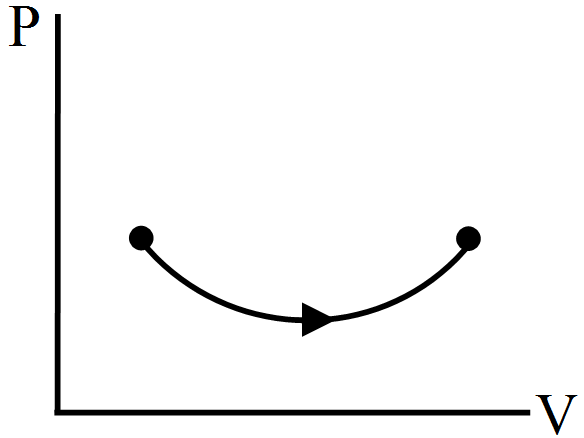
Consider the process on a system shown in figure. During the process, the work done by the system:
  • Continuously increases.
  • B
    Continuously decreases.
  • C
    First increases then decreases.
  • D
    First decreases then increases.
Answer
Correct option: A.
Continuously increases.
Explanation:
Work done by a system, $\text{W}=\int\text{PdV}$
Here,
P = Pressure on the system
dV = change in volume
Since dV is positive, i.e. the volume is continuously increasing, work done by the system also continuously increases.
View full question & answer
MCQ 81 Mark
A gas is contained in a metallic cylinder fitted with a piston. The piston is suddenly moved in to compress the gas and is maintained at this position. As time passes the pressure of the gas in the cylinder:
  • A
    Increases.
  • Decreases.
  • C
    Remains constant.
  • D
    Increases or decreases depending on the nature of the gas.
Answer
Correct option: B.
Decreases.
Explanation:
As the piston of a metallic cylinder containing gas is moved to compress the gas, the volume in which the gas is contained reduces, leading to increase in pressure and temperature. When the time elapses, the heat generated radiates through the metallic cylinder as metals are good conductors of heat. Consequently, the pressure of the gas in the cylinder decreases because of decrease in the temperature.
View full question & answer
MCQ 91 Mark
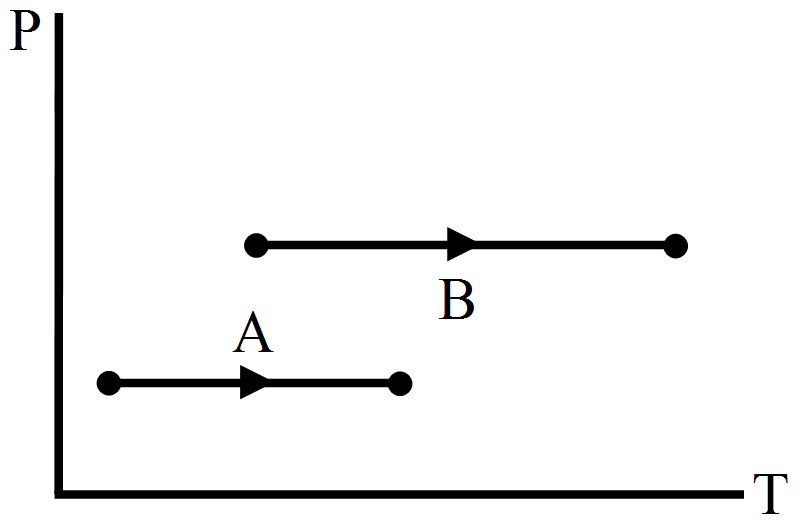
Consider two processes on a system as shown in figure. The volumes in the initial states are the same in the two processes and the volumes in the final states are also the same. Let $\Delta\text{W}_1$ and $\Delta\text{W}_2$ be the work done by the system in the processes $A$ and $B$ respectively.
  • A
    $\Delta\text{W}_1>\Delta\text{W}_2.$
  • B
    $\Delta\text{W}_1=\Delta\text{W}_2.$
  • $\Delta\text{W}_1<\Delta\text{W}_2.$
  • D
    Nothing can be said about the relation between $\Delta\text{W}_1$ and $\Delta\text{W}_2.$
Answer
Correct option: C.
$\Delta\text{W}_1<\Delta\text{W}_2.$
Work done by the system, $\Delta\text{W}=\text{P}\Delta\text{V}$
Here,
$P =$ Pressure in the process
$\Delta\text{V} =$ Change in volume during the process
Let $V_i$ and $V_f$ be the volumes in the initial states and final states for processes $A$ and $B,$ respectively. Then,
$\Delta\text{W}_1=\text{P}_1\Delta\text{V}_1$
$\Delta\text{W}_2=\text{P}_2\Delta\text{V}_2$
But $\Delta\text{V}_2=\Delta\text{V}_1,$
$\big[(\text{V}_{\text{f}_1}-\text{V}_{\text{i}_1})=(\text{V}_{\text{f}_2}-\text{V}_{\text{i}_2})\big]$
$\Rightarrow\frac{\Delta\text{W}_1}{\Delta\text{W}_2}=\frac{\text{P}_1}{\text{P}_2}$
$\Rightarrow\Delta\text{W}_1<\Delta\text{W}_2\ [\because\text{P}_2>\text{P}_1]$
View full question & answer
MCQ 101 Mark
Refer to figure. Let $\Delta\text{U}_1$ and $\Delta\text{U}_2$ be the changes in internal energy of the system in the processes A and B. Then,
  • A
    $\Delta\text{U}_1>\Delta\text{U}_2$
  • $\Delta\text{U}_1=\Delta\text{U}_2$
  • C
    $\Delta\text{U}_1<\Delta\text{U}_2$
  • D
    $\Delta\text{U}_1\neq\Delta\text{U}_2$
Answer
Correct option: B.
$\Delta\text{U}_1=\Delta\text{U}_2$
The internal energy of the system is a state function, i.e. it only depends on the initial and final point of the process and doesn't depend on the path followed. Both processes A and B have common initial and final points. Therefore, change in internal energy in process A is equal to the change in internal energy in process​ B. Thus,
$\Delta\text{U}_1=\Delta\text{U}_2=0$
View full question & answer