Questions

2 Marks Questions

🎯

Test yourself on this topic

12 questions · timed · auto-graded

Question 12 Marks
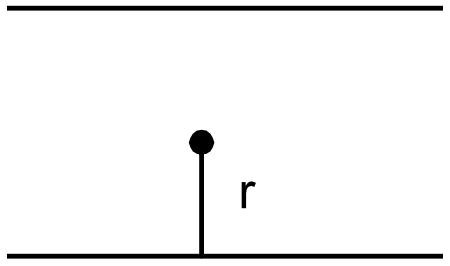
A transmission wire carries a current of 100A. What would be the magnetic field B at a point on the road if the wire is 8m above the road?
Answer
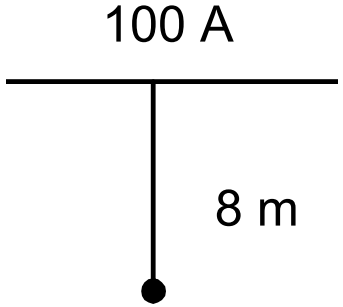
$\text{i} = 100\text{A},\text{d} = 8\text{m}$
$\text{B}=\frac{\mu_0\text{i}}{2\pi\text{r}}$
$=\frac{4\pi\times10^{-7}\times100}{2\times\pi\times8}=2.5\mu\text{T}$
View full question & answer
Question 22 Marks
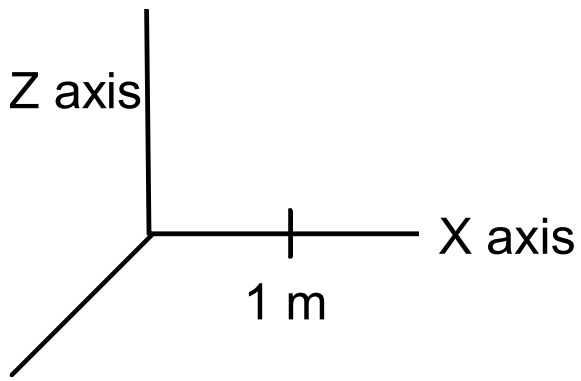
A current of 10A is established in a long wire along the positive z-axis. Find the magnetic field $\overrightarrow{\text{B}}$ at the point (1m, 0, 0).
Answer

$\text{i} = 10\text{A},\text{d} = 1\text{m}$
$\text{B}=\frac{\mu_0\text{i}}{2\pi\text{r}}=\frac{10^{-7}\times4\pi\times10}{2\pi\times1}$
$=20\times10^{-6}\text{T}=2\mu\text{T}$
Along +ve Y direction.
View full question & answer
Question 32 Marks
You are facing a circular wire carrying an electric current. The current is clockwise as seen by you. Is the field at the centre coming towards you or going away from you?
Answer
According to the right-hand thumb rule, if we curl the fingers of our right hand in the direction of the current flowing, then the thumb will point in the direction of the magnetic field developed due to it and vice versa. Therefore, in this case, the field at the centre is going away from us.
View full question & answer
Question 42 Marks
In order to have a current in a long wire, it should be connected to a battery or some such device. Can we obtain the magnetic due to a straight, long wire by using Ampere's law without mentioning this other part of the circuit?
Answer
We can obtain a magnetic field due to a straight, long wire using Ampere's law by mentioning the current flowing in the wire, without emphasising on the source of the current in the wire. To apply Ampere's circuital law, we need to have a constant current flowing in the wire, irrespective of its source.
View full question & answer
Question 52 Marks
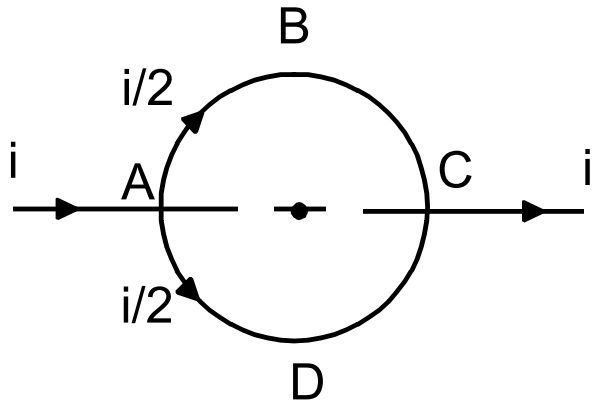
A conducting circular loop of radius a is connected to two Iong, straight wires. The straight wires carry current I as shown in figure. Find the magnetic field B at the centre of the loop.
Answer

$\text{l}=\frac{\text{i}}{2}$ in each semicircle
$\text{ABC}=\overrightarrow{\text{B}}=\frac{1}{2}\times\frac{\mu_0\Big(\frac{\text{i}}{2}\Big)}{2\text{a}}$ downwards
$\text{ADC}=\overrightarrow{\text{B}}=\frac{1}{2}\times\frac{\mu_0\Big(\frac{\text{i}}{2}\Big)}{2\text{a}}$ upwards
Net $\overrightarrow{\text{B}}=0$
View full question & answer
Question 62 Marks
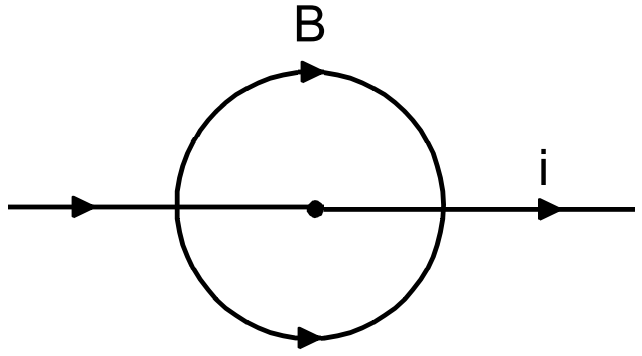
In Ampere's $\oint\overrightarrow{\text{B}}.\text{d}\overrightarrow{\text{l}}=\mu_0\text{i},$ the current outside the curve is not included on the right hand side. Does it mean that the magnetic field B calculated by using Ampere's law, gives the contribution of only the currents crossing the area bounded by the curve?
Answer
In Ampere's law $\oint\overrightarrow{\text{B}}.\text{d}\overrightarrow{\text{l}}=\mu_0\text{i},$ is the total current crossing the area bounded by the closed curve. The magnetic field B on the left-hand side is the resultant field due to all existing currents.
View full question & answer
Question 72 Marks
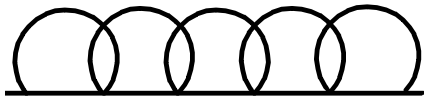
A tightly-wound, long solenoid has n turns per unit length, a radius r and carries a current i. A particle having charge q and mass m is projected from a point on the axis in a direction perpendicular to the axis. What can be the maximum speed for which the particle does not strike the solenoid ?
Answer

No. of turns per unit length = n,
radius of circle $= \frac{\text{r}}{2},$
current in the solenoid = i,
Charge of Particle = q,
mass of particle = m
$\therefore\text{B}=\mu_0\text{ni}$
Again $\frac{\text{mV}^2}{\text{r}}=\text{qVB}\Rightarrow\text{V}=\frac{\text{qBr}}{\text{m}}=\frac{\text{q}\mu_0\text{nir}}{2\text{m}}=\frac{\mu_0\text{ni}\ \text{qr}}{2\text{m}}$
View full question & answer
Question 82 Marks
A copper wire of diameter 1.6 mm carries 20A. Find the maximum magnitude of the magnetic field $\overrightarrow{\text{B}}$ due to this current.
Answer

$\text{d}= 1.6 \text{mm}$
$\text{So},\ \text{r} = 0.8\text{mm}= 0.0008\text{m}$
$\text{i} = 20 \text{A}$
$\overrightarrow{\text{B}}=\frac{\mu_0\text{i}}{2\pi\text{r}}=\frac{4\pi\times10^{-7}\times20}{2\times\pi\times8\times10^{-4}}$
$=5\times10^{-3}\text{T}=5\text{mT}$
View full question & answer
Question 92 Marks
The magnetic field inside a tightly wound, long solenoid is $\text{B}=\mu_0\text{ni}.$ It suggests that the field does not depend on the total length of the solenoid, and hence if we add more loops at the ends of a solenoid the field should not increase. Explain qualitatively why the extra-added loops do not have a considerable effect on the field inside the solenoid.
Answer
The magnetic field due to a long solenoid is given as $\text{B}=\mu_0\text{ni},$ where n is the number of loops per unit length. So, if we add more loops at the ends of the solenoid, there will be an increase in the number of loops and an increase in the length, due to which the ratio n will remain unvaried, thereby leading to not a considerable effect on the field inside the solenoid.
View full question & answer
Question 102 Marks
Using the formula $\overrightarrow{\text{F}}=\text{q}\overrightarrow{\text{v}}\times\overrightarrow{\text{B}}$ and $\text{B}=\frac{\mu_0\text{i}}{2\pi\text{r}},$ show that the SI units of the magnetic field B and the permeability constant $\mu_0$ may be written as N/A-m and $NA^2$ respectively.
Answer
$\overrightarrow{\text{F}}=\text{q}\overrightarrow{\text{v}}\times\overrightarrow{\text{B}}$
$\text{B}=\frac{\text{F}}{\text{qv}}=\frac{\text{F}}{\text{ITv}}=\frac{\text{N}}{\text{A.sec}/\text{sec}.}=\frac{\text{N}}{\text{A-m}}$
$\text{B}=\frac{\mu_0\text{I}}{2\pi\text{r}}$
$\mu_0=\frac{2\pi\text{rB}}{\text{I}}=\frac{\text{m}\times\text{N}}{\text{A-m}\times\text{A}}=\frac{\text{N}}{\text{A}^2}$
View full question & answer
Question 112 Marks
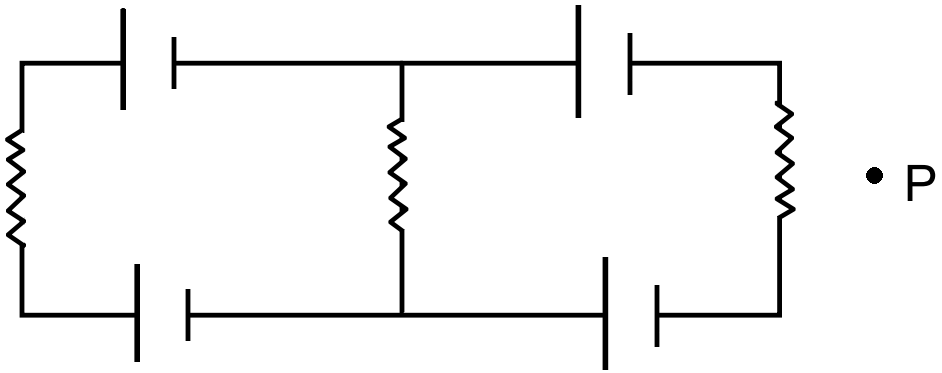
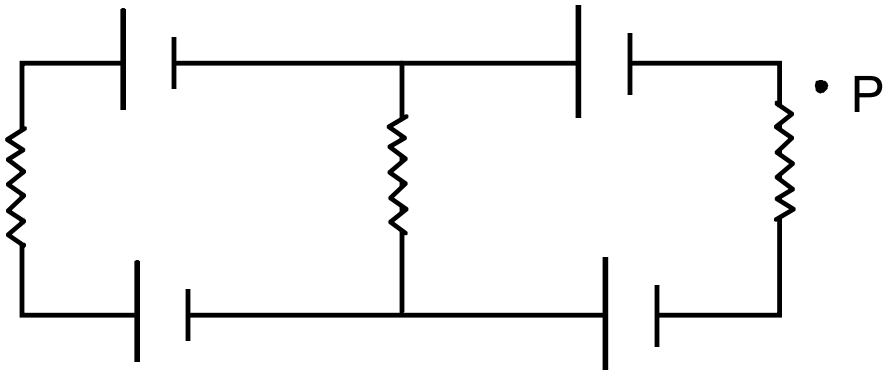
Each of the batteries shown in figure has an emf equal to 5V. Show that the magnetic field B at the point P is zero for any set of values of the resistances.
Answer

Net current in circuit = 0
Hence the magnetic field at point P = 0
[Owing to wheat stone bridge principle]
View full question & answer
Question 122 Marks
A circular loop of one turn carries a current of 5.00A. If the magnetic field B at the centre is 0.200mT find the radius of the loop.
Answer
$\text{B} = 0.2\text{mT},$
$\text{i} = 5\text{A},$
$\text{n} = 1,$
$\text{r} = ?$
$\text{B}=\frac{\text{n}\mu_0\text{i}}{2\text{r}}$
$\Rightarrow\text{r}=\frac{\text{n}\times\mu_0\text{i}}{2\text{B}}=\frac{1\times4\pi\times10^{-7}\times5}{2\times0.2\times10^{-3}}$
$=3.14\times5\times10^{-3}\text{m}$
$= 15.7\times10^{-3}\text{m}$
$ = 15.7 × 10^{-1}\text{cm} = 1.57\text{cm}$
View full question & answer
2 Marks Questions - Physics STD 12 Science Questions - Vidyadip