Questions

Assertion (A) & Reason (B) MCQ

🎯

Test yourself on this topic

17 questions · timed · auto-graded

Question 11 Mark
Two statements are given-one labelled Assertion (A) and the other labelled Reason (R). Select the correct answer to these questions from the codes (a), (b), (c) and (d) as given below.
  1. Both A and R are true and R is the correct explanation of A.
  2. Both A and R are true but R is NOT the correct explanation of A.
  3. A is true but R is false.
  4. A is false and R is also false.
Assertion (A): When a charged particle moves perpendicular to magnetic field then its kinetic energy and momentum gets affected.
Reason (R): Force changes velocity of charged particle.
Answer
  1. A is false and R is also false.
Explanation:

When a charged particle moves perpendicular to magnetic field, it experiences a force which changes the direction of motion of the particle without changing the magnitude of velocity of the particle. Hence kinetic energy remains constant but momentum of electron changes.
View full question & answer
Question 21 Mark
Two statements are given-one labelled Assertion (A) and the other labelled Reason (R). Select the correct answer to these questions from the codes (a), (b), (c) and (d) as given below.
  1. Both A and R are true and R is the correct explanation of A.
  2. Both A and R are true but R is NOT the correct explanation of A.
  3. A is true but R is false.
  4. A is false and R is also false.
Assertion (A): A solenoid tends to expand, when a current passes through it.
Reason (R): Two straight parallel metallic wires carrying current in same direction repel each other.
Answer
  1. A is false and R is also false.
Explanation:

When current flows through a solenoid, the currents in the various turns of the solenoid are parallel and in the same direction. Since the currents flowing through parallel wires in the same direction lead to force of attraction between them, the turns of the solenoid will also attract each other and as a result,the solenoid tends to contract.
View full question & answer
Question 31 Mark
Two statements are given-one labelled Assertion (A) and the other labelled Reason (R). Select the correct answer to these questions from the codes (a), (b), (c) and (d) as given below.
  1. Both A and R are true and R is the correct explanation of A.
  2. Both A and R are true but R is NOT the correct explanation of A.
  3. A is true but R is false.
  4. A is false and R is also false.
Assertion (A): A charge, whether stationary or in motion produces a magnetic field around it.
Reason (R): Moving charges produce only electric field in the surrounding space.
Answer
  1. A is false and R is also false.
Explanation:

A charge, whether stationary or in motion, produces an electric field around it. If it is in motion, then in addition to the electric field, it also produces a magnetic field, because moving charges produce magnetic field in the surrounding space.
View full question & answer
Question 41 Mark
Two statements are given-one labelled Assertion (A) and the other labelled Reason (R). Select the correct answer to these questions from the codes (a), (b), (c) and (d) as given below.
  1. Both A and R are true and R is the correct explanation of A.
  2. Both A and R are true but R is NOT the correct explanation of A.
  3. A is true but R is false.
  4. A is false and R is also false.
Assertion (A): The magnetic field intensity at the centre of a circular coil carrying current changes, if the current through the coil is doubled.
Reason (R): The magnetic field intensity is dependent on current in conductor.
Answer
  1. Both A and R are true and R is the correct explanation of A.
Explanation:

The magnetic field at the centre of circular coil is given by.

$\text{B}=\frac{\mu_0}{4\pi}\frac{2\pi\text{nl}}{\text{a}}$

So if current through coil is doubled then magnetic field is B' = 2B.

The magnetic field also get doubled. The magnetic field is directly proportional to the current in conductor.
View full question & answer
Question 51 Mark
Two statements are given-one labelled Assertion (A) and the other labelled Reason (R). Select the correct answer to these questions from the codes (a), (b), (c) and (d) as given below.
  1. Both A and R are true and R is the correct explanation of A.
  2. Both A and R are true but R is NOT the correct explanation of A.
  3. A is true but R is false.
  4. A is false and R is also false.
Assertion (A): Magnetic field lines can be entirely confined within the core of a toroid, but not within a straight solenoid.
Reason (R): The magnetic field inside the solenoid is uniform.
Answer
  1. Both A and Rare true but R is NOT the correct explanation of A.
Explanation:

Magnetic field lines can be entirely confined to the core of a toroid because toroid has no ends. It can confine the field within its core. A straight solenoid has two ends. If the entire flux were confined between these ends, the flux throughout the cross-section at each end would be non-zero.
View full question & answer
Question 61 Mark
Two statements are given-one labelled Assertion (A) and the other labelled Reason (R). Select the correct answer to these questions from the codes (a), (b), (c) and (d) as given below.
  1. Both A and R are true and R is the correct explanation of A.
  2. Both A and R are true but R is NOT the correct explanation of A.
  3. A is true but R is false.
  4. A is false and R is also false.
Assertion (A): In a conductor, free electrons keep on moving but no magnetic force acts on a conductor in a magnetic field.
Reason (R): Force on free electron due to magnetic field always acts perpendicular to its direction of motion.
Answer
  1. A is true but R is false.
Explanation:

In a conductor, the average velocity of electrons is zero. Hence no current flows through the conductor. Hence, no force acts on this conductor.
View full question & answer
Question 71 Mark
Two statements are given-one labelled Assertion (A) and the other labelled Reason (R). Select the correct answer to these questions from the codes (a), (b), (c) and (d) as given below.
  1. Both A and R are true and R is the correct explanation of A.
  2. Both A and R are true but R is NOT the correct explanation of A.
  3. A is true but R is false.
  4. A is false and R is also false.
Assertion (A): When a magnetic dipole is placed in a non uniform magnetic field, only a torque acts on the dipole.
Reason (R): Force would act on dipole if magnetic field is uniform.
Answer
  1. A is false and R is also false.
Explanation:

In a non-uniform magnetic field, a torque and a net force both act on the dipole. If magnetic field is uniform, net force on dipole would be zero.
View full question & answer
Question 81 Mark
Two statements are given-one labelled Assertion (A) and the other labelled Reason (R). Select the correct answer to these questions from the codes (a), (b), (c) and (d) as given below.
  1. Both A and R are true and R is the correct explanation of A.
  2. Both A and R are true but R is NOT the correct explanation of A.
  3. A is true but R is false.
  4. A is false and R is also false.
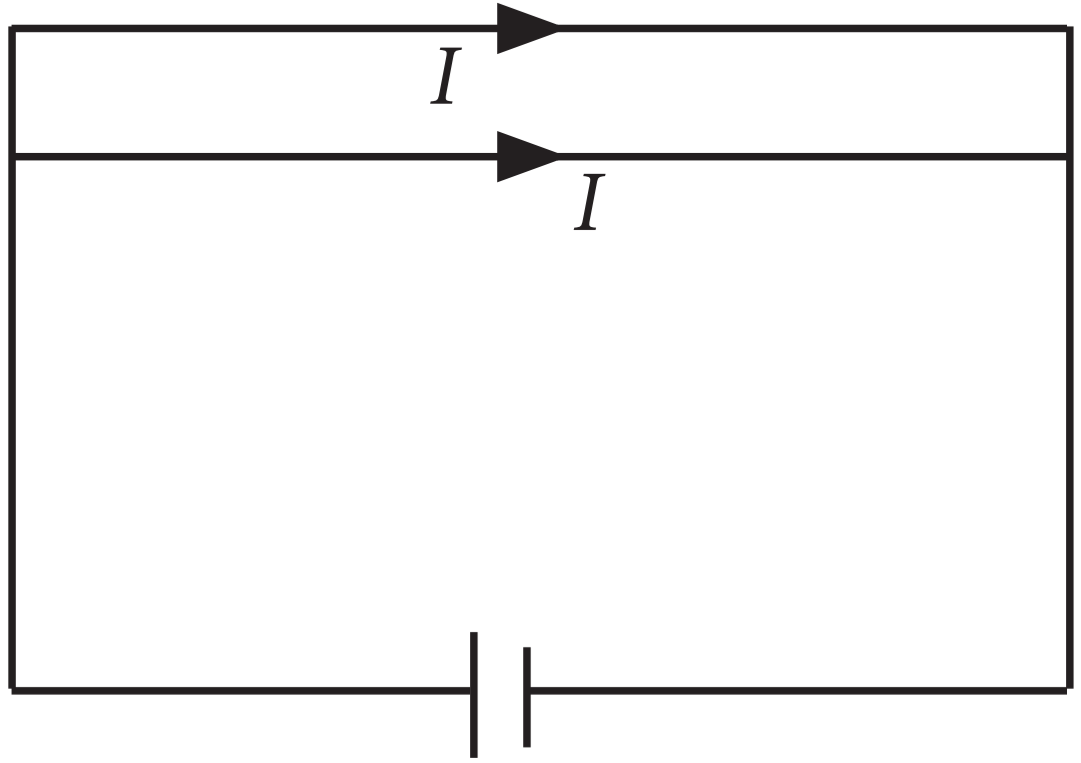
Assertion (A): When two long parallel wires, hanging freely are connected in parallel to a battery, they come closer to each other. Reason (R): Wires carrying current in opposite direction repel each other.
Answer
  1. Both A and Rare true but R is NOT the correct explanation of A.

Explanation:

The wires are parallel to each other but the direction of current in it is in same direction so they attract each other. If the current in the wires is in opposite direction then wires repel each other. When the currents are in opposite directions, the magnetic forces are reversed and the wires repels each other.

View full question & answer
Question 91 Mark
Two statements are given-one labelled Assertion (A) and the other labelled Reason (R). Select the correct answer to these questions from the codes (a), (b), (c) and (d) as given below.
  1. Both A and R are true and R is the correct explanation of A.
  2. Both A and R are true but R is NOT the correct explanation of A.
  3. A is true but R is false.
  4. A is false and R is also false.
Assertion (A): When force is zero, the charged particle follows linear path.
Reason (R): A charged particle enters in a uniform magnetic field, whose velocity makes an angle 8 with magnetic field will cover a linear path.
Answer
  1. A is true but R is false.
Explanation:

When charged particle enters the uniform field they makes angle $\theta$ with the field. Then its path is decided by combined effect of two component of velocity. $\text{v}\cos\theta$ parallel to the field. Due to the parallel field the charge will follow a linear path and due to the perpendicular component $(\text{v}\cos\theta)$ of the field will be circular. This results in a helical path whose axis is parallel to the parallel component of the field.
View full question & answer
Question 101 Mark
Two statements are given-one labelled Assertion (A) and the other labelled Reason (R). Select the correct answer to these questions from the codes (a), (b), (c) and (d) as given below.
  1. Both A and R are true and R is the correct explanation of A.
  2. Both A and R are true but R is NOT the correct explanation of A.
  3. A is true but R is false.
  4. A is false and R is also false.
Assertion (A): When the observation point lies along the length of the current element, magnetic field is zero.
Reason (R): Magnetic field close to current element is zero.
Answer
  1. A is true but R is false.
Explanation:

Since $\text{dB}\propto\sin\theta$ where $\theta$ is angle between the direction of the flow of current and the line joining the elementary portion to the observation point which is zero in this case, so the magnetic field is also zero (because sin8 is equal to zero).
View full question & answer
Question 111 Mark
Two statements are given-one labelled Assertion (A) and the other labelled Reason (R). Select the correct answer to these questions from the codes (a), (b), (c) and (d) as given below.
  1. Both A and R are true and R is the correct explanation of A.
  2. Both A and R are true but R is NOT the correct explanation of A.
  3. A is true but R is false.
  4. A is false and R is also false.
Assertion (A): An electron and proton enters a magnetic field with equal velocities, then, the force experienced by proton will be more than electron.
Reason (R): The mass of proton is 1999 times more than the mass of electron.
Answer
  1. A is false and R is also false.
Explanation:

The force experienced by a charge particle in a magnetic field is given by,

$\vec{\text{F}}=\text{q}(\vec{\text{v}}\times\vec{\text{B}})$

which is independent of mass. As q, v and Bare same for both the electron and proton, hence both will experience same force.
View full question & answer
Question 121 Mark
Two statements are given-one labelled Assertion (A) and the other labelled Reason (R). Select the correct answer to these questions from the codes (a), (b), (c) and (d) as given below.
  1. Both A and R are true and R is the correct explanation of A.
  2. Both A and R are true but R is NOT the correct explanation of A.
  3. A is true but R is false.
  4. A is false and R is also false.
Assertion (A): When current is represented by a straight line, the magnetic field will be circular.
Reason (R): According to Fleming's left hand rule, direction of force is parallel to the magnetic field.
Answer
  1. A is true but R is false.
Explanation:

When current is straight, it means the current is passing through a straight conductor, the magnetic field produced due to current through a straight conductor is in the form of concentric circular magnetic lines of force whose centres lie on the linear conductor and are in a plane perpendicular to the plane of linear conductor. It means the magnetic field is circular.
View full question & answer
Question 131 Mark
Two statements are given-one labelled Assertion (A) and the other labelled Reason (R). Select the correct answer to these questions from the codes (a), (b), (c) and (d) as given below.
  1. Both A and R are true and R is the correct explanation of A.
  2. Both A and R are true but R is NOT the correct explanation of A.
  3. A is true but R is false.
  4. A is false and R is also false.
Assertion (A): A charged particle moving in a uniform magnetic field penetrates a layer of lead and there by loses half of its kinetic energy. The radius of curvature of its path is now reduced to half of its initial value.
Reason (R): Kinetic energy is inversely proportional to radius of curvature.
Answer
  1. Both A and Rare true but R is NOT the correct explanation of A.
Explanation:

The radius of curvature of a charged particle in a magnetic re rs given y,

$\text{r}=\frac{\text{mv}}{\text{qB}}=\frac{\sqrt{2\text{mK.E.}}}{\text{qB}}\text{i.e. r}\propto\sqrt{\text{K.E}}.$

When kinetic energy is halved, the radius is reduced to $\Big(\frac{1}{\sqrt{2}}\Big)$ times its initial value.
View full question & answer
Question 141 Mark
Two statements are given-one labelled Assertion (A) and the other labelled Reason (R). Select the correct answer to these questions from the codes (a), (b), (c) and (d) as given below.
  1. Both A and R are true and R is the correct explanation of A.
  2. Both A and R are true but R is NOT the correct explanation of A.
  3. A is true but R is false.
  4. A is false and R is also false.
Assertion (A): An ammeter is connected in series in the circuit.
Reason (R): An ammeter is a high resistance galvanometer.
Answer
  1. A is true but R is false.
Explanation:

An ammeter is a low resistance galvanometer. It is used to measure the current in amperes. To measure the current of a circuit, the ammeter is connected in series in the circuit so that the current to be measured must pass through it. Since, the resistance of ammeter is low, so its inclusion in series in the circuit does not change the resistance and hence the main current in the circuit.
View full question & answer
Question 151 Mark
Two statements are given-one labelled Assertion (A) and the other labelled Reason (R). Select the correct answer to these questions from the codes (a), (b), (c) and (d) as given below.
  1. Both A and R are true and R is the correct explanation of A.
  2. Both A and R are true but R is NOT the correct explanation of A.
  3. A is true but R is false.
  4. A is false and R is also false.
Assertion (A): Voltmeter is connected in parallel with the circuit.
Reason (R): Resistance of a voltmeter is very large.
Answer
  1. Both A and R are true and R is the correct explanation of A.
Explanation:

A voltmeter is always connected in parallel. This has a large resistance.
View full question & answer
Question 161 Mark
Two statements are given-one labelled Assertion (A) and the other labelled Reason (R). Select the correct answer to these questions from the codes (a), (b), (c) and (d) as given below.
  1. Both A and R are true and R is the correct explanation of A.
  2. Both A and R are true but R is NOT the correct explanation of A.
  3. A is true but R is false.
  4. A is false and R is also false.
Assertion (A): In electric circuits, wires carrying currents in opposite directions are often twisted together.
Reason (R): If the wire are not twisted together, the combination of the wires forms a current loop. 'Tile magnetic field generated by the loop might affect adjacent circuits or components.
Answer
  1. Both A and R are true and R is the correct explanation of A.
Explanation:

If the wires are twisted together, they can be modelled as a single wire carrying current in the opposite directions. In this model, no magnetic field is induced in the wires which does not affect adjacent circuits.
View full question & answer
Question 171 Mark
Two statements are given-one labelled Assertion (A) and the other labelled Reason (R). Select the correct answer to these questions from the codes (a), (b), (c) and (d) as given below.
  1. Both A and R are true and R is the correct explanation of A.
  2. Both A and R are true but R is NOT the correct explanation of A.
  3. A is true but R is false.
  4. A is false and R is also false.
Assertion (A): There is a spark in the switch when the switch is closed.
Reason (R): Current flowing in the conductor produces magnetic field
Answer
  1. Both A and Rare true but R is NOT the correct explanation of A.
View full question & answer
Assertion (A) & Reason (B) MCQ - Physics STD 12 Science Questions - Vidyadip