- A$U$
- B$R$
- C$C$
- ✓$O$
Triangle, quadrilateral, circle, etc., are examples of closed curves.
All sides and angles in a square are equal, while all other three options have unequal measures.
The three angles of a quadrilateral are $80^\circ , 70^\circ $ and $120^\circ .$
Let the fourth angle be $x.$
We know that the sum of all the angles of a quadrilateral is $360^\circ .$
$80^\circ + 70^\circ + 120^\circ + x = 360^\circ $
$\Rightarrow 270^\circ + x = 360^\circ $
$\Rightarrow x = 360^\circ – 270^\circ $
$\Rightarrow x = 90^\circ $
Thus, the fourth angle is $90^\circ .$
Two intersecting lines can never be parallel to each other. So, as they are intersecting, this is not possible that they are both parallel to the same line.
A straight angle is equal to $180^\circ .$
A ray is a line segment which has only one end point. One end of ray is fixed and the other end doesnt exist.
Three lines will not necessarily intersect in a plane. Thus, the minimum point of intersection will be 0.
An angle of measure $180^\circ $ is a straight angle.
A rectilinear figure is a figure all of whose edges meet at right angles. These edges are formed by straight lines so as to form a polygon with all interior angles of $90^\circ $
They are line segments joining two opposite vertices in a polygon.
line segment has a definite length.
When we join number of points without lifting our pen we make a shape which not necessarily should be straight or curve. We get a plane curve.
Vertex of an angle lie on it.
An intersection can be seen at the legs of a table and bed. But there is no such intersection in Mango and Cricket ball
A curve is a shape or a line which is smoothly drawn in a plane having a bent or turns in it.
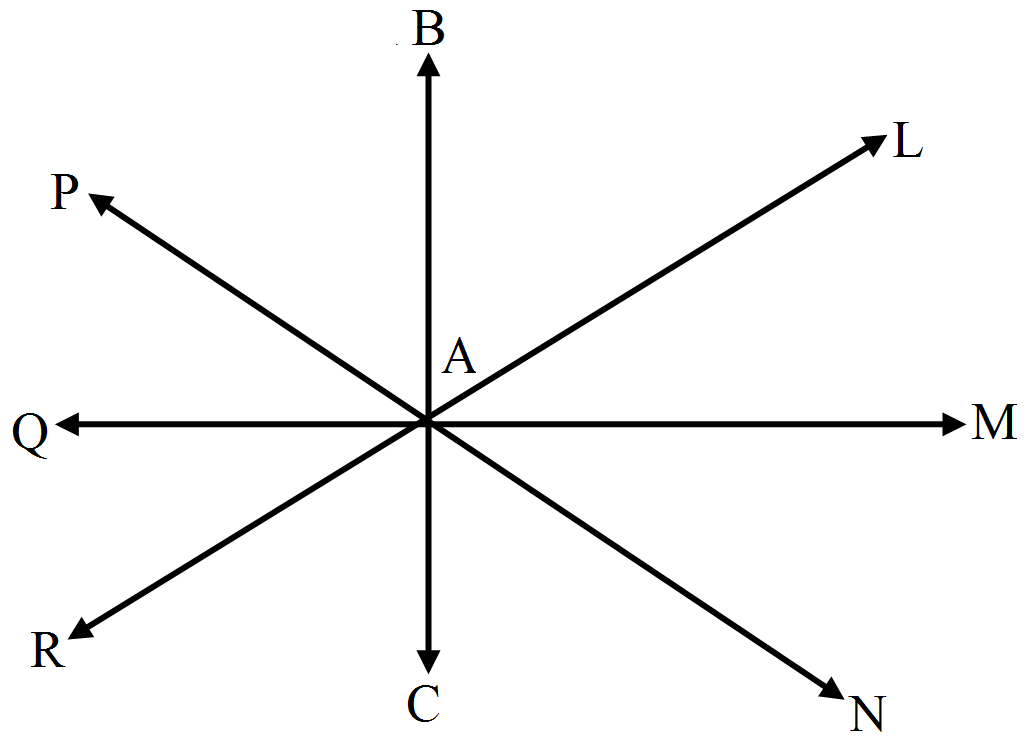
An unlimited number of rays can be drawn with a given point as the initial point.
For example:

Parallel lines are equidistant from each other at every point and intersect at infinity or are equivalent to non-intersecting lines.
The symbol of a ray is $\rightarrow $
Hence, A ray $CD$ is symbolically written as $\overrightarrow{\text{CD}}$
Parallel lines never intersect each other by virtue of their property.
A ray has a starting point but no end point..

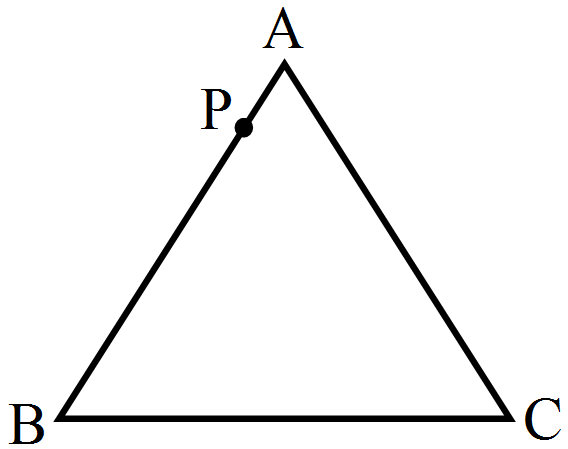
In the figure, $P$ lies on $AB$. Its lies on the $\triangle\text{ABC}.$
line segment has a fixed length since it is joined by two fixed points..
from a point infinite(endless) number of rays can be drawn..
$\therefore$ Largest angle
$=\frac{180^\circ\times4}{2+3+4}=\frac{180^\circ\times4}{9}=80^\circ$
A Scalene triangle is defined as the triangle in which no sides are equal.
$\therefore$ A scalene triangle has different sides.
A complete angle is equal to $360^\circ .$
A line does not have any end point. It is a line segment that is extended endlessly on both sides.
Sum of exterior angles of every polygon irrespective of number of its sides $360^\circ $ As it is a regular polygon, all exterior angles are equal and are $30^\circ $
So, number of sides of the polygon $=\frac{360^{\circ}}{30^{\circ}}=12$
Every line segment has a definite length, which can be measured using a ruler.
$\therefore$ Sum of three angles is $180^\circ$ and sum of two equal angles $= 70^\circ + 70^\circ = 140^\circ ,$ then third angle will be $180^\circ - 140^\circ = 40^\circ .$
Perimeter is defined as the sum of the length of all the sides of a triangle.
The polygon is a closed curve. The angles formed by a polygon within are called interior angles.
$x + 2y - 4 = 0....(i)$ and $2y + 4y - 12 = 0.....(ii)$
Slope of $(i) = \text{m}_1=\frac{1}{2}$
Slope of $(ii) \text{m}_2=\frac{2}{4}=\frac{1}{2}\text{m}_1=\text{m}_2$
Therefore lines are parallel.
An altitude is defined as the perpendicular drawn from a vertex to the opposite side of a triangle.
Diameter $= 2x$ radius
We classify the polygons by their number of sides.
So, it can be any number only it should have line segments and it should be a closed figure.
Since, $1$ right angle $= 90^\circ $
Therefore, $2$ right angles $= 90^\circ \times 2 = 180^\circ $
$\therefore$ A triangle has $180^\circ $ and if two angles are complementary i.e. sum of two angles is $90^\circ ,$ then third angle will be $180^\circ - 90^\circ = 90^\circ .$