MCQ 11 Mark
$n^2 + n + 1$ is a or an ______ number for all $\text{n}\in\text{N}$
AnswerConsider $n^2$$+ n = n (n + 1)$
We know that if $n$ is a number, then $n +1$ will be its consecutive number And product of a number and its consecutive number is always even.
For example, $2 \times 3$ $= 6; 9 \times 10$ $= 90$ And as $n^2$$+ n$ is an even number.
Then $n^2$ $+ n + 1$ will be the next consecutive number of the even number, which is an odd number.
Hence, $n^2$ $+ n + 1$ will always be an odd number for all natural numbers.
View full question & answer→MCQ 21 Mark
If $a$ and $b$ are whole numbers, then $a - b$ is:
Answer If $a$ and $b$ are whole numbers, then there may be the following $3$ cases:
Case $1$: When $a > b$ Then, $a - b \Rightarrow $ Whole/ Natural number
Case $2$: When $a < b$Then, $a - b \Rightarrow $ Integer
Case $3$: When $a = 0$ and $b = 0$ Then, $a - b \Rightarrow $ Whole number.
Hence, option $D$ is correct.
View full question & answer→MCQ 31 Mark
Which of the following satisfies closure property for whole numbers?
- A
$12 + 0 = 12$
- B
$13 + 0 = 13$
- C
$16 + 6 = 22$
- ✓
Answer All numbers are whole numbers. For closure property, whole number $+$ whole number $=$ whole number.
In all the cases, the above property is satisfied.
View full question & answer→MCQ 41 Mark
The successor of the smallest prime number is:
Answer The smallest prime number is $2$
So, Successor of $2 = 2 + 1 = 3$
View full question & answer→MCQ 51 Mark
$100$ million is equal to:
AnswerCorrect option: C. $10$ Crore
$ 100$ million $= 100,000,000100,000,000$
$= 10,00,00,000 = 10 = 10,00,00,000 = 10$ crore
View full question & answer→MCQ 61 Mark
The smallest natural number is:
Answer We know that natural numbers start from $1, 2, 3, ...$
So, the smallest natural number $=1$
View full question & answer→MCQ 71 Mark
The value of $1735 \times 1232 - 1735 \times 232$ is:
- A
$17350$
- B
$173500$
- ✓
$1735000$
- D
$173505$
AnswerCorrect option: C. $1735000$
Using distributive law of multiplication over subtraction, we get
$1735 \times 1232 - 1735 \times 232 = 1735 (1232 - 232)$
$= 1735 \times 1000$
$= 1735000$
Hence, the correct option is $(c).$
View full question & answer→MCQ 81 Mark
Multiplying a negative integer for odd times gives a _____ result:
Answer$ (-1) \times (-1) \times (-1).......$odd times $=$ Negative sign.
View full question & answer→MCQ 91 Mark
$A$ and $b$ are two co-primes. Which of the following is/ are true$?$
AnswerCorrect option: C. Both $(a)$ and $(b).$
A set of numbers which do not have any other common factor other than $1$ are called co-prime.
The $LCM$ of two co-prime numbers is equal to their product.
The $HCF$ of two co-prime numbers is $1.$
View full question & answer→MCQ 101 Mark
How many $4$ digit numbers, in all are there$?$
AnswerCorrect option: C. $9000$
$\Rightarrow $ The smallest $4 −$ digit number $= 1000.$
$\Rightarrow $ The greatest $4 −$ digit number $= 9999.$
$\Rightarrow $ Total $4 −$ digit numbers $= (9999 - 1000) + 1$
$= 8999 + 1$
$= 9000$
So, we say that we have $9000$ four - digit numbers.
View full question & answer→MCQ 111 Mark
$67 + 33 = 33 + 67$ is an example of:
Answer$67 + 33 = 33 + 67$ is an example of commutative property of addition.
View full question & answer→MCQ 121 Mark
In whole numbers closure property is not satisfied w.r.t. operation:
- A
$(+, ÷)$
- B
$(+, \times )$
- C
$(−, \times )$
- ✓
AnswerClosure property in whole number states that if we do the operation between two whole number we should get a whole number. $2, 5$ are
whole number. $2 - 5 = (-3)$ is not a whole number. $\frac{2}{5} = 0.4$ is not a whole number.
Closure property is not satisfied w.r.t. subtraction and division in whole numbers.
View full question & answer→MCQ 131 Mark
$4 \times 538 \times 25 = ?$
- A
$32280$
- B
$26900$
- ✓
$53800$
- D
$10760$
AnswerCorrect option: C. $53800$
$4 \times 538 \times 25$
$= 100 \times 538$
$= 53800$
View full question & answer→MCQ 141 Mark
The difference between the greatest and least numbers of $\frac{5}{9},\frac{1}{9},\frac{11}{9}$ is-
- A
$ \frac{9}{2}$
- B
$ \frac{10}{9}$
- C
$ \frac{3}{8}$
- ✓
AnswerThe ascending order of given numbers is $ \frac{1}{9},\frac{5}{9},\frac{11}{9}$ Here denominator is equal, so greater the numerator greater will be the value.
$ \therefore$ Required difference
$\frac{11}{9}- \frac{1}{9}=\frac{10}{9}$
View full question & answer→MCQ 151 Mark
Multiplicative identity of whole number is given by:
- ✓
$1$
- B
$0$
- C
Both $0$ and $1$
- D
AnswerThe multiplicative identity property states that any time you multiply a number by $1,$ the result, or product, is that original number.
So it is clear that multiplicative property is given by
View full question & answer→MCQ 161 Mark
The natural number which is a multiple of every number is ________.
AnswerThere is no such number which is a multiple of every number!
View full question & answer→MCQ 171 Mark
Which of the following when added to the additive identity element results $0?$
AnswerThe additive identity element is $0.$ We know that the sum of $0$ and any number is the number itself.
Let the number be $x.$
$\therefore x + 0 = 0$
$\Rightarrow x = 0$
View full question & answer→MCQ 181 Mark
The smallest number which is neither prime nor composite is:
MCQ 191 Mark
The sum of two odd numbers is:
AnswerThe sum of two odd numbers is an even number.
Example: $5 + 3 = 8$
View full question & answer→MCQ 201 Mark
Mark the correct alternative in the following: Additive inverse of $28$ is:
- A
$\frac{1}{28}$
- B
$0$
- ✓
$-28$
- D
$82$
AnswerHere, the given number is $28.$
Additive inverse of a given number is a number which when added to the given number gives zero.
Now $28 + (-28) = 0$
Thus, $-28$ is the additive inverse of $28.$
Hence, the correct option is $(c).$
View full question & answer→MCQ 211 Mark
Whole numbers are not closed under ......... operation.
Answer Whole numbers are not closed under subtraction operation because when any two whole numbers are considered and from them one is subtracted from the other, the difference so obtained is not necessarily a whole number.
Eg. $2 - 5 = -3.$
View full question & answer→MCQ 221 Mark
$- 174 □ - 170 = - 174$ then the symbol in blank is:
AnswerCorrect option: C. $+$ or $-$
$\frac{4}{-17}+\frac{0}{-17} =\frac{4}{-17}$
$\frac{4}{-17}-\frac{0}{-17}= \frac{4}{-17}$
Therefore we use both $+$ or $-$
View full question & answer→MCQ 231 Mark
Which of the following statement is true$?$
- A
Every whole number is a natural number.
- ✓
Every natural number is a whole number.
- C
'1' is the least whole number.
- D
AnswerCorrect option: B. Every natural number is a whole number.
Natural numbers set is $1, 2, 3, ......$
Whole numbers set is $0, 1, 2, 3, .....$
Clearly every natural number is a whole number.
View full question & answer→MCQ 241 Mark
Which of the following operations are not associative with respect to whole numbers?
- A
- ✓
- C
Addition and multiplication
- D
Multiplication and division
AnswerAssociative property does not hold good w.r.t. subtraction:
$\text A - (\text{B - C}) \neq (\text{A - B}) - \text{C}$
Associative property does not hold good w.r.t. division as well:
$\text{A}\div(\text{B}\div\text{C})\neq(\text{A}\div\text{B})\div\text{C}$
View full question & answer→MCQ 251 Mark
Which one of the following is the smallest odd whole number$?$
AnswerThe natural numbers along with $0$ form the collection of whole numbers.
So, the numbers $0, 1, 2, 3, 4, …$ form the collection of whole numbers.
A natural number which is not divisible by $2$ is called an odd whole number.
So, in the collection $“0, 1, 2, 3, 4, …”, 1$ is the smallest odd whole number.
Hence, the correct option is $(b).$
View full question & answer→MCQ 261 Mark
When we multiply a whole number and the multiplicative identity of whole numbers, then we get _____.
- ✓
- B
The multiplicative identity
- C
$0$
- D
AnswerThe product of the multiplicative identity of whole number i.e.,
$1$ and a whole number we get the number itself.
View full question & answer→MCQ 271 Mark
$1001 \div 11$ of $13 = ?$
Answer$= 1001 \div 11$ of $13$
$= 1001 \div (11 \times 13)$
$= 1001 \div 143 = 7$
View full question & answer→MCQ 281 Mark
What whole number is nearest to $457$ which is divisible by $11?$
Answer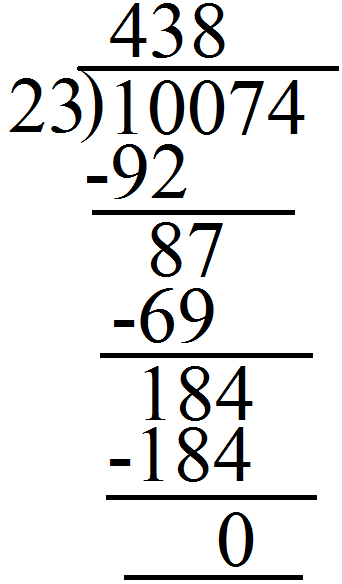
Hence, $462$ is divisible by $11.$
Here, the numbers given in options $(b)$ and $(d)$ are divisible by $11.$
However, we want a whole number nearest to $457$ which is divisible by $11.$
So, $462$ is whole number nearest to $457$ and divisible by $11.$ View full question & answer→MCQ 291 Mark
If $n$ is a whole number such that $n + n = n$ then $n = ?$
Answer$n + n = n^2n = n$ Clearly $n = 0$, satisfies
So $n = 0$ is the final answer.
View full question & answer→MCQ 301 Mark
The number of surjections from$\text{ A }= {1, 2,...\text{n}},\text{ n} \leq 2$ onto $B = \{a, b\}$ is:
- A
$^\text{n}\text{P}_2$
- ✓
$2^\text{n}-2 $
- C
$2^\text{n}-1 $
- D
AnswerCorrect option: B. $2^\text{n}-2 $
$A = \{1, 2, 3, ........, n\} $
$B = \{a, b\}$
A has $n$ elements. $B$ has $2$ elements.
$\therefore$ No. of surjection is $ 2^{\text{n}}-2$
View full question & answer→MCQ 311 Mark
Whole numbers are not closed under ......... operation:
AnswerWhole numbers are not closed under subtraction operation because when any two whole numbers are considered and from them one is subtracted from the other,
the difference so obtained is not necessarily a whole number.
Eg. $2 - 5 = −3.$
View full question & answer→MCQ 321 Mark
If we write natural numbers from $1$ to $100,$ the number of times the digit $5$ has been written is:
Answer If we write natural numbers from $1$ to $100,$ the number of times the digit $5$ has been written is $20.$
View full question & answer→MCQ 331 Mark
The largest number of $6$ digits which is exactly divisible by $16$ is:
- A
$999980$
- B
$999982$
- ✓
$999984$
- D
$999964$
AnswerCorrect option: C. $999984$
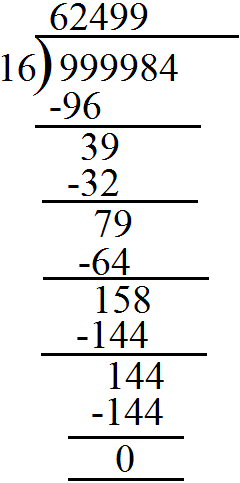
Hence, $999984$ is exactly divisible by $16.$
The largest six-digit number which is exactly divisible by $16$ is $999984.$ View full question & answer→MCQ 341 Mark
Which one of the following whole numbers does not have a predecessor$?$
AnswerThe numbers $0, 1, 2, 3, 4, ….$ form the collection of whole numbers.
The smallest whole number is $0.$
So, $0$ does not have a predecessor.
Hence, the correct option is $(b).$
View full question & answer→MCQ 351 Mark
Let $x$ be a real variable, and let $3 < x < 4.$ Which of the following values, $x$ might have$?$
- A
$-3.1$
- ✓
$\sqrt{11}$
- C
$\sqrt{\frac{10}{11}}$
- D
AnswerCorrect option: B. $\sqrt{11}$
$x$ can have any values between $3$ and $4$ so it can be rational or irrational.
option $c = 0.9$ and options $A$ and $D$ are outside the given range.
View full question & answer→MCQ 361 Mark
The property represented by $a \times (b + c) = a \times b + a \times c$ is:
AnswerDistributive property say that multiplication an division can be distributed over parenthesis.
$a \times (b + c) = a \times b + a \times c$
View full question & answer→MCQ 371 Mark
The counting numbers $1, 2, 3, 4, ....$ are called:
AnswerNatural numbers are the set of whole numbers $($except $0).$
The numbers $1,2,3,4,5.......$ are called natural numbers.
View full question & answer→MCQ 381 Mark
Simplify using distributive property: $14 \times 6 + 14 \times 4 = ...........$
AnswerThe Distributive Property is easy to remember if you recall that "multiplication distributes over addition".
Formally, they write this property as $"a(b + c) = ab + ac".$
$14 \times 6 + 14 \times 4$
$= 14 \times (6 + 4) ($distributive property$)$
$= 14 \times 10$
$= 140.$
View full question & answer→MCQ 391 Mark
Which of the following shows the distributive property of multiplication over addition$?$
- A
$(x + 0) \times (y + 0) = x \times y$
- B
$x \times y = y \times x$
- C
$x \times 1 = x$
- ✓
$x (y + z) = (x \times y) + (x \times z)$
AnswerCorrect option: D. $x (y + z) = (x \times y) + (x \times z)$
$x(y + z) = (x \times y) + (x \times z)$ shows the distributive property of multiplication over addition.
View full question & answer→MCQ 401 Mark
How many whole numbers are there between $1018$ and $1203?$
AnswerNumber of whole numbers $= (1203 - 1018) - 1$
$= 185 - 1$
$= 184$
View full question & answer→MCQ 411 Mark
$587 \times 99 = ?$
- A
$57213$
- B
$58513$
- ✓
$58113$
- D
$56413$
AnswerCorrect option: C. $58113$
$587 \times 99$
$= 587 \times (100 - 1)$
$= 587 \times 100 - 587 \times 1$
$= 58700 - 587$
$= 58113$
View full question & answer→MCQ 421 Mark
$24679 \times 92 + 24679 \times 8 = ?$
- A
$493580$
- B
$1233950$
- ✓
$2467900$
- D
AnswerCorrect option: C. $2467900$
By using the distributive property, we have:
$24679 \times 92 + 24679 \times 8$
$= 24679 \times (92 + 8)$
$= 24679 \times 100$
$= 2467900$
View full question & answer→MCQ 431 Mark
Which of the following statements is incorrect$?$
- A
$0$ is the additive identity for natural numbers
- B
$0$ is the additive identity for whole numbers
- C
$0$ is the additive identity for integers
- ✓
$1$ is the additive identity for rational numbers
AnswerCorrect option: D. $1$ is the additive identity for rational numbers
We know that, the sum of $0$ and any rational number is the number itself.
Thus, $0$ is the additive identity for rational numbers.
View full question & answer→MCQ 441 Mark
The least number divisible by each of the numbers $15, 20, 24$ and $32$ is:
Answer$LCM$ of $15, 20, 24$ and $32$ is given by
$15 = 3 \times 5 = 3^1 \times 5^1$
$20 = 2 \times 2 \times 5 = 2^2 \times 5^1$
$24 = 2 \times 2 \times 2 \times 3 = 2^3 \times 3^1$
$32 = 2 \times 2 \times 2 \times 2 \times 2 = 2^5$
$LCM = 2^5 \times 3^1 \times 5^1 = 480$
View full question & answer→MCQ 451 Mark
Which of the following expressions is equal to $83 \times 5?$
- A
$8 \times (3 + 5)$
- B
$5 \times (8 + 3)$
- ✓
$5 \times (80 + 3)$
- D
$80 \times (3 + 5)$
AnswerCorrect option: C. $5 \times (80 + 3)$
$83 \times 5 = (80 + 3) \times 5$
View full question & answer→MCQ 461 Mark
The number of whole numbers between the smallest whole number and the greatest $2$ digit number is:
AnswerSmallest whole number $= 0$
Greatest $2-$digit whole number $= 99$
The whole numbers between $0$ and $99$ are $1, 2, 3, 4 …… 97, 98.$
To find the number of whole numbers between $0$ and $99,$
Subtract $1$ from the difference of $0$ and $99.$
Therefore, Number of whole numbers between $0$ and $99 = (99 - 0) - 1$
$= 99 - 1$
$= 98$
Hence, the correct option is $(d).$
View full question & answer→MCQ 471 Mark
For any integer $′a′,$ the value of $a + 0 = ..........$
View full question & answer→MCQ 481 Mark
The predecessor of $1$ million is:
- A
$9999$
- B
$99999$
- ✓
$999999$
- D
$1000001$
AnswerCorrect option: C. $999999$
We have:
$1$ million $= 10,00,000$
Predecessor of $1$ million,
$= 10,00,000 - 1 = 9,99,999$
View full question & answer→MCQ 491 Mark
On a vertical number line positive numbers are placed ____ $0.$
AnswerPositive number are located above 0 and negative numbers are located below $0$ on a vertical number line.
View full question & answer→MCQ 501 Mark
Mark the correct alternative in the following:
What is the additive identity element in the set of whole numbers$?$
AnswerAn additive identity is a number which when added to any number, the number is unchanged.
For example: $0 + 7 = 7, 0 + 9 = 9, 0 + (- 11) = -11$ etc.
Thus, $0$ is the additive identity in the set of whole numbers.
Hence, the correct option is $(a).$
View full question & answer→