Question 12 Marks
Find the following products, using distributive laws: $439 \times 997$
Answer$439 \times 997= 439 \times (1000 - 3)$
$= 439 \times 1000 - 439 \times 3$ (Using distributive law of multiplication over addition)
$= 439000 - 1317$
$= 437683$
View full question & answer→Question 22 Marks
Find the value of the following using various properties: $569 \times 17 + 569 \times 13 + 569 \times 70$
Answer$559 \times 17 + 569 \times 13 + 569 \times 70= 569 \times (17 + 13 + 70)$
$= 569 \times 100$
$= 569000$ (By using distributive property)
View full question & answer→Question 32 Marks
Find the following products, using distributive laws:
$245 \times 1008$
Answer$245 \times 1008= 245 \times (1000 + 8)$
$= 245 \times 1000 + 245 \times 8$ (Using distributive law of multiplication over addition)
$= 245000 + 1960$
$=246960$
View full question & answer→Question 42 Marks
Determine the sums given below using suitable rearrangement. $15409 + 278 + 691 + 422$
Answer$15409 + 278 + 691 + 422 (15409 + 278) + (691 + 422)$ (Using associative property of addition)
$= 15687 + 1113 = 16800$
View full question & answer→Question 52 Marks
Find a whole number n such that $n ÷ n = n.$
AnswerGiven: $n ÷ n = n$
$\Rightarrow nnnn = n$
$\Rightarrow n = n^2$
i.e., the whole number $n$ is equal to $n^2$
$\therefore$ The given whole number must be $1.$
View full question & answer→Question 62 Marks
Determine the following products by suitable rearrangements : $2 \times 1658 \times 50$
View full question & answer→Question 72 Marks
Determine the sums given below using suitable rearrangement. $3259 + 10001 + 2641 + 9999$
Answer$3259 + 10001 + 2641 + 9999 (3259 + 10001) + (2641 + 9999)$ (Using associative property of addition)
$= 13260 + 12640 = 25900$
View full question & answer→Question 82 Marks
Find the following products, using distributive laws: $740 \times 105$
Answer$740 \times 105= 740 \times (100 + 5)$
$= 740 \times 100 + 740 \times 5$ (Using distributive law of multiplication over addition)
$= 74000 + 3700$
$= 77700$
View full question & answer→Question 92 Marks
Add the following numbers and check by revershing the order of the addends: $19753 + 2867$
Answer$19753 + 2867 = 22620$
By reversing the order of the addends,
we get: $2867 + 19753 = 22620$
$\therefore$ $19753 + 2867 = 2867 + 19753$
View full question & answer→Question 102 Marks
Use distributive law to find the value of:
$1063 \times 128 - 1063 \times 28.$
AnswerUsing distributive law, we have:
$1063 \times 128 - 1063 \times 28$
$= 1063 \times (128 - 28)$
$= 1063 \times 100$
$= 106300$
View full question & answer→Question 112 Marks
Determine the sums given below using suitable rearrangement.
$953 + 707 + 647$
Answer$953 + 707 + 647$
$953 + (707 + 647)$ (Using associative property of addition)
$= 953 + 1354$
$= 2307$
View full question & answer→Question 122 Marks
There are six sections of Class $VI$ in a school and there are $45$ students in each section. If the monthly charges from each student be $Rs. 1650,$ find the total monthly collection from Class $VI.$
AnswerNumber of students in $1$ section $= 45$
Number of students in $6$ sections $= 45 \times 6 = 270$
Monthly charges from $1$ student $= Rs. 1650$
Therefore, Total monthly collection from class $VI = Rs. 1650 \times 270 = Rs. 4,45,500$
View full question & answer→Question 132 Marks
Find the following products, using distributive laws:
$996 \times 367$
Answer$996 \times 367= 367 \times (1000 - 4)$
$= 367 \times 1000 - 367 \times 4$ (Using distributive law of multiplication over addition)
$= 367000 \times 1468$
$= 365532$
View full question & answer→Question 142 Marks
Find the value of the following using various properties: $9870 \times 561 - 9870 \times 461$
Answer$9870 \times 561 - 9870 \times 461= 9870 \times (561 - 461)$
$= 9870 \times 100$
$= 987000$ (By using distributive property)
View full question & answer→Question 152 Marks
Add the following numbers and check by revershing the order of the addends:
$16509 + 114$
Answer$16509 + 114 = 16623$
By reversing the order of the addends, we get:
$114 + 16509 = 16623$
$\therefore$ $16509 + 114 = 114 + 16509$
View full question & answer→Question 162 Marks
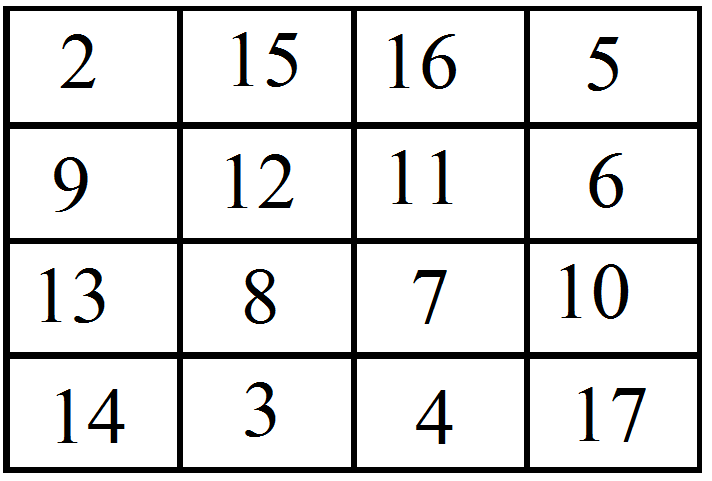
Complete one of the following magic squares by supplying the missing numbers:
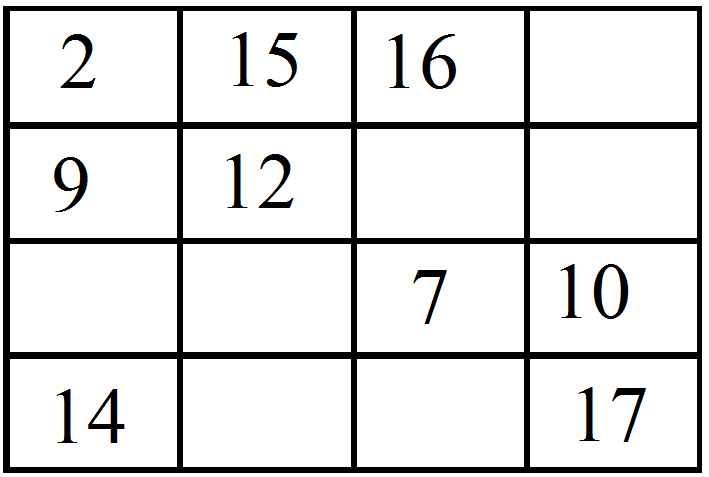
AnswerIn a magic square, the sum of each row is equal to the sum of each column and the sum of each main diagonal. By using this concept, we have:
View full question & answer→Question 172 Marks
Determine the following products by suitable rearrangements : $4 \times 927 \times 25$
Answer$4 \times 927 \times 25= (4 \times 25) \times 927$
$= 100 \times 927$
$= 92700$
View full question & answer→Question 182 Marks
Find the following products, using distributive laws: $947 \times 96$
Answer$947 \times 96= 947 \times (100 - 4)$
$= 947 \times 100 - 947 \times 4$ (Using distributive law of multiplication over addition)
$= 94700 - 3788$
$= 90912$
View full question & answer→Question 192 Marks
Find the following products, using distributive laws: $ 2437 \times 999$
AnswerDistributive property of multiplication over addition states that $a(b + c) = ab + ac$
Distributive property of multiplication over subtraction states that $a(b - c) = ab - ac$
$2437 \times 999$
$= 2437 \times (1000 - 1)$
$= 2437 \times 1000 - 2437 \times 1$
$= 2437000 - 2437$
$= 2434563$
View full question & answer→Question 202 Marks
Find the following products, using distributive laws: $1553 \times 198$
Answer$1553 \times 198= 1553 \times (200 - 2)$
$= 1553 \times 200 - 1553 \times 2$ (Using distributive law of multiplication over addition)
$= 310600 - 3106$
$= 307494$
View full question & answer→Question 212 Marks
Find the following products, using distributive laws: $847 \times 99$
AnswerDistributive property of multiplication over addition states that $a(b + c) = ab + ac$
Distributive property of multiplication over subtraction states that $a(b - c) = ab - ac$
$847 \times 99$
$= 847 \times (100 - 1)$
$= 847 \times 100 - 847 \times 1$
$= 84700 - 847$
$= 83853$
View full question & answer→Question 222 Marks
Find the sum: $(1546 + 498) + 3589$. Also, find the sum: $1546 + (498 + 3589)$. Are the two sums equal? State the property satisfied.
AnswerWe have: $(1546 + 498) + 3589 = 2044 + 3589 = 5633$
Also, $1546 + (498 + 3589) = 1546 + 4087 = 5633$
Yes, the two sums are equal.
The associative property of addition is satisfied.
View full question & answer→Question 232 Marks
Determine the following products by suitable rearrangements : $250 \times 60 \times 50 \times 8$
Answer$250 \times 60 \times 50 \times 8= (250 \times 8) \times (60 \times 50)$
$= 2000 \times 3000$
$= 6000000$
View full question & answer→Question 242 Marks
Add the following numbers and check by revershing the order of the addends: $2359 + 548$
Answer$2359 + 548 = 2907$ By reversing the order of the addends,
we get: $548 + 2359 = 2907$
$\therefore$ $2359 + 548 = 548 + 2359$
View full question & answer→Question 252 Marks
How many whole numbers are there between $1032$ and $1209?$
AnswerNumber of whole numbers between $1032$ and $1209 = (1209 - 1032) - 1 = 177 - 1 = 176$
View full question & answer→Question 262 Marks
Find the following products, using distributive laws: $472 \times 1097$
Answer$472 \times 1097= 472 \times (1000 + 97)$
$= 472 \times 1000 + 472 \times 97$ (Using distributive law of multiplication over addition)
$= 472000 + 45784$
$= 517784$
View full question & answer→Question 272 Marks
Determine the sums given below using suitable rearrangement. $2 + 3 + 4 + 5 + 45 + 46 + 47 + 48$
Answer$2 + 3 + 4 + 5 + 45 + 46 + 47 + 48 (2 + 3 + 4 + 5) + (45 + 46 + 47 + 48)$ (Using associative property of addition)
$= 14 + 186 = 200$
View full question & answer→Question 282 Marks
Find the following products, using distributive laws: $3576 \times 9$
AnswerDistributive property of multiplication over addition states that $a(b + c) = ab + ac$
Distributive property of multiplication over subtraction states that $a(b - c) = ab - ac$
$3476 \times 9$
$= 3576 \times (10 - 1)$
$= 3576 \times 10 - 3576 \times 1$
$= 35760 - 3576$
$= 32184$
View full question & answer→Question 292 Marks
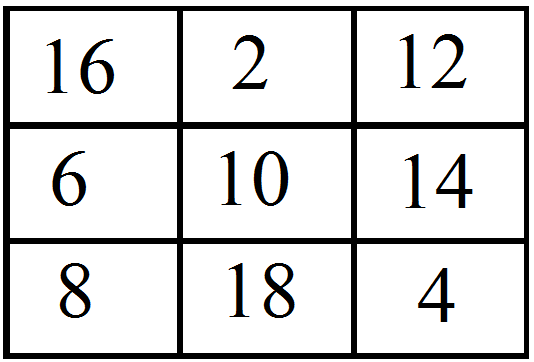
Complete one of the following magic squares by supplying the missing numbers:
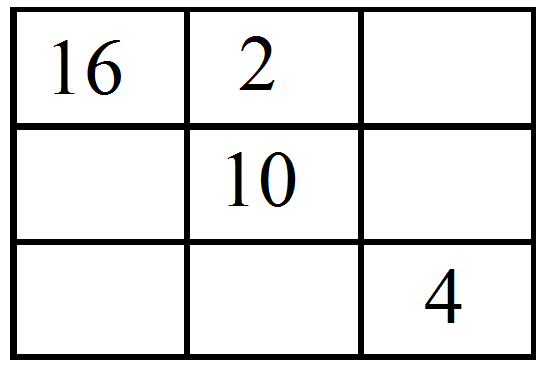
AnswerIn a magic square, the sum of each row is equal to the sum of each column and the sum of each main diagonal. By using this concept, we have:
View full question & answer→Question 302 Marks
Determine the following products by suitable rearrangements : $625 \times 20 \times 8 \times 50$
Answer$625 \times 20 \times 8 \times 50$
$= (20 \times 50) \times 8 \times 625$
$= 1000 \times 8 \times 625$
$= 8000 \times 625$
$= 5000000$
View full question & answer→Question 312 Marks
Find the sum by short method:
$6784 + 9999$
Answer$6784 + 9999$
$= 6784 + (10000 - 1)$
$= (6784 + 10000) - 1$ (Using associative property of addition)
$= 16784 - 1$
$= 16783$
View full question & answer→Question 322 Marks
Determine the following products by suitable rearrangements : $8 \times 125 \times 40 \times 25$
Answer$8 \times 125 \times 40 \times 25$
$= (8 \times 125) \times (40 \times 25)$
$= 1000 \times 1000$
$= 1000000$
View full question & answer→Question 332 Marks
Complete one of the following magic squares by supplying the missing numbers: 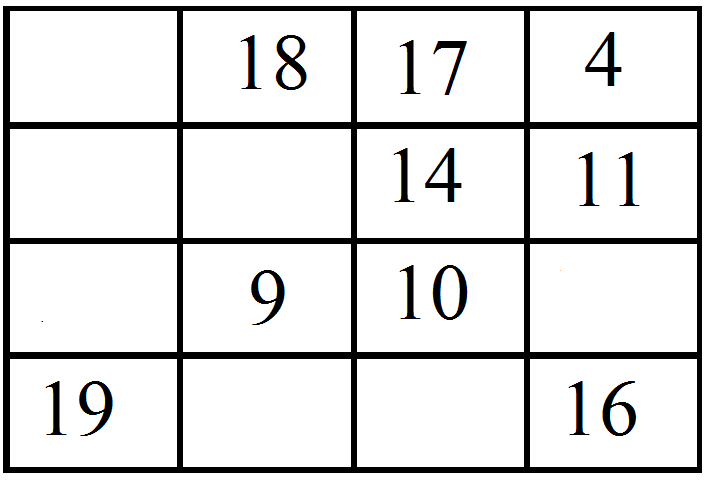
Answer In a magic square, the sum of each row is equal to the sum of each column and the sum of each main diagonal. By using this concept, we have: 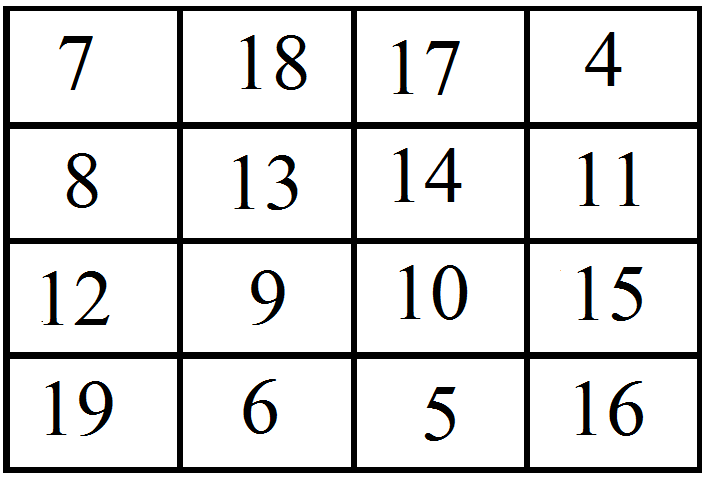
View full question & answer→Question 342 Marks
Determine the following products by suitable rearrangements : $574 \times 625 \times 16$
Answer$574 \times 625 \times 16= 574 \times (625 \times 16)$
$= 574 \times 10000$
$= 5740000$
View full question & answer→Question 352 Marks
Determine the sums given below using suitable rearrangement. $1983 + 647 + 217 + 353$
Answer$1983 + 647 + 217 + 353 (1983 + 647) + (217 +353)$ (Using associative property of addition)
$= 2630 + 570 = 3200$
View full question & answer→Question 362 Marks
Determine the sums given below using suitable rearrangement.
$1 + 2 + 3 + 4 + 96 + 97 + 98 + 99$
Answer$1 + 2 + 3 + 4 + 96 + 97 + 98 + 99$
$(1 + 2 + 3 + 4) + (96 + 97 + 98 + 99)$ (Using associative property of addition)
$= (10) + (390)$
$= 400$
View full question & answer→Question 372 Marks
The product of two whole number is zero. What do you conclude?
AnswerIf the product of two whole number is zero, then one of them is definitely zero.
Example: $0 \times 2 = 0$ and $0 \times 15 = 0$ If the product of whole number is zero, then both of them may be zero.
$ I.e. 0 \times 0 = 0$ Now, $2 \times 5 = 10$. Here, the product will be non-zero because the numbers to be multiplied are not equal to zero.
View full question & answer→Question 382 Marks
Complete one of the following magic squares by supplying the missing numbers:
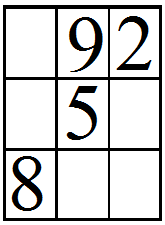
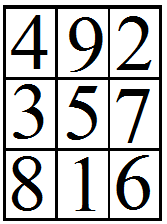
AnswerIn a magic square, the sum of each row is equal to the sum of each column and the sum of each main diagonal. By using this concept, we have:
View full question & answer→Question 392 Marks
Find the sum by short method:
$10578 + 99999$
Answer$10578 + 99999$
$= 10578 + (100000 - 1)$
$= (10578 + 100000) - 1$ (Using associative property of addition)
$= 110578 - 1$
$= 110577$
View full question & answer→Question 402 Marks
Find the value of the following using various properties: $8759 \times 94 + 8759 \times 6$
Answer$8759 \times 94 + 8759 \times 6$
$= 8759 \times (94 + 6)$
$= 8759 \times 100$
$= 875900$ (By using distributive property)
View full question & answer→Question 412 Marks
Write the three whole numbers occurring just before $10001.$
AnswerThree whole numbers occurring just before $10001$ are as follows:
$10001 - 1 = 10000 $
$10000 - 1 = 9999$
$ 9999 - 1 = 9998 $
$\therefore$ The three whole numbers just before $10001$ are $10000, 9999$ and $9998.$
View full question & answer→Question 422 Marks
Find the value of the following using various properties: $16825 \times 16825 - 16825 \times 6825$
Answer$16825 \times 16825 - 16825 - 6825$
$= 16825 \times (16825 - 6825)$
$= 16825 \times 10000$
$= 168250000$ (By using distributive property)
View full question & answer→Question 432 Marks
For any whole numbers $a, b, c,$ is it true that $(a + b) + c = a + (c + b)$? Give reasons.
AnswerFor any whole numbers $a, b$ and $c,$ we have: $(a + b) + c = a + (b + c)$
Let $a = 2, b = 3$ and $c = 4$ [we can take any values for $a, b$ and $c$]
$L.H.S. = (a + b) + c = (2 + 3) + 4 = 5 + 4 = 9 $
$R.H.S. = a + (c + b) = a + (b + c)$
[$\because $ Whole numbers follow the commutative law]
$= 2 + (3 + 4) = 2 + 7 = 9$
$\therefore$ This shows that associativity (in addition) is one of the properties of whole numbers.
View full question & answer→Question 442 Marks
Find the following products, using distributive laws:
$580 \times 64$
Answer$580 \times 64= 580 \times (60 + 4)$
$= 580 \times 60 + 580 \times 4$ (Using distributive law of multiplication over addition)
$= 34800 + 2320$
$= 37120$
View full question & answer→Question 452 Marks
Find the value of the following using various properties: $7459 \times 999 + 7459$
Answer$7459 \times 999 + 7459= 7459 \times (999 + 1)$
$= 7459 \times 1000$
$= 7459000$ (By using distributive property)
View full question & answer→Question 462 Marks
Find the value of the following using various properties: $647 \times 13 + 647 \times 7$
Answer$647 \times 13 + 647 \times 7$
$= 647 \times (13 + 7)$
$= 647 \times 20$
$= 12940$ (By using distributive property)
View full question & answer→