Questions · Page 2 of 4

[1 Marks Each] M.C.Q.

MCQ 511 Mark
Which organs help a fish to swim in water?
  • A
    Scales.
  • B
    Stream lined body.
  • C
    Fins.
  • All the above.
Answer
Correct option: D.
All the above.
Scales, streamlined bodies and fins help a fish to swim in the water.
View full question & answer
MCQ 521 Mark
Skeleton of human body is made up of:
  • A
    Bones.
  • B
    Cartilage.
  • Both bones and cartilage.
  • D
    None of these.
Answer
Correct option: C.
Both bones and cartilage.
View full question & answer
MCQ 531 Mark
Match the following:
S.No.
Column $A$
 
Column $B$
$(i)$
Knee cap
$(A)$
Radius
$(ii)$
Smallest bone
$(B)$
Humerus
$(iii)$
Lower arm home
$(C)$
Patella
$(iv)$
Upper arm bone
$(D)$
Stapes
  • A
    $(i-D), (ii-C), (iii-A), (iv-B)$
  • B
    $(i-C), (ii-A), (iii-D), (iv-B)$
  • $(i-C), (ii-D), (iii-A), (iv-B)$
  • D
    $(i-C), (ii-B), (iii-D), (iv-A)$
Answer
Correct option: C.
$(i-C), (ii-D), (iii-A), (iv-B)$
View full question & answer
MCQ 541 Mark
Underwater divers wear which of the following things to move easily in water?
  • A
    A head torch.
  • B
    Helmet.
  • Flippers.
  • D
    A watch.
Answer
Correct option: C.
Flippers.
Flippers help in easy crawling and making loops.
View full question & answer
MCQ 551 Mark
Which one of the following has a different type of joint than others?
  • A
    Finger.
  • B
    Elbow.
  • C
    Knee.
  • Shoulder.
Answer
Correct option: D.
Shoulder.
Shoulder joint is of ball and stick type where as others are hinge joints.
View full question & answer
MCQ 561 Mark
Direction: Match Column$-I$ with Column$-II$ and select the correct answer using the codes given below the column.
S.No.
Column - $I$
 
Column - $II$
$A.$
Neck
$(p)$
Slither.
$B.$
Shoulder
$(q)$
Pivotal joint.
$C.$
Birds
$(r)$
Ball and socket joint.
$D.$
Snake
$(s)$
Have hollow bones.
  • A
    $A - (p), B - (q), C - (r), D - (s)$
  • B
    $A - (s), B - (q), C - (r), D - (p)$
  • C
    $A - (r), B - (s), C - (q), D - (p)$
  • $A - (q), B - (r), C - (s), D - (p)$
Answer
Correct option: D.
$A - (q), B - (r), C - (s), D - (p)$
View full question & answer
MCQ 571 Mark
Direction: Read the passages given below and answer the questions that follow Passage. The $X-$rays show the shape of bones of our body. We can also have some idea about the number and shape of bones in some parts of our body by feeling them. Pelvic bones:
  • A
    Are present at all joints.
  • B
    Are present only at shoulders.
  • Enclose the portion of our body that is below the stomach.
  • D
    Enclose the portion of our body that is above the stomach.
Answer
Correct option: C.
Enclose the portion of our body that is below the stomach.
View full question & answer
MCQ 581 Mark
The group of similar cells which cooperate to perform a particular function is called:
  • Tissue.
  • B
    Organ.
  • C
    Organ system.
  • D
    Skeletal.
Answer
Correct option: A.
Tissue.
Tissue.
View full question & answer
MCQ 591 Mark
How many types of skeleton are present in as nail$?$
  • $1$
  • B
    $2$
  • C
    $3$
  • D
    None of these.
Answer
Correct option: A.
$1$
Snails have $1$ skeleton, the hard outer exoskeleton i.e. the shell.
View full question & answer
MCQ 601 Mark
Direction: Match Column$-I$ with Column$-II$ and select the correct answer using the codes given below the column.
S.No.
Column - $I$
 
Column - $II$
$A.$
Hinge joint.
$(p)$
Neck joint.
$B.$
Gliding joint.
$(q)$
Hip joint.
$C.$
Pivot joint.
$(r)$
Knee point.
$D.$
Ball & Socket joint.
$(s)$
Wrist point.
  • $A - (r), B - (s), C - (p), D - (q)$
  • B
    $A - (p), B - (q), C - (s), D - (r)$
  • C
    $A - (s), B - (p), C - (r), D - (q)$
  • D
    $A - (q), B - (r), C - (p), D - (s)$
Answer
Correct option: A.
$A - (r), B - (s), C - (p), D - (q)$
View full question & answer
MCQ 611 Mark
Which joint is present at the hip region?
  • A
    Hinge joint.
  • B
    Pivot joint.
  • C
    Pectoral joint.
  • Pelvic joint.
Answer
Correct option: D.
Pelvic joint.
Pelvic joint is present in the hip region.
View full question & answer
MCQ 621 Mark
Which characteristic feature enables a bird to fly?
  • A
    Feathers.
  • B
    Wings.
  • C
    Hollow bones.
  • All of these.
Answer
Correct option: D.
All of these.
Wings, hollow bones and feathers help a bird to fly.
View full question & answer
MCQ 631 Mark
Which one of the following organs is not protected by rib cage?
  • A
    Heart.
  • B
    Lung.
  • Kidney.
  • D
    Liver.
Answer
Correct option: C.
Kidney.
Kidney.
View full question & answer
MCQ 641 Mark
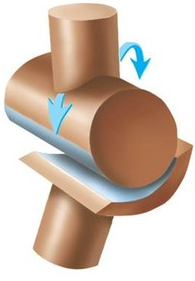
Which joint moves in the same way as shown in the figure given below?
  • A
    Gliding joint.
  • B
    Pivot joint.
  • Hinge joint.
  • D
    Ball and socket joint.
Answer
Correct option: C.
Hinge joint.
Hinge joint functions as the given figure.
View full question & answer
MCQ 651 Mark
The ___________ in earthworms help to get a good grip on the ground.
  • A
    Muscular foot.
  • B
    Legs.
  • C
    Rings.
  • Bristles.
Answer
Correct option: D.
Bristles.
Bristles.
View full question & answer
MCQ 661 Mark
Which two body systems most directly cause the arm to bend?
  • Skeletal and muscular.
  • B
    Reproductive and circulatory.
  • C
    Respiratory and excretory.
  • D
    Nervous and digestive.
Answer
Correct option: A.
Skeletal and muscular.
Skeletal and muscular system allow a human arm to bend and move.
View full question & answer
MCQ 671 Mark
Which of the following statements is incorrect about the bones present in arm?
  • A
    Humerus is present in upper arm.
  • B
    Radius and ulna are present in forearm.
  • There are seven bones in the wrist.
  • D
    Each finger has three bones and thumbs have two bones.
Answer
Correct option: C.
There are seven bones in the wrist.
View full question & answer
MCQ 681 Mark
Which one among the following statements is correct for the human skull?
  • A
    Skull is a soft structure surrounds the spinal cord.
  • B
    Supper part of skull, made up of $10$ bones Joined together.
  • The face and Jaw contain $14$ bones.
  • D
    The lower jaw bone is immovable.
Answer
Correct option: C.
The face and Jaw contain $14$ bones.
View full question & answer
MCQ 691 Mark
Which part of the human skeleton retains cartilage even in an adult?
  • Jaw.
  • B
    Ear.
  • C
    Nose.
  • D
    All of these.
Answer
Correct option: A.
Jaw.
Ear and nose retain cartilage even in an adult.
View full question & answer
MCQ 701 Mark
Joints are the:
  • A
    Places where two parts of our body seem to be joined.
  • B
    The points of contact between two (or more) bones together with tissues that surround it.
  • C
    The points of contact between two (or more) bones.
  • Both $(a)$ and $(b).$
Answer
Correct option: D.
Both $(a)$ and $(b).$
View full question & answer
MCQ 711 Mark
Movement in maximum directions occurs in:
  • A
    Pivot joint.
  • B
    Hinge joint.
  • Ball and socket joint.
  • D
    Gliding joint.
Answer
Correct option: C.
Ball and socket joint.
View full question & answer
MCQ 721 Mark
Which among the following is an example of movable joints?
  • A
    Joint between bones of cranium.
  • B
    Joint between upper jaw and skull.
  • Joint between lower jaw and skull.
  • D
    All the above.
Answer
Correct option: C.
Joint between lower jaw and skull.
View full question & answer
MCQ 731 Mark
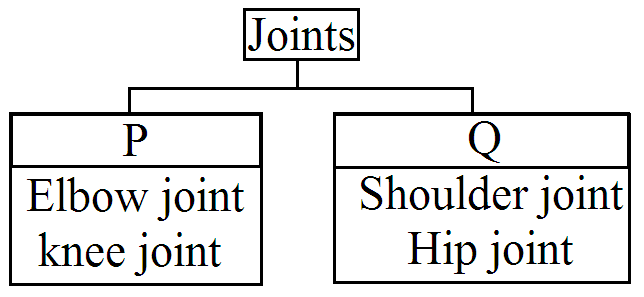
Identify $P$ and $Q$ in the given chart.
  • A
    $P$
    $Q$
    Gliding Joint
    Pivot Joint
  • $P$
    $Q$
    Hinge Joint
    Ball and socket joint
  • C
    $P$
    $Q$
    Pivot joint
    Hinge joint
  • D
    $P$
    $Q$
    Hinge joint
    Gliding joint
Answer
Correct option: B.
$P$
$Q$
Hinge Joint
Ball and socket joint
 
$P$
$Q$
Hinge Joint
Ball and socket joint
In the chart $P$ is hinge joint and $Q$ is ball and socket joint.
View full question & answer
MCQ 741 Mark
A streamlined body is one:
  • In which middle portion of body is large as compared to head or tail portion.
  • B
    In which middle portion is smaller as compared to head or tail portion.
  • C
    Both the above.
  • D
    None of these.
Answer
Correct option: A.
In which middle portion of body is large as compared to head or tail portion.
View full question & answer
MCQ 751 Mark
Human skeleton is formed by:
  • A
    Bones.
  • B
    Cartilages.
  • Bones and cartilages.
  • D
    Bones, cartilages and muscles.
Answer
Correct option: C.
Bones and cartilages.
Human skeleton is formed by bones and cartilages.
View full question & answer
MCQ 761 Mark
The elbow joint:
  • A
    Is a hinge joint.
  • B
    Allows only a back and forth movement.
  • C
    Allows movement in one direction only.
  • All of the above.
Answer
Correct option: D.
All of the above.
All of the above.
View full question & answer
MCQ 771 Mark
The body and legs of cockroaches have hard coverings forming an outer _________.
  • Skeleton.
  • B
    Skin.
  • C
    Both $(a)$ & $(b).$
  • D
    None of these.
Answer
Correct option: A.
Skeleton.
Skeleton.
View full question & answer
MCQ 781 Mark
Direction: Read the passages given below and answer the questions that follow Passage. The places in our body where two parts of our body seem to be joined is called a joint, e.g. in the elbow different bones are joined together. We can bend or move our body only at those points where bones meet. There are many different types of joints in our body to help in carrying out different movements and activities. A joint that allows movements in all directions is called:
  • A
    Pivotal joint.
  • B
    Hinge joint.
  • Ball and socket joint.
  • D
    None of these.
Answer
Correct option: C.
Ball and socket joint.
View full question & answer
MCQ 791 Mark
Ribs refers to:
  • A
    Chest bones.
  • B
    Backbone.
  • C
    Chest bones and backbone.
  • The bones that join the chest bone and back bone.
Answer
Correct option: D.
The bones that join the chest bone and back bone.
View full question & answer
MCQ 801 Mark
What is a joint?
  • A
    Framework of the body.
  • B
    Fluid connective tissue.
  • The place where two bones are joined.
  • D
    The place where tendons are fastened together.
Answer
Correct option: C.
The place where two bones are joined.
The place where two bones are joined is called a joint.
View full question & answer
MCQ 811 Mark
Select the one that forms supporting frame work of nasal and ducal cavities and consists of cranium and facial bones.
  • A
    Backbone.
  • B
    Skeleton.
  • Skull.
  • D
    None of these.
Answer
Correct option: C.
Skull.
Skull.
View full question & answer
MCQ 821 Mark
Which part of body is protected by the vertebral column?
  • Spinal cord.
  • B
    Rib cage.
  • C
    Brain.
  • D
    Heart.
Answer
Correct option: A.
Spinal cord.

The given figure represents backbone. Backbone protects the spinal cord. It is made up of a series of small bones called vertebrae.

View full question & answer
MCQ 831 Mark
Direction: Read the passages given below and answer the questions that follow Passage. The places in our body where two parts of our body seem to be joined is called a joint, e.g. in the elbow different bones are joined together. We can bend or move our body only at those points where bones meet. There are many different types of joints in our body to help in carrying out different movements and activities. The joint where our head joins the neck is a:
  • A
    Hinge joint.
  • Pivotal joint.
  • C
    Joint that allows movement in all directions.
  • D
    Ball and socket joint.
Answer
Correct option: B.
Pivotal joint.
Pivotal joint.
View full question & answer
MCQ 841 Mark
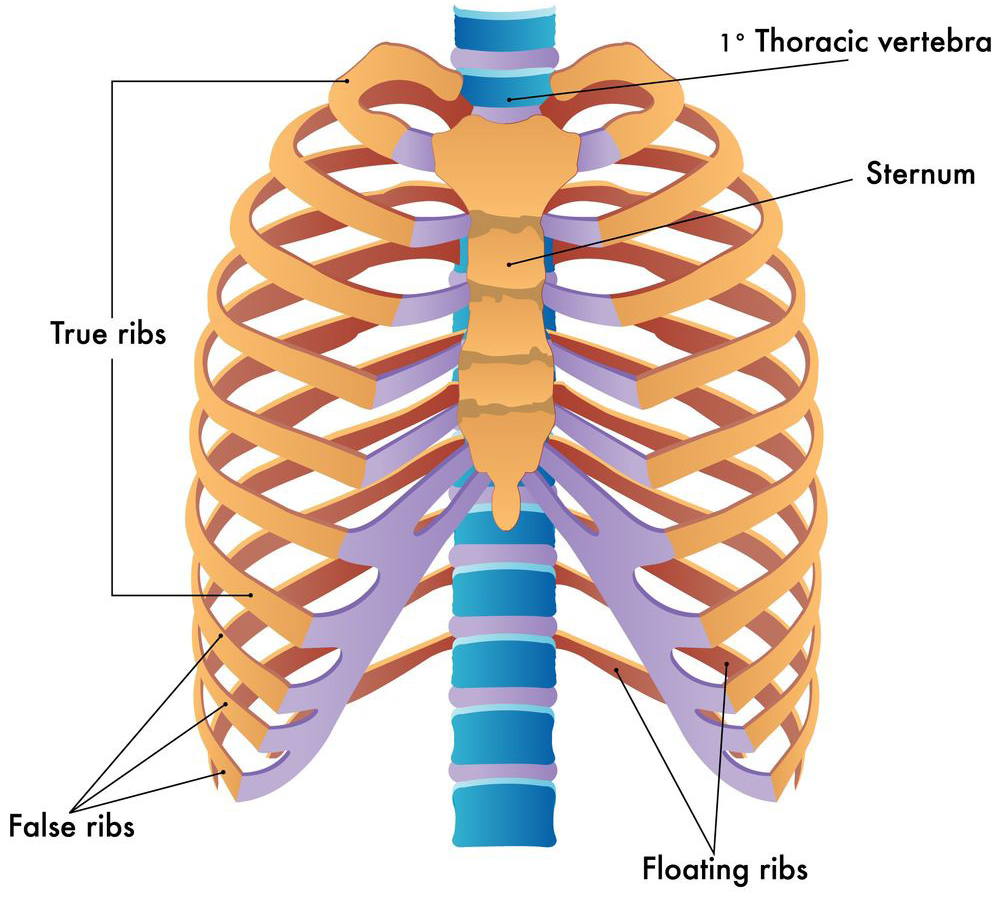
The part of the human skeleton shown in picture protects which of the following:
  • A
    Heart.
  • B
    Lungs.
  • C
    Windpipe.
  • All of these.
Answer
Correct option: D.
All of these.
All of these.
View full question & answer
MCQ 851 Mark
Knee joints are:
  • Hinge joints.
  • B
    Ball and socket joints.
  • C
    Pivotal joints.
  • D
    Fixed joints.
Answer
Correct option: A.
Hinge joints.
Hinge joints.
View full question & answer
MCQ 861 Mark
Which of the following does not have a backbone?
  • A
    Snake.
  • B
    Bird.
  • Earthworm.
  • D
    Fish.
Answer
Correct option: C.
Earthworm.
Snail is an invertebrate.
View full question & answer
MCQ 871 Mark
Which joint is located at neck?
  • Pivot joint.
  • B
    Fixed joint.
  • C
    Ball and socket joint.
  • D
    Hinge joint.
Answer
Correct option: A.
Pivot joint.
Pivot joint allows us to bend our head forward and backward and turn the head to our right or left.
View full question & answer
MCQ 881 Mark
At which parts of our body can we bend?
  • A
    Knee.
  • B
    Elbow.
  • C
    Neck.
  • All of these.
Answer
Correct option: D.
All of these.
Knee joint, neck joint and elbow joints can be bent easily.
View full question & answer
MCQ 891 Mark
Which joint allows movement in all directions?
  • A
    Hinge.
  • B
    Pivot.
  • Ball and socket.
  • D
    Gliding.
Answer
Correct option: C.
Ball and socket.
Ball and socket joint allows movement in many directions. The shoulder joint and hip joint are examples of ball and socket joint.
View full question & answer
MCQ 901 Mark
Which among the following is not a hip bone?
  • A
    Ilium.
  • B
    Ischium.
  • Incus.
  • D
    Pubis.
Answer
Correct option: C.
Incus.
Incus.
View full question & answer
MCQ 911 Mark
A specialized organ of our body whose function is contraction by means of which change of shape or movement of body part is under taken:
  • A
    Cartilage.
  • Muscle.
  • C
    Both of these.
  • D
    None of these.
Answer
Correct option: B.
Muscle.
Muscle.
View full question & answer
MCQ 921 Mark
At which joint can the movement be only like the opening and closing of a door?
  • A
    Neck.
  • Knee.
  • C
    Arm.
  • D
    Both $(b)$ and $(c).$
Answer
Correct option: B.
Knee.

The part labelled $Q$ is the hinge joint. The movement at this joint resembles opening and closing of a door. e.g. Elbow joint.

View full question & answer
MCQ 931 Mark
Out of twelve pairs of ribs ___________ pairs are not joined to the breastbone.
  • Two.
  • B
    Three.
  • C
    Four.
  • D
    Five.
Answer
Correct option: A.
Two.
Two.
View full question & answer
MCQ 941 Mark
The joints which help in the movement of knee is:
  • A
    Gliding joint.
  • B
    Pivot joint.
  • C
    Ball and socket joint.
  • Hinge joint.
Answer
Correct option: D.
Hinge joint.
Hinge joint.
View full question & answer
MCQ 951 Mark
A network of bones which are joined to sternum at one end and backbone to the other end:
  • A
    Cranium bones.
  • B
    Hip girdle.
  • Ribcage.
  • D
    Wrist bones.
Answer
Correct option: C.
Ribcage.
Ribcage.
View full question & answer
MCQ 961 Mark
John met with an accident and had a fracture. Which test/ report clearly gives the fracture details to the doctor?
  • A
    Blood report.
  • An $X-$ray.
  • C
    Muscle test.
  • D
    Urine report.
Answer
Correct option: B.
An $X-$ray.

An $X-$ray gives detailed image of the fractured bones.

View full question & answer
MCQ 971 Mark
In cockroaches, the body parts helping in movement are:
  • Three pairs of legs and two pairs of wings.
  • B
    Two pairs of legs and two pairs of wings.
  • C
    Two pairs of legs and three pairs of wings.
  • D
    None of these.
Answer
Correct option: A.
Three pairs of legs and two pairs of wings.
View full question & answer
MCQ 981 Mark
Which organ system consists mainly of brain and spinal cord?
  • A
    Muscular system.
  • B
    Digestive system.
  • Nervous system.
  • D
    Skeletal system.
Answer
Correct option: C.
Nervous system.
Nervous system.
View full question & answer
MCQ 991 Mark
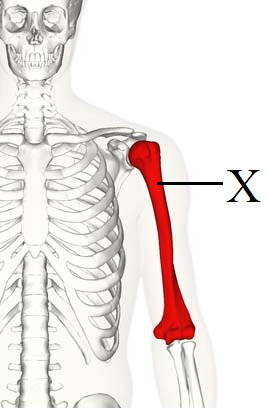
Which of the following bones is represented by the part labelled $X$ in the given figure?
  • A
    Femur.
  • Humerus.
  • C
    Ulna.
  • D
    Tibia.
Answer
Correct option: B.
Humerus.

$X$ is the humerus.

View full question & answer
MCQ 1001 Mark
The joint in between the adjacent vertebrae in the back bone is:
  • A
    Hinge joint.
  • B
    Pivotal joint.
  • C
    Fixed joint.
  • Gliding joint.
Answer
Correct option: D.
Gliding joint.
Gliding joint.
View full question & answer
[1 Marks Each] M.C.Q. - Page 2 - Science STD 6 Questions - Vidyadip