- AHandloom.
- BShuttle.
- ✓Charkha.
- DMachine.
50 questions · timed · auto-graded

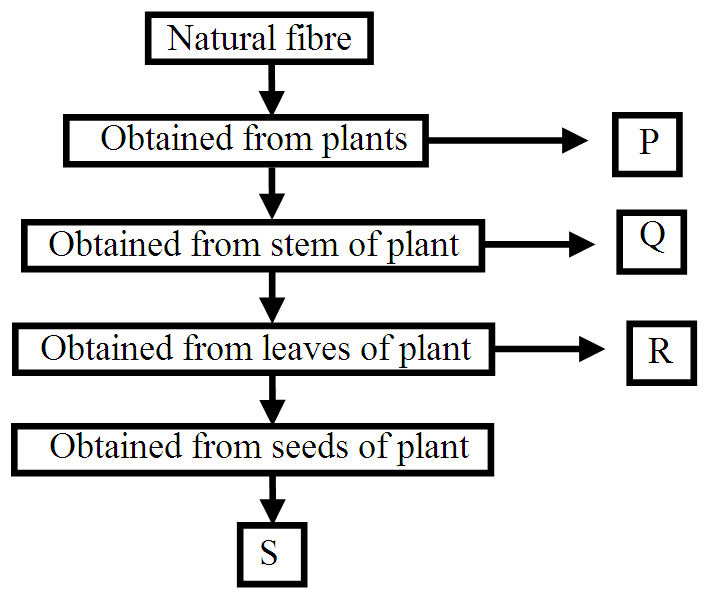
In the given flow chart, $P$ is an animal fibre like wool or silk. $Q$ could be jute, flax or hemp. $R$ is sisal and $S$ is cotton. Wool is used in winter clothing while cotton is used for summer clothing. Plant stem fibres like jute, flax, hemp are generally used for making bags, ropes, carpets, etc. Sisal which is a leaf fibre is also used for almost same purposes.
In knitting a single yam is used to make a fabric.
|
S.No.
|
Column - $I$
|
S.No.
|
Column - $II$
|
|
$A.$
|
Rotting out gummy skin of jute stem to separate fibres.
|
$(p)$
|
Jute
|
|
$B.$
|
Most important industrial crop.
|
$(q)$
|
Retting
|
|
$C.$
|
Cheapest natural fibre.
|
$(r)$
|
Carding
|
|
$D.$
|
Combing and straightening of cotton fibres.
|
$(s)$
|
Cotton
|
Weaving is done both in handlooms and power looms.
Jute is mainly grown in north-east India.
|
$(i)$
|
$(ii)$
|
$(iii)$
|
$(iv)$
|
|
Sisal
|
Hemp
|
Acrylic
|
Shahtoosh
|
|
$(i)$
|
$(ii)$
|
$(iii)$
|
$(iv)$
|
|
Flax
|
Jute
|
Nylon
|
Silk
|
|
$(i)$
|
$(ii)$
|
$(iii)$
|
$(iv)$
|
|
Wool
|
Cotton
|
Silk
|
Coir
|
|
$(i)$
|
$(ii)$
|
$(iii)$
|
$(iv)$
|
|
Coir
|
Flax
|
Nylon
|
Wool
|
|
$(i)$
|
$(ii)$
|
$(iii)$
|
$(iv)$
|
|
Wool
|
Cotton
|
Silk
|
Coir
|
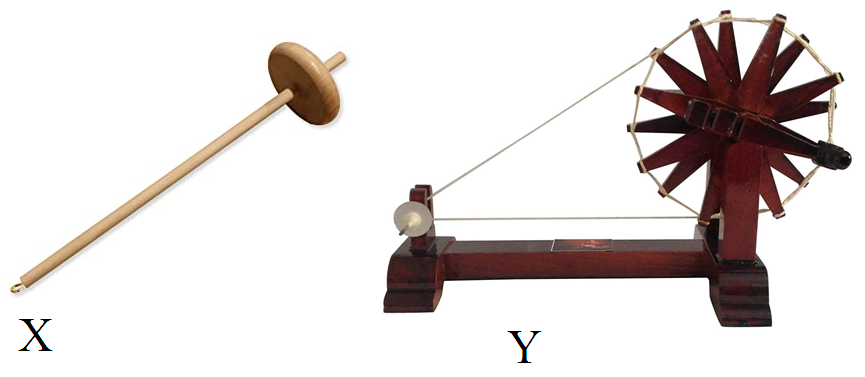
Charkha, its use was popularized by Mahatma Gandhi as part of independence movement. Charkha is a hand operated device used for spinning.
Coconut fibres are used to make mattresses.
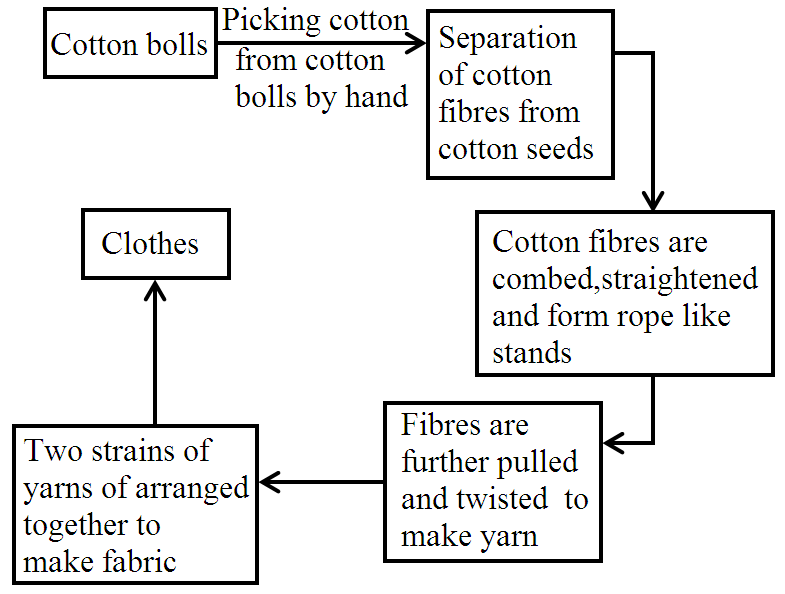
Weaving and knitting are the two main process of making a fabric.
Wool is obtained from sheep.


Decron is a example of synthetic fibre.

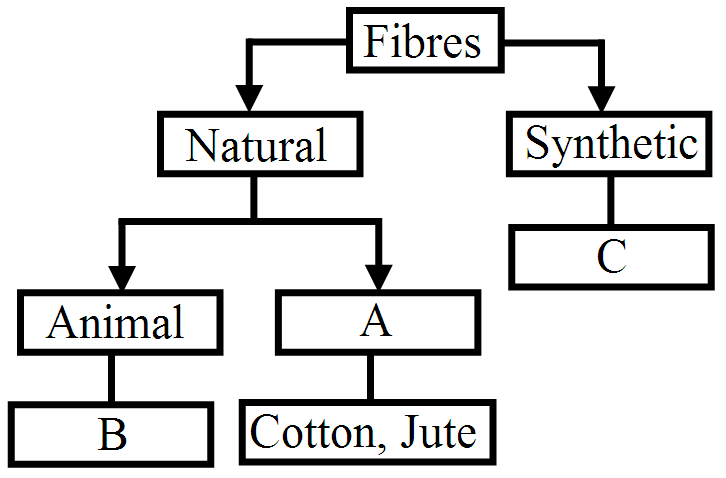
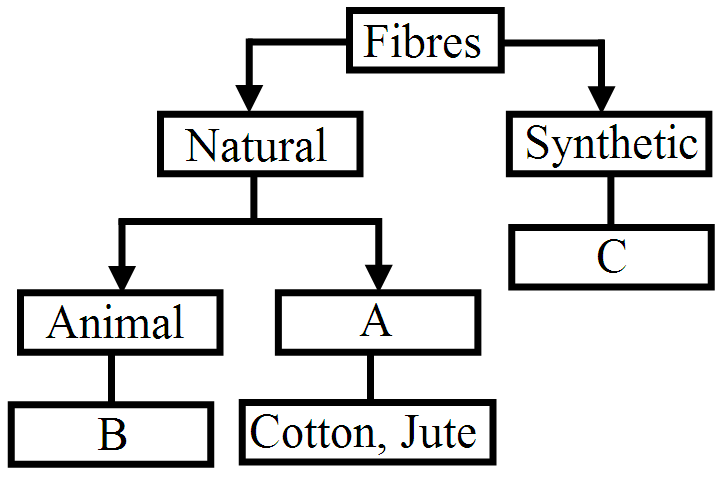
$'A'$ is for 'Plant' because natural fibres is further divided into animal and plant fibres.

Cotton gin machines separates cotton seed and fibres easily.
|
S.No.
|
Column $I$
|
S.No.
|
Column $II$
|
|
$(i)$
|
Ginning
|
$(a)$
|
Cleaning and disentangling the fibres.
|
|
$(ii)$
|
Combing
|
$(b)$
|
Brushing and straightening of fibres.
|
|
$(iii)$
|
Carding
|
$(c)$
|
Bolls.
|
|
$(iv)$
|
Seed pods
|
$(d)$
|
Cotton fibres after being separated from seeds.
|
|
$(v)$
|
Lint
|
$(e)$
|
Separating fibres from seed.
|
|
S.No.
|
Column $I$
|
S.No.
|
Column $II$
|
|
$(i)$
|
Ginning
|
$(e)$
|
Separating fibres from seed.
|
|
$(ii)$
|
Combing
|
$(b)$
|
Brushing and straightening of fibres.
|
|
$(iii)$
|
Carding
|
$(a)$
|
Cleaning and disentangling the fibres.
|
|
$(iv)$
|
Seed pods
|
$(c)$
|
Bolls.
|
|
$(v)$
|
Lint
|
$(d)$
|
Cotton fibres after being separated from seeds.
|
The process of arranging two sets of yams together to make a fabric is called weaving.
Cotton fibres are separated from the seeds by combing.

Figures $X$ and $Y$ represent takli and charkha respectively. Both takli and charkha are used in spinning i.e., process of twisting fibres to make yarn.