Questions · Page 2 of 3

[1 Marks Each] M.C.Q.

MCQ 511 Mark
Which of the following statements is/ are correct?
  • A
    Roots conduct water to the leaves.
  • B
    The number of petals and sepals in a flower is always equal.
  • Leaves produce food for the plant.
  • D
    None of the above.
Answer
Correct option: C.
Leaves produce food for the plant.
View full question & answer
MCQ 521 Mark
A plant has weak stem and cannot stand upright. It spreads on the ground. It may be called:
  • A
    Herb.
  • B
    Shrub.
  • Creeper.
  • D
    Climber.
Answer
Correct option: C.
Creeper.
It is a creeper.
View full question & answer
MCQ 531 Mark
The part of the leaf by which it is attached to the stem is called:
  • Petiole.
  • B
    Lamina.
  • C
    Veins.
  • D
    None of these.
Answer
Correct option: A.
Petiole.
Petiole.
View full question & answer
MCQ 541 Mark
Select the plant whose roots store food for future use:
  • A
    Turnip.
  • B
    Sweet potato.
  • C
    Tapioca.
  • All of these.
Answer
Correct option: D.
All of these.
The roots of all these plants store food for future use.
View full question & answer
MCQ 551 Mark
The water is released:
  • A
    By plants into air by process of transpiration.
  • B
    Through leaves in the form of water vapour.
  • Both the above.
  • D
    None of the above.
Answer
Correct option: C.
Both the above.
Plants release a lot of water into the air by transpiration. The water is released through leaves in the form of water vapours.
View full question & answer
MCQ 561 Mark
The flat green portion of the leaf is called:
  • A
    Petiole.
  • Lamina.
  • C
    Leaflet.
  • D
    Stipule.
Answer
Correct option: B.
Lamina.
Lamina.
View full question & answer
MCQ 571 Mark
The prominent parts of the open flower are called ______ ?
  • A
    Sepals
  • Petals
  • C
    Pistil
  • D
    Stamens
Answer
Correct option: B.
Petals
Petals
View full question & answer
MCQ 581 Mark
The root absorbs water from the:
  • A
    Stem
  • Soil
  • C
    Branches
  • D
    Flower
Answer
Correct option: B.
Soil
The root absorb water from the soil.
View full question & answer
MCQ 591 Mark
Which of the following is the correct match between the characteristics of stem and the category of plant?
  • Weak stem which cannot stand upright: Creeper.
  • B
    Green tender stem: Shrub.
  • C
    Thick, hard stem with branching near: Tree the base.
  • D
    Thick, hard stem with branches high: Herb on the plant.
Answer
Correct option: A.
Weak stem which cannot stand upright: Creeper.

A creeper is a plant having thin, long and weak stem, which cannot stand upright and spreads on the ground, e.g. Money plant. The rest can be corrected as:
Shrub Hard woody stem with branching near the base, e.g. Jasmine.
Tree Hard thick woody stem with branching much above the ground on the stem, e.g. Banyan, neem
Herb Non-woody, soft delicate, green tender stem e.g. Sunflower, tomato.

View full question & answer
MCQ 601 Mark
Lemon tree belongs to which category?
  • A
    Herb.
  • Shrub.
  • C
    Tree.
  • D
    Can't say.
Answer
Correct option: B.
Shrub.
It is a shrub. It is taller and has a hard stem.
View full question & answer
MCQ 621 Mark
The branches of this root arise from a thick structure under the ground are:
  • Taproot
  • B
    Fibrous roots
  • C
    Veins
  • D
    None of these
Answer
Correct option: A.
Taproot
The branches of this root arise from a thick structure under the ground are taproot.
View full question & answer
MCQ 631 Mark
Which part of the plant joins leaf and root ?
  • A
    Branches
  • B
    Buds
  • C
    Flowers
  • Stem
Answer
Correct option: D.
Stem
Stem joins leaf and root.
View full question & answer
MCQ 641 Mark
Which of the following statement(s) is/are correct?
  • Creepers are plants having weak stems that cannot stand upright and spread on ground.
  • B
    The part of the leaf by which it is attached to the stem is called lamina.
  • C
    Herbs have a hard stem.
  • D
    None of the above.
Answer
Correct option: A.
Creepers are plants having weak stems that cannot stand upright and spread on ground.
It is called petiole and not lamina the part of leaf attached to stem. Herbs have green, tender stem.
View full question & answer
MCQ 651 Mark
Plants with weak stem that cannot stand upright and spread on the ground are called:
  • Trees
  • B
    Creepers
  • C
    Plants
  • D
    All of these
Answer
Correct option: A.
Trees
Plants with weak stem that cannot stand upright and spread on the ground are creepers.
View full question & answer
MCQ 661 Mark
The plants having leaves with parallel venation have _________.
  • A
    Taproots.
  • B
    Lateral roots.
  • Fibrous roots.
  • D
    None of these.
Answer
Correct option: C.
Fibrous roots.
The plants having leaves with parallel venation have fibrous roots.
View full question & answer
MCQ 671 Mark
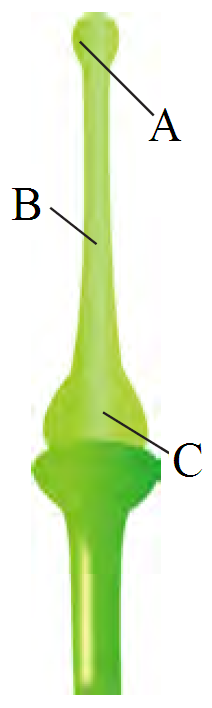
The Picture below shows a pistil. Label its parts $A, B, C$ correctly.
  • A
    $A-$style, $B-$stigma, $C-$ovary.
  • $A-$stigma, $B-$style, $C-$ovary.
  • C
    $A-$ovary, $B-$style, $C-$stigma.
  • D
    None of the above.
Answer
Correct option: B.
$A-$stigma, $B-$style, $C-$ovary.

It correctly represents various parts.

View full question & answer
MCQ 681 Mark
Direction: Read the passages given below and answer the questions that follow. Passage If you look at a leaf carefully you can easily see some lines on the leaf. These lines are called veins. In some cases you can see a thick vein in the middle of the leaf. This vein is called midrib. The design made by veins is called the leaf venation. The pattern of veins of the leaf is called:
  • Leaf venation.
  • B
    Reticulate venation.
  • C
    Parallel venation.
  • D
    All of the above.
Answer
Correct option: A.
Leaf venation.
Leaf venation.
View full question & answer
MCQ 691 Mark
A process in which water comes out from the leaves in the form of vapour is:
  • A
    Photosynthesis
  • Transpiration
  • C
    Venation
  • D
    Conduction
Answer
Correct option: B.
Transpiration
Transpiration is a process in which water comes from the leaves in the form of vapour.
View full question & answer
MCQ 701 Mark
Name plants which have roots outside the soil.
  • A
    Sugarcane
  • B
    Money plant
  • C
    Banyan
  • All of these
Answer
Correct option: D.
All of these

Sugarcane, money plant and banyan have roots outside the soil.

View full question & answer
MCQ 721 Mark
Leaf venation and type of root is correctly paired in
  • Parallel venation, fibrous roots.
  • B
    Parallel venation, taproot.
  • C
    No relation exists in leaf venation and type of roots.
  • D
    Reticulate venation, fibrous roots.
Answer
Correct option: A.
Parallel venation, fibrous roots.
Plants with parallel leaf venation have fibrous roots while plants with reticulate leaf venation have taproots.
View full question & answer
MCQ 731 Mark
.. are joints on stem from which leaves or branches arise.
  • A
    Midrib
  • B
    Viens
  • C
    Leaf venation
  • Node
Answer
Correct option: D.
Node
Node are joints on stem from which leaves or branches arise.
View full question & answer
MCQ 741 Mark
In a rose flower, we find:
  • Many sepals which are colored.
  • B
    Stamen are joined to petals.
  • C
    Pistil is not present.
  • D
    All of the above are correct.
Answer
Correct option: A.
Many sepals which are colored.
Except, all others are incorrect.
View full question & answer
MCQ 751 Mark
The process by which water and minerals travel up the stem is called:
  • A
    Photosynthesis
  • B
    Venation
  • C
    Transpiration
  • Conduction
Answer
Correct option: D.
Conduction
The process by which water and minerals travel up the stem is called conduction.
View full question & answer
MCQ 761 Mark
The swollen part of the pistil is:
  • A
    Ovules
  • B
    Petals
  • Ovary
  • D
    Sepals
Answer
Correct option: C.
Ovary
The swollen part of the pistil is ovary.
View full question & answer
MCQ 771 Mark
Which plant has prop roots?
$(p)$ Bamboo $(q)$ Sugarcane $(r)$ Banyan.
  • A
    Only $p.$
  • B
    $(p)$ and $(q).$
  • $p, q$ and $r.$
  • D
    All of these.
Answer
Correct option: C.
$p, q$ and $r.$
$p, q$ and $r.$
View full question & answer
MCQ 781 Mark
Flowers that have stamens and no pistils are:
  • Male flowers
  • B
    Female flowers
  • C
    Both $(a)$ and $(b)$
  • D
    None of these
Answer
Correct option: A.
Male flowers
Flowers that have stamens and no pistil are male flowers.
View full question & answer
MCQ 791 Mark
Direction: Read the passages given below and answer the questions that follow. Passage Various parts of a plant are stem, branches, roots, leaves, flowers and fruits. Plants are classified on the basis of differences in their heights, stems and branches. Branches grow in some plants close to the ground and in some plants higher up on the stems. A plant has green and tender stem. The plant is most likely to belong to which category?
  • Herb.
  • B
    Shrub.
  • C
    Tree.
  • D
    Can't predict.
Answer
Correct option: A.
Herb.
hese are characteristics of stem of a herb.
View full question & answer
MCQ 801 Mark
The leaf has a network of veins on both sides of the midrib in:
  • Reticulate venation
  • B
    Parallel venation
  • C
    Both $(a)$ and $(b)$
  • D
    None of these
Answer
Correct option: A.
Reticulate venation

The leaf has a network of vie ns on both sides of the midrib in reticulate venation.

View full question & answer
MCQ 811 Mark
The net-like design on both sides of midrib is called _____ ?
  • A
    Leaf venation
  • B
    Parallel venation
  • Reticulate venation
  • D
    Lamina
Answer
Correct option: C.
Reticulate venation
Reticulate venation
View full question & answer
MCQ 821 Mark
Those plants have branches arising from the base of the stem and their stem is hard and woody are called:
  • A
    Trees
  • B
    Herbs
  • Shrubs
  • D
    None of these
Answer
Correct option: C.
Shrubs
Some plants have branches arising from the base of the stem and their stem is hard and woody are called shrubs.
View full question & answer
MCQ 831 Mark
In a mango tree the branches appear:
  • A
    At the base of stem.
  • Higher up on the stem.
  • C
    No where on the stem.
  • D
    None of the above.
Answer
Correct option: B.
Higher up on the stem.
In a mango tree branches appear, higher upon the stem.
View full question & answer
MCQ 841 Mark
Male reproductive part of flower is
  • A
    Sepals.
  • B
    Petals.
  • Stamens.
  • D
    Pistil.
Answer
Correct option: C.
Stamens.
Stamen is male reproductive part.
View full question & answer
MCQ 851 Mark
Which of the following combination of features would you observe in grass?
  • Parallel venation and fibrous root.
  • B
    Parallel venation and tap root.
  • C
    Reticulate venation and fibrous root.
  • D
    Reticulate venation and tap root.
Answer
Correct option: A.
Parallel venation and fibrous root.
Grass has parallel venation in leaves (veins run parallel to one another on both sides of the mid rib) and fibrous root system (bunch of similar size fibre-like roots).
View full question & answer
MCQ 861 Mark
Which of the following is not a correct match?
  • A
    Petiole: attaches leaf to stem.
  • B
    Lamina: green flat part of leaf.
  • C
    Margin: gives shape to the leaf.
  • Veins: transpiration.
Answer
Correct option: D.
Veins: transpiration.
Veins provide support to the leaf and carry water and dissolved minerals to the leaf and food away from the leaf. Transpiration takes place through the minute pores on the surface of a leaf called, stomata (transpiration is evaporation of water from plants).
View full question & answer
MCQ 871 Mark
Which of the following statements is/ are correct?
  • Leaf venation is the pattern of veins of leaf.
  • B
    In the process of photosynthesis plants absorb nitrogen and carbon dioxide from atmospheric air.
  • C
    Stems anchor the plants firmly in the soil.
  • D
    None of the above.
Answer
Correct option: A.
Leaf venation is the pattern of veins of leaf.
Nitrogen is not absorbed in photosynthesis. More over roots anchor the plant.
View full question & answer
MCQ 881 Mark
Plants with weak stems that take support and climb up are called ?
  • A
    Tree
  • Climber
  • C
    Creeper
  • D
    Shrub
Answer
Correct option: B.
Climber
Climber
View full question & answer
MCQ 891 Mark

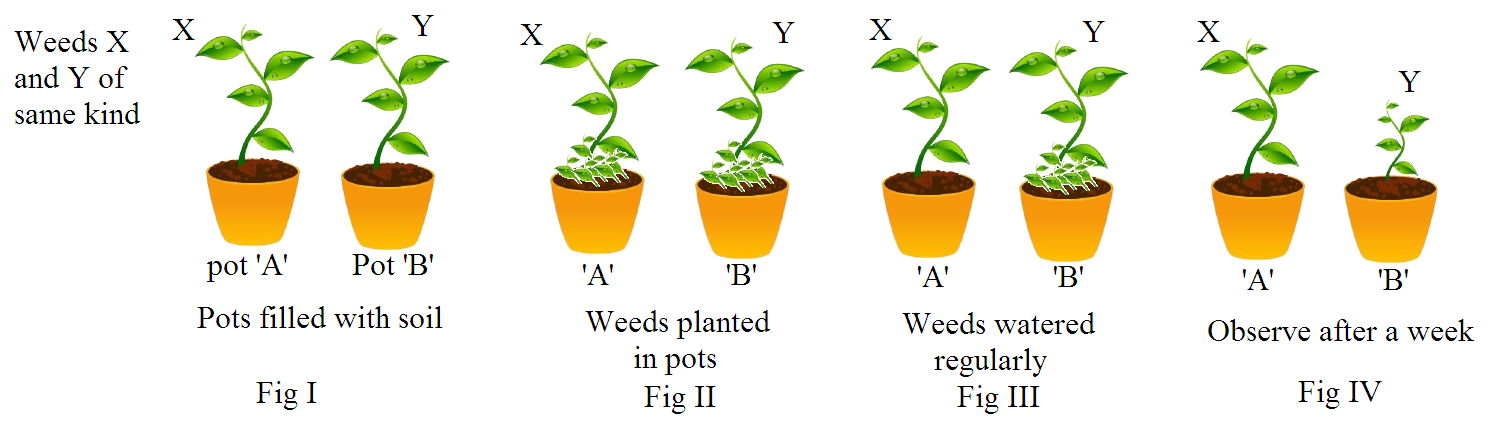
Observe the figures given below:

After a week $($Fig. $IV)$ the weed in pot $'A'$ was healthy and that in pot $'B'$ started wilting and drying up. It shows that
  • A
    Starch is present in the leaves.
  • B
    For photo synthesis, the presence of sunlight is necessary.
  • C
    Transpiration cannot occur in absence of water.
  • Water is absorbed by roots and transported to other plant parts.
Answer
Correct option: D.
Water is absorbed by roots and transported to other plant parts.

Since roots of plant 'B' were cut before planting it $($Fig. $II),$ it failed to absorb water from soil.

View full question & answer
MCQ 901 Mark
Direction: Read the passages given below and answer the questions that follow. Passage Various parts of a plant are stem, branches, roots, leaves, flowers and fruits. Plants are classified on the basis of differences in their heights, stems and branches. Branches grow in some plants close to the ground and in some plants higher up on the stems. Select the one in which the branches appear higher up on the stem:
  • A
    Brinjal.
  • B
    Wheat.
  • Mango.
  • D
    None of these.
Answer
Correct option: C.
Mango.

In a mango tree the branches appear, higher-up on the stem.

View full question & answer
MCQ 911 Mark
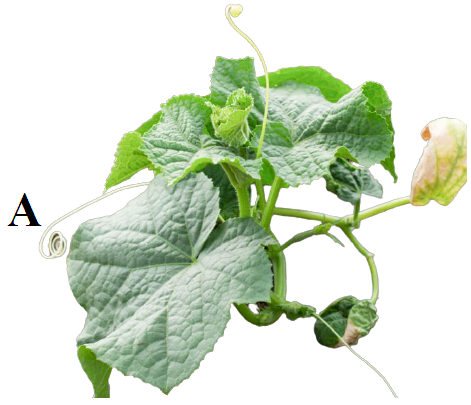
The part marked $'A'$ in the figure of cucumber plant is called:
  • A
    Prop root.
  • Tendril.
  • C
    Climber.
  • D
    Petiole.
Answer
Correct option: B.
Tendril.

(Note: In climbing plants, it refers to slender, elongated structure which serves as an organ of attachment, may be modified stem, leaf or stipule).

View full question & answer
MCQ 921 Mark
When the inner part of an ovary of a flower were observed with the help of a lens, some small beadlike structures are observed. These are called:
  • A
    Anther.
  • B
    Stamen.
  • Ovule.
  • D
    None of these.
Answer
Correct option: C.
Ovule.
Small beads like structures inside the ovary of a flower are called ovules.
 
View full question & answer
MCQ 931 Mark
Why do we eat roots of turnip?
  • Food is stored in them.
  • B
    Starch is prepared in them.
  • C
    It is a green vegetable.
  • D
    It is easily available.
Answer
Correct option: A.
Food is stored in them.
The food is prepared in leaves of plants and it travels through the stem and is stored indifferent parts of plant.
View full question & answer
MCQ 941 Mark
Read the following sentences about photosynthesis:
  1. Sunlight, carbon dioxide, chlorophyll and water are necessary.
  2. Oxygen is absorbed.
  3. Leaves carry out photosynthesis.
  4. Proteins are made during photosynthesis.
Choose the correct pair of sentences that are true to photosynthesis
  • A
    $(iii)$ and $(iv)$
  • $(i)$ and $(iii)$
  • C
    $(ii)$ and $(iv)$
  • D
    $(i)$ and $(iv)$
Answer
Correct option: B.
$(i)$ and $(iii)$

Statements $(i)$ and $(iii)$ are correct. Photosynthesis is the process by which leaves prepare food. Sunlight, carbon dioxide, chlorophyll and water are necessary for it.
The other sentences can be corrected as:

  1. Oxygen is released (not absorbed) during this process.
  2. Carbohydrates (not proteins) are made during photosynthesis.
View full question & answer
MCQ 951 Mark
Those roots come out from the base of stem is:
  • A
    Taproot
  • Fibrous roots
  • C
    Veins
  • D
    None of these
Answer
Correct option: B.
Fibrous roots
Fibrous roots come out from the base of stem.
View full question & answer
MCQ 961 Mark
Line likes structures can be seen on the surface of leaves are called:
  • A
    Petiole
  • Veins
  • C
    Lamina
  • D
    None of these
Answer
Correct option: B.
Veins
Line likes structures can be seen on the surface of leaves are called veins.
View full question & answer
MCQ 971 Mark
Which of the following is given out during the process of photosynthesis?
  • A
    Water vapours.
  • B
    Carbon dioxide.
  • Oxygen.
  • D
    None of these.
Answer
Correct option: C.
Oxygen.
Oxygen.
View full question & answer
MCQ 981 Mark
The small leaf-like structures of flower is called _____ ?
  • Sepals
  • B
    Petals
  • C
    Pistil
  • D
    Stamens
Answer
Correct option: A.
Sepals
Sepals
View full question & answer
MCQ 991 Mark
Tiny pores on the lower surface of leaves are called
  • A
    Bores
  • Stomata
  • C
    Guard cell
  • D
    Lenticels
Answer
Correct option: B.
Stomata
Tiny pores on the lower surface of leaves are called stomata.
Stomata is responsible for exchange of gases and transpiration.
View full question & answer
MCQ 1001 Mark
Direction: Read the passages given below and answer the questions that follow. Passage Various parts of a plant are stem, branches, roots, leaves, flowers and fruits. Plants are classified on the basis of differences in their heights, stems and branches. Branches grow in some plants close to the ground and in some plants higher up on the stems. On the basis of height and other characteristics Neem plant is classified as:
  • A
    Herb.
  • B
    Shrub.
  • Tree.
  • D
    Any of these.
Answer
Correct option: C.
Tree.
It is quite tall and classified as tree.
View full question & answer
[1 Marks Each] M.C.Q. - Page 2 - Science STD 6 Questions - Vidyadip