Questions · Page 2 of 3

[1 Marks Each] M.C.Q.

MCQ 511 Mark
Letter $E$ is placed in front of plane mirror, how would its image look like and also name the phenomenon involved in this.
  • A
    $E,$ Reflection.
  • $\exists,$ Lateral inversion.
  • C
    $E,$ Lateral inversion.
  • D
    $\exists$ Refraction.
Answer
Correct option: B.
$\exists,$ Lateral inversion.
View full question & answer
MCQ 521 Mark
Read the given statements and select the correct option,
Statement $1$: Rahul placed a colored plastic bottle in front of the beam of a torch light. Then he placed a transparent sheet of same size on the other side of bottle. No shadow will form on the screen.
Statement $2$: Translucent objects allow light to pass through them partially.
  • A
    Both statements $1$ and $2$ are true and statement $2$ is the correct explanation of statement $1.$
  • B
    Both statements $1$ and $2$ are true but statement $2$ is not the correct explanation of statement $1.$
  • C
    Statement $1$ is true but statement $2$ is false.
  • Statement $1$ is false but statement $2$ is true.
Answer
Correct option: D.
Statement $1$ is false but statement $2$ is true.
A colored plastic bottle is an opaque material. When a light beam is incident on it, a shadow will form on the screen can easily pass through the transparent material.
View full question & answer
MCQ 531 Mark
Read the following sentences carefully, and choose the incorrect one:
  • A
    An object which gives out its own light is called a luminous object.
  • B
    An object which does not give out its own light is called a non-luminous object.
  • C
    A luminous object can be seen because the light given out by it enters our eyes.
  • None of the above
Answer
Correct option: D.
None of the above
Here, are all the statements are correct. Hence, your answer will be
View full question & answer
MCQ 541 Mark
In a pinhole camera, the image formed is:
  • A
    Erect
  • Inverted
  • C
    Smaller
  • D
    Larger
Answer
Correct option: B.
Inverted
Inverted
View full question & answer
MCQ 551 Mark
In a quiz competition, you are asked a question where you have to choose the statement which is/ are correct?
  • A
    The pinhole camera works on the principle that light travels in straight-cross lines.
  • B
    An erect image is formed in a pinhole camera very simply.
  • A pinhole camera forms a real and inverted image of an object.
  • D
    The pinhole camera is a complex device to see the images of various objects.
Answer
Correct option: C.
A pinhole camera forms a real and inverted image of an object.

Here, are all the statements are incorrect. Hence, your answer will be option $[C]. [A]$ The pinhole camera works on the principle that light travels in straight lines. $[B]$ An inverted image is formed in a pinhole camera very simply. $[D]$ The pinhole camera is a simple device to see the images of various objects.

View full question & answer
MCQ 561 Mark

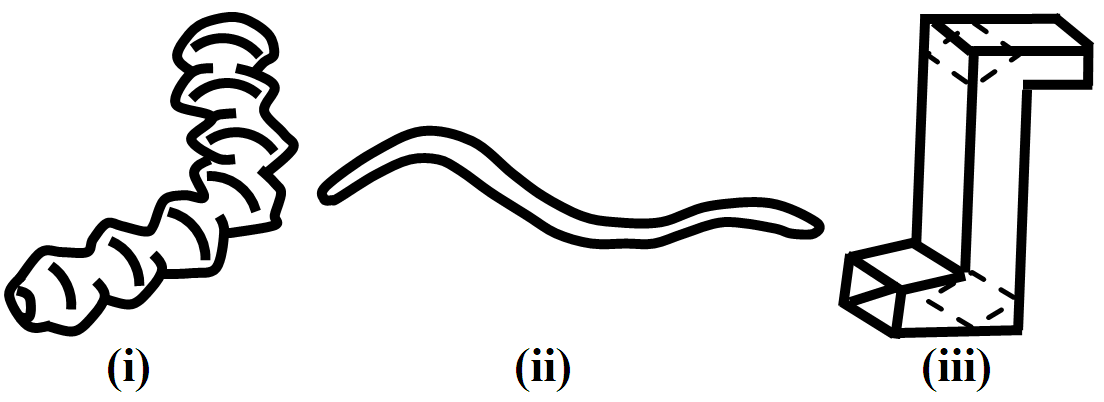
Which of the items above will allow you to see around a corrner from where you are stending?
  • A
    $(i)$ only.
  • $(iii)$ only.
  • C
    $(i)$ and $(ii).$
  • D
    $(i)$ and $(iii).$
Answer
Correct option: B.
$(iii)$ only.

Figure $(iii)$ is periscope which is used to see around the corners. It is based upon the principle of rectilinear propagation of light and reflection of light.

View full question & answer
MCQ 571 Mark
Which of the following is not a luminous object?
  • A
    Burning gas lantern
  • Moon
  • C
    Glow worm
  • D
    Sun
Answer
Correct option: B.
Moon
The bodies which have its own source of energy to emit light are called luminous bodies. Example: Stars, burning candle, sun, etc.
The bodies which are not able to emit light but are visible only when they reflect light produced by the luminous objects are called non-luminous bodies. Example: earth, blackboard, moon.
View full question & answer
MCQ 581 Mark
Which of the following explains why air is not visible?
  • A
    It is nearly a perfect transparent substance.
  • It neither absorbs nor reflects light.
  • C
    It transmits whole of light.
  • D
    All of these.
Answer
Correct option: B.
It neither absorbs nor reflects light.
An object is visible, when it either absorbs light or reflects light. Air is not visible because it neither absorbs nor reflects light.
View full question & answer
MCQ 591 Mark
Which of the following will not form a circular shadow?
  • Shoe box
  • B
    A ball
  • C
    A circular disk
  • D
    Ice-cream cone
Answer
Correct option: A.
Shoe box
Shoe box will not form a circular shadow as it is rectangular in shape and hence will form a non-circular shadow.
View full question & answer
MCQ 601 Mark
Which of the following statements is $NOT$ true regarding shadows?
  • A
    A shadow gives only the outline of that object.
  • B
    Shadows are formed due to the blocking of light by an opaque object.
  • Images are similar to shadows.
  • D
    A shadow formed is always on the opposite side of the light source.
Answer
Correct option: C.
Images are similar to shadows.
Images are not similar to shadows.
View full question & answer
MCQ 611 Mark
In a periscope two plane mirrors are fitted at its two ends in such a way that:
  • A
    They intersect each other.
  • They are parallel to one another.
  • C
    They make an angle of $90^\circ$ with each other.
  • D
    They make an angle of $30^\circ$ with each other.
Answer
Correct option: B.
They are parallel to one another.
View full question & answer
MCQ 621 Mark
Which of these materials could produce a shadow?
  • A
    A clear glass slab
  • B
    A milky white plastic
  • C
    Clear water
  • A piece of wood
Answer
Correct option: D.
A piece of wood
An opaque object is required to produce a shadow.
View full question & answer
MCQ 631 Mark
Images of actors on screen in cinema halls are;
  • Virtual image.
  • B
    Real images.
  • C
    Imaginary images.
  • D
    All the above.
Answer
Correct option: A.
Virtual image.
Virtual image.
View full question & answer
MCQ 641 Mark
Vikas is doing his homework which is given by his teacher. Would you help him to choose the incorrect sentences?
  • A
    The regular reflection of light by the smooth surface of a plane mirror produces an image of our face when we look into the mirror.
  • B
    The image which can be obtained on a screen is called a real image.
  • C
    A real image can be formed on a screen because light rays actually pass through it.
  • The image formed in a pinhole camera is an example of virtual image.
Answer
Correct option: D.
The image formed in a pinhole camera is an example of virtual image.
The image formed in a pinhole camera is an example of real image because it can be received on a screen. A real image is formed when light rays coming from an object actually meet a point after reflection from the mirror.
View full question & answer
MCQ 651 Mark
"Speed of light is the same, no matter how it is measured" was first contemplated by:
  • A
    A.A. Michelson
  • B
    John Dalton
  • Albert Einstein
  • D
    None of these
Answer
Correct option: C.
Albert Einstein
Albert Einstein
View full question & answer
MCQ 661 Mark
When an opaque object comes in the path of light it forms
  • A
    An image with colours.
  • Shadow.
  • C
    Black and white image.
  • D
    Depends on the colour of the light.
Answer
Correct option: B.
Shadow.
A shadow is formed when an opaque object comes in the way of light.
View full question & answer
MCQ 671 Mark
Which of the following is a characteristic of virtual image?
  • A
    It can be obtained on a screen.
  • B
    It is always inverted.
  • C
    It is always formed in front of the mirror.
  • It is always erect.
Answer
Correct option: D.
It is always erect.
It is always erect.
View full question & answer
MCQ 681 Mark
Babu appeared in class test but he confused to know the incorrect statement. Would you help him to know that?
  • A
    We cannot see clearly through a translucent material.
  • B
    Those materials which allow only some of the light to pass through them are called translucent materials.
  • C
    If we can see through an object but not clearly, it is allowing the light to pass through it only partially and hence it is a translucent object.
  • Air, water, polythene, glass, tissue paper are the examples of translucent materials.
Answer
Correct option: D.
Air, water, polythene, glass, tissue paper are the examples of translucent materials.

The materials like butter paper, oil paper, tissue paper, sheet of white cotton, frosted glass, muddy water and clouds are translucent materials. They allow only a part of the light falling on their surface to pass through them. As we cannot see clearly through a translucent material.

View full question & answer
MCQ 691 Mark
In the last year board examination, Rahul were asked a question where he had to choose the statement which was were incorrect? Will you be able to answer this question?
  • A
    The formation of shadow by a source of light also suggests that the light travels in straight lines.
  • B
    The fact that we cannot see around a corner also shows that light travels in a straight line.
  • C
    The property of light travelling in straight lines is called rectilinear propagation of light.
  • None of the above
Answer
Correct option: D.
None of the above
Here, are all the statements are correct. Hence, your answer will be
View full question & answer
MCQ 701 Mark
Which of the following will produce diffuse reflection of light?
  • A
    Plane mirror and piece of paper
  • B
    Piece of paper and still water in lake
  • C
    Plane mirror and leather bag
  • Piece of paper and leather bag
Answer
Correct option: D.
Piece of paper and leather bag
As we know that the way light is reflected from a surface depends on whether the surface is rough or smooth. Most of the objects have rough surfaces. Due to their rough surfaces most of the objects reflect light in all directions. This is called a regular reflections or diffuse reflection. For example, a piece of paper and leather bag have a rough surface. So, it reflects the light falling on it in all directions.
View full question & answer
MCQ 711 Mark
Which one of the following types of energy is required to see any non-luminous object?
  • Light energy.
  • B
    Heat energy.
  • C
    Sound energy.
  • D
    Wind energy.
Answer
Correct option: A.
Light energy.
Light energy.
View full question & answer
MCQ 721 Mark
Does the shadow of an object always provide us correct information about the shape of the object?
  • A
    Yes
  • No
  • C
    Can't say
  • D
    All are incorrect
Answer
Correct option: B.
No
Sometimes a shadow can mislead us
View full question & answer
MCQ 731 Mark
A very narrow beam of light is called:
  • Ray.
  • B
    Beam.
  • C
    Candela.
  • D
    All the above.
Answer
Correct option: A.
Ray.
Ray.
View full question & answer
MCQ 741 Mark
Lunar eclipse occurs on ___________ day.
  • A
    Partial moon.
  • Full moon.
  • C
    New moon.
  • D
    Crescent moon.
Answer
Correct option: B.
Full moon.
Full moon.
View full question & answer
MCQ 751 Mark
Which of the following is not a source of light?
  • A
    Star.
  • B
    Burning candle.
  • C
    Torch.
  • None of these.
Answer
Correct option: D.
None of these.
None of these.
View full question & answer
MCQ 761 Mark
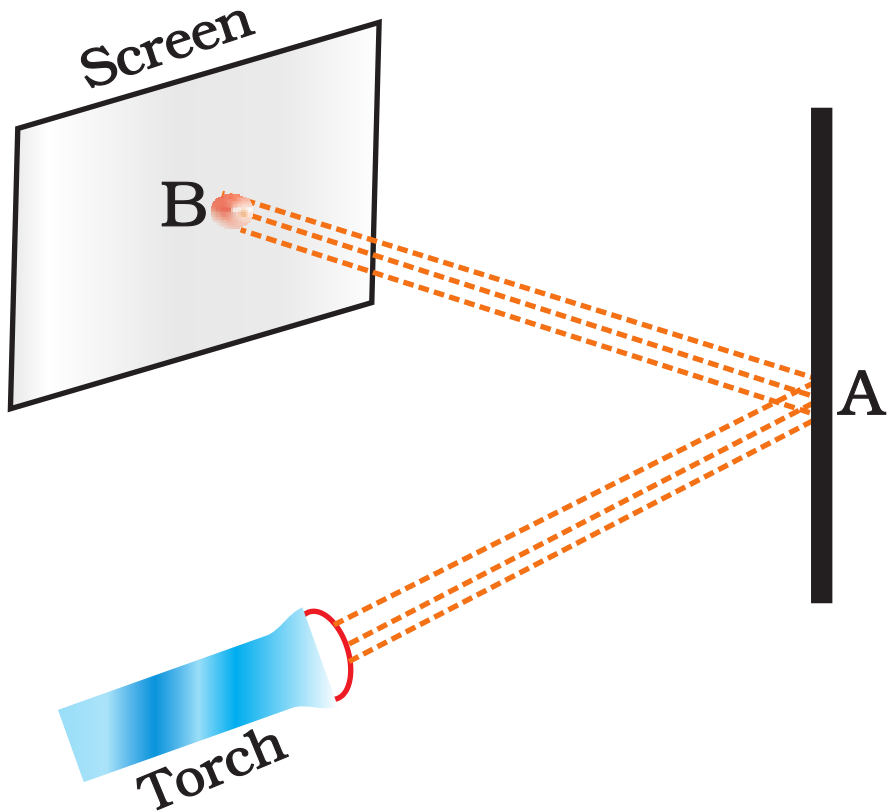
Observe the picture given in Fig. carefully.

A patch of light is obtained at B, when the torch is lighted as shown. Which of the following is kept at position A to get this patch of light?
  • A
    A wooden board.
  • B
    A glass sheet.
  • A mirror.
  • D
    A sheet of white paper.
Answer
Correct option: C.
A mirror.
A mirror is kept at position A to get a patch of light because only a mirror can change the direction of light that falls on it, i.e. causes reflection.
View full question & answer
MCQ 771 Mark
Which is an example of a translucent object?
  • A thin sheet of paper.
  • B
    A thin glass slab.
  • C
    A thin iron sheet.
  • D
    All of these.
Answer
Correct option: A.
A thin sheet of paper.
A thin sheet of paper is transparent.
View full question & answer
MCQ 781 Mark
Rahul and Ravi are standing on the opposite sides of a closed door, both of them are able to see each other clearly. Which type of substance is used to make this door?
  • Transparent.
  • B
    Translucent.
  • C
    Opaque.
  • D
    All the above.
Answer
Correct option: A.
Transparent.
Transparent.
View full question & answer
MCQ 791 Mark
Sunlight can pass through:
  • A
    Walls
  • B
    Bushy tree
  • C
    Rocks
  • Water
Answer
Correct option: D.
Water
Those materials which allow all the light to pass through them are called transparent materials. The materials like water, glass, polythene, air and groundnut oil are transparent materials. They allow almost all the light to pass through them.
View full question & answer
MCQ 801 Mark
If an object placed in the path of light allowed almost the whole of the light falling on it to pass through it, then the object is classified as:
  • Transparent
  • B
    Translucent
  • C
    Opaque
  • D
    None of these
Answer
Correct option: A.
Transparent
Transparent
View full question & answer
MCQ 811 Mark
Which of these materials can cast a shadow?
  • A
    A clear glass
  • B
    A clean cellophane paper
  • C
    Clear water
  • A piece of wood
Answer
Correct option: D.
A piece of wood
A piece of wood is opaque and can cast a shadow.
View full question & answer
MCQ 821 Mark
You are standing upright in a room in front of a vertical mirror. In this mirror, you can see from your position, only the upper two- third part of your body. You wish to see the full image of your body in the mirror. Which combination of the following three courses of action will achieve this?
  1. Move away from the mirror.
  2. Move towards the mirror.
  3. Use a mirror whose height will allow you to see your full image.
  • A
    $I$ only.
  • B
    $II$ only.
  • $III$ only.
  • D
    Either $I$ or $III.$
Answer
Correct option: C.
$III$ only.

To see the entire length of your body reflected in the mirror, you should use a mirror whose height will allow you to see your full image.

View full question & answer
MCQ 831 Mark
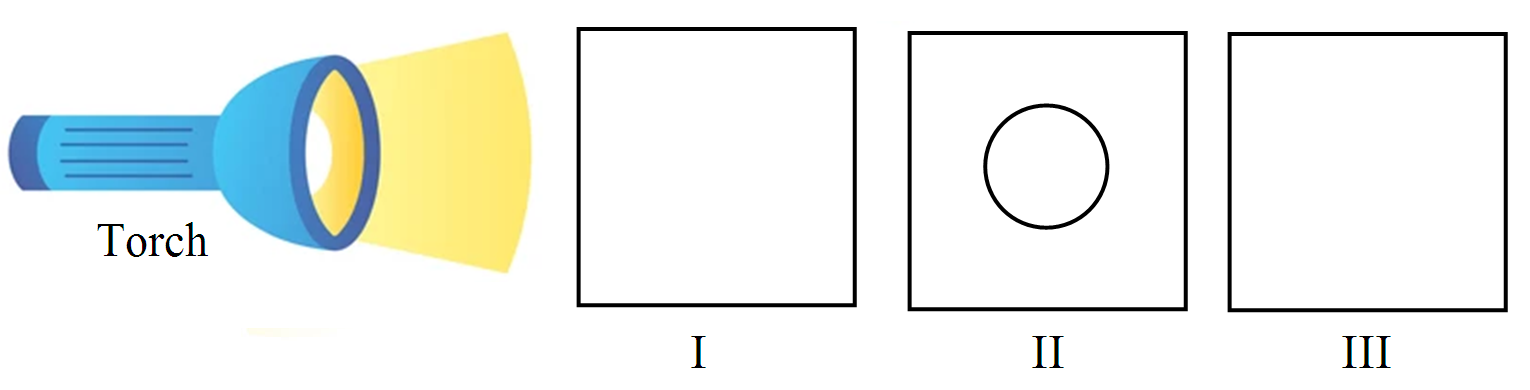
Geeta placed three objects made of different materials as shown in the figure. She observed a bright spot of light at $(II)$ but $(III)$ would not get any spot.-Then,
  • A
    $(I)$ and $(II)$ are made of transparent materials and $(III)$ is made of opaque material.
  • B
    $(I)$ is made of transparent material, $(II)$ is made of translucent material and $(III)$ is made of opaque material.
  • $(I)$ is made of transparent material, $(II)$ is made of opaque material and $(III)$ is made of either transparent or opaque or translucent material.
  • D
    $(I)$ and $(II)$ are made of opaque material and $(III)$ is made of transparent material.
Answer
Correct option: C.
$(I)$ is made of transparent material, $(II)$ is made of opaque material and $(III)$ is made of either transparent or opaque or translucent material.
Transparent material allows light to pass through it and opaque object obstructs it.
View full question & answer
MCQ 841 Mark
Which of the following is a characteristic of the image formed by plane mirror?
  • A
    Erect.
  • B
    Virtual.
  • C
    Same size as object.
  • All the above.
Answer
Correct option: D.
All the above.
All the above.
View full question & answer
MCQ 851 Mark
What happen to light rays when they strike an uneven surface from same direction?
  • A
    They are reflected in the same direction
  • They are reflected in many directions
  • C
    They are absorbed by the surface
  • D
    They pass through the surface and are diffracted
Answer
Correct option: B.
They are reflected in many directions
The reflection will be irregular reflection.
View full question & answer
MCQ 861 Mark
If a student stand $3\ m$ in front of a mirror, what is the distance between he and his image?
  • A
    $1.5\ m$
  • B
    $3\ m$
  • $6\ m$
  • D
    $7.5\ m$
Answer
Correct option: C.
$6\ m$
Distance between object and image becomes double the distance between object and mirror.
View full question & answer
MCQ 871 Mark
Pragya is completed her science chapter where she wrote some statements. She wants to know whether the statements are correct or not? Pragya wants to take help from you:
  • A
    We can see clearly through the transparent materials.
  • B
    Those materials which allow all the light to pass through them are called transparent materials.
  • If we are able to see through an object clearly it is allowing all the light to pass through it and hence it is a non-transparent object.
  • D
    None of the above
Answer
Correct option: C.
If we are able to see through an object clearly it is allowing all the light to pass through it and hence it is a non-transparent object.
When we are able to see through an object clearly it is allowing all the light to pass through it and hence it is called transparent object.
View full question & answer
MCQ 881 Mark
Recently, in a science class test, you are asked a question where you have to say whether the statements are correct or not?
  • A
    Shadows are formed when light is stopped by an object.
  • B
    An object forms shadow on the opposite side to the source of light.
  • C
    The sunlight also forms shadow of the objects which are on the ground or near the ground.
  • Our shadow is shortest before the candle at night.
Answer
Correct option: D.
Our shadow is shortest before the candle at night.
Our shadow is shortest at noon. The length of our shadow goes on decreasing till noon. The length of our shadow starts increasing in the afternoon. And our shadow becomes very long in the evening and just before sunset.
View full question & answer
MCQ 891 Mark
A transparent object which is mostly used in windows of houses.
  • A
    Polythene.
  • Wood.
  • C
    Glass.
  • D
    Ground glass.
Answer
Correct option: B.
Wood.
Wood.
View full question & answer
MCQ 901 Mark
Wool is which type of medium?
  • A
    Transparent.
  • B
    Translucent.
  • Opaque.
  • D
    Optical.
Answer
Correct option: C.
Opaque.
Opaque.
View full question & answer
MCQ 911 Mark
Which of the following is a man-made source of light?
  • A
    Sun.
  • B
    Meteor.
  • Tube-light.
  • D
    Star.
Answer
Correct option: C.
Tube-light.
Tube-light.
View full question & answer
MCQ 921 Mark
What happens when light falls on a wooden chair?
  • A part of the light reflected from the chair enters our eyes.
  • B
    Light passes through the wooden chair.
  • C
    The chair sends a signal to our eyes that enables us to see it.
  • D
    Electrical energy is given out by the chair.
Answer
Correct option: A.
A part of the light reflected from the chair enters our eyes.
Chair is an opaque object. Opaque objects completely stop light from passing through them. When light falls on a wooden chair, a part of the light gets reflected from the chair and enters our eyes.
View full question & answer
MCQ 931 Mark
When a person sees himself in a mirror, what do his eyes observe?
  • A virtual image whose rays originate at the person.
  • B
    A virtual image formed from light that originate behind the mirror.
  • C
    Areal image whose rays appear to originate at the person.
  • D
    A real image whose rays originate behind the mirror.
Answer
Correct option: A.
A virtual image whose rays originate at the person.
Real and inverted image is formed on the retina.
View full question & answer
MCQ 941 Mark
Fill in the blanks with most appropriate option.
Although a number of objects, such as kites, birds, aeroplanes move in space, but their shadow is not seen on the earth. This is due to the reason that the ______$(i)$______, the region of complete _______$(ii)$_______ is not able to reach the earth. The region of partial _______$(iii)$______, that is the ______$(iv)$______ reaching the earth is too large and too faint to be visible to us.
  • A
    $(i)$ Penumbra $(ii)$ Darkness $(iii)$ Brightness $(iv)$ Umbra.
  • B
    $(i)$ Penumbra $(ii)$ Brightness $(iii)$ Darkness $(iv)$ Umbra.
  • $(i)$ Umbra $(ii)$ Darkness $(iii)$ Brightness $(iv)$ Penumbra.
  • D
    $(i)$ Umbra $(ii)$ Brightness $(iii)$ Darkness $(iv)$ Penumbra.
Answer
Correct option: C.
$(i)$ Umbra $(ii)$ Darkness $(iii)$ Brightness $(iv)$ Penumbra.

$(i)$ Umbra $(ii)$ Darkness $(iii)$ Brightness $(iv)$ Penumbra.

View full question & answer
MCQ 951 Mark
Which of the following will form a shadow similar to that formed by a thin note-book?
  • A rectangular box
  • B
    A circular box
  • C
    Both the above
  • D
    None of these
Answer
Correct option: A.
A rectangular box
​​​​​​A rectangular box
View full question & answer
MCQ 961 Mark
Speed of light in vacuum is:
  • A
    $3 \times 10^8\ km/ h$
  • $3 \times 10^8m/ s$
  • C
    $4 \times 10^8m/ h$
  • D
    $4 \times 10^8m/ s$
Answer
Correct option: B.
$3 \times 10^8m/ s$
$3 \times 10^8m/ s$
View full question & answer
MCQ 971 Mark
Which of the following absorbs light the most?
  • A
    A mirror
  • B
    A piece of white paper
  • A black wallet
  • D
    A green leaf
Answer
Correct option: C.
A black wallet
A black wallet absorbs most of the light.
View full question & answer
MCQ 981 Mark
The object that does not give out light on its own is the:
  • A
    Star
  • B
    Lighted matchstick
  • C
    Light bulb
  • Shinning mirror
Answer
Correct option: D.
Shinning mirror
An object which does not give out its own light is called a non-luminous object. As we know that mirror is a non-luminous object which does not have its own light. Actually, when sun light falls on the surface of mirror, then all the sunlight is reflected or sent by the mirror towards the certain direction. And to us, it appears as if the light is being given out by the mirror itself. But in reality, mirror light is the sunlight which is reflected from the surface of mirror. Thus, mirror behaves as a the non-luminous. It works as a reflector of sunlight just like the moon.
View full question & answer
MCQ 991 Mark
The plane mirror forms a:
  • Virtual image
  • B
    Real image
  • C
    Inverted image
  • D
    Magnified image
Answer
Correct option: A.
Virtual image
A plane mirror is a thin, flat and smooth sheet of class having a shiny coating of silver metal or aluminum metal on one side. The regular reflection of light by a smooth, surface of a plane mirror produces an image of our face when we look into the mirror. A plane mirror always forms virtual images. The reflections of objects in water are also virtual images.
View full question & answer
MCQ 1001 Mark
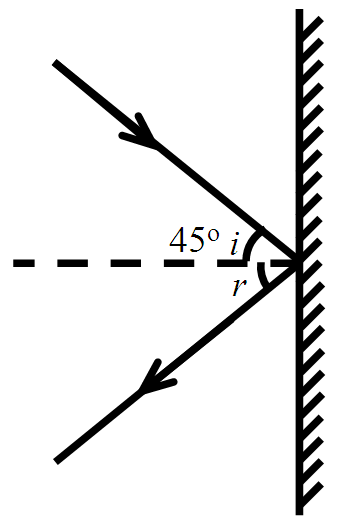
Look at the following figure and find out the angle of reflection.
  • A
    $30^\circ $
  • $45^\circ$
  • C
    $90^\circ$
  • D
    $60^\circ$
Answer
Correct option: B.
$45^\circ$
$45^\circ$
View full question & answer
[1 Marks Each] M.C.Q. - Page 2 - Science STD 6 Questions - Vidyadip