Questions

Answer The Following Questions In Short.[2 Marks Each]

🎯

Test yourself on this topic

17 questions · timed · auto-graded

Question 12 Marks
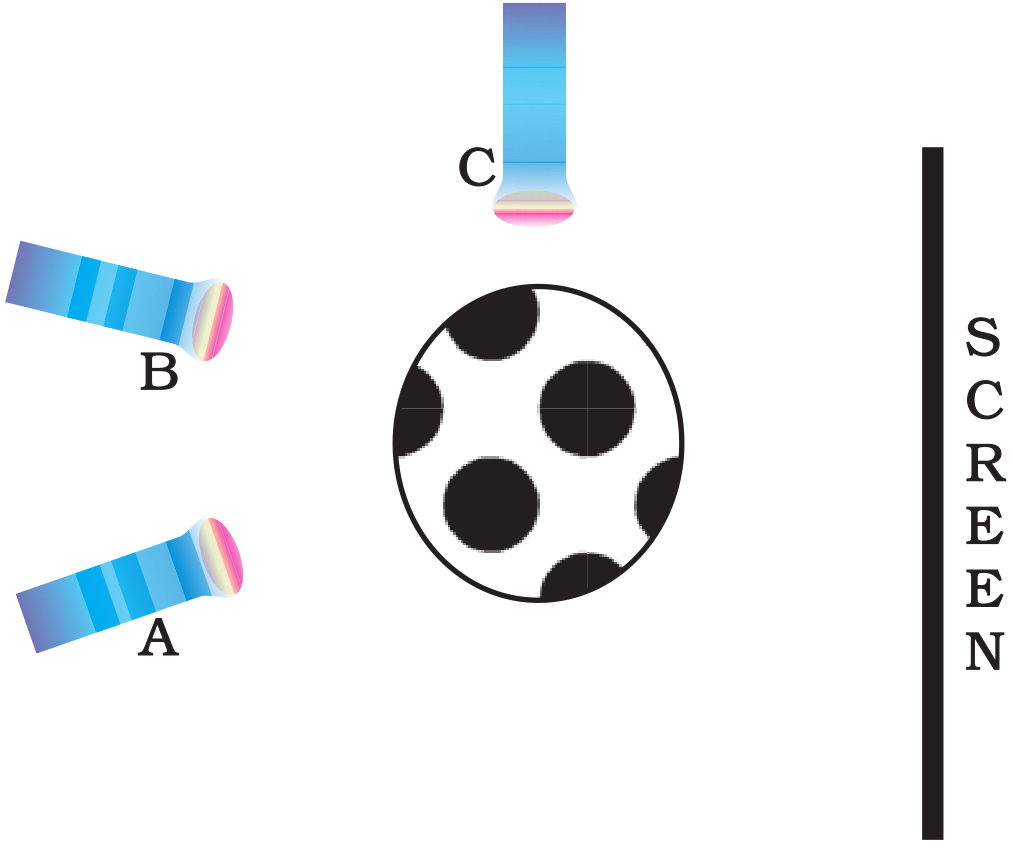
Three torches $A, B$ and $C$ shown in Fig. are switched on one by one. The light from which of the torches will not form a shadow of the ball on the screen.
Answer
The light from the torch $C$ will not form a shadow on the screen because light travels in a straight path and forms the shadow on the same path from which it is coming.
View full question & answer
Question 22 Marks
Distinguish between the following.
Opaque objects and Transparent objects.
Answer
S. No.
Opaque objects
Transparent objects
$(i)$
Objects which do not allow any lightto pass through them.
Objects through which light can pass totally.
$(ii)$
For example, book, brick, etc.
For example, glass, air, etc.
View full question & answer
Question 32 Marks
Give two examples of each.
  1. Transparent and non luminous object.
  2. Translucent and non luminous object.
Answer
  1. Air and water.
  2. Polythene and smoke.
View full question & answer
Question 42 Marks
What is the difference between transparent and translucent object?
Answer
If we are able to see clearly through an object, it is said to be transparent. Whereas there are some objects through which we can see but not clearly. Such objects are known as translucent objects.
Transparent objects allows light to pass through them completely whereas translucent objects doesn’t allow light to pass through them completely.
View full question & answer
Question 52 Marks
Distinguish between the following.
Luminous body and Non-luminous body.
Answer
S. No.
Luminous body
Non-luminous body
$(i)$
Objects which emit their own light.
Objects which do not emit their own light.
$(ii)$
For example, sun, stars, etc.
For example, moon, earth, etc.
View full question & answer
Question 62 Marks
Correct the following statements. The colour of the shadow of an object depends on its colour of the object.
Answer
The colour of the shadow of an object does not depend on its colour. It is always black irrespective of any coloured object.
View full question & answer
Question 72 Marks
Correct the following statements.
Transparent objects allow light to pass through them partially.
Answer
Transparent objects allow most of the light to pass through them or translucent objects allow light to pass through them partially.
View full question & answer
Question 82 Marks
Distinguish between the following.
Solar eclipse and Lunar eclipse.
Answer
Solar eclipse
Lunar eclipse
When the moon comes in between the sunand the earth, the earth darkens during the day. This is solar eclipse.
When the earth is in between the sun andthe moon, the moon cannot be seen. Thisis lunar eclipse.
View full question & answer
Question 92 Marks
Classify the following as luminous and non luminous object.
Sun, moon, table, chair, stars.
Answer
Luminous: Sun, stars.
Non luminous: Moon, table, chair.
View full question & answer
Question 102 Marks
Suggest a situation where we obtain more than one shadow of an object at a time.
Answer
More than one shadow or multiple shadows of an object can be obtained by using multiple sources of light, i.e. during a night match being played in a stadium, multiple shadows of players are seen due to flood (stadium) lights in the stadium.
View full question & answer
Question 112 Marks
Why can we see our image in the mirror?
Answer
Light rays reflected from parts of our body fall on mirror and are reflected back. When these reflected rays reach our eyes (reflected on our retina), we can see the image. Mirror has one surface painted so when we see the mirror light rays which reflect from our body not get pass through mirror.
View full question & answer
Question 122 Marks
Give example of an object which is:
  1. Opaque and luminous.
  2. Translucent and luminous.
Answer
  1. Sun.
  2. Flame of gas burner.
View full question & answer
Question 132 Marks
How is a shadow formed?
Answer
When a beam of light shines on an opaque object, some light rays are stopped and some pass by the edges. The region without light formed behind the object is called shadow.
View full question & answer
Question 142 Marks
Distinguish between the following.
Beam and Ray.
Answer
S. No.
Beam
Ray
$(i)$
A group of parallel rays is called beam.
Path of light is called ray.
$(ii)$
It is represented by many arrows.
It is represented by an arrow.
View full question & answer
Question 152 Marks
Can you only see reflected light?
Answer
No, people can see both direct and reflectd light that means we can see things that reflects visible light and the things that produce visible light.
View full question & answer
Question 162 Marks
What is the difference between luminous and non luminous objects?
Answer
Objects that give out or emit light of their own are known as luminous objects. For example candle, sun etc. Objects that cannot give out or emit light of their own are known as non- luminous objects. Such as chair, book etc.
View full question & answer
Question 172 Marks
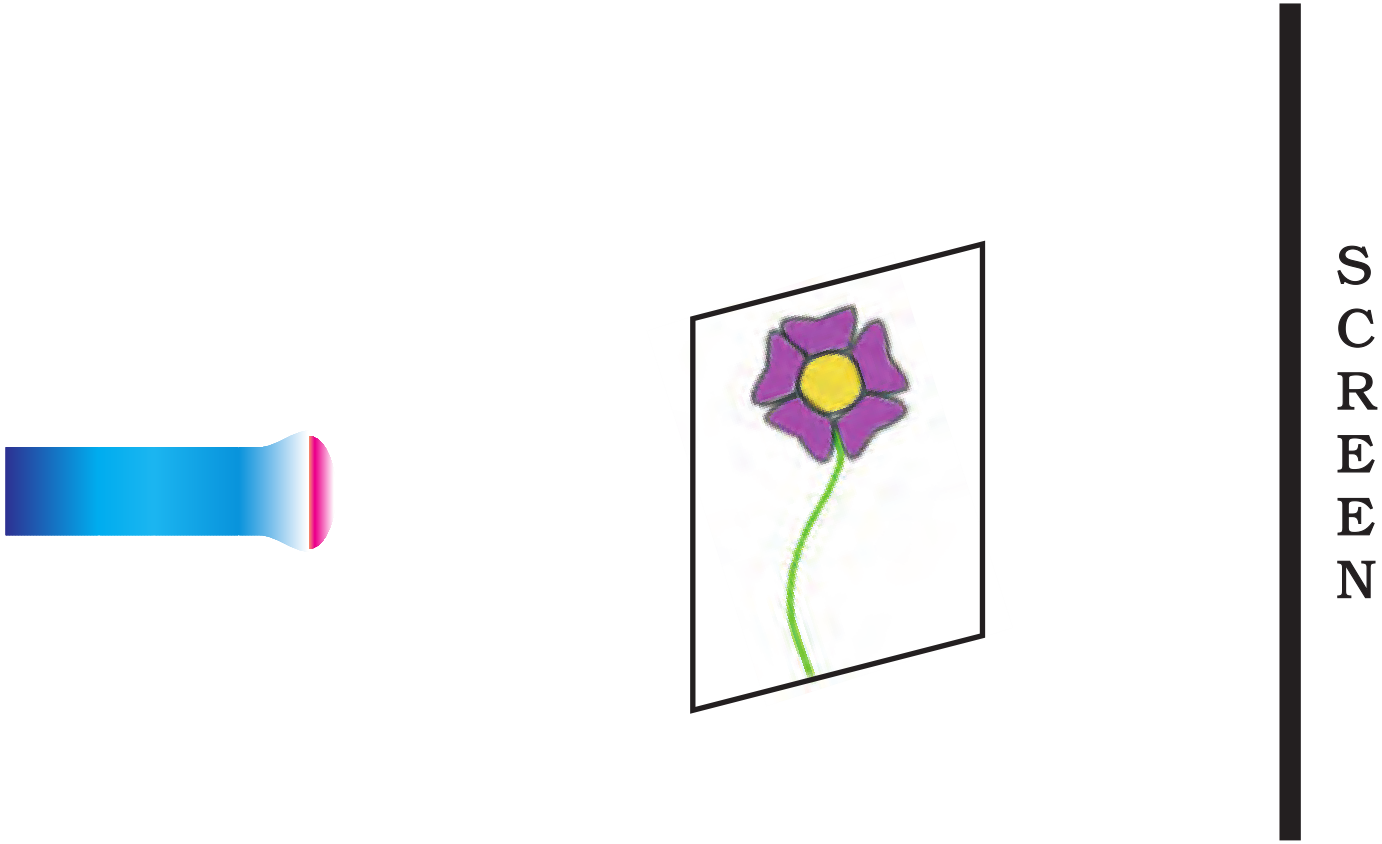
In Fig. a flower made of thick coloured paper has been pasted on the transparent glass sheet. What will be the shape and colour of shadow seen on the screen?
Answer
The shape of the flower on the screen will be the same as that of the flower but the shadow of flower is of black colour.
View full question & answer
Answer The Following Questions In Short.[2 Marks Each] - Science STD 6 Questions - Vidyadip