Questions

[3 Marks Each] QUE-ANS

🎯

Test yourself on this topic

15 questions · timed · auto-graded

Question 13 Marks
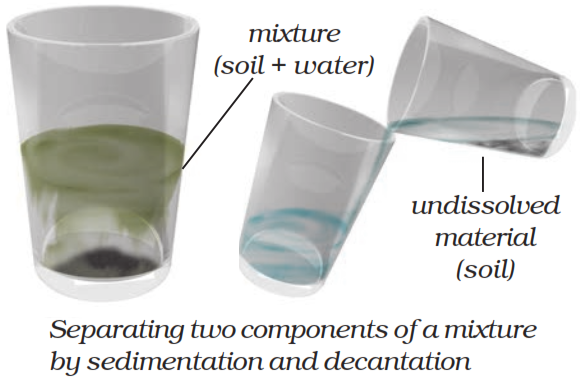
How will you separate sand and water from their mixture?
Answer
We will separate sand and water by sedimentation and decantation method. First we leave this mixture for some time. After some time, the sand which is; heavier is settled down at the bottom. After that we wall pour water into another container and the mixture will be separated.
View full question & answer
Question 23 Marks
Mention the methods that can be used for the separation of the following mixtures:
  1. Wheat, sugar and husk
  2. Rice, gram and iron fillings
  3. Sand, Mack gram (urad) and husk.
Answer
  1. Mixture of wheat, sugar and husk.
  • For separating husk from the mixture, we should follow the winnowing method as husk is lighter than other two components.
  • Wheat and sugar can be separated by sieving as they have different sizes.
  1. Mixture of rice, gram and iron fillings.
  • For separating iron fillings, we can use a magnet.
  • Rice and gram can be separated either by sieving or by handpicking.
  1. Sand, black gram (urad) and husk.
  • For separating sand from the mixture, we can sieve the mixture.
  • Black gram (urad) and husk can be separated by the method of winnowing.
View full question & answer
Question 33 Marks
Activity.Take two glasses and pour half a cup of water in each of them. Add a teaspoon of salt to one glass and stir till the salt dissolves. Go on adding salt, one teaspoon at a time, till the solution saturates. Record the number of spoons of salt that dissolved in the water, in Table. Now, repeat the same activity with sugar. Repeat this with some other substances that are soluble in water.
What do you notice from Table? Do you find that water dissolves different substances in different amounts?
Answer
Substance
Number of spoons of substance that dissolved in water
Salt
$1$ spoon of salt in $100\ gm$ water at $25^\circ C.$
Sugar
$4$ spoons of sugar in $100\ gm$ water at $25^\circ C.$
Copper sulphate
Nearly $4$ spoon of copper sulphate in $100\ gm$ of water at $25^\circ C.$
We notice from the table that different substances dissolve in water in different amounts.
View full question & answer
Question 43 Marks
Name the steps and methods you will use to separate the following:
  1. Coconut oil, salt and water.
  2. Chalk powder, water and stones.
  3. Iron filings, sand and salt.
Answer
  1. Coconut oil is separated by using a separating funnel and the salt is separated by evaporation.
  2. Stones being heavy are separated by sedimentation and chalk powder is separated by filtration.
  3. Iron filings are separated using a magnet and the sand is separated by dissolving in water followed by sedimentation and decantation.
View full question & answer
Question 53 Marks
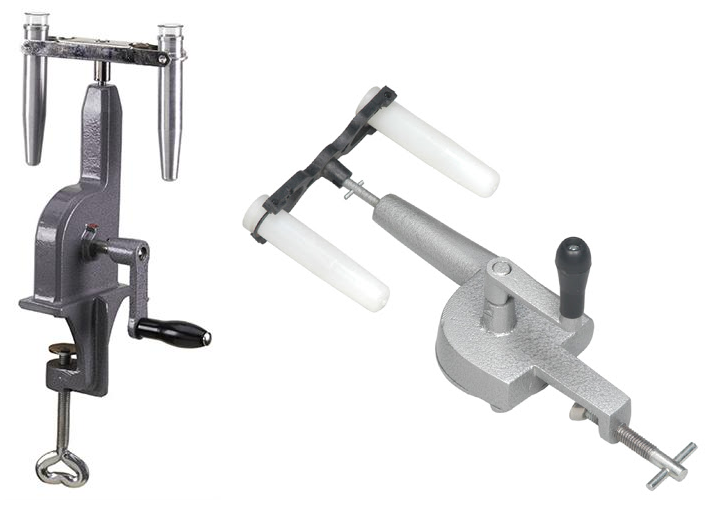
What is the importance of centrifugation? How is it done?
Answer
Centrifugation is the process of separating suspended particles from a liquid by rotating the liquid at a high speed.
The mixture is taken in a closed bottle and rotated at a high speed. The heavy particles settle at the bottom while light particles remain behind. This method is also used to separate cream from milk. Cream collects at the centre and being lighter than milk, it floats at the top of the mixture.
View full question & answer
Question 63 Marks
Sheela, Saima and Ravi have to dissolve maximum amount of sugar in the same amount of milk so as to win in a game. Ravi took hot boiling milk while Saima took ice cold milk. Sheela managed to get milk at room temperature. Whom do you think would win the game and why?
Answer
Ravi would win the game because Ravi took hot boiling milk and hot milk at higher temperature would dissolve more amount of sugar and also solubility increases with temperature. So, Ravi would be able to dissolve maximum amount of sugar in milk.
View full question & answer
Question 73 Marks
A mixture of iron nails, salt, oil and water is provided to you. Give stepwise methods to separate each component from this mixture?
Answer
Steps for the separation of iron nails, salt, oil and water. Iron nails are separated from the mixture by using magnets. Then by using decantation oil and water is separated. Oil being lighter forms the upper layer in the beaker and we can decant off the upper layer of oil. Now, the mixture contains dissolved salt and water. Salt can be obtained from the water by the process of evaporation. The water present in salt solution will form water vapour and then the salt is left behind.
View full question & answer
Question 83 Marks
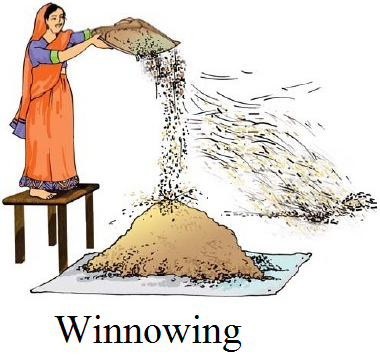
What is winnowing? Where is it used?
Answer
Winnowing is used to separate heavier and lighter components of a mixture by wind or by blowing air. This process is used by farmers to separate lighter husk particles from heavier seeds of grain.
View full question & answer
Question 93 Marks
Paheli was feeling thirsty but there was only a pot of water at home which was muddy and unfit for drinking. How do you think Paheli would have made this water fit for drinking if the following materials were available to her.
Alum, tub, muslin cloth, gas stove, thread, pan and lid.
Answer
Filtration using muslin cloth (cotton fabric).
$\downarrow$
Swirl with alum (tied with a thread) and leave water undisturbed for some time.
$\downarrow$
The clear liquid above the impurities is poured in another container (tub) (decantation).
$\downarrow$
Boil for $10\ min$ on gas stove in convered pan with lid.
$\downarrow$
Cool, filter and now, it is fit for drinking.
View full question & answer
Question 103 Marks
Activity.
  1. Heat a beaker containing some water. Allow the water to boil. If you continue heating, would the water turn into steam and disappear completely?
  2. Now, add two spoons of salt to water in another beaker and stir it well. Do you see any change in the colour of water? Can you see any salt in the beaker, after stirring
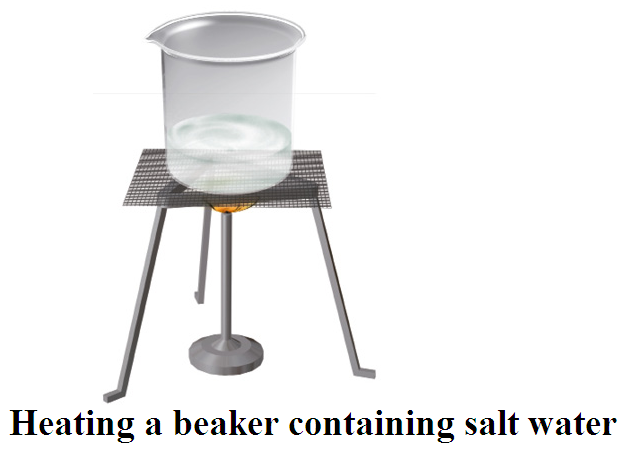
  3. Heat the beaker containing the salt water (Fig.). Let the water boil away. What is left in the beaker?
Answer
  1. Yes, the water will disappear completely.
  2. Yes, the colour of water will become slightly white. No, salt cannot be seen in the beaker after stirring as it gets completely dissolved.
  3.  

Some salt will be left in the beaker.
View full question & answer
Question 113 Marks
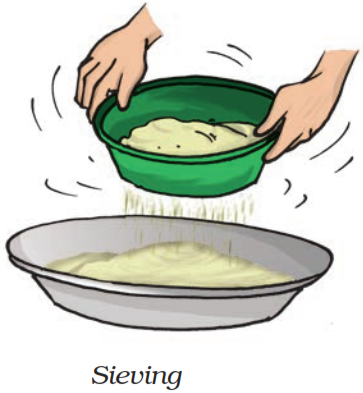
What is Sieving? Where can it be used?
Answer
Sieving is a process by which fine particles are separated from bigger particles by using a sieve. It is used in flour mill or at construction sites. In flour mill, impurities like husks and stones are removed from wheat. Pebbles and stones are removed from sand by sieving.
View full question & answer
Question 123 Marks
Write various methods of separation of compounds from their mixture.
Answer
  • Handpicking.
  • Threshing.
  • Winnowing.
  • Sedimentation.
  • Decantation.
  • Filtration.
  • Evaporation.
  • Condensation.
View full question & answer
Question 133 Marks
Read the story titled $“WISE$ $FARMER”$ and tick the correct option to complete the story.
A farmer was sad/ happy to see his healthy wheat crop ready for harvest. He harvested the crops and left it under the sun/ rain to dry the stalks. To separate the seeds from the bundles of the stalk he handpicked/ threshed them. After gathering the seed grains he wanted to separate the stones and husk from it. His wife winnowed/ threshed them to separate the husk and later sieved/ hand picked to remove stones from it. She ground the wheat grains and sieved/ filtered the flour. The wise farmer and his wife got a good price for the flour. Can you tell why?
Answer
  1. Happy
  2. Sun
  3. Threshed
  4. Winnowed
  5. Hand-picked
  6. Sieved
They got a good price as they used appropriate methods of separation to get good quality of flour (atta).
View full question & answer
Question 143 Marks
What is filtration?
Answer
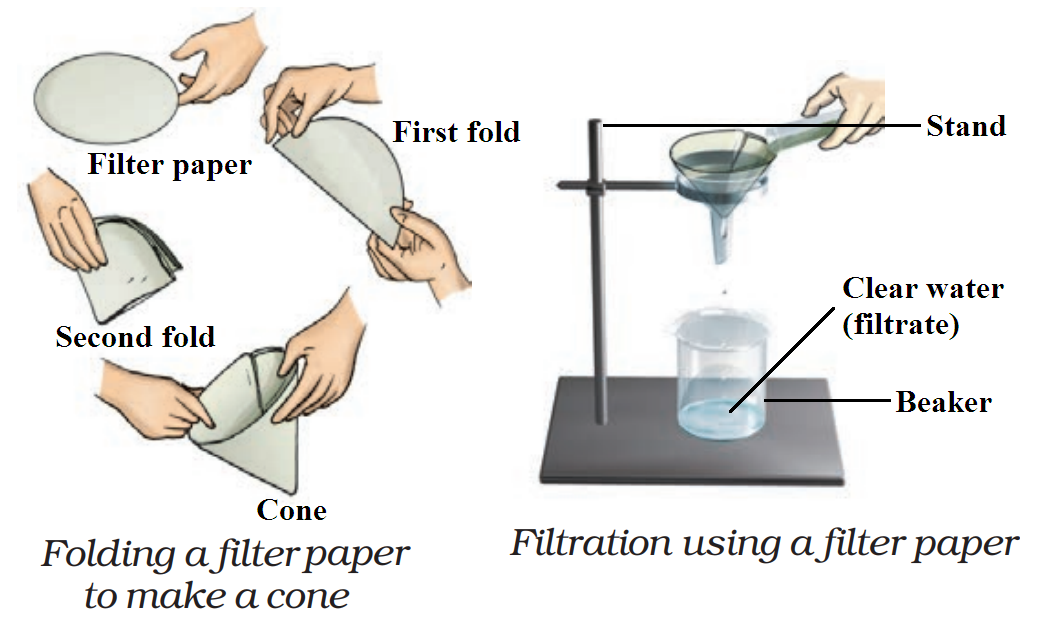
When one component of a mixture is soluble in water and other component is insoluble in water, the soluble component gets dissolved and insoluble one is separated by filtering the solution.
The process by which insoluble substance can be separated from a solution, by passing that solution through a porous paper (filter paper) is called filtration. During filtration, the solid insoluble substance is retained at the filter paper as residue while the liquid free from any suspended matter passes through the filter paper and is collected as filtrate. This filtrate may be warmed to dry to obtain soluble component. Figures (a), (b), (c) show the folding and use of filter paper in filtration.

 
View full question & answer
Question 153 Marks
Why do we need to separate different components of a mixture? Give two examples.
Answer
Among different components of mixture there are many substances which are harmful or not useful for us. To remove these harmful or unuseful components we need to separate them.
For example:
  1. Tea leaves are separated from the liquid with a strainer while preparing tea.
  2. Stone pieces from wheat, rice or pulses are picked out by hand.
View full question & answer