Questions

[5 Marks Each] QUE-ANS

🎯

Test yourself on this topic

8 questions · timed · auto-graded

Question 15 Marks
Read the story titled $\text{“WISE FARMER”}$ and tick the correct option to complete the story.
A farmer was,
  1. Sad/ happy to see his healthy wheat crop ready for harvest. He harvested the crops and left it under the.
  2. Sun/ rain to dry the stalks. To separate the seeds from the bundles of the stalk he.
  3. Handpicked/ threshed them. After gathering the seed grains, he wanted to separate the stones and husk from it. His wife.
  4. Winnowed/ threshed them to separate the husk and later.
  5. Sieved/ handpicked to remove stones from it. She ground the wheat grains and.
  6. Sieved/ filtered the flour. The wise farmer and his wife got a good price for the flour.
Answer
  1. Happy.
  2. Sun.
  3. Threshed.
  4. Winnowed.
  5. Handpicked.
  6. Sieved.
They got a good price as they used appropriate methods of separation to get good quality of flour.
View full question & answer
Question 25 Marks
How is common salt obtained from seawater?
Answer
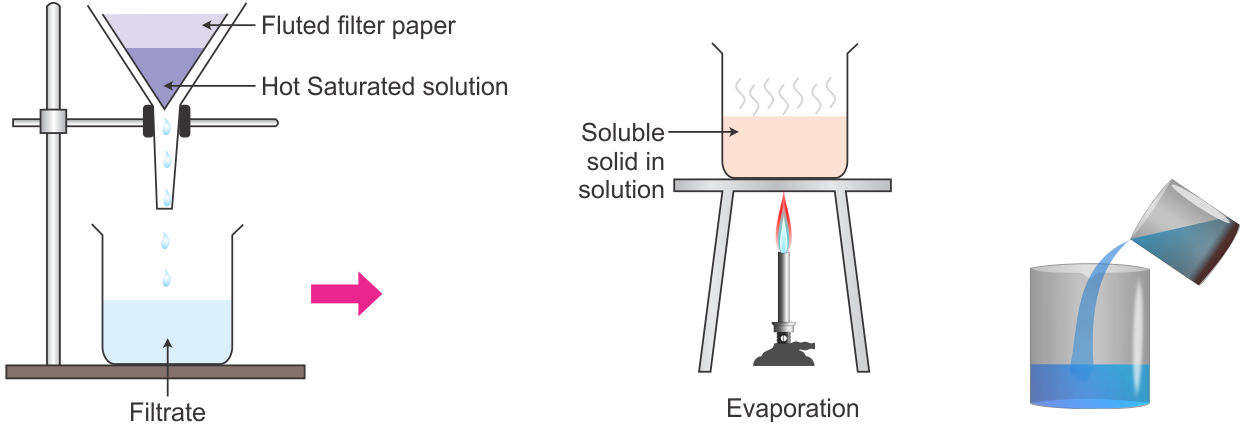
When seawater is allowed to evaporate in shallow pits, water gets heated by sunlight and changes into water vapour by the process of evaporation leaving behind impure solid salts. Now, the lumps of impure common salt are crushed to get powdered salt. The powdered common salt is dissolved in water to prepare a solution. Now the solution of common salt is filtered to remove insoluble impurities. The clear solution is evaporated by heating to remove the water content to obtain a concentrated solution of common salt. The hot and concentrated solution is allowed to cool. On cooling, crystallization takes place and crystals of pure common salt are obtained.
View full question & answer
Question 35 Marks
How would you obtain clear water from a sample of muddy water?
Answer
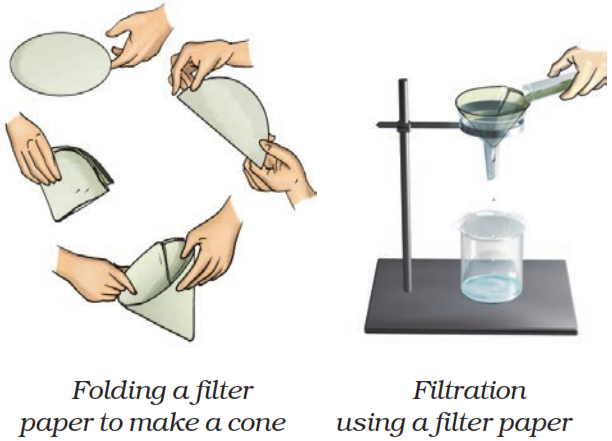
We will obtain clear water from a sample of muddy water by the process of filtration. A filter paper is one such filter that has very fine pores in it. Figure $(a, b)$ shows the steps involved in using a filter paper. A filter paper folded in the form of a cone is fixed in a funnel. The mixture is then poured on the filter paper. Solid particles in the mixture do not pass through it and remain on the filter.
View full question & answer
Question 45 Marks
Both Sarika and Mohan were asked to make salt solution. Sarika was given a teaspoonful of salt and half a glass of water, whereas Mohan was given twenty teaspoons full of salt and half a glass of water.
  1. How would they make salt solutions?
  2. Who would be able to prepare saturated solution?
Answer
  1. They will mix salt with water within a certain amount to make salt solution. Hence, Sarika will make a better salt solution.
  2. Saturation is the point at which a solution of a substance can dissolve no more of that substance and additional amount of that substance will appear as a precipitate. Mohan’s solution would be saturated because in Mohan’s case, some salt would remain undissolved and settled at the bottom of the glass.
View full question & answer
Question 55 Marks
Match the mixtures in Column $I$ with their method of separation in Column $II$.
 
$COLUMN\ I$
 
$COLUMN\ II$
$a$
Oil mixed in water
$i$
Sieving
$b$
Iron powder mixed with flour
$ii$
Hand picking
$c$
Salt mixed with water
$iii$
Decantation
$d$
Lady's finger mixed with french beans
$iii$
Magnet
$e$
Rice flour mixed with kidney beans
$iv$
Evaporation
Answer
 
$COLUMN\ I$   $COLUMN\ II$
$a$
Oil mixed in water
$i$
Decantation
$b$
Iron powder mixed with flour
$ii$
Magnet
$c$
Salt mixed with water
$iii$
Evaporation
$d$
Lady's finger mixed with french beans
$iv$
Hand picking
$e$
Rice flour mixed with kidney beans
$v$
Sieving
View full question & answer
Question 65 Marks
How will you separate the components of the following?
  1. Tea leaves from tea.
  2. Pebbles from rice.
  3. Butter from milk.
  4. Sand and husk.
  5. Water and kerosene oil.
  6. Mud and water.
Answer
  1. Filtration or sieving.
  2. Handpicking or sieving.
  3. Churning.
  4. Winnowing.
  5. Separating.
  6. sedimentation and decantation.
View full question & answer
Question 75 Marks
You are provided with a mixture of salt, sand, oil and water. Write the steps involved for the separation of salt, sand and oil from the mixture by giving an activity along with the diagram.
Answer
  1. Oil being insoluble in water forms a separate layer. The top layer of oil is decanted to separate it from the.
  2. The mixture is then filtered with the help of a filter paper and funnel. The mixture is poured on the filter paper. Sand particles being bigger in size do not pass through the filter paper, they remain on the filter and the liquid is collected in the beaker placed under the funnel.
  3. Heat the beaker and allow it to boil. Water evaporate leaving behind the salt.
View full question & answer
Question 85 Marks
Match the following items given in Column $A$ with that in Column $B$:
S.No.
Column $A$
S.No.
Column $B$
$(a)$
Handpicking
$(i)$
Conversion of water vapours into liquids.
$(b)$
Threshing
$(ii)$
Separating bran from flour.
$(c)$
Winnowing
$(iii)$
Separating larger size impurities.
$(d)$
Sieving
$(iv)$
Separating butter from milk.
$(e)$
Sedimentation
$(v)$
Conversion of water into Us vapours.
$(f)$
Evaporation
$(vi)$
Separating grains from its stalks.
$(g)$
Condensation
$(vii)$
Settling of heavier components at bottom.
$(h)$
Churning
$(viii)$
Separation by wind or by blowing air.
Answer
S.No.
Column $A$
S.No.
Column $B$
$(a)$
Handpicking
$(iii)$
Separating larger size impurities.
$(b)$
Threshing
$(iv)$
Separating grains from its stalks.
$(c)$
Winnowing
$(viii)$
Separation by wind or by blowing air.
$(d)$
Sieving
$(ii)$
Separating bran from flour.
$(e)$
Sedimentation
$(vii)$
Settling of heavier components at bottom.
$(f)$
Evaporation
$(v)$
Conversion of water into its vapours.
$(g)$
Condensation
$(i)$
Conversion of water vapours into liquids.
$(h)$
Churning
$(iv)$
Separating butter from milk.
View full question & answer