Questions

Answer The Following Questions In Short.[2 Marks Each]

🎯

Test yourself on this topic

20 questions · timed · auto-graded

Question 12 Marks
Write any two activities which require more than a bucket of water.
Answer
Two activities which require use of more than one bucket of water is washing more than $10$ clothes and irrigating a crop field.
View full question & answer
Question 22 Marks
What is the importance of water cycle?
Answer
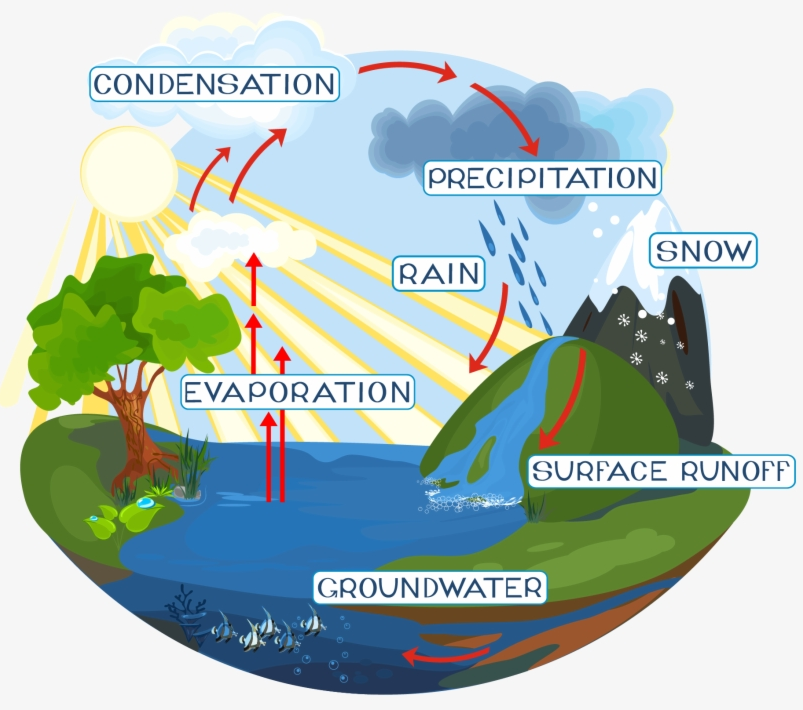
The water cycle is important for us because of the following reasons:
  • Water cycle helps in regulating weather on earth.
  • Water cycle makes water available in its various forms on the earth. The most important is the rainwater.
View full question & answer
Question 32 Marks
Take out a cooled bottle of water from refrigerator and keep it on a table. After some time you notice a droplets of water around it. Why?
Answer
This is because water vapour near the cold bottle collides with it, becomes cool, and condenses into water droplets. These water droplets collect and form a puddle of water around the bottle.
View full question & answer
Question 42 Marks
What happens to the water that rain and snow bring to different regions of earth?
Answer
Some of the water flows in the form of rivers and streams, the rain water also fills up the lakes and pond, a part of rain water gets absorbed by the ground and seems to disappear in the soil. Some of this water is brought back to the air by the process of evaporation and transpiration.
View full question & answer
Question 52 Marks
Are there regions where people do not get adequate amount of water? How do they manage?
Answer
Hot and dry regions like Rajasthan do not get adequate amount of water. They have to travel long distances for collecting drinking water.
View full question & answer
Question 62 Marks
What are the different ways by which water vapour is put into the atmosphere?
Answer
Water in oceans, lakes and ponds gets evaporated due to atmospheric heat. Factories and thermal power stations produce a lot of steam and put it into the atmosphere. Plants throw out water vapour by transpiration. Animals excrete water vapour through respiration and sweating. All this vapour accumulates in the atmosphere.
View full question & answer
Question 72 Marks
List some more use of water, apart from our daily activities in which water is nrequired.
Answer
We obtain food from plants, plants needs water to grow and cook their food by the process of photosynthesis. Water is used in industries for processing large number of things that we uses like fabrics, paper etc,
View full question & answer
Question 82 Marks
How can we harvest rain water?
Answer
Roof top rain water harvesting-in this system rain water is collected from roof top to a storage tank through pipes. There is one more method in which rain water is allowed to go into the ground directly from the road side drains that collect rain water.
View full question & answer
Question 92 Marks
We know that water changes into vapour when heated. But it is a common experience that water from wet roads, rooftops and floors disappears without heating. Explain how water changes into its vapour even without heating?
Answer
During the day time, sunlight falls on the water in oceans, rivers and lakes. The fields, roads, rooftops and other land areas also receive sunlight. The sunlight also carries heat with it. As a result, water from oceans, rivers, lakes and the soil, and other land areas gets continuously changed into its vapour.
View full question & answer
Question 102 Marks
Distinguish between the following.
Flood and Drought.
Answer
 
Flood
Drought
$1.$
Condition when continuous rains cause water run-off that cannot be carried in river channels or retained in eservoirs.
Condition of abnormally dry weather within a geographic region where some rain is usually expected.
$2.$ It occurs through heavy rainfall. It occurs through no rainfall.
$3.$ It is often held in the coastal Andhra Pradesh & Odisha. The dry region seen in leeward side of Western ghats.
View full question & answer
Question 112 Marks
How will you show the presence of water vapour in the air?
Answer
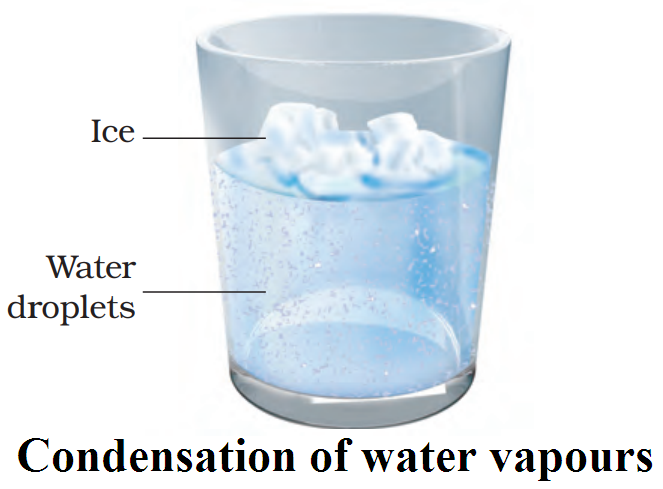
First, take a clean glass and put some ice cubes in it. Keep it in the open air. After some time, small droplets of water will be observed on the outer surface of the glass. This is because water vapour in the air comes in contact with cold surface of glass and condenses. These droplets of water are due to condensation of water vapour present in the air.
View full question & answer
Question 122 Marks
Write the disastrous effects of floods.
Answer
  1. Floods damage property.
  2. Floods endanger lives of humans and animals.
  3. Floods cause soil erosion.
  4. Navigation is impaired.
View full question & answer
Question 132 Marks
What are the various methods of rainwater harvesting?
Answer
  • Rooftop rainwater harvesting: In this system, the rainwater from the rooftop is collected in a storage tank through pipes.
  • A big pit is dug near house for collecting rainwater. This pit is filled with different layers of bricks, coarse gravels and sand or granite pieces.
View full question & answer
Question 142 Marks
Distinguish between the following.
Evaporation and Condensation.
Answer
 
Evaporation
Condensation
$1.$
The process of changing water from liquid form to its vapour form.
The process of conversion of vapour into liquid form of water.
$2.$
Evaporation occurs before a liquid reaches its boiling point.
Condensation is a phase change regardless of the temperature.
$3.$
Evaporation usually takes place in low altitudes.
Condensation happens mainly at higher altitudes.
View full question & answer
Question 152 Marks
What is dew and how it is formed?
Answer
On a clear day, water evaporates from the warm ground into the atmosphere. When night falls, the ground radiates the day's warmth into the skies. The ground becomes much cooler, causing the water vapour to condense. This condensed vapour is dew.
View full question & answer
Question 162 Marks
What happens if it rains heavily?
Answer
Excess of rainfall leads to many problems. It raises the water level in rivers, lakes and ponds. The water may then spread over larger area causing the situation of floods. The crop fields, forests, villages and cities may get submerged by water.
View full question & answer
Question 172 Marks
Distinguish between the following.
Surface water and Groundwater.
Answer
 
Surface water
Groundwater
$1$.
Water collected on the ground or oceans and streams.
Water collected beneath the ground between the soil particles.
$2$.
It is water found in a river, lake or other surface cavities.
Groundwater is water contained in or by a subsurface layer of soil or rock.
$3$.
Surface water is usually not very high in mineral content.
Groundwater commonly contains less contamination than surface water because the rock tends to act as a filter to remove some contaminants.
$4$.
Surface water is called as soft water due to its less mineral content.
Due to the minerals picked up while filtering through the rocks, groundwater is typically considered to be hard water.
View full question & answer
Question 182 Marks
Suppose you want to dry your school uniform quickly. Would spreading it near an anghiti or heater help? If yes, how?
Answer
Yes, spreading of clothes near an angithi or a heater would help dry the clothes quicker. This is because heat generated from an angithi or a heater causes the water to evaporate at a faster rate.
View full question & answer
Question 192 Marks
What is transpiration and write the factors affecting it?
Answer
A part of water absorbed by the plants is released by plant through their leaves into the air by a process called transpiration.
Transpiration is affected by the following factors:
  • Temperature.
  • Humidity.
  • Windspeed.
  • Time of the day.
View full question & answer
Question 202 Marks
How can the states of water be interchanged?
Answer
On heating, ice (solid water) changes into liquid water and then into water vapour. On condensation, vapours convert into liquid and on freezing, liquid water forms ice.
View full question & answer