Questions

[3 Mark Questions]

🎯

Test yourself on this topic

38 questions · timed · auto-graded

Question 13 Marks
Describe three important buildings in your city or village. Are they located in a special part of the settlement (e.g. the centre)? What are the activities that take place in these buildings?
Answer
The thee important buildings in my city, Delhi, are:
Rashtrapati Bhavan: It is the official residence of the President of India.
Parliament House: Here elected representatives of the people meet and discuss all important issues regarding the countary.
Supreme Court: It is the highest Court of the country where all the cases are decided. The building is called the Supreme Court building.
View full question & answer
Question 23 Marks
What were the important crafts of the Harappan people?
Answer
In the Harappan cities, there were men and women who made all kinds of things either in their own homes or in special workshop known as crafts persons.
  1. Copper and bronze were used to make tools, weapons, ornaments and vessels. Gold and silver were used to make ornaments and vessels.
  2. The Harappans made seals out of stone. These seals were generally rectangular in shape and had an animal carved on them.
  3. The Harappans made beads, weights and blades. Most of the beads were made out of carnelian, a beautiful red stone. They also made pots with beautiful black designs.
View full question & answer
Question 33 Marks
How was Harappa discovered?
Answer
  1. In 1856, when British were building the Lahore to Multan railways, they stumbled upon a mound of finely baked bricks near the site of Harappa in the present day Pakistan.
  2. However, it was not until 1924 that John Marshall, the then Director General of Archaeological Survey of India, announced the existence of a great civilization called the Indus Valley Civilization.
  3. Since Harappa was the first city to be discovered it was also called Harappan Civilization.
View full question & answer
Question 43 Marks
Are there any old buildings in your locality? Find out how old they are and who looks after them.
Answer
There are many old building near my localtiy. There are:
  1. Red fort: Red Fort was constructed in the 17th century.
  2. Jama Masjid: Jama Masjid was also constructed in the 17th century.
  3. Ferozeshah Kotla: Ferozeshah Kotla was also constructed in the 15th century.
The Archaeological survey of India looks after these ancient buildings.
View full question & answer
Question 53 Marks
What is the meaning of seals and sealing?
Answer
Seals may have been used to stamp bags or packets containing goods that were sent from one place to another. After a bag was closed or tied, a layer of wet clay was applied on the knot, and the seal was pressed on it. The impression of the seal is known as sealing. Harappan people used the seals for signs of proprietorship, against ill or bad omens etc also.
View full question & answer
Question 63 Marks
Describe the life of the people in Harappan cities?
Answer
The Harappan city was a very busy place. There were people who planned the construction of special buildings in the city. They may have kept the most valuable objects, such as ornaments of gold and silver, or beautiful beads, for themselves. And there were scribes, people who knew how to write, who helped prepare the seals, and perhaps wrote on other materials that have not survived till date. Men and women, craftsmen, made all kinds of things- either in their own homes, or in special workshops. People were travelling to distant lands at that time by carts to inland places or by ship to foreign lands.
View full question & answer
Question 73 Marks
What types of metals were used to make tools in earlier cities?
Answer
There were mainly four types of metals that were used to make tools in earlier cities. They were- Copper, bronze, gold, and silver. Copper and bronze were used to make tools, weapons, ornaments and vessels. Gold and silver were used to make ornaments and vessels.
View full question & answer
Question 83 Marks
Write a short note on ‘The Cattle Rearing of the Harapp Answer:
Answer
The Cattle Rearing.
  1. The Harappans reared cattle, sheep, goat, and buffalo.
  2. Water and pasture was available around settlements,
  3. In the dry summer months, large herds of animals were probably taken to greaterdistances in search of grass and water.
View full question & answer
Question 93 Marks
How do archaeologists know that cloth was used in the Harappan civilization?
Answer
The archaeologists have found actual pieces of cloth attached to the lid of a silver vase and some copper objects at Mohenjodaro. As we know that cloth is made up of cotton, probably, the farmers grew cotton at that time. The archaeologists have also found spindle whorls, made of terracotta and faience which were used to spin thread. This proves that the cloth was used in Harappan civilization.
View full question & answer
Question 103 Marks
What led to the decline of the Harappan civilisation?
Answer
The historians are uncertain regarding the causes for the decline of the Harappan civilisation. Various factors were responsible for the end of the physical existence of the Harappan cities.
  1. The decline in the quality of buildings and town planning indicates as if the rulers were losing control which forced the people to move to newer settlements.
  2. The rivers changed their course, which led to either heavy floods or drought like situations.
  3. Ecological changes led to the decline of land and agriculture. With time, the requirement for fuel increased, which led to excessive deforestation. Moreover, grazing by large herds of animals destroyed the green cover. All this must have enforced them to evacuate to other areas.
View full question & answer
Question 113 Marks
What were the main features of the cities built during the Harappa Civilisation?
Answer
Harappan cities were divided into two or more parts. The western part was higher and was also called the citadel. The eastern part or the lower town was made up of baked bricks. These bricks were laid in interlocking pattern that made the wall strong. Some of the cities also had a huge water tank or ‘The Great Bath’. Fire altars for worshipping were also found in these tanks. Most of the houses were either one or two stories high. They were built around a courtyard. The cities also had covered drainage systems. The drainage system also had manhole at regular intervals for cleaning up.
View full question & answer
Question 123 Marks
Write in brief the story of Harappa’s finding.
Answer
The story of Harappa.
  1. About 152 years ago (1855 A.D.), when railway lines were being laid down for the first time in west Punjab. Engineers stumbled upon the site of Harappa in present-day Pakistan. To them, it appeared like a mount which was a rich source of ready-made, high quality bricks.
  2. The labourers (working on railway-line) carried off thousands of bricks from the walls of the old building of the city (later on named as Harappa) to construct railway lines. Many buildings were completely destroyed.
  3. Then, nearly eighty five years ago (1920 A.D.), archaeologists found the site, and realized that this was one of the oldest cities in the subcontinent. As this was the first city to be discovered.
View full question & answer
Question 133 Marks
Describe the drain-system of the Harappans.
Answer
  1. In cities related with the Harappan civilisation, each drain had a gentle slope so that water could flow through it.
  2. Very often, drains in houses were connected to those in streets and smaller drains led to bigger ones.
  3. As the drains were covered, inspection holes were provided at intervals to clean them. All three (i.e.drains, houses and streets) were probably planned and built at the same time.
View full question & answer
Question 143 Marks
List three factors which show that Lothal was an important production centre of the Harappan civilisation.
Answer
Following factors show that Lothal was an important production centre of the Harappan civilisation:
  1. It was situated near areas where raw materials such as semi-precious stones were easily available.
  2. This was an important centre for making objects out of stone, shell and metal.
  3. Pieces of stone, half made beads, tools for bead making and finished beads have all been found in a building. This building was probably a workshop for making beads.
View full question & answer
Question 153 Marks
Describe the trade under Indus Valley Civilization.
Answer
  1. Trading thrived in Harappa.
  2. It suggests that long-distance trade existed.
  3. Goods coming from outside perhaps included copper from Rajasthan, gold from Karnataka and precious stones from Iran and Afghanistan.
  4. Seals of Mesopotamia have been found in Indus region while seals of Indus Valley have been found in Mesopotamia.
View full question & answer
Question 163 Marks
Write the names of the cities related with the earliest civilisation of the Indian subcontinent.
Answer
  1. Mohenjodaro.
  2. Harappa.
  3. Rakhigarhi.
  4. Dholavira.
  5. Kalibangan.
  6. Lothal.
  7. Ropar.
View full question & answer
Question 173 Marks
Do you have covered drains in your locality? What are the advantages of having covered drains?
Answer
Yes, we have covered drains in our locality.Followings are the advantages of having covered drains:
  1. Under this system each drain generally had a gentle slope so that water could flow through it.
  2. Very often drains in houses are connected to those on the streets and smaller drains led into bigger ones. It helps people in keeping clean their houses and buildings in a modern systematic manner.
  3. As the streets and lanes drained are covered, inspection holes are provided at intervals to clean them from time to time. Covered drains protect people from foul smell and help them to keep good health.
  4. Covered drains are proof of more advanced civilised life.
View full question & answer
Question 183 Marks
Discuss the work of specialists in the Harappans’ society.
Answer
  1. Meaning:
A specialist is a person who is trained to do only one type of work, for instance, cutting stone or polishing beads or carving seats.
  1. Specialists as Producers:
  1. Many of the things that were produced were probably the work of specialists.
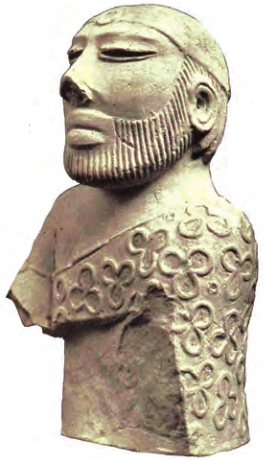
  2. We find a figure of a man bearing beard.
  3. If we look at the statue or figure we see how well the face is carved and how carefully the beard is shown.
  4. According to scholars this must have been the work of an expert crafts person.
View full question & answer
Question 193 Marks
Why seals seem to be puzzling items in Indus Valley?
Answer
  1. Of the various articles discovered in the Indus Valley, about 200 seals are the most puzzling.
  2. They were little pieces of soft stones, ivory and clay.
  3. They were generally rectangular in shape.
  4. On these are engraved figures of animals and birds.
  5. Seals were perhaps used by different guilds or merchants or traders.
View full question & answer
Question 203 Marks
List some of the important architectural features of Dholavira.
Answer
The city of Dholavira was located on Khadir Beyt in the Rann of Kutch in Gujarat. Here fresh water was available and the soil was very fertile.
  1. Unlike some of the other Harappan cities, which were divided into two parts, Dholavira was divided into three parts.
  2. Each part was surrounded with massive stone walls, with entrances through gateways.
  3. There was also a large open area in the settlement, where public ceremonies could be held.
View full question & answer
Question 213 Marks
Where do we find early cities of the Indian subcontinent? What unique objects have been found by Archaeologists in these cities?
Answer
  1. The early cities of the Indian subcontinent are found in present-day Pakistan, and in India. In India these are found in Gujarat, Rajasthan, Haryana, Western parts of U.P. and Punjab.
  1. Archaeologists have found a set of unique objects in almost all these cities:
  1. Red pottery painted with designs in black,
  2. Stone Weights,
  3. Seals with writing,
  4. Special beads,
  5. Copper tools, and
  6. Long stone blades.
View full question & answer
Question 223 Marks
Describe the drains laid in the cities of Harappan.
Answer
  1. Many of the cities had covered drains.
  2. Very carefully these were laid out in straight lines.
  3. Each drain had a gentle slope so that the water could flow through it.
  4. Very often drains in houses were connected to those on streets and smaller drains led into bigger ones.
View full question & answer
Question 233 Marks
“There are many evidences that cloth was worn by the Harappans.” Explain in brief.
Answer
  1. The Harappans prepared and used cloth. Cotton was probably grown at Mehrgarh from about 7,000 years ago.
  2. Actual pieces of cloth were found attached to the lid of a silver vase and some copper objects at Mohenjodaro.
  3. Archaeologists have also found Spindle whorls, made of terracotta and faience. These were used to spin thread.
  4. We also have indirect evidence to show how cloth was decorated. For instance, a stone statue of an important man found at Mohenjodaro shows him wearing an embroidered garment.
View full question & answer
Question 243 Marks
What kind of jewellery was worn by Harappan men and women?
Answer
  1. Both men and women seem to be fond of ornaments.
  2. Necklaces, armlets, finger rings and bangles were worn both by men and women.
  3. Ornaments were of great variety and design.
  4. The ornaments were made of different metals such as gold, silver, copper and bronze.
View full question & answer
Question 253 Marks
Write about the drains in the Harappan cities.
Answer
People of Harappa paid special attention to the drainage system. Many of the cities had covered drains. All the drains were laid out in straight lines having a gentle slope so that water could flow through it. Drains in the houses were connected to the street drains.Inspection holes were provided at regular intervals to ensure proper cleaning of the drains.
View full question & answer
Question 263 Marks
Why were metals, writing, the wheel, and the plough important for the Harappans?
Answer

Metals: Archaeologists have found things made of metal, including copper, bronze, gold and silver Copper and bronze were used to tools, weapons, ornaments and vessels. Gold and silver were used to make ornaments and vessels.Writing: There were scribes, people who know how to write, they helped to prepare seals, kept a record and wrote on materials that have not survived.
Wheel: It played a great role in the life of Harappans for example:
  1. People could travels long distance easily.
  2. Goods were carried easily to one place to another.
Plough: It was used to dig the earth for turning the soil are planting seeds.
View full question & answer
Question 273 Marks
Discuss in brief the life in Harappa City.
Answer
Life in Harappa City:
  1. Probably Harappa was a busy place. There were people who planned the construction of special buildings in the city. These were probably the rulers.
  2. Most probably the rulers of the Harappan city sent people to distant lands to get metal, precious stones and other things that they desired or required.
  3. The rulers may have kept the most valuable objects, such as ornaments of gold and silver or beautiful beads for themselves.
  4. And there were scribes, people who knew how to write, who helped prepare the seals and perhaps wrote (or engraved) on other materials.
View full question & answer
Question 283 Marks
What do you know about agriculture and food habits of Harappa?
Answer
  1. The Harappan culture used common food articles.
  2. They took simple food.
  3. They ate variety of food grains like wheat, barley, lentil, chickpea and sesame.
  4. Besides, vegetables, fruits and cloves, milk were also included in their food.
View full question & answer
Question 293 Marks
Give one word for each of the following terms or sentences:
  1. Stage when the culture of a country or region is developed and advanced.
  2. Clay tablets and idols.
  3. A place where surplus grains were stored.
  4. A place where ships were loaded, unloaded and repaired.
Answer
  1. Civilisation.
  2. Terracotta.
  3. Grainaries.
  4. Dockyard.
View full question & answer
Question 303 Marks
Write important historical events against the following dates:
  1. About 7000 years ago.
  2. About 4700 years ago.
  3. About 3900 years ago.
  4. About 2500 years ago.
Answer
  Dates Events
(i) About 7000 years ago. Cotton cultivation at Mehrgarh.
(ii) About 4700 years ago. Beginning of cities life in Indian sub-continent.
(iii) About 3900 years ago. Beginning of the end of early Indian cities.
(iv) About 2500 years ago. The emergence of other phases of cities in Indian sub – continent.
View full question & answer
Question 313 Marks
S.No Metals   States
1. Copper (a) Gujarat.
2. Gold (b) Afghanistan.
3. Tin (c) Rajasthan.
4. Precious stones (d) Karnataka.
Answer
Match the columns:
S.No Metals   States
1. Copper (c) Rajasthan.
2. Gold (d) Karnataka.
3. Tin (b) Afghanistan.
4. Precious stones (a) Gujarat.
View full question & answer
Question 323 Marks
What are raw materials? How did the Harappans make their provision?
Answer
  1. Meaning.
  1. Raw materials are substances that are either found naturally (such as wood, or ores of metals) or produced by farmers or herders.
  2. These are generally processed to produce finishing goods.
  3. For instance cotton, produced by farmers, is a raw material that is processed to make cloth.
  1. Provision or Search of Raw Materials:
  1. While some of the raw materials that the Harappans used were available locally many items such as copper, tin, gold, silver and precious stones had to be brought from distant places.
  2. The Harappans probably got copper from Rajasthan and even from Oman.
  3. Tin, which was mixed with copper to produce bronze, may have been brought from Afghanistan and Iran.
  4. Gold could have come all the way from Karnataka and
  5. Precious stones from Gujarat, Iran and Afghanistan.
View full question & answer
Question 333 Marks
Look at the picture given below. Please state its use in earlier time. Are we presently using something like this ?
Image
Answer
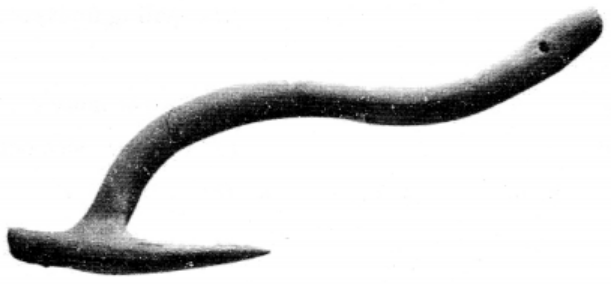
In the picture, a plough has been shown, which was found in the Harappan cities. This is a toy, but archaeologists believe that this was used in digging and turning the soil for the purpose of planting of seeds. Presently, our farmers in villages also use plough for the same purpose. It appears that present-day ploughs have been developed from the Harappan plough.
View full question & answer
Question 343 Marks
State the reasons which could have been possible behind the end of the Harappan Civilization.
Answer
Around 3900 years ago, the Harappan Civilization suddenly seems to end up. People stopped living in many of the cities. Writing, seals and weights were no longer used. Raw materials brought from long distances became rare. In Mohenjodaro, we find that garbage piled up on the streets, the drainage system broke down. Why did all this happen ? The reasons are not clear. The following reasons may be behind the ending up of the Harappan Civilization :
• Some suggest that the rivers dried up.
• Some suggest that there was deforestation.
• In some areas, there were floods.
• The rulers might have lost control.
• The people moved into newer, smaller settlements etc.

But none of these reasons can explain the end of all the cities. Flooding or a river drying up would have had an effect in only some areas.
View full question & answer
Question 353 Marks
Are there any old buildings in your locality? Find out how old they are and who looks after them.
Answer
There are many old buildings near my locality. They are :
      1. Red Fort
      2. Jama Masjid
      3. Ferozeshah Kotla

Red Fort was constructed in the 17th century.
Jama Masjid was also constructed in the 17th century.
Ferozeshah Kotla was built in the 15th century.
The Archaeological Survey of India looks after the ancient buildings.
View full question & answer
Question 363 Marks
Make a list of what the Harappans ate, and put a tick mark against the things you eat today.
Answer
The Harappans used to eat the following articles/things (See Left Hand Column) :
Harappans food articlesTick mark
(against the things we eat today)
1. Wheat
2. Barley
3. Pulses
4. Peas
5. Rice
6. Sesame
7. Linseed
8. Mustard
View full question & answer
Question 373 Marks
Make a list of all the terracotta toys shown in the lesson. What do you think children would have enjoyed playing with the most?
Answer
List of the Terracotta Toys
1. A toy cart made of clay.
2. Small clay carts resembling the modern ekhas.
3. Puppets
4. Whistles made in the form of birds and rattles of all kinds.
5. Marbles
6. Dolls
7. Models of different cattle and animals. (Humped bull, Rhinoceros)
8. Seals
9. Jewellery articles.
We think that girls would have enjoyed dolls and puppets most, while the male children would have enjoyed carts or ekhas and rattles.
View full question & answer
Question 383 Marks
Why were metals, writing, the wheel, and the plough important for the Harappans?
Answer
(1) Metals : Archaeologists have found things made of metal, including copper, bronze, gold, and silver. Copper and bronze were used to make tools, weapons, ornaments, and vessels. Gold and silver were used to make ornaments and vessels.
(2) Writing : There were scribes, people who know how to write, they helped to prepare seals, kept a record, and wrote on materials that have not survived.
(3) Wheel : It played a great role in the life of Harappans for example:
      • People could travel long distances easily.
      • Goods were carried easily from one place to another.
(4) Plough : It was used to dig the earth for turning the soil and planting seeds.
View full question & answer
[3 Mark Questions] - Social Science STD 6 Questions - Vidyadip