Questions

[5 marks Questions]

🎯

Test yourself on this topic

16 questions · timed · auto-graded

Question 15 Marks
What was the basis of belief in the system of Bhakti?
Answer
According to this system of belief, if a chosen deity was worshipped with a pure heart, the deity would appear in the form in which he or she may have desired. So the deity could be thought of as human being, lion, tree or any other form. Once this idea gained acceptance, artists made beautiful images of these deities.
View full question & answer
Question 25 Marks
Discuss in short the Xuan Zang’s visit to India.
Answer
  1. Xuan Zang came to India about 1400 years ago. He came to visit places associated with the life of the Buddha as well as famous Buddhist monasteries.
  2. He took the land route back to China (through the north-west, and Central Asia). He carried back with him statues of the Buddha made of gold, silver and sandalwood, and over 600 manuscripts on the backs of 20 horses.
  3. Over 50 manuscripts were lost when the boat on which he was crossing the Indus capsized.
  4. Xuan Zang spent the rest of his life translating the remaining manuscripts from Sanskrit into Chinese.
View full question & answer
Question 35 Marks
Which religions flourished after the coming of rulers from distant lands in India?
Answer
In India, Buddhism and Hinduism were the two main religions. Buddhism was divided into two cults–Hinayana and Mahayana. Hinayana was the simpler and older form of Buddhism which worshipped Buddha as a scholar. Mahayana was a new form of Buddhism with rituals and ceremonies where Buddha was worshipped as God. Menander, the Indo Greek ruler and Kanishka, the Kushana ruler followed Buddhism and gifted land to Buddhist monks for monasteries. Hinduism was patronised by Satavahana ruler who worshipped Vishnu, Shiva and Mother Goddess. Hinduism, by this period, witnessed a seesaw change. Emphasis was now placed on loving devotion to God called Bhakti.
View full question & answer
Question 45 Marks
There are several major pilgrimages performed by people in India today. Find out about any one of them, and write a short description. (Hint: who can go on the pilgrimage-men, women or children? How long does it take? How do people travel? What do they take with them? What do they do when they reach the holy place? Do they bring anything back with them?)
Answer
Amarnath ki Yatra is one of the most ardous journey undertaken by the pilgrims. It is a sacred place for the Hindus. Amarnath in Himalaya has natural shivilnga made of ice. The journey is undertaken by people of all ages. It takes about 15 days from Delhi. The journey starts in the month of August. Part of the journey covered by train, other part of foot and riding on animals. The security forces have to protect the pilgrims from terrorist attacks. The pilgrims carry offerings and after bathing they offer their prayers, they start on the return journey. Very often pilgirms bring 'prasad' which is distributed among the people back home.
View full question & answer
Question 55 Marks
Write a short note on Nalanda.
Answer
Nalanda was a unique centre of learning when Xuan Zang, the Chinese pilgrim visited the subcontinent. He and other pilgrims spent time studying in Nalanda, (Bihar) the most famous Buddhist monastery of the period. This is how he describes it.
  1. The teachers of Nalanda are men of the highest ability and talent. They follow the teachings of the Buddha in all sincerity.
  2. The rules of the monastery are strict, and everyone has to follow them.
  3. Discussions are held throughout the day, and the old and the young mutually help one another.
  4. Learned men from different cities come here to settle their doubts.
  5. The gate keeper asks new entrants difficult questions. They are allowed to enter only after they have been able to answer these. Seven to eight out of every ten are not able to answer.
View full question & answer
Question 65 Marks
Discuss the returning journey of Fa Xian to his country China from the subcontinent.
Answer
  1. Fa Xian came to India about 1600 years ago during the reign of Chandraguptall. He remained in his court. After several years he returned to China.
  2. He boarded a ship belonging to some merchants and started off from Bengal. They had hardly travelled for two days when they were caught in a storm.
  3. The merchants started throwing their merchandise overboard so as to lighten the load and save the ship from sinking.
  4. Fa Xian threw away his meagre personal belongings, but clung to his books and the statues of the Buddha that he had collected.
  5. Finally the storm subsided after 13 days. It took him more than 90 days to reach Java, where he halted for five months, before boarding another merchant ship that took him to China.
View full question & answer
Question 75 Marks
Match the following:
S.No.
 
S.No.
 
1.
Muvendar
(a)
Mahayana Buddhism.
2.
Lords of the dakshinapatha
(b)
Buddhacharita.
3.
Ashvaghosha
(c)
Satavahana rulers.
4.
Bodhisattvas
(d)
Chinese pilgrim.
5.
Xuan Zang
(e)
Cholas, Cheras and Pandyas.
 
Answer
S.No.
 
S.No.
 
1.
Muvendar
(e)
Cholas, Cheras and Pandyas.
2.
Lords of the dakshinapatha
(c)
Satavahana rulers.
3.
Ashvaghosha
(b)
Buddhacharita
4.
Bodhisattvas
(a)
Mahayana Buddhism
5.
Xuan Zang
(d)
Chinese pilgrim
View full question & answer
Question 85 Marks
How did Bhakti gain popularity in India during this period?
Answer
  1. During this period, worship of certain deities became a key feature of Hinduism.
  2. These deities were Shiva, Vishnu and goddesses like Durga.
  3. These deities were worshipped through Bhakti, an idea which became quite popular at that time.
  4. Bhakti is normally understood as a person’s devotion to his or her chosen deity.
  5. Anyone whether rich or poor, belonging to the so-called ‘high’ or ‘low’ castes, man or woman, could follow the path of Bhakti.
View full question & answer
Question 95 Marks
Mention important historical events against the following given dates:
  1. About 7000 years ago.
  2. About 2300 years ago.
  3. About 2000 years ago.
  4. About 1900 years ago.
  5. About 1600 years ago.
  6. About 1400 years ago.
Answer
S.NO. Dates Events
(i) About 7000 years ago. Discovery of silk making.
(ii) About 2300 years ago. The Cholas, Cheras and Pandyas ruled the Dakshinapatha or the remote southern parts of India.
(iii) About 2000 years ago. Growing demand for silk in the Roman Empire.
(iv) About 1900 years ago. Kanishka, the Kushana ruler ruled.
(v) About 1600 years ago. Fa Xian came to India.
(vi) About 1400 years ago. Xuan Zang came to India. Composed devotional poems in praise of Lord Shiva.
View full question & answer
Question 105 Marks
Explain the term “muvendar”.
Answer
It is a Tamil word meaning three chiefs, used for the heads of three ruling families– the Cholas, Cheras and the Pandyas.
They became powerful in South India around 2300 years ago. Each of the three chiefs had two centres of power: one on inland and one on the coast. Out of these six cities, two were very important: Puhar or Kaveripattinam, the port of the Cholas, and Madurai, the capital of the Pandyas. The chiefs did not collect regular taxes. Instead, they demanded and received gifts from people. They also went on military expeditions and collected tribute from the neighbouring areas.
View full question & answer
Question 115 Marks
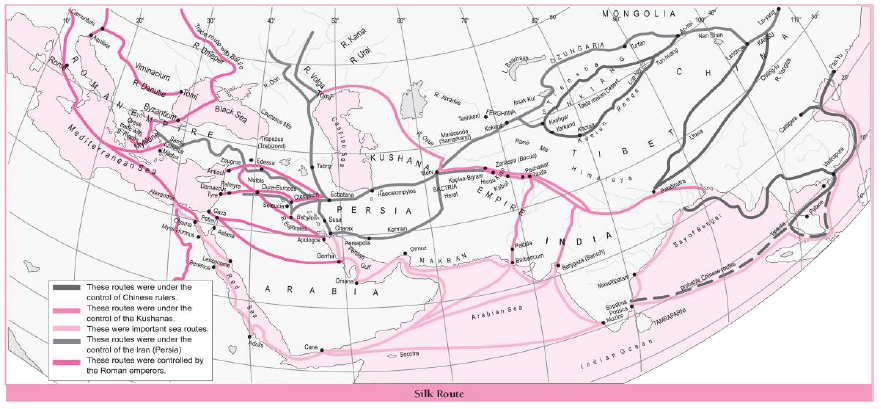
Write a note on ‘significance of Silk Route’ with the help of a map.
Answer
The most important reason for development and prosperity during this age was the Silk Route. Since silk was the main item of this route, it was called Silk Route. The Chinese were the first carriers of silk to other parts of the world. The main branch started from China, ran across Central Asia and ended on the West Asian provinces of the Roman Empire. It was through this route that India exported peach, ivory, textile and precious stones to other countries. It even imported gold, glass, tin and copper through this route. Many Indian rulers tried to control the Silk Route. They gave protection to merchants on this route. In return, merchants gave them a share in profit. It was a profitable route leading to prosperity of India.
View full question & answer
Question 125 Marks
Describe the development of New Kingdoms along the coasts.
Answer
Development of New Kingdoms along the coasts:
  1. The southern half of the Indian subcontinent is marked by a long coastline, hills and plateaus, and river valleys, of which that of the Kaveri is the most fertile.
  1. Chiefs and rulers who controlled the river valleys and the coasts became rich and powerful.
  1. Sangam poems mention the muvendar. This is a Tamil word meaning three chiefs, used for the heads of three ruling families, the Cholas, Cheras and Pandyas, who became powerful in south India around 2300 years ago.
  1. Each of the three chiefs had two centres of power: one inland, and one on the coast. Of these six cities, two were very important: Puhar or Kaveripattinam, the port of the Cholas, and Madurai, the capital of the Pandyas.
  1. The Chiefs (of these new Kingdoms) did not collect regular taxes. Instead, they demanded and received gifts from their subordinates. They also went on raids, and collected tribute from neighbouring areas. They kept some of the wealth and distributed the rest amongst their supporters, including kinsmen, soldiers and poets.
  1. Many poets whose compositions are found in the Sangam collection composed poems in praise of chiefs who generally rewarded them with gold, horses, elephants, chariots, precious stones and line as well as very costly cloth.
View full question & answer
Question 135 Marks
Discuss the Quest of the Chinese Pilgrims.
Answer
The Quest of the Chinese Pilgrims are as follows:
  1. As traders and merchants journeyed to distant lands in caravans and ships, pilgrims generally travelled with them. Several pilgrims from China visited India from time to time.
  2. The best-known of the Chinese Buddhist pilgrims, is Fa Xian. He came to the subcontinent about 1600 years ago.
  3. Another Chinese pilgrim, who is very popular in Indian history is Xuan Zang. He came to the subcontinent around 1400 years ago.
  4. The third well-known Chinese pilgrim is I-Qing. He came about 50 years after Xuan Zang (or nearly 1350 years ago).
  5. The above referred to all three Chinese pilgrims came to visit places associated with the life of the Buddha as well as famous monasteries.
  6. Each of these pilgrims left an account of their journeys of the dangers they encountered on their travels, which generally took years, of the country and the monasteries that they visited, and the books they carried back with them.
View full question & answer
Question 145 Marks
Give answer to each of the following only in one word or one sentence;
  1. Mehendra.
  2. Sanghamitra.
  3. The Third Sangam was held at.
  4. The Capital of the Chalukyas.
  5. The greatest ruler of Chola dynasty.
  6. The greatest ruler of Satavahana dynasty.
  7. The greatest religious event related with lives of Mahendra and Sanghamitra.
Answer
  1. Mehendra, son of the greatest Mauryan ruler, Ashoka.
  2. Sanghamitra, daughter of Ashoka.
  3. Madurai.
  4. Badami or Vengi.
  5. Karikalp.
  6. Gautiputra Satakarm.
  7. They went to Sri Lanka to spread Buddhism during the reign of their father, Ashoka.
View full question & answer
Question 155 Marks
Discuss in short the story of the Silk making and Silk Route in your own words.
Answer
The Story of the Silk Making and of Silk Route is given below:
  1. The rich, glossy colours of silk, as well as its smooth texture, make it a highly valued fabric in most societies.
  2. Making silk is a complicated process. Raw silk has to be extracted from the cocoons of silk worms spun into thread and then woven into cloth.
  3. Techniques of making silk were first invented in China around 7000 years ago.
  4. While the techniques remained a closely guarded secret for thousands of years, some people from China who went to distant lands on foot, horseback, and on , camels, carried silk with them. The paths they followed came to be known as the Silk Route.
  5. Sometimes, Chinese rulers sent gifts of silk to rulers in Iran and West Asia and from there, knowledge of silk spread further west.
  6. Nearly 2000 years ago, wearing silk became the fashion among rulers and wealthy people in Rome.
It was very costly, as it had to be brought all the way from China, along dangerous roads, through mountains and deserts. People living along the route (i.e., the Silk Route) often demanded payments for allowing traders to pass through.
Some rulers tried to control large portions of the route. This was because they could benefit from taxes, tributes and gifts that were brought by traders along the route. In return, they generally protected the traders who passed through their kingdoms from attacks by robbers.
In history the best known of the rulers who controlled the Silk Route were the Kushanas, who ruled over central Asia and northwest India around 2000 years ago. During their rule, a branch of the Silk Route extended from Central Asia down to the Indus Valley, from where silk was shipped westwards to the Roman empire.
View full question & answer
Question 165 Marks
Describe new7 developments and the spread of Ruddhism dining the Kanishka’s period and afterwmrds.
Answer
  1. The most famous Kushana ruler was Kanishka, who ruled around 1900 years ago. He organized a Buddhist council, where scholars met and discussed important matters.
  1. Ashvaghosha, a poet who composed a biography of the Buddha, the Buddhacharita, lived in court of Kanishka.
  1. A new form of Buddhism, known as Mahayana (the Big ship) Buddhism, developed during the age of Kanishka. This had two distinct features. Earlier, the Buddha’s presence was shown in sculpture by using certain signs. For example, his attainment of enlightenment was shown by sculptures of the peepal tree.
  1. Now, statues of the Buddha were made. Many’of these were made in Mathura (a city in modern Uttar Pradesh), while others were made in Taxila (located in modern Pakistan).
  1. The second change was a belief in Bodhisattvas. These were supposed to be people who had attained enlightenment, but, instead of giving up worldly existence, they remained in the world to help other people.
  1. The worship of Bodhisattvas became very popular and spread throughout Central Asia, China, and later to Korea and Japan.
  1. Buddhism also spread in western and southern India where dozens of caves were built for monks. Some of these were built by kings and queens, others by merchants and farmers. These were often built near passes through the Western Ghats. Roads connecting prosperous ports on the coasts with cities in the Deccan ran through these passes. Traders probably halted in these cave-monasteries during their travels.
  1. Buddhism also spread south eastwards, to Sri Lanka, Myanmar, Thailand and other parts of Southeast Asia including, Indonesia. The older form of Buddhism, known as Theravada Buddhism was more popular in these areas.
View full question & answer