Questions

[5 marks Questions]

🎯

Test yourself on this topic

14 questions · timed · auto-graded

Question 15 Marks
Name and explain the local bodies that look after the urban areas.
Answer
The local bodies that look after the problems of the urban areas are:
  1. Municipal Corporations.
  2. Municipalities.
  3. Town Area Committees.
Municipal Corporations: These are the local governing bodies of big cities such as Delhi, Mumbai, Kolkata, Chennai etc. The main functions of the municipal corporations are providing public health and sanitation, making arrangement for vaccination, supply of safe drinking water, clearing and disposal of garbage, cleaning roads, drains and public toilets.
Municipalities: Smaller towns and cities with population ranging between 20,000-5, 00,000 have municipalities as the local government body.
Town Area Committees: Municipalities and municipal corporations carry their day to day work with the help of a number of committees such as the education committee, the public health committee and the district planning committee.
View full question & answer
Question 25 Marks
Describe the scene in the buses which go to factory areas.
Answer
Scene in the buses:
  1. The buses were crowded.
  2. At every bus stop more and more people boarded the bus and the crowd went on increasing in the bus.
  3. The writer and her cousin stood in a comer so that they could not be squashed.
  4. They felt surprise how people travelled daily in such a crowded state.
View full question & answer
Question 35 Marks
What problems are posed by urban poverty?
Answer
Urban poverty poses the problems of housing, water, sanitation, health, education, social security and livelihoods. Poor people live in slums which are overcrowded, often polluted and lack basic civic amenities like clean drinking water, sanitation and health facilities. Most of the people are involved in the informal sector activities where there is constant threat of eviction, removal, confiscation of goods and almost non- existent social security cover. These are some of the problems that are faced by the poor urban people.
View full question & answer
Question 45 Marks
What percentage of workers in Ahmedabad work on the street and what do they do?
Answer
In a survey of Ahmedabad city it was found that 12 per cent of all the workers in the city were people working on the street. They sometimes sell things or repair them or provide a service. They work on their own. They are not employed by anyone and therefore have to organize their own work. They have to plan how much to purchase, as well as where and how to set up their shops. Their shops are usually temporary in structures.
View full question & answer
Question 55 Marks
Describe the working conditions of the workers in factories.
Answer
Working conditions for the workers in factories:
  1. They have to work for 12 hours a day.
  2. They have to work in day and night shifts on the machines. One worker for first 12 hours, another for next 12 hours on the same machine.
  3. If they protest in respect of working condition or wages, they are dismissed from the job.
  4. They are not well-treated.
View full question & answer
Question 65 Marks
Describe the scene at the market place.
Answer
  1. The market was about to open.
  2. People had already collected to buy things because it was a festival season.
  3. There were rows and rows of shops:
  4. They sold sweets, toys, clothes, footwear, utensils, electronic goods etc.
  5. A dentist’s clinic was also there at one end of the market.
View full question & answer
Question 75 Marks
Why do people prefer working in an organised sector?
Answer
Unorganized sector is characterized by low wages, long hours of work and lack of job security. People prefer to work in an organised sector because of the following reasons:
  1. Workers enjoy security of employment.
  2. There are fixed number of working hours. If workers work more, they have to be paid overtime by the employer
  3. Employees of the organised sector are entitled to medical leave, payment during holidays, provident fund etc.
  4. Workers also get medical benefits and under the laws, factory manager has to ensure facilities like drinking water and a safe working environment.
View full question & answer
Question 85 Marks
What happened at the dentist’s clinic?
Answer
  1. The cousin of the author alongwith him went to the dentist for check up of her teeth.
  2. They waited for their turn.
  3. When the turn came the dentist checked up her teeth. One tooth had a cavity.
  4. The dentist asked them to come next day as the cavity had to be filled.
  5. The cousin felt sorry that she allowed her teeth to be decayed because of her carelessness. How it would be painful to get the cavity filled !
View full question & answer
Question 95 Marks
Who were working on street? What activities were in action on the street/ roads?
Answer
  1. A vegetable vendor.
  2. Stall of flowers and garments.
  3. Newspaper vendor.
  4. Cobbler under a tree.
  5. Roadside barber.
  6. Cart pusher with all kinds of plastic bottles, boxes, hairpins, clips, etc.
  7. Cycle trolly, carrying vegetables.
Activities:
  1. Plying of buses.
  2. Plying of autorickshaw with school children.
  3. Rickshaw stand with severed rickshaws to take people to the nearby markets.
View full question & answer
Question 105 Marks
Compare livelihood challenges faced by rural and urban women.
Answer
Challenges faced by rural women:
  1. Poor resource base and resource quality (small or no agricultural land and water).
  2. Illiteracy and lack of skill.
  3. Lack of awareness on different government schemes and programmes.
  4. Lack of knowledge of disasters.
Challenges faced by urban women:
  1. Lack of employment and irregular jobs.
  2. Lack of job security and low wages.
  3. Lack of sufficient and timely credit support system for petty trade.
  4. Fear of eviction by police and civic bodies.
  5. Congested and hazardous working conditions.
View full question & answer
Question 115 Marks
How do these people organise their work?
Answer
These people organise their work in the following manner:
  1. They are not employed. Hence they have to organise their own work in the following manner:
  2. They plan how much to purchase, where and how to set up their shops.
  3. Their shops are temporary structures:
  4. Sometimes some boards
  5. Papers spread over discarded boxes
  6. Canvas sheets hung on four poles
  7. Their own casts
  8. Plastic sheets spread on the pavements.
  9. These people have no security.
  10. Police can dismantle their shops in a while.
  11. Vendors sell their goods (food items), already prepared at home like snacks, foods, chholas, etc.
View full question & answer
Question 125 Marks
Give an account of Sudha’s duties.
Answer
Sudha’s Duties:Sudha works in a company of the Government as marketing manager. Her office is surrounded by tall buildings.
  1. She is marketing manager in the company manufacturing biscuits.
  2. She supervises 50 sales persons. They get orders and payments from shopkeepers.
  3. She has divided the city into six zones/regions.
  4. She works for six days.
  5. She meets each salesperson once a week.
  6. She checks their progress and discusses and sorts out their problems.
  7. She pirns sales for the whole city. She often travels and works late in the evenings.
View full question & answer
Question 135 Marks
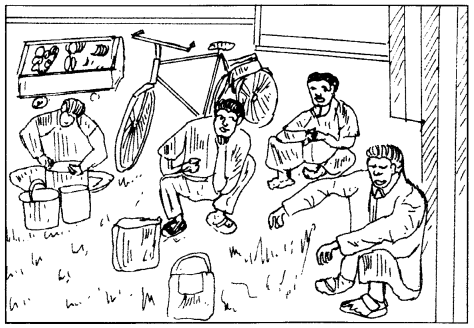
Why labourers gather at the labour chowk? What do you do as labourers?
Answer
The labourers gather at the labour chowk for finding jobs on daily wage basis.
These labourers do the following works:
  1. They act as helpers to masons.
  2. They dig at construction sites.
  3. They lift loads.
  4. They unload trucks in the market.
  5. They dig pipelines and telephone cables.
  6. They also build roads.
  7. These labourers are called casual workers.
View full question & answer
Question 145 Marks
Where does Nirmala work and what does she do there? What are her working conditions?
Answer
  1. Nirmala works in a garment factory.
  2. The factory stitches summer clothes to be sent to USA, UK, Germany and Netherlands.
Working conditions for Nirmala:
  1. She works as tailor on a sewing machine.
  2. She works for long hours (nearly 12 hours) from December to April. Her working time begins at 9 a.m. and finishes at 10 p.m., sometimes even late.
  3. She works six days a week.
  4. Her wages are Rs. 80A per day for eight hours and Rs. 40/- extra for working late.
  5. Her job is not permanent. During lean period (from June to November) she remains out of job and has to work elsewhere.
View full question & answer