Questions · Page 4 of 4

M.C.Q. [1 Marks Each]

MCQ 1511 Mark
The triangle formed by $BC = 5\ cm, AC = 3\ cm$ and $AB = 5.8\ cm$ is:
  • A
    $\text{A right angled } \triangle$
  • B
    $\text{An isosceles } \triangle$
  • C
    $\text{An equilateral } \triangle$
  • $\text{A scalene }\triangle$
Answer
Correct option: D.
$\text{A scalene }\triangle$

Cleary sum of any two given sides of is greater than the third side,
so a triangle can be formed. Now all the sides of triangle are unequal, so the triangle formed is a scalene $\triangle$
View full question & answer
MCQ 1521 Mark
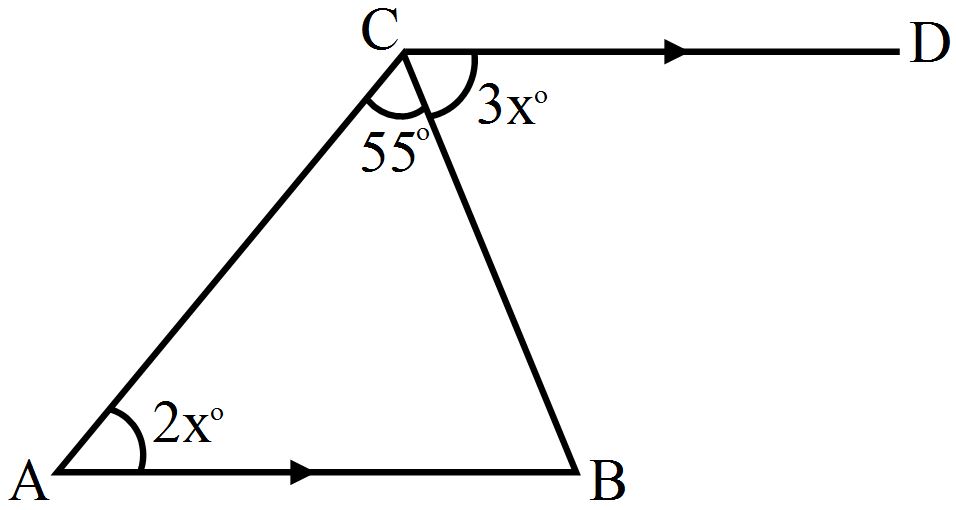
In Fig. if $AB \| CD$, the value of $x$ is:
  • $25$
  • B
    $35$
  • C
    $15$
  • D
    $20$
Answer
Correct option: A.
$25$

Since, $AB \| DE$
$\angle \text{DCB}=\angle \text{CBA}=3\text{x}^\circ$ [Alternate angles]
Now,
$\angle \text{ACB}+\angle \text{CAB}+\angle \text{CBA}=180^\circ$ [Angle sum property of triangle]
$\Rightarrow 55^\circ + 2\text{x}^\circ + 3\text{x}^\circ= 180$
$\Rightarrow 5\text{x}^\circ= 125^\circ$
$\Rightarrow \text{x} = 25$
Hence, the correct answer is option $(a).$

View full question & answer
MCQ 1531 Mark
If one angle of a triangle is obtuse, the triangle is called:
  • A
    Acute$-$angled
  • Obtuse$-$angled
  • C
    Right$-$angled
  • D
    None of these
Answer
Correct option: B.
Obtuse$-$angled
Obtuse$-$angled
View full question & answer
MCQ 1541 Mark
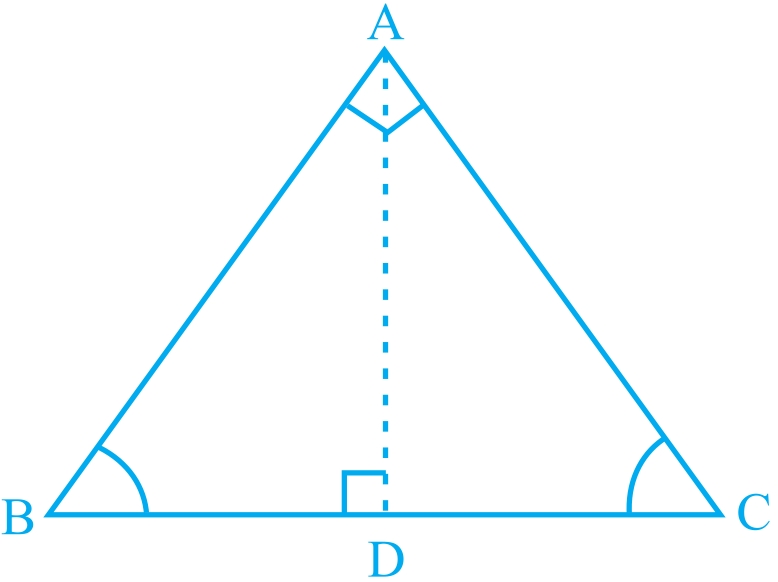
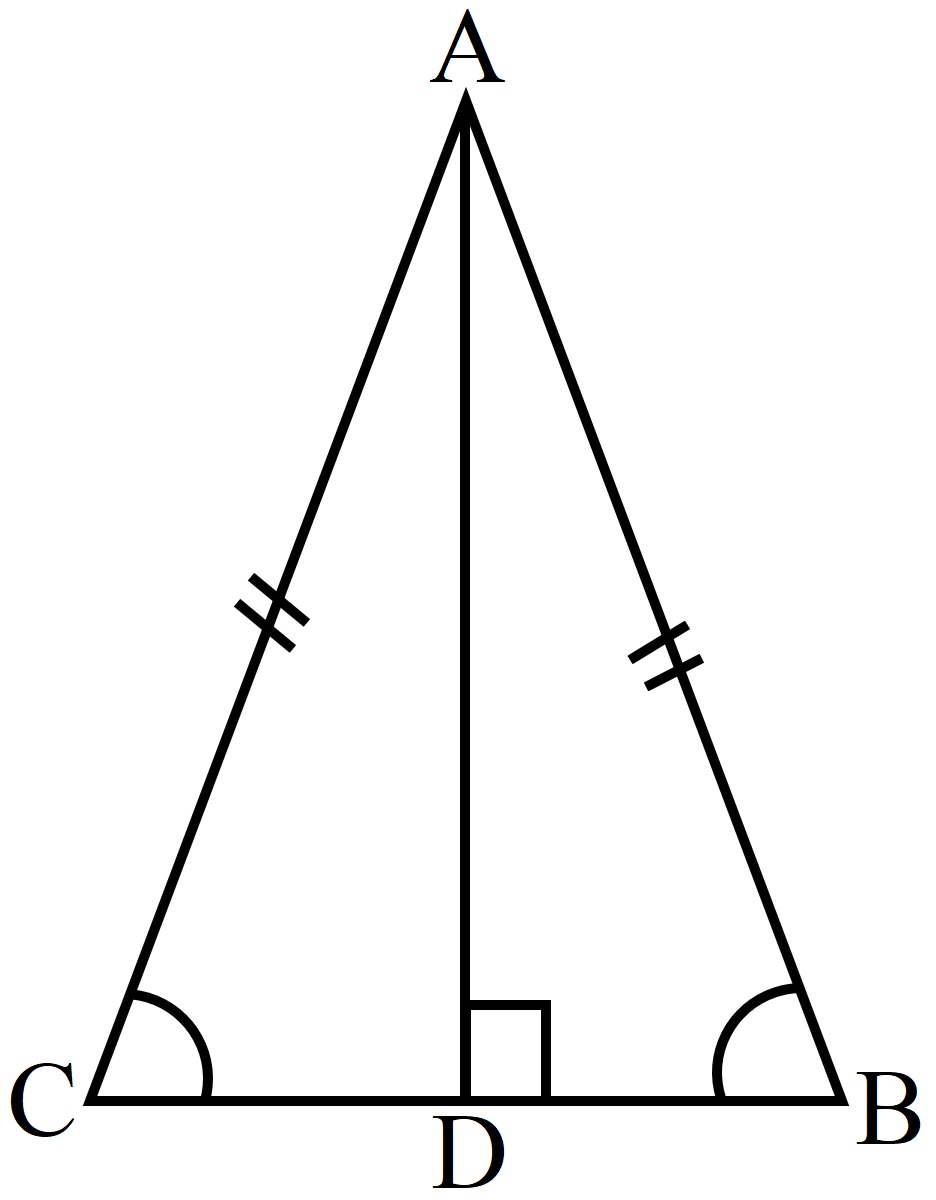
$ABC$ is an isosceles triangle with $AB = AC$ and $AD$ is altitude, then ____.
  • A
    $\angle\text{B}>\angle\text{C}$
  • B
    $\angle\text{B}<\angle\text{C}$
  • $\angle\text{B}=\angle\text{C}$
  • D
    $\text{None of these}$
Answer
Correct option: C.
$\angle\text{B}=\angle\text{C}$

In the given triangle $\triangle\text{ABC}$

$AB = AC$
$AD$ is perpendicular
So in $\triangle\text{ADC},\triangle\text{ADB}$
$AD = AD$ Common
$\triangle\text{ADC}=\triangle\text{ADB}=90^\circ$
$\triangle\text{ADC}\cong\triangle\text{ADB}$
$\Rightarrow\angle\text{B}=\angle\text{C}$

View full question & answer
MCQ 1551 Mark
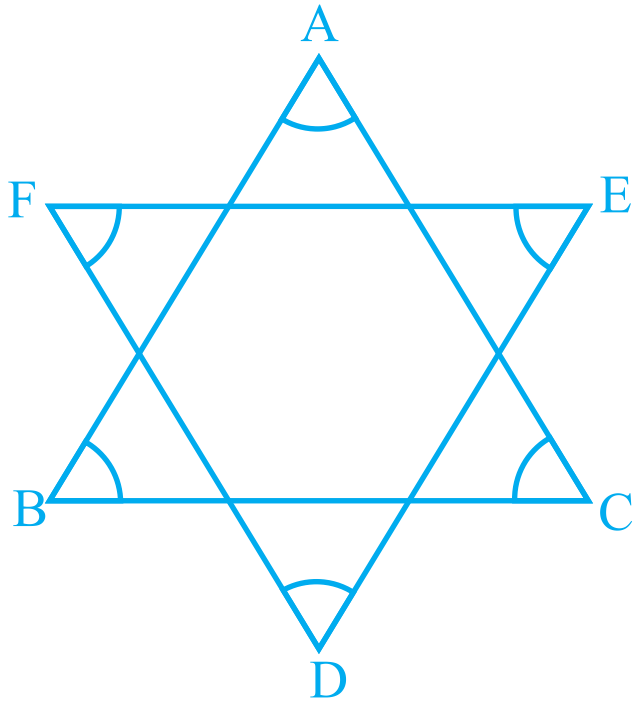
In Figure. the value of $\angle\text{A}+\angle\text{B}+\angle\text{C}+\angle\text{D}+\angle\text{E}+\angle\text{F} \ \text{is}:$
  • A
    $190^\circ$
  • B
    $540^\circ$
  • $360^\circ$
  • D
    $180^\circ$
Answer
Correct option: C.
$360^\circ$

As we know, sum of all the interior angles of a triangle is $180^\circ .$
$\text{In} \ \triangle\text{ABC}, \ \angle\text{A}+\angle\text{B}+\angle\text{C}=180^{\circ}$ $[\text{interior angles of }\triangle\text{ABC}].....(\text{i})$
$\text{In} \ \triangle\text{DEF}, \ \angle\text{D}+\angle\text{E}+\angle\text{F}=180^{\circ}$ $[\text{interior angles of }\triangle\text{DEF}].....(\text{ii})$
On adding Equation. (i) and (ii), we get.
$\angle\text{A}+\angle\text{B}+\angle\text{C}+\angle\text{D}+\angle\text{E}+\angle\text{F}\\ =180^{\circ}+180^{\circ}$
$=360^{\circ}$

View full question & answer
MCQ 1561 Mark
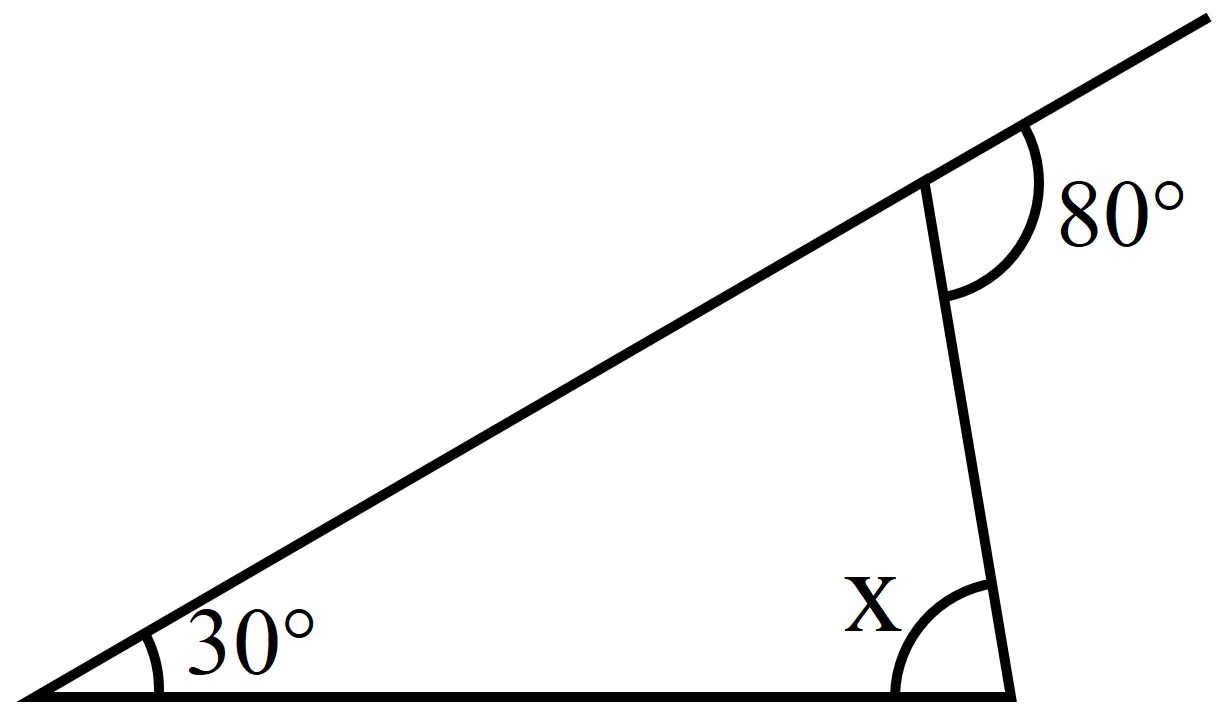
Find the value of $x$
  • A
    $120^\circ$
  • B
    $30^\circ$
  • C
    $110^\circ$
  • $50^\circ$
Answer
Correct option: D.
$50^\circ$

The exterior angle is equal to the sum of two opposite interior angle.
$80 = x + 30,$
$x = 50 degree$

View full question & answer
MCQ 1571 Mark
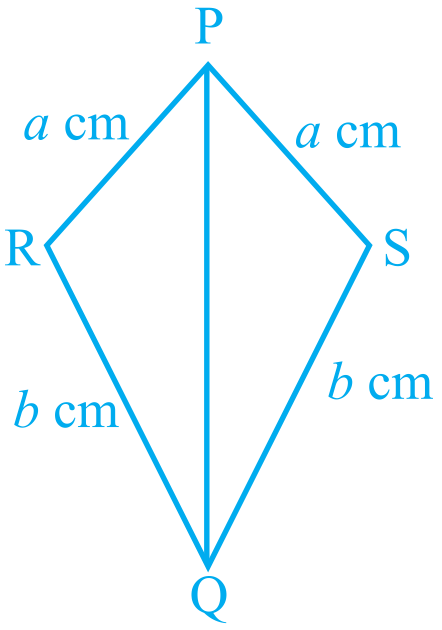
By which congruency criterion, the two triangles in Figure. are congruent?
  • A
    $RHS.$
  • B
    $ASA.$
  • $SSS.$
  • D
    $SAS.$
Answer
Correct option: C.
$SSS.$

In $\triangle\text{PQR}$ and $\triangle\text{PQS},$
$PR = PS = a cm$
$RQ = SQ = b cm$
$PQ = PQ =$ Common line segment
By $SSS$ congruence criterion,
$\triangle\text{PQR}\cong\triangle\text{PQS}$

View full question & answer
MCQ 1581 Mark
One of the angles of a triangle is $110^\circ $ and the other two angles are equal what is the measure of each of these equal angles.
  • $35^\circ , 35^\circ$
  • B
    $40^\circ , 40^\circ$
  • C
    $11^\circ , 11^\circ$
  • D
    $80^\circ , 80^\circ$
Answer
Correct option: A.
$35^\circ , 35^\circ$
View full question & answer
MCQ 1591 Mark
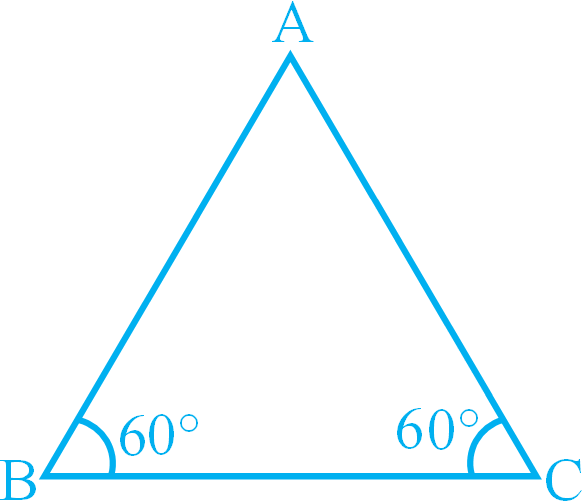
If two angles of a triangle are $60^\circ $ each, then the triangle is:
  • A
    Isosceles but not equilateral.
  • B
    Scalene.
  • Equilateral.
  • D
    Right-angled.
Answer
Correct option: C.
Equilateral.

$\text{In} \ \angle\text{ABC},$ $\angle\text{A}+\angle\text{B}+ \angle\text{C}=180^{\circ}$ [angle sum property of a triangle]
$\Rightarrow \ \angle\text{A}+60^{\circ}+60^{\circ}=180^{\circ}$ ${[\because\angle\text{B}=\angle{\text{C}}=60^{\circ},\text{given}]}$
$\Rightarrow \ \angle\text{A}=120^{\circ}-80^{\circ}$
$\Rightarrow \ \angle\text{A}=60^{\circ}$

Since, all the angles are of $60^\circ $.
so, it is an equilateral triangle.

View full question & answer
MCQ 1601 Mark
In Figure. $\angle\text{BAC}=90^{\circ},$ $\text{AD}\bot\text{BC}$ and$\angle\text{ BAD}=50^{\circ},$ then$\angle\text{ ACD}$ is:
  • $50^\circ$
  • B
    $40^\circ$
  • C
    $70^\circ$
  • D
    $60^\circ$
Answer
Correct option: A.
$50^\circ$

Given, $\angle\text{BAC}=90^{\circ},$ $\text{AD}\bot\text{BC}$ and $\angle\text{ BAD}=50^{\circ}$
In $\triangle\text{ABD},$
$\angle\text{ABD}+\angle\text{DAB}+\angle\text{ADB}=180^{\circ}$ [angle sum property of a triangle]
$\Rightarrow \ \angle\text{ABD}+50^{\circ}+90^{\circ}=180^{\circ}$
$\Rightarrow \ \angle\text{ABD}+140^{\circ}=180^{\circ}$
$\Rightarrow \ \angle\text{ABD}=180^{\circ}-140^{\circ}$
$\Rightarrow \ \angle\text{ABD}=40^{\circ}$
Now In$\triangle\text{ABD},$
$\angle\text{A}+\angle\text{B}+\angle\text{C}=180^{\circ}$ [angle sum property of a triangle]
$\Rightarrow \ 90^{\circ}+40^{\circ}+\angle\text{C}=180^{\circ}$
$\Rightarrow \ \angle\text{C}=180^{\circ}-130^{\circ}$
$\Rightarrow \ \angle\text{C}=50^{\circ}$
$\therefore\ \angle\text{ACD}=50^{\circ}$

View full question & answer
MCQ 1611 Mark
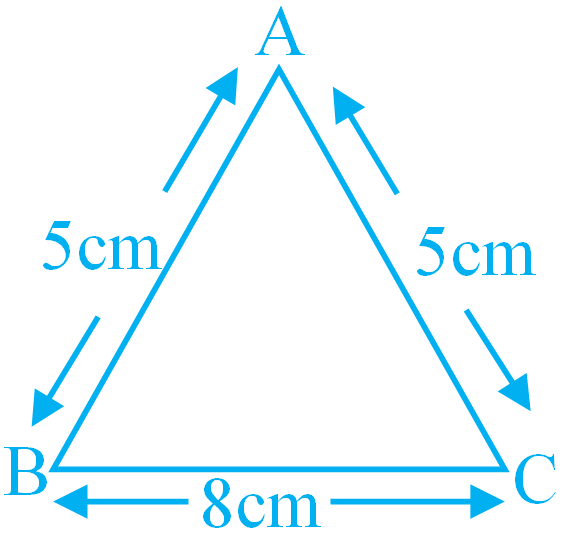
The trianlge $\text{ABC}$ formed by $\ce{AB = 5\ cm, BC = 8\ cm, AC = 4\ cm}$ is:
  • A
    An isosceles triangle only.
  • A scalene triangle only.
  • C
    An isosceles right triangle.
  • D
    Scalene as well as a right triangle.
Answer
Correct option: B.
A scalene triangle only.
$i.$ It’s not isosceles triangle as all the sides are of different measure.
$ii.$ It’s not right triangle, since it does not follow Pythagoras theorem.

$\Rightarrow 4^2 + 5^2 = 8^2$
$\Rightarrow 16 + 25 = 64$
$\Rightarrow 41\neq64 ($not satisfied$)$
Hence, it is scalane triangle as all the sides are of different measure.
View full question & answer
MCQ 1621 Mark
If all the angles of a triangle are acute, the triangle is called:
  • A
    Obtuse$-$angled
  • Acute$-$angled
  • C
    Right$-$angled
  • D
    None of these
Answer
Correct option: B.
Acute$-$angled
An equilateral triangle is a triangle with all three angles and sides equal. If all a triangle's angles are equal, they all must measure $60$ degrees, adding up to $180$ degrees total. Since all angles are acute, or less than $90$ degrees, an equilateral triangle is also an acute triangle.
View full question & answer
MCQ 1631 Mark
Which type of triangle has two sides of equal length?
  • A
    Scalene
  • B
    A cute$-$angled
  • C
    Equilateral
  • Isosceles
Answer
Correct option: D.
Isosceles
Isosceles
View full question & answer
MCQ 1641 Mark
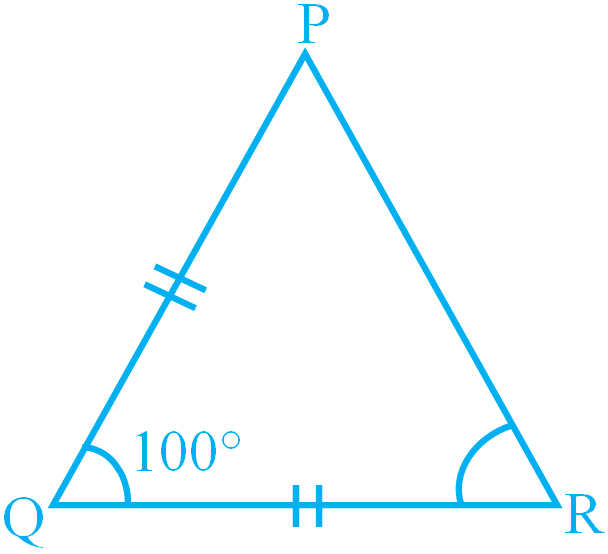
In $\triangle\text{PQR},$ if $PQ = QR$ and $\angle\text{Q} = 100^\circ $, then $\angle\text{R}$ is equal to:
  • $40^\circ$
  • B
    $80^\circ$
  • C
    $120^\circ$
  • D
    $50^\circ$
Answer
Correct option: A.
$40^\circ$
$\text{In} \ \triangle\text{PQR},$ $\text{PQ} = \text{QR}$
$\text{Let} \ \angle\text{P}=\angle\text{R}=\text{x}$


As we know,
$\therefore\ \angle\text{P}+\angle\text{Q}+\angle\text{R}=\text{180}^{\circ}$ [angle sum property of a triangle]
$\Rightarrow \ \text{x}+100^{\circ}+\text{x}=180^{\circ}$ $[\because\angle\text{Q}=100^{\circ},\text{given}]$
$\Rightarrow \ \text{2x}+100^{\circ}=180^{\circ}$
$\Rightarrow \ \text{2x}=80^{\circ}$
$\Rightarrow \ \text{x}=40^{\circ}$
Hence, $\angle\text{P}=\angle\text{R}=\text{40}^{\circ}$
View full question & answer
MCQ 1651 Mark
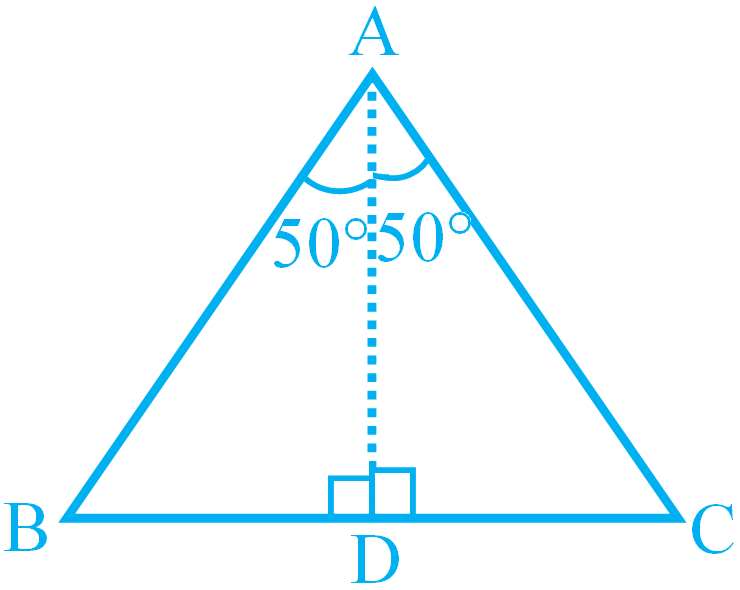
In $\triangle\text{ABC},$ $\angle\text{A}=100^{\circ}, AD$ bisects$\angle\text{A}$ and $AD \bot BC$. then, $\angle\text{B}$ is equal to:
  • A
    $80^\circ$
  • B
    $20^\circ$
  • $40^\circ$
  • D
    $30^\circ$
Answer
Correct option: C.
$40^\circ$
Given, $\angle\text{BAD}=\angle\text{DAC}=50^{\circ}$ $[\because\text{AD} \ \text{bisect}\angle\text{A} \ \text{and} \ \angle\text{A}=100^{\circ}]$
and $\angle\text{BDA}=\angle\text{ADC}=90^{\circ}$ $[\because\text{AD}\bot\text{BC}]$

Now, in $\triangle\text{ABD},$
$\angle\text{ABD}+\angle\text{BAD}+\angle\text{BDA}=180^{\circ}$ [angle sum property ofb triangle]
$\Rightarrow \ \angle\text{ABD}+50^{\circ}+90^{0}=180^{\circ}$
$\Rightarrow \ \angle\text{ABD}+140^{\circ}=180^{\circ}$
$\Rightarrow \ \angle\text{ABD}=180^{\circ}-140^{\circ}$
$\Rightarrow \ \angle\text{ABD}=140^{\circ}$
View full question & answer
MCQ 1661 Mark
Maximum number of possible obtuse angles in a triangle is:
  • A
    $0$
  • $1$
  • C
    $2$
  • D
    $3$
Answer
Correct option: B.
$1$
Any triangle must have interior angles that add up to $180^{\circ}$. An obtus angle is an angle greater than $90^{\circ}$ but less than $180^{\circ}$ If you an angle that was $91^{\circ}$.
The other $2$ angles would have to be acute. This is because the other angles would take up $180^{\circ}-91^{\circ}=89^{\circ}$ of the triangle.
Since $89^{\circ}$ is less than $90^{\circ}$, this means the other $2$ angles must both be acute.You are left with $1$ obtuse angle.
View full question & answer
MCQ 1671 Mark
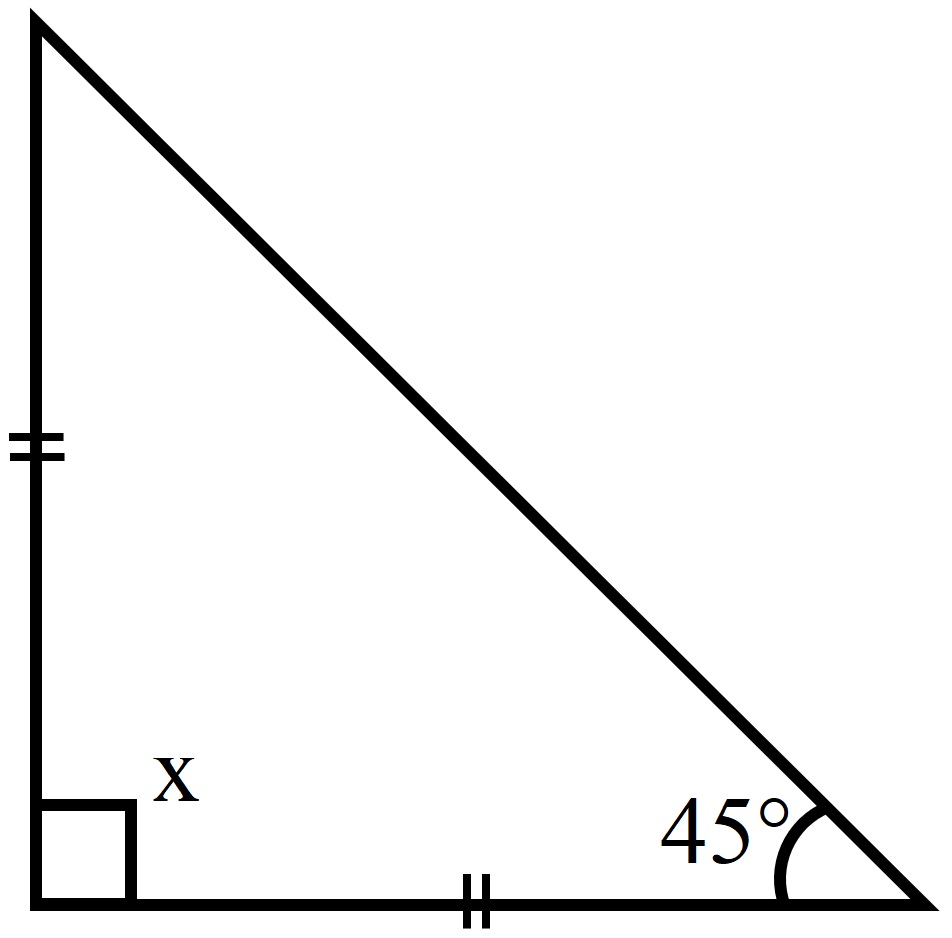
Find angle x in the following figure:
  • $90^\circ$
  • B
    $80^\circ$
  • C
    $95^\circ$
  • D
    $100^\circ$
Answer
Correct option: A.
$90^\circ$

$x + 45 + 45^\circ = 180^\circ$
$\Rightarrow x = 90^\circ .$

View full question & answer
MCQ 1681 Mark
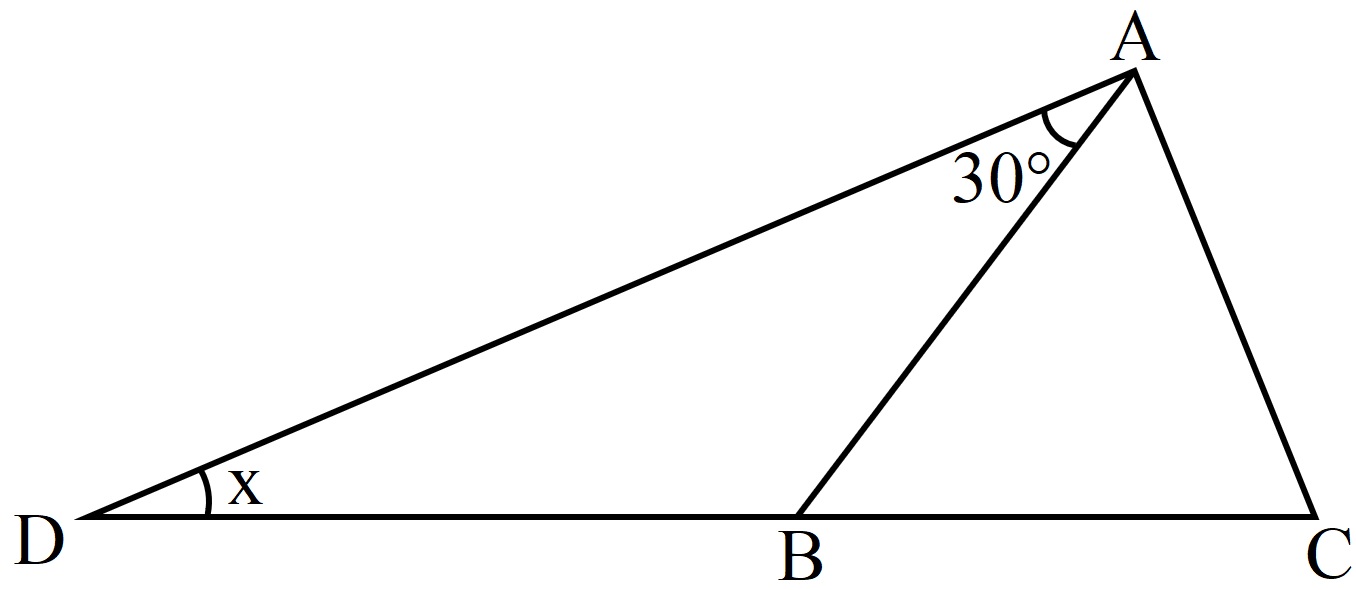
In the following figure, $\triangle\text{ABC}$ is an equilateral triangle. Find $\angle\text{x}$
  • A
    $30^\circ$
  • B
    $45^\circ$
  • $60^\circ$
  • D
    $90^\circ $
Answer
Correct option: C.
$60^\circ$

$\angle\text{ABC}=60^\circ$
$\therefore\angle\text{ABD}=180^\circ-60^\circ=120^\circ$
$\therefore\text{x}=180^\circ-(120^\circ+30^\circ)$
$=30^\circ$

View full question & answer
MCQ 1691 Mark
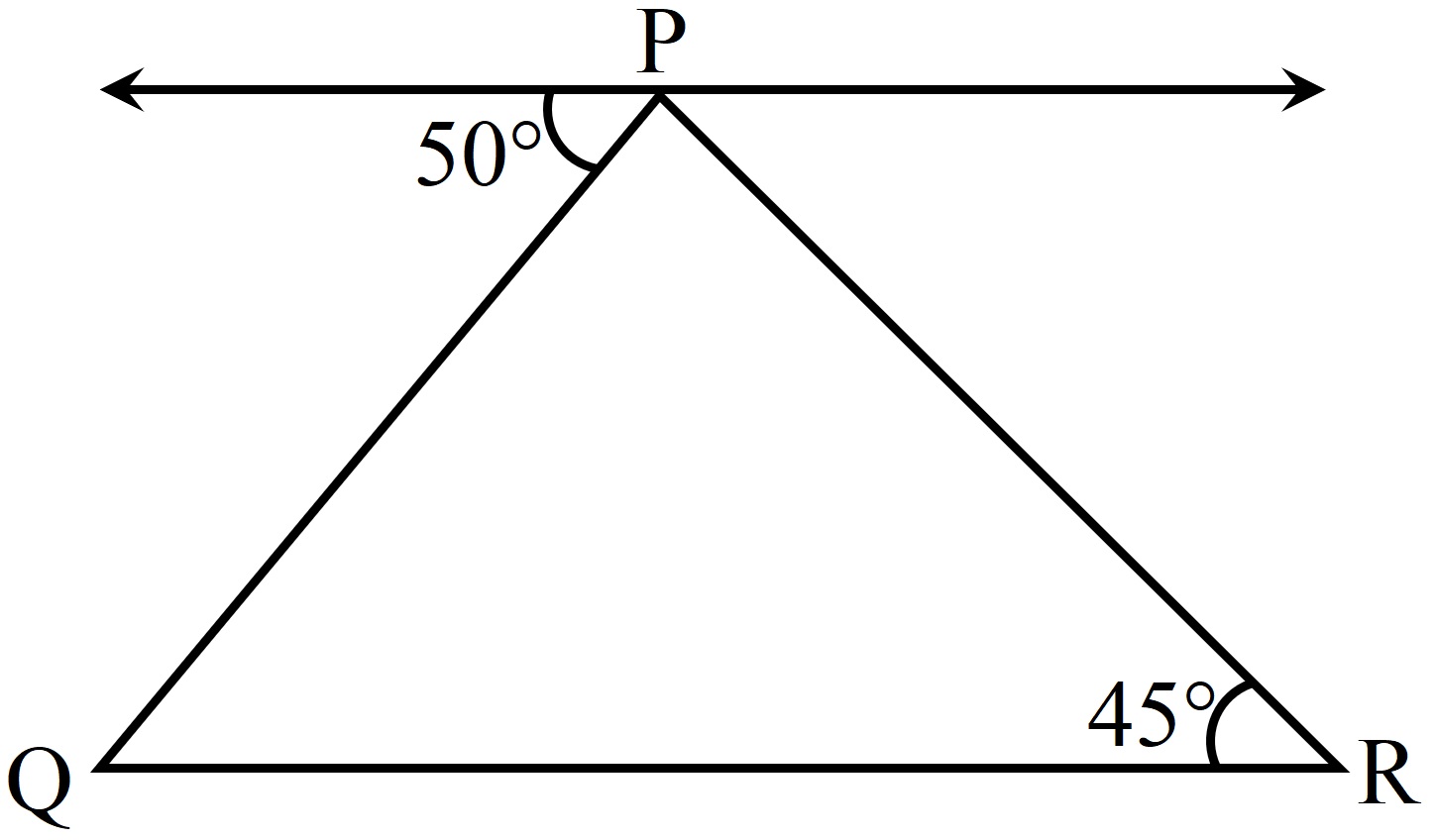
In the following figure, $\text{m}\parallel\text{QR}$. Then, the measure of $\angle\text{QPR}$ is.
  • A
    $80^\circ$
  • $85^\circ$
  • C
    $75^\circ$
  • D
    $70^\circ$
Answer
Correct option: B.
$85^\circ$

$\angle\text{PQR}=50^\circ$
$\therefore\angle\text{QPR}-180^\circ-(50^\circ+45^\circ)$
$=85^\circ$

View full question & answer
MCQ 1701 Mark
The length of two sides of a triangle are $7\ cm$ and $9\ cm$. The length of the third side may lie between:
  • A
    $1\ cm$ and $10\ cm.$
  • B
    $2\ cm$ and $8\ cm.$
  • $2\ cm$ and $16\ cm.$
  • D
    $1\ cm$ and $16\ cm.$
Answer
Correct option: C.
$2\ cm$ and $16\ cm.$
The third side must be greater than the difference between two sides and less than the sum of two sides.
Sum of two sides $= 7 + 9 = 16\ cm$
Difference of two sides $= 9 - 7 = 2\ cm$
So, length of the third side must lie between $2\ cm$ and $16\ cm.$
View full question & answer
MCQ 1711 Mark
Which of the following cannot be the sides of a right triangle?
  • $2 \ cm, 2 \ cm, 4 \ cm$
  • B
    $ 5 \ cm, 12 \ cm, 13 \ cm$
  • C
    $ 6 \ cm, 8 \ cm, 10 \ cm$
  • D
    $ 3 \ cm, 4 \ cm, 5 \ cm$
Answer
Correct option: A.
$2 \ cm, 2 \ cm, 4 \ cm$
$22 + 22 = 8; 42 = 16 \therefore 22 + 22 \neq 42$
View full question & answer
MCQ 1721 Mark
 In which case of the following lengths of sides of a triangle, is it possible to draw a triangle?
  • A
    $3 \ cm, 4 \ cm, 7 \ cm$
  • B
     $2 \ cm, 3 \ cm, 7 \ cm$
  • $ 3 \ cm, 4 \ cm, 5 \ cm$
  • D
    $ 3 \ cm, 3 \ cm, 7 \ cm$
Answer
Correct option: C.
$ 3 \ cm, 4 \ cm, 5 \ cm$
$3+4>5 ; 4+5>3 ; 5+3>4$
View full question & answer
MCQ 1731 Mark
The ratio of the measures of the three angles of a triangle is $2 : 3 : 4$. The measure of the largest angle is
  • $ 80^\circ$
  • B
    $ 60^\circ$
  • C
    $ 40^\circ$
  • D
     $180^\circ$
Answer
Correct option: A.
$ 80^\circ$
Largest angle $=\frac{4}{2+3+4} \times 180^{\circ}=80^{\circ}$
View full question & answer
MCQ 1741 Mark
Two angles of a triangle measure $90^\circ $ and $30^\circ $. The measure of the third angle is
  • A
    $ 90^\circ$
  • B
     $30^\circ$
  •  $60^\circ$
  • D
    $ 120^\circ$
Answer
Correct option: C.
 $60^\circ$
Third angle $= 180^\circ – (90^\circ + 30^\circ ) = 60^\circ .$
View full question & answer
MCQ 1751 Mark
Which of the following statement is false?
  •  The sum of the lengths of any two sides of a triangle is less than the third side.
  • B
     In a right-angled triangle, the square on the hypotenuse = sum of the squares on the legs.
  • C
     If the Pythagorean property holds, the triangle must be right-angled.
  • D
     The diagonal of a rectangle produce ‘by itself the same area as produced by its length and breadth
Answer
Correct option: A.
 The sum of the lengths of any two sides of a triangle is less than the third side.
a
View full question & answer
MCQ 1761 Mark
Which of the following statements is true?
  •  A triangle can have all the three angles equal to $60^\circ .$
  • B
     A triangle can have all the three angles greater than $60^\circ .$
  • C
     The sum of any two angles of a triangle is always greater than the third angle.
  • D
     The difference between the lengths of any two sides of a triangle is greater than the length of the third side
Answer
Correct option: A.
 A triangle can have all the three angles equal to $60^\circ .$
 A triangle can have all the three angles equal to $60^\circ .$
View full question & answer
MCQ 1771 Mark
Which of the following statements is true?
  • A
     A triangle can have two right angles
  • B
     A triangle can have two obtuse angles
  •  A triangle can have two acute angles
  • D
     A triangle can have all the three angles less than $60^\circ $
Answer
Correct option: C.
 A triangle can have two acute angles
 A triangle can have two acute angles
View full question & answer
MCQ 1781 Mark
The measure of each angle of an equilateral triangle is
  • A
    $ 30^\circ$
  • B
     $45^\circ$
  • C
    $ 90^\circ$
  • $ 60^\circ$
Answer
Correct option: D.
$ 60^\circ$
$x^\circ + x^\circ + x^\circ = 180^\circ$
$\Rightarrow x^\circ = 60^\circ .$
View full question & answer
MCQ 1791 Mark
The total measure of the three angles of a triangle is
  • A
    $ 360^\circ$
  • B
    $ 90^\circ$
  • $ 180^\circ$
  • D
     none of these
Answer
Correct option: C.
$ 180^\circ$
$ 180^\circ$
View full question & answer
MCQ 1821 Mark
If one angle of a triangle is obtuse, the triangle is called
  • A
     acute-angled
  •  obtuse-angled
  • C
     right-angled
  • D
     none of these
Answer
Correct option: B.
 obtuse-angled
b
View full question & answer
MCQ 1831 Mark
If one angle of a triangle measures 90°, the triangle is called
  • A
     acute-angled
  • B
     obtuse-angled
  •  right-angled
  • D
     none of these
Answer
Correct option: C.
 right-angled
c
View full question & answer
MCQ 1841 Mark
If all the angles of a triangle are acute, the triangle is called
  • A
     obtuse-angled
  •  acute-angled
  • C
     right-angled
  • D
     none of these
Answer
Correct option: B.
 acute-angled
b
View full question & answer
MCQ 1851 Mark
If all the three sides of a triangle are equal, the triangle is called
  •  equilateral
  • B
     right-angled
  • C
     isosceles
  • D
     scalene
Answer
Correct option: A.
 equilateral
a
View full question & answer
MCQ 1861 Mark
If two sides of a triangle are equal, the triangle is called
  •  isosceles
  • B
     equilateral
  • C
     scalene
  • D
     right-angled
Answer
Correct option: A.
 isosceles
a
View full question & answer
MCQ 1871 Mark
If two sides of a triangle are not equal, the triangle is called
  •  scalene
  • B
     isosceles
  • C
     equilateral
  • D
     right-angled
Answer
Correct option: A.
 scalene
a
View full question & answer
MCQ 1911 Mark
How many elements are there in a triangle?
  • A
     $3$
  •  $6$
  • C
     $4$
  • D
     None of these.
Answer
Correct option: B.
 $6$
$6$
View full question & answer