Questions · Page 4 of 6

M.C.Q. [I MARKS]

MCQ 1511 Mark
Which of the following metals are soft enough to be even cut with a knife?
  • A
    Sodium
  • B
    Potassium
  • C
    Lithium
  • All of these
Answer
Correct option: D.
All of these
View full question & answer
MCQ 1521 Mark
The property of metals by which they can be beaten into thin sheets is called $..........$
  • A
    Ductility
  • B
    Sheetability
  • C
    Metallic
  • Malleability
Answer
Correct option: D.
Malleability
View full question & answer
MCQ 1551 Mark
Which of the following can be beaten into thin sheets? Why?
  • Zinc
  • B
    Phosphorus
  • C
    Sulphur
  • D
    Oxygen
Answer
Correct option: A.
Zinc
Zinc is metal and it can be beaten into thin sheets. The property of metals which allows metals to be hammered into thin sheets is called Malleability.
View full question & answer
MCQ 1561 Mark
Painting keeps away $..........$ and $...........$ from steel structures and prevents rusting of it.
  • A
    Oxides and chlorides.
  • Air and moisture.
  • C
    Nitrogen and Oxygen.
  • D
    None.
Answer
Correct option: B.
Air and moisture.
View full question & answer
MCQ 1571 Mark
A mineral from which. a metal can be extracted on the commercial scale, economically is called.
  • Ore
  • B
    Metalloid
  • C
    Corrosion
  • D
    Metal
Answer
Correct option: A.
Ore
View full question & answer
MCQ 1581 Mark
Fill in the blanks with the most appropriate option.
$i.\ 'W'$ is very reactive metal, reacts vigorously with oxygen and water therefore, stored in $.......(1).......$.
$ii.\ 'X'$ is non-metal, soft and dull and forms $.......(2).......$. oxides with oxygen.
$iii.\ 'Y'$ is very reactive $.......(3).......$. catches fire if exposed to air, therefore, stored in water.
$iv.\ 'Z'$ does not react with dilute hydrochloric acid even on heating but it reacts with sulphuric acid. When it is exposed to moist air for long, it acquires a dull $.......(4).......$. coating.
  • A
    $1 -$Water,$ 2-$basic, $3-$metal, $4-$reddish brown.
  • B
    $1-$Kerosene,$ 2-$acidic, $3-$metal, $4-$reddish brown.
  • $1-$Kerosene,$ 2-$acidic,$ 3-$non-metal,$ 4-$green.
  • D
    $1-$Water, $2-$basic, $3-$non-metai, $4-$green.
Answer
Correct option: C.
$1-$Kerosene,$ 2-$acidic,$ 3-$non-metal,$ 4-$green.
$1-$Kerosene, $2-$acidic, $3-$non-metal,$ 4-$green.
View full question & answer
MCQ 1591 Mark
Food cans are coated with tin and not with zinc because:
  • A
    Zinc is less reactive than tin.
  • B
    Zinc has a higher melting point than tin.
  • C
    Zinc is costlier than tin.
  • Zinc is more reactive than tin.
Answer
Correct option: D.
Zinc is more reactive than tin.
Zinc is more reactive than tin. Tin only reacts with very strong acids. However, zinc can react with simple acids found in food. Hence, in order to prevent food poisoning, the food cans are coated with a cheap, less reactive metal like tin.
View full question & answer
MCQ 1601 Mark
When acidic oxide of sulphur reacts with water it forms:
  • A
    Nitric acid.
  • B
    Sulphuric acid.
  • Sulphurous.
  • D
    Sulphur dioxide.
Answer
Correct option: C.
Sulphurous.
View full question & answer
MCQ 1611 Mark
Which of the following non$-$metals exists in liquid state at room temperature?
  • A
    Chlorine
  • B
    Nitrogen
  • Bromine
  • D
    Hydrogen
Answer
Correct option: C.
Bromine
Bromine is the only non$-$metal which exists in liquid state at room temperature.
View full question & answer
MCQ 1631 Mark
The property of metal by which it can be drawn into wires is called $..........$
  • Ductility
  • B
    Sonority
  • C
    Malleability
  • D
    Usture
Answer
Correct option: A.
Ductility
The property of metal by which it can be drawn into wires is called ductility. Example, copper and aluminium wires are widely used.
View full question & answer
MCQ 1641 Mark
Which of the following is not a metal?
  • A
    Copper
  • Sulphur
  • C
    Aluminum
  • D
    Iron
Answer
Correct option: B.
Sulphur
Copper, aluminum and iron are metals but sulphur is not a metal.
View full question & answer
MCQ 1651 Mark
How many electrons are present in non$-$metals in their outermost shell$?$
  • A
    $1, 2$ or $3$
  • B
    $8, 9$ or $10$
  • C
    $10, 20$ or $30$
  • $4, 5, 6$ or $7$
Answer
Correct option: D.
$4, 5, 6$ or $7$
Non$-$metals generally contain $4, 5, 6, 7$ or $8$ electrons in their outermost orbit or shell.
$i.$ Carbon $2, 4$
$ii.$ Nitrogen $2, 5$
$iii.$ Oxygen $2, 6$
$iv.$ Fluorine $2, 7$
The number of valence electrons in carbon, nitrogen, oxygen and fluorine are $4, 5, 6, 7$ respectively.
View full question & answer
MCQ 1661 Mark
Which one of the following is correct about nylon fibres?
  • A
    Nylon fibres are very strong.
  • B
    NyIon fibres absorb very little water.
  • C
    NyIon fibres are fairly elastic.
  • All the above.
Answer
Correct option: D.
All the above.
All the above.
View full question & answer
MCQ 1671 Mark
$(P)$ Duralumin $- (Al = 95\%, Cu = 4\%, Mn = 0.5\%, Mg = 0.5\%)$
$(Q)$ Solder$- (Sn = 50\%$ to $60\%$ $Pb = 50\%$ to $40\%)$
$(R)$ Brass$- (Cu = 60\%$ to $80\%$ $Sn = 0\%$ to $40\%)$
  • A
    $(P)$
    $(Q)$
    $(R)$
    False
    True
    False
  • $(P)$
    $(Q)$
    $(R)$
    True
    False
    True
  • C
    $(P)$
    $(Q)$
    $(R)$
    False
    True
    False
  • D
    $(P)$
    $(Q)$
    $(R)$
    True
    False
    False
Answer
Correct option: B.
$(P)$
$(Q)$
$(R)$
True
False
True
 
$(P)$
$(Q)$
$(R)$
True
False
True
View full question & answer
MCQ 1681 Mark
Which substance is used for making pencil lead?
  • A
    Sulphur
  • B
    Silicon
  • Graphite
  • D
    Aluminium
Answer
Correct option: C.
Graphite
Graphite
View full question & answer
MCQ 1691 Mark
Which of the following is $\text{NOT}$ a general property of metals$?$
  • A
    Ductility.
  • B
    Malleability.
  • Bad conductor of electricity.
  • D
    Sonorous nature.
Answer
Correct option: C.
Bad conductor of electricity.
All metals are good conductors of electricity, whereas insulators are bad conductors of electricity.
View full question & answer
MCQ 1701 Mark
Which of the following non-metals are used in fertilisers$?$
  • A
    Nitrogen
  • B
    Phosphorus
  • Both $(a)$ and $(b)$
  • D
    None of these
Answer
Correct option: C.
Both $(a)$ and $(b)$
View full question & answer
MCQ 1711 Mark
Which of the following reacts with cold water vigorously?
  • A
    Carbon.
  • Sodium.
  • C
    Magnesium.
  • D
    Sulphur.
Answer
Correct option: B.
Sodium.
The vigour $($or intensity$)$ of reaction of a metal with water depends on its chemical reactivity. Sodium is a very reactive metal, so it reacts violently even with cold water.
View full question & answer
MCQ 1721 Mark
Metals are generally $............$
  • A
    Soft and ductile
  • B
    Hard and brittle
  • C
    Non-reactive and malleable.
  • Hard, ductile and malleable
Answer
Correct option: D.
Hard, ductile and malleable
View full question & answer
MCQ 1731 Mark
When non$-$metals react with water then:
  • A
    Hydrogen gas is formed
  • B
    Carbon dioxide gas is formed
  • Non$-$metals do not react with water
  • D
    None of these
Answer
Correct option: C.
Non$-$metals do not react with water
View full question & answer
MCQ 1741 Mark
Which of the following statements are true?
$i.$ Among all the naturally occurring elements, around eighty percent are metals.
$ii.$ Non$-$metals are more abundant than metals.
$iii.$ Sodium and potassium are soft like wax.
$iv.$ Bromine is a reddish brown liquid at room temperature.
  • A
    $(i)-(ii)-(iv)$
  • $(i)-(iii)-(iv)$
  • C
    $(i)-(ii)-(iii)$
  • D
    All of these.
Answer
Correct option: B.
$(i)-(iii)-(iv)$
$1.$ There are $118$ elements which we so far know, out of which around $92$ are naturally occurring. Mostly are metals in $92$ elements. So this statement is true that among all the naturally occurring elements, around eighty percent are metals.
Now for statement two, it is wrong because in the case of periodic table metals are more abundant than non-metals.
$2.$ Sodium and potassium are group one elements. Sodium and potassium both are alkali metals. The hardness of metals are identified by the cohesive forces between them. In case of sodium and potassium the cohesive force between them is very weak. Due to this reason, these two elements are very soft just like wax.
$3.$ Bromine have atomic number $35,$ at room temperature bromine is liquid which is reddish brown in colour. It also easily evaporates and forms fumes which also have similar colour.
View full question & answer
MCQ 1751 Mark
Aluminium is good conductor of heat, so it so used in.
  • A
    Duralumin
  • Paint
  • C
    Electric wire
  • D
    All the above
Answer
Correct option: B.
Paint
Paint
View full question & answer
MCQ 1761 Mark
 
Column-A
 
Column-B
$(i)$
Ductile
$(p)$
The property of making resonating sound.
$(ii)$
Malleable
$(q)$
A substance can be drawn into wires.
$(iii)$
Sonority
$(r)$
The substance can be beaten into thin sheets.
$(iv)$
Tensile strength
$(s)$
Ability to withstand the longitudinal pull.
Choose the right match:
  • A
    $i → p, ii → q, iii → r, iv → s$
  • $i → q, ii → r, iii → p, iv → s$
  • C
    $i → s, ii → p, iii → q, iv → r$
  • D
    $i →r, ii → s, iii → p, iv → q$
Answer
Correct option: B.
$i → q, ii → r, iii → p, iv → s$
View full question & answer
MCQ 1771 Mark
Metals are generally hard. Which of the following metals is an exception and can be cut with a knife?
  • A
    Iron.
  • Sodium.
  • C
    Gold.
  • D
    Magnesium.
Answer
Correct option: B.
Sodium.
Metals are generally hard. This means that most of the metals cannot be cut easily. But sodium metal is soft and can be easily cut with a knife.
View full question & answer
MCQ 1781 Mark
$(P)$ Stain less steel is an alloy of iron and copper $(Q)$ Ainico can also be called as magnetic steel $(R)$ German silver is an alloy of silver and nickel $(S)$ Bell metal and gun metal are Iron-carbon alloys.
  • A
    $(P)$
    $(Q)$
    $(R)$
    $(S)$
    False
    True
    False
    False
  • $(P)$
    $(Q)$
    $(R)$
    $(S)$
    False
    True
    False
    False
  • C
    $(P)$
    $(Q)$
    $(R)$
    $(S)$
    False
    True
    False
    True
  • D
    $(P)$
    $(Q)$
    $(R)$
    $(S)$
    True
    False
    False
    True
Answer
Correct option: B.
$(P)$
$(Q)$
$(R)$
$(S)$
False
True
False
False
$(P)$
$(Q)$
$(R)$
$(S)$
False
True
False
False
View full question & answer
MCQ 1791 Mark
Which of the following is a liquid at room temperature?
  • A
    Iron
  • Bromine
  • C
    Iodine
  • D
    Phosphorus
Answer
Correct option: B.
Bromine
Bromine
View full question & answer
MCQ 1801 Mark
Which among the following is the most reactive metal?
  • A
    Copper
  • Calcium
  • C
    Iron
  • D
    Magnesium
Answer
Correct option: B.
Calcium
Calcium is the most reactive metal than copper, iron and magnesium. It lies above all of these metals in reactivity series.
View full question & answer
MCQ 1821 Mark
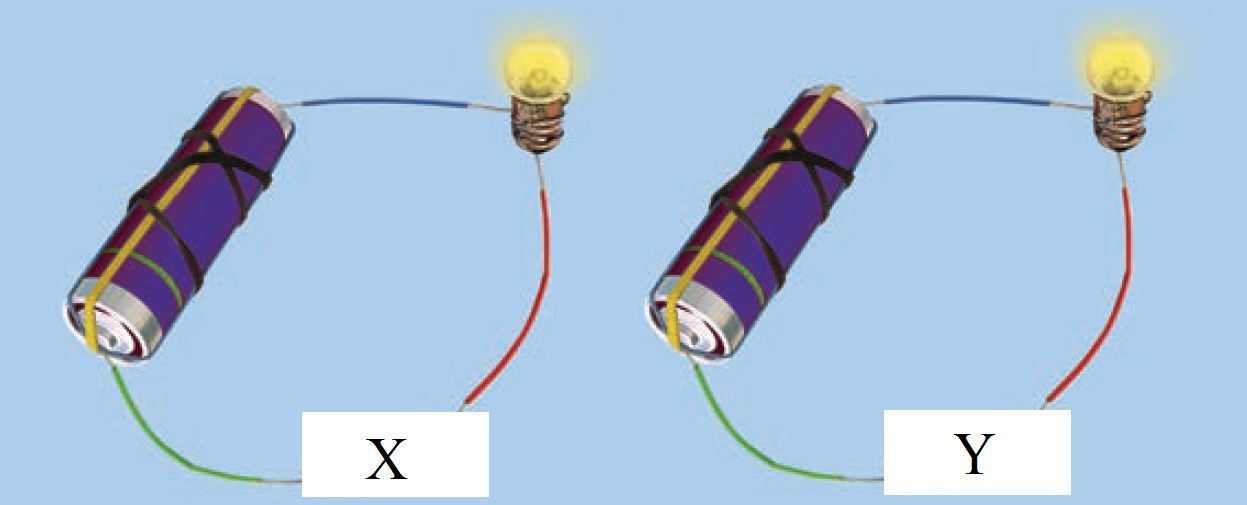
Materials $'X$ and $'Y'$ in the figure are.
  • A
    $X$
    $Y$
    Aluminium foil
    Pencil lead
  • B
    $X$
    $Y$
    Pencil lead
    Copper block
  • $X$
    $Y$
    Pencil lead
    Wooden block
  • D
    $X$
    $Y$
    Copper block
    Pencil lead
Answer
Correct option: C.
$X$
$Y$
Pencil lead
Wooden block
$X$
$Y$
Pencil lead
Wooden block
View full question & answer
MCQ 1831 Mark
The property by which metals can be beaten into sheets is known as $............$
  • A
    Ductility
  • B
    Sonority
  • Malleability
  • D
    Lusture
Answer
Correct option: C.
Malleability
Malleability is the property of metals by virtue of which they can be beaten into sheets. Gold is the most malleable metal.
View full question & answer
MCQ 1841 Mark
Metals are:
  • A
    Soft and brittle
  • Hard and solid
  • C
    Liquid
  • D
    Generally liquid
Answer
Correct option: B.
Hard and solid
Hard and solid
View full question & answer
MCQ 1851 Mark
In displacement reactions:
  • A more reactive metal displaces a less reactive metal.
  • B
    A less reactive metal displaces a more reactive metal.
  • C
    Both $(a)$ and $(b).$
  • D
    None of these.
Answer
Correct option: A.
A more reactive metal displaces a less reactive metal.
View full question & answer
MCQ 1861 Mark
Which of the following is $NOT$ a heavy metal?
  • A
    $Cd$
  • B
    $Hg$
  • C
    $Pb$
  • $K$
Answer
Correct option: D.
$K$

$'K'$ is not a heavy metal. It is a light metal.

View full question & answer
MCQ 1871 Mark
An element $X$ reacts with water to from a solution which turns phenolphthalein indicator pink. The element $X$ is most likely to be:
  • A
    Sulphur
  • Sodium
  • C
    Carbon
  • D
    Silicon
Answer
Correct option: B.
Sodium

Phenolphthalein is an indicator used in acid-base titrations. It turns colorless in acidic solutions and pink in basic solutions. Sodium is a metal which reacts with water to form sodium hydroxide, which is a base. Hence, phenolphthalein turns the solution pink.

View full question & answer
MCQ 1881 Mark
A purple colored non$-$metal forms of brown solution in alcohol which is applied on wounds as an antiseptic. Name the non$-$metal.
  • A
    Sulphur
  • B
    Sodium
  • Iodine
  • D
    Chlorine
Answer
Correct option: C.
Iodine
Iodine is a non$-$metal which is used to make purple colored solution called tincher iodine which is applied on cuts and wounds as an antiseptic.
View full question & answer
MCQ 1891 Mark
Phosphorus combines with oxygen to form oxides. How many types of oxides are formed by it?
  • A
    One
  • Two
  • C
    Three
  • D
    Four
Answer
Correct option: B.
Two
Phosphorus combines with oxygen and forms two oxides phosphorus trioxide and phosphorus pentoxide.
View full question & answer
MCQ 1901 Mark
Viscose is formed by dissolving:
  • A
    Wood pulp into a solution of hydrochloric acid.
  • Wood pulp into sodium hydroxide solution.
  • C
    Wood pulp into sulphuric acid solution.
  • D
    Polyester into sodium hydroxide solution.
Answer
Correct option: B.
Wood pulp into sodium hydroxide solution.
View full question & answer
MCQ 1911 Mark
Non metals are generally $.................$
  • A
    Hard and ductile
  • Soft and brittle
  • C
    Hard and brittle
  • D
    Soft and ductile
Answer
Correct option: B.
Soft and brittle
Soft and brittle
View full question & answer
MCQ 1921 Mark
Which of the following elements is a metalloid?
  • A
    Sodium
  • B
    Sulphur
  • Silicon
  • D
    Silver
Answer
Correct option: C.
Silicon
Silicon is a metalloid. The elements whose properties are intermediate between the properties of metals and nonmetals are called Metalloids.
View full question & answer
MCQ 1931 Mark
Mohan is writing some statements, choose the incorrect statements and help him:
  • Metals have high melting points and low boiling points.
  • B
    Metals have high density which means they are heavy.
  • C
    Metals are sonorous.
  • D
    Sodium and potassium are examples of metals.
Answer
Correct option: A.
Metals have high melting points and low boiling points.
Metals have high melting points and high boiling points. Rest of all are correct.
View full question & answer
MCQ 1941 Mark
Mr. Ramakant, a science teacher organised a quiz in the class. He stated few applications of non-metals and asked students to guess the names of the non-metals. Mark the correct option.
  • A
    Non-metals used in fertilisers$-K, Cl.$
  • B
    Non-metal used in water purification process$-Br.$
  • C
    Non-metal used in crackers$-N.$
  • Non-metal used as an antiseptic$-I.$
Answer
Correct option: D.
Non-metal used as an antiseptic$-I.$

 Non-metals used in fertilisers$-N, P;$ in water purification process$-CI;$ in crackers$-S, P.$
View full question & answer
MCQ 1951 Mark
When a copper vessel is exposed to moist air for long, it acquires a dull green coating. The green material is a mixture of.
  • A
    Copper oxide and Copper Nitrate.
  • Copper hydroxide & Copper Carbonate.
  • C
    Copper carbonate and Copper sulphate.
  • D
    Copper hydroxide and Copper Nitrate.
Answer
Correct option: B.
Copper hydroxide & Copper Carbonate.
View full question & answer
MCQ 1971 Mark
When non$-$metals combine with oxygen, what do they produce?
  • Acidic oxides.
  • B
    Basic oxides.
  • C
    Amphoteric oxides.
  • D
    Salts.
Answer
Correct option: A.
Acidic oxides.
Non$-$metals form two types of oxides, they can be acidic or neutral oxides.
View full question & answer
MCQ 1981 Mark
Identify the true statement from the following.
  • A
    Metals have fixed melting points whereas non$-$metals do not.
  • B
    All metals are malleable.
  • The hardest substance known is a non$-$metal.
  • D
    Tungsten is a bad conductor of heat and electricity.
Answer
Correct option: C.
The hardest substance known is a non$-$metal.
The hardest substance known is diamond. Diamond is an allotrope of carbon i.e., a non$-$metal.
View full question & answer
MCQ 1991 Mark
Which of the following metal exists in the liquid state at room temperature?
  • A
    Magnesium
  • B
    Manganese
  • Mercury
  • D
    Sodium
Answer
Correct option: C.
Mercury
Mercury is used for making thermometers. It is liquid at room temperature and is a very good conductor of heat.
View full question & answer
MCQ 2001 Mark

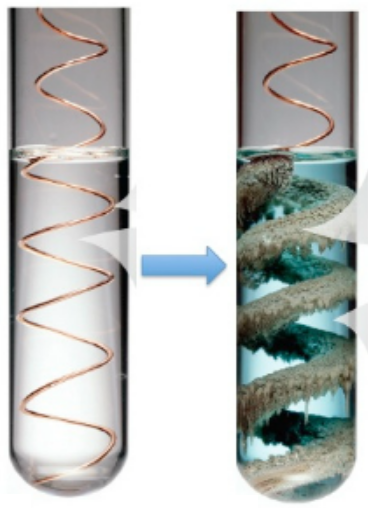
Vidisha placed a copper wire in silver nitrate solution as shown in the figure.

Which of the following represents the correct observation?
  • The colour of the solution turned blue and precipitate of solid silver was obtained.
  • B
    Colour of solution turned green and copper wire turned blue.
  • C
    There was no change in the colour of solution or colour of the wire.
  • D
    Colour of the solution became silver and there was no change in the colour of copper wire.
Answer
Correct option: A.
The colour of the solution turned blue and precipitate of solid silver was obtained.
Copper is more reactive than silver so, it displaces silver from silver nitrate solution and blue coloured copper nitrate solution is formed.
View full question & answer