Questions

as requested in detail. [5 marks ]

🎯

Test yourself on this topic

9 questions · timed · auto-graded

Question 15 Marks
How are babies produced through IVF technique? What are such babies called?
Answer
IVF (In Vitro Fertilisation), is an artificial type of fertilisation. Some women’s oviducts are blocked and so they cannot bear babies because sperms cannot reach the egg for fertilisation. In such cases, freshly released eggs and sperms are kept together for a few hours for IVF (fertilisation outside the body). In case fertilisation occurs, zygote thus formed is allowed to develop for a week and then it is placed in the mother’s uterus. Complete development of baby occurs in uterus and is born like any other baby. Babies born through this technique are called test tube babies.
View full question & answer
Question 25 Marks
What is metamorphosis? Explain.
Answer
Some insects and animals undergo a series of changes after birth. Their young ones look quite different from them. The features of these young ones are completely different from the adults. A biological process in which larva transforms into an adult through drastic changes (sudden and abrupt changes) in the body of the animal during the life cycle of an invertebrate or amphibian is called metamorphosis. For example, frog, butterfly, etc., undergo metamorphosis.
View full question & answer
Question 35 Marks
Explain how Amoeba reproduce?
Answer
Amoeba reproduces through the process of binary fission. Binary fission is another method of asexual reproduction. Amoeba is a single-celled organism. It begins the process of reproduction by the division of its nucleus into two nuclei followed by division of its body into two, each part receiving a nucleus. Finally two daughter cells are produced from one parent Amoeba. This type of asexual reproduction in which an animal reproduces by dividing into two individuals is known as binary fission.
View full question & answer
Question 45 Marks
What is budding? Explain.
Answer
Budding is type of asexual reproduction in which an organism or new individual develops from an outgrowth from a single parent. This outgrowth is called bud. On maturation this bud get separated from the parent’s body to grow into new individual. This process of reproduction is known as budding. For example, Hydra, yeast and sponges produce their young ones through the process of budding. In some organisms, like sponges, buds are not separated from their parent’s body and form a colony. They remain attached to parent’s body.
View full question & answer
Question 55 Marks
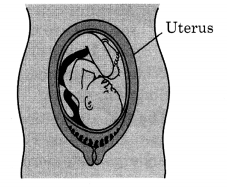
Explain with a diagram the development of an embryo.
Answer

Image

An embryo is developed in the process of fertilisation. Fertilisation results in the formation of zygote which begins to develop into an embryo .

The zygote divides repeatedly to give rise to a ball of cell which further begin to form groups that develop into different tissues and organs of the body. This developing structure is called an embryo. The embryo gets embedded in the wall of the uterus for further development. The embryo continues to develop in the uterus. It gradually develops different body parts. This developing stage of embryo is called foetu

View full question & answer
Question 65 Marks
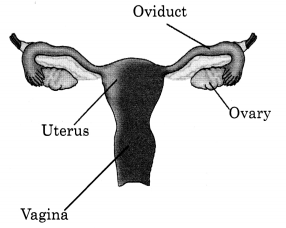
Describe female reproductive organs with the help of a labelled diagram.
Answer

Image

The female reproductive organs mainly consist of a pair of ovaries, oviducts or fallopian tubes, uterus and vagina. The female gametes called ova or eggs are produced by ovary. In human beings, a single matured egg is released into the oviduct by one of the ovaries every month. Uterus is the part inside which the embryo grows and develops finally into a baby. An egg or ovum is a single cell. Vagina is the part which receives the penis during copulation. The following diagram shows these organs clearly.

View full question & answer
Question 75 Marks
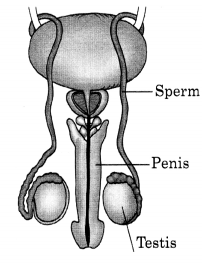
Describe the male reproductive organs with the help of a labelled diagram.
Answer

Image
The male reproductive organs mainly consist of a pair of testes, two sperm ducts (vas deferens) and a penis. Male gametes called sperms are produced by the testes. Though the sperms are very small in size, each has a head, a middle piece and a tail. It is unicelled with all the usual cell components. Figure $9.14$ shows the male reproductive organs in humans.
View full question & answer
Question 85 Marks
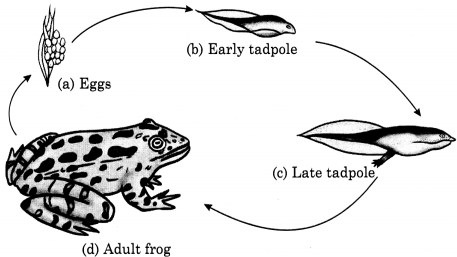
What do you mean by metamorphosis? How does metamorphosis take place in frog? Explain with a diagram.
Answer
The transformation of the larva into an adult through drastic (sudden or abrupt) changes is called metamorphosis. For example, a moth emerging out of the cocoon, an adult frog from a tadpole, etc., undergo metamorphosis.

Frog undergoes through three stages during its life cycle in which eggs laid down by frogs transform into tadpoles (larva) and finally into an adult following the process of metamorphosis. The following diagram clearly shows this process.

Image

View full question & answer
Question 95 Marks
What do you mean by reproduction? Describe various modes of reproduction.
Answer
Reproduction is an important process which is responsible for the continuity of life on the planet earth. In this process, an individual produces young ones of the same species. It helps in increasing the population of the same species on the earth, generation after generation. This is the fundamental feature which ensures the existence of all life forms on the earth. There are two modes of reproduction:
$-$Sexual reproduction: In this type of reproduction, both male and female parents are involved and they produce different gametes called male gametes or sperms and female gametes or ova $($egg$)$ respectively. Both fuse to form zygote which finally develops into foetus. For example, mammals including human beings higher invertebrates and all vertebrates undergo sexual reproduction.
$-$Asexual reproduction: In this type of reproduction, only single parent is involved and gametes or sex cells are not produced. Budding, binary fission, etc., are different methods of asexual reproduc¬tion. Lower organisms like Hydra, Amoeba, yeast, etc., undergo asexual reproduction.
View full question & answer