Questions · Page 2 of 5

M.C.Q. [I MARKS]

MCQ 511 Mark
Which of the following is not an oviparous animal?
  • A
    Snake.
  • B
    Fish.
  • Rat.
  • D
    Frog.
Answer
Correct option: C.
Rat.
Snake, fish and frog are oviparous animals whereas rat is viviparous animals.
View full question & answer
MCQ 521 Mark
In a science quiz competition, lilly is asked a question where she had to choose the statement which was/were incorrect?
  • A
    An embryo is formed by the repeated cell division of zygote whereas a foetus is formed by the growth and development of an embryo.
  • B
    An embryo is an unborn baby in the uterus in the early stages of development whereas a foetus is an unborn baby in the uterus in the later stages of development.
  • C
    The body features of growing baby in the embryo are not much developed whereas the body features of developing baby can be identified.
  • None of the above.
Answer
Correct option: D.
None of the above.
View full question & answer
MCQ 531 Mark
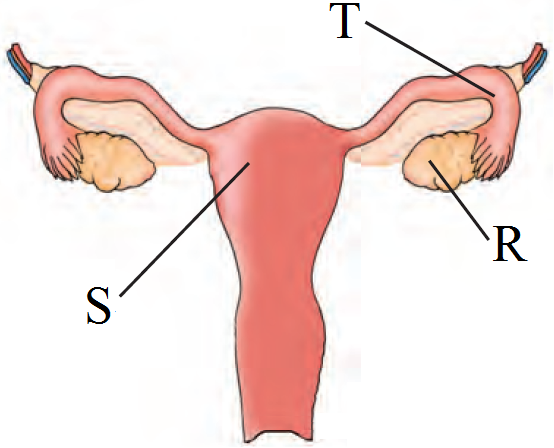
Identify $R, S$ and $T$ in the given figure.
  • A
    $(R)$
    $(S)$
    $(T)$
    Ovulation
    Fertilization
    Implantation
  • B
    $(R)$
    $(S)$
    $(T)$
    Fertilization
    Ovulation
    Implantation
  • $(R)$
    $(S)$
    $(T)$
    Ovulation
    Implantation
    Fertilization
  • D
    $(R)$
    $(S)$
    $(T)$
    Implantation
    Fertilization
    Ovulation
Answer
Correct option: C.
$(R)$
$(S)$
$(T)$
Ovulation
Implantation
Fertilization
View full question & answer
MCQ 541 Mark
Which of the following comparisons are true of sexual and asexual reproduction?
 
Sexual reproduction
Asexual reproduction
$(i)$
Involves two individuals
Involves only one individual parent
$(ii)$
Involves a simple process
Involves a complex process
$(iii)$
Involves the union of two types of gametes
No fusion of gametes
  • A
    Only $(i)$ and $(ii)$
  • Only $(i)$ and $(iii)$
  • C
    Only $(ii)$ and $(iii)$
  • D
    All the above
Answer
Correct option: B.
Only $(i)$ and $(iii)$
Options $I$ and $III$ are true of comparison of sexual and asexual reproduction.
View full question & answer
MCQ 551 Mark
Which of the following organisms undergo metamorphosis?
$(i)$
Silk moth
$(ii)$
Snake
$(iii)$
Frog
$(iv)$
Hen
$(v)$
Butterfly
$(vi)$
Human
$(vii)$
Cat
$(viii)$
Cockroach
$(ix)$
Whale
$(x)$
Dog
  • A
    $(i), (ii), (iii), (v)$ and $(x)$ only
  • $(i), (iii), (v)$ and $(viii)$ only
  • C
    $(ii), (iii), (iv)$ and $(v)$ only
  • D
    $(iv), (vi), (vii)$ and $(ix)$ only
Answer
Correct option: B.
$(i), (iii), (v)$ and $(viii)$ only
View full question & answer
MCQ 561 Mark
During the evolution process, in which of the following organisms eyes appeared first
  • B
  • C
  • D
Answer
Correct option: A.
View full question & answer
MCQ 581 Mark
In which of the following parts of the female reproductive system does fertilization occur?
  • A
    Ovary
  • B
    Vagina
  • C
    Uterus
  • Fallopian tube
Answer
Correct option: D.
Fallopian tube
Fertilization takes place in the fallopian tube.
View full question & answer
MCQ 591 Mark
The gene of red hair is recessive to the gene for black hair. What will be the hair color of a person if he inherits a gene for red hair from his mother and a gene for black hair from his father?
  • A
    Red
  • Black
  • C
    Brown
  • D
    Grey
Answer
Correct option: B.
Black
View full question & answer
MCQ 601 Mark
Which of the following statements are correct about menstrual cycle?
  • A
    A girl who has reached puberty will menstruate throughout her life.
  • B
    Menstruation occurs every 28 days.
  • C
    During every menstrual cycle, one mature ovum will be released by the ovary.
  • Both $(B)$ and $(C)$.
Answer
Correct option: D.
Both $(B)$ and $(C)$.
Statements II and III are true. Menstruation occurs every $28$ days and during every menstrual cycle, one mature ovum will be released by the ovary.
View full question & answer
MCQ 611 Mark
The animals which give birth to young ones are known as $............$
  • A
    Oviparous animals.
  • Viviparous animals.
  • C
    Wild animals.
  • D
    Domestic animals.
Answer
Correct option: B.
Viviparous animals.
View full question & answer
MCQ 621 Mark
Which of the following is called the larva of a frog?
  • A
    Nymph
  • Tadpole
  • C
    Caterpillar
  • D
    Fry
Answer
Correct option: B.
Tadpole
The larva of a frog is tadpole.
View full question & answer
MCQ 631 Mark
Ruchi is doing his homework which is given by his teacher. Would you help him to choose the correct sentences?
  • A
    The process of reproduction ensures continuity of life on the earth.
  • B
    The production of new organisms from the existing organisms of the same species is known as reproduction.
  • C
    Reproduction gives rise to more organisms with the same basic characteristics as their parents.
  • All the above.
Answer
Correct option: D.
All the above.
View full question & answer
MCQ 641 Mark

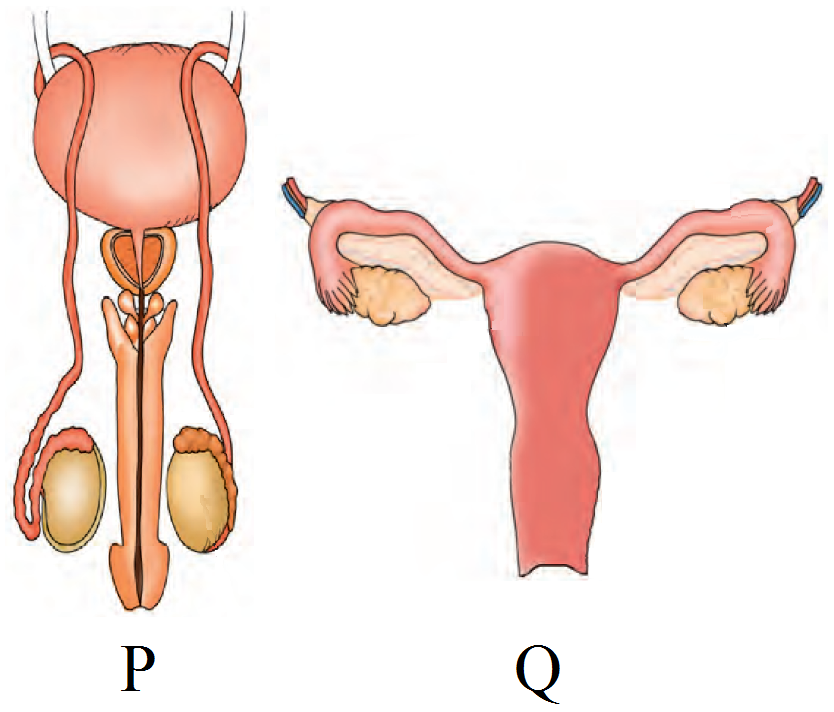
Refer to the given figures, $P$ and $Q$.

How do reproductive cells produced in $P$ differ from those produced in $Q$ in terms of production and their modes of storage?
  • Mature cells of $P$ can get stored for longer periods in reproductive tract whereas in $Q$, only immature cells remain stored.
  • B
    $P$ produces fewer reproductive cells than $Q$ does.
  • C
    Reproductive cells produced by $P$ do not show motility.
  • D
    $Q$ produces reproductive cells for a longer period in an individual's life span than $P$ does.
Answer
Correct option: A.
Mature cells of $P$ can get stored for longer periods in reproductive tract whereas in $Q$, only immature cells remain stored.
View full question & answer
MCQ 651 Mark
The fusion of the egg and the sperm is called $..........$
  • A
    Zygote
  • B
    Reproduction
  • C
    Foetus
  • Fertilization
Answer
Correct option: D.
Fertilization
View full question & answer
MCQ 661 Mark
The transformation of the larva into an adult through drastic changes is called:
  • A
    Metaphase
  • B
    Metastasis
  • C
    Meteorite
  • Metamorphosis
Answer
Correct option: D.
Metamorphosis
View full question & answer
MCQ 671 Mark
The eggs in females is produced by the:
  • A
    Sperm
  • Ovaries
  • C
    Zygote
  • D
    Testes
Answer
Correct option: B.
Ovaries
Egg/ova is the female gamete. It fuses with the male gamete, sperm to form zygote.It is produced by the ovaries.
View full question & answer
MCQ 681 Mark
Which of the following organs contain graafian follicles?
  • A
    Fallopian tube
  • B
    Uterus
  • C
    Vagina
  • Ovary
Answer
Correct option: D.
Ovary
Ovary has graafian follicles.
View full question & answer
MCQ 701 Mark
Reproduction by budding takes place in:
  • Hydra.
  • B
    Paramecium.
  • C
    Amoeba.
  • D
    Bacteria.
Answer
Correct option: A.
Hydra.
In Hydra, reproduction takes place by budding. A small part of the body of an organism grows as ‘bud’ which then detaches and becomes a new organism.
The other options Amoeba, Paramecium and bacteria reproduce asexually by binary fission.
View full question & answer
MCQ 711 Mark
How are Paramecium and Amoeba are similar?
  • A
    Unicellular.
  • B
    Does not have a nucleus.
  • C
    Reproduces by binary fission.
  • Both $(A)$ and $(C)$
Answer
Correct option: D.
Both $(A)$ and $(C)$
Unicellular organisms like amoeba and paramoecium undergoes binary fission.
View full question & answer
MCQ 721 Mark
After fertilisation, the resulting cell which gives rise to a new individual is the:
  • A
    Embryo.
  • B
    Foetus.
  • C
    Ovum.
  • Zygote.
Answer
Correct option: D.
Zygote.

After fertilisation (i.e. combining of sperm with the egg), zygote is formed. It is the beginning of formation of a new individual. All the multicellular animals start their life from a single cell called zygote.

View full question & answer
MCQ 731 Mark
In which of the following animals fertilization is external?
  • A
    Birds and fish
  • B
    Amphibians and birds
  • C
    Reptiles and fish
  • Fish and amphians
Answer
Correct option: D.
Fish and amphians
Fertilization is external in fish and amphibians.
View full question & answer
MCQ 741 Mark
Hina is writing some statements but she confused to know whether the statements are correct or not? If you know the answer to this question, then tell her:
  • A
    The fertilisation which takes place inside the female body is called internal fertilisation.
  • B
    In internal fertilisation, the male animals puts his sperms into the female animal’s body.
  • Internal fertilisation takes place in a very large number of animals such as frog, fish and star fish, cow, and horses etc.
  • D
    None of the above.
Answer
Correct option: C.
Internal fertilisation takes place in a very large number of animals such as frog, fish and star fish, cow, and horses etc.
Internal fertilisation takes place in a very large number of animals such as humans, cows, dogs, cats, tigers, lions, birds, reptiles, insects etc., but not in frog, fish and star fish.
View full question & answer
MCQ 751 Mark
Which of the following statement is or are incorrect?
  • A
    Larva is an immature form of an animal formed by the hatching of its eggs.
  • B
    The change from tadpole to frog is an example of metamorphosis.
  • There is an exception of internal fertilization which takes place in hen.
  • D
    None of the above.
Answer
Correct option: C.
There is an exception of internal fertilization which takes place in hen.
The hen is a bird. Internal fertilization take place in hen also. But a hen does not give birth to chicks (like human beings). As fertilization take place inside the body of hen and after that it travels down the oviduct, many protective layers are formed around the embryo. The hard shell that we see in hen’s egg, is the outermost protective layer. After the hard egg shell is formed around the developing embryo, the hen finally lays the egg. The hen then sits on the eggs to provide sufficient warmth to the eggs for the development of the embryo into the chicks. The embryo takes about $3$ weeks or $21$ days to develop into a complete chick. And after the chick is completely developed, the egg shell breaks open automatically and the chick comes out of it.
View full question & answer
MCQ 761 Mark
The fusion of sperm and ova usually occur in the:
  • A
    Ovary
  • B
    Uterus
  • C
    Testes
  • Oviduct
Answer
Correct option: D.
Oviduct
View full question & answer
MCQ 771 Mark
How many ova is/are released at a time in the female human being?
  • A
    $4$
  • B
    $3$
  • C
    $2$
  • $1$
Answer
Correct option: D.
$1$
One ova is released at a time in female human beings.
View full question & answer
MCQ 781 Mark
Which of the following is a specialized structure that provides nourishment to the foetus from the mother and collects wastes from it, passing them onto the mother?
  • A
    Fallopian tube
  • Placenta
  • C
    Cowper's gland
  • D
    Blastocyst
Answer
Correct option: B.
Placenta

Placenta is a specialized structure that provides nourishment to the foetus from the mother and collects wastes from it, passing them onto the mother.

View full question & answer
MCQ 791 Mark
Which of the following statements are incorrect regarding a test tube baby?
$i.$ It is developed wholly in a test tube.
$ii.$ It is developed through tissue culture method.
$iii.$ The ovum is fertilised externally and thereafter implanted in the uterus.
$iv.$ It develops from an unfertilised egg.
  • A
    $(i)$ and $(iv)$ only
  • B
    $(ii)$ and $(iv)$ only
  • C
    $(i)$ and $(iii)$ only
  • $(i), (ii)$ and $(iv)$ only
Answer
Correct option: D.
$(i), (ii)$ and $(iv)$ only
In some women, oviducts are blocked. These women are unable to bear babies because sperms cannot reach the egg for fertilisation. In such cases, doctors collect freshly released egg and sperms and keep them together for a few hours for $\text{IVF}$ or in vitro fertilisation $($fertilisation outside the body$)$ in the same conditions as they would have got inside the woman's body. In case fertilisation occurs, the zygote is allowed to develop for about a week and then it is placed in the mother's uterus. Complete development takes place in the uterus and the baby is born like any other baby. Babies born through this technique are called test$-$tube babies.
View full question & answer
MCQ 801 Mark
Which of the following shows external fertilisation?
  • Frog
  • B
    Human being
  • C
    Cow
  • D
    Hen
Answer
Correct option: A.
Frog
View full question & answer
MCQ 811 Mark
Name the process in which tadpoles develop into the young frogs.
  • A
    Budding
  • Metamorphosis
  • C
    Fertilisation
  • D
    Embedding
Answer
Correct option: B.
Metamorphosis

The transformation of the larva into an adult through drastic changes is called metamorphosis. Frogs, butterflies, silkworm, etc., undergo metamorphosis.

View full question & answer
MCQ 821 Mark
Fertilization results immediately in the formation of:
  • A zygote.
  • B
    An embryo.
  • C
    A placenta.
  • D
    A foetus.
Answer
Correct option: A.
A zygote.
The process by which male and female gametes fuse to each other is called fertilization.
View full question & answer
MCQ 831 Mark
Which of the following is an example of viviparous animal?
  • A
    Cobra
  • B
    Fish
  • Cat
  • D
    Hen
Answer
Correct option: C.
Cat
Viviparous animals give birth to their young ones. Cat is an example of an animal that gives birth to it's young ones. On the other hand, hen, fish and cobra lay eggs and are termed as oviparous animals.
View full question & answer
MCQ 841 Mark
How many modes of reproduction are there in animals?
  • A
    One type
  • Two types
  • C
    Three types
  • D
    Four types
Answer
Correct option: B.
Two types
Two types
View full question & answer
MCQ 851 Mark
Aquatic animals in which fertilization occurs in water are said to be:
  • A
    Viviparous without fertilization.
  • Oviparous with external fertilization.
  • C
    Viviparous with internal fertilization.
  • D
    Oviparous with internal fertilization
Answer
Correct option: B.
Oviparous with external fertilization.
The aquatic animals in which fertilization takes place in water, lay unfertilized eggs and fertilization takes place when male gametes, already present in water, float up to them and fuse. Thus, these animals are oviparous as they lay eggs, and exhibit external fertilization as the fusion of male and female gametes takes place outside the body of an organism.
View full question & answer
MCQ 861 Mark
The stage when all the body parts can be identified is known as$.........$
  • A
    Zygote
  • Foetus
  • C
    Embryo
  • D
    Infant
Answer
Correct option: B.
Foetus
Foetus
View full question & answer
MCQ 871 Mark
Female gamete in humans is called:
  • A
    Ovary
  • B
    Sperm
  • Ova
  • D
    Uterus
Answer
Correct option: C.
Ova
Female gamete in humans is called ova/egg. It is produced by the ovaries. The male gamete called sperm fuses with the egg to form a zygote.
View full question & answer
MCQ 881 Mark
In which of the following organisms does metamorphosis takes place?
  • A
    Butterfly
  • B
    Silkworm
  • C
    Frogs
  • All of the given
Answer
Correct option: D.
All of the given
The process of transformation of young ones into adult while undergoing drasticchanges is called metamorphosis. Butterfly, frogs, silkworm, etc., are examples of animalsthat undergo metamorphosis.
View full question & answer
MCQ 891 Mark
Where does the fusion of male and female gametes generally take place?
  • Fallopian tube
  • B
    Ovary
  • C
    Uterus
  • D
    Zygote
Answer
Correct option: A.
Fallopian tube
View full question & answer
MCQ 901 Mark
In humans, the development of fertilised egg takes place in the:
  • A
    Ovary
  • B
    Oviduct
  • C
    Testis
  • Uterus
Answer
Correct option: D.
Uterus
View full question & answer
MCQ 911 Mark
Which of the following terms is used to describe the mass of eggs of a frog?
  • A
    Follicles
  • B
    Ostium
  • Spawn
  • D
    Both $(A)$ and $(B)$
Answer
Correct option: C.
Spawn
The mass of eggs of a frog is called spawn.
View full question & answer
MCQ 921 Mark
Read the given statements and select the correct option.
Statement $1:$ In human male, testes lie outside the abdominal cavity in a thin pouch called scrotum.
Statement $2:$ Scrotum helps in maintaining the low temperature of the testes necessary for spermatogenesis.
  • Both statements $1$ and $2$ are true and statement $2$ is the correct explanation of statement $1.$
  • B
    Both statements $1$ and $2$ are true but statement $2$ is not the correct explanation of statement $1.$
  • C
    Statement $1$ is true but statement $2$ is false.
  • D
    Both statements $1$ and $2$ are false.
Answer
Correct option: A.
Both statements $1$ and $2$ are true and statement $2$ is the correct explanation of statement $1.$
View full question & answer
MCQ 941 Mark
How many parents are involved in sexual reproduction?
  • A
    $4$
  • $2$
  • C
    $1$
  • D
    $0$
Answer
Correct option: B.
$2$
In sexual reproduction such as humans, two parents are required. In case of plants, male and female reproductive parts are required.
View full question & answer
MCQ 951 Mark
Which of the following organisms reproduces asexually?
  • Protozoa
  • B
    Frog
  • C
    Lizard
  • D
    Housefly
Answer
Correct option: A.
Protozoa
Protozoa reproduces asexually.
View full question & answer
MCQ 961 Mark
Pick the odd one out from each series given below and select the correct option.
$a.$ Scrotum, Epididymis, Seminal vesicle, Fallopian tube.
$b.$ Uterus, Cervix, Vagina, Testis.
$c.$ Cow, Dog, Cat, Sparrow.
  • $(i)$
    $(ii)$
    $(iii)$
    Fallopian tube
    Testis
    Sparrow
  • B
    $(i)$
    $(ii)$
    $(iii)$
    Epididymis
    Cervix
    Dog
  • C
    $(i)$
    $(ii)$
    $(iii)$
    Scrotum
    Vagina
    Cow
  • D
    $(i)$
    $(ii)$
    $(iii)$
    Seminal vesicle
    Uterus
    Cat
Answer
Correct option: A.
$(i)$
$(ii)$
$(iii)$
Fallopian tube
Testis
Sparrow
Scrotum, epididymis and seminal vesicle are parts of male reproductive system while Fallopian tube is a part of female reproductive system. Uterus, cervix and vagina are parts of female reproductive system while testis is the part of male reproductive system. Cow, dog and cat are examples of viviparous animals while sparrow is an example of oviparous animal.
View full question & answer
MCQ 971 Mark
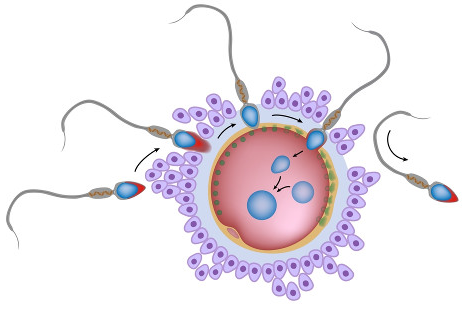
Identify the process shown below.
  • A
    Fission
  • Fertilization
  • C
    Conjugation
  • D
    Ovulation
Answer
Correct option: B.
Fertilization
The given figure represents fertilization.
View full question & answer
MCQ 981 Mark
The offspring formed as a result of sexual reproduction exhibits more variations because:
  • A
    Sexual reproduction is lengthy process.
  • B
    Genetic material comes from two parents of different species.
  • Genetic material comes from two parents of same species.
  • D
    Genetic material comes from many parents.
Answer
Correct option: C.
Genetic material comes from two parents of same species.
The offspring formed as a result of sexual reproduction exhibits more variations because genetic material comes from two parents of same species.
View full question & answer
MCQ 991 Mark
Foetus is the.
  • Well developed embryo
  • B
    Developing embryo
  • C
    A zygote
  • D
    Male gamete
Answer
Correct option: A.
Well developed embryo
View full question & answer
MCQ 1001 Mark
Which of the following is not a part of the male reproductive system?
  • A
    Vas deferens
  • B
    Penis
  • C
    Testes
  • Ovary
Answer
Correct option: D.
Ovary
Ovary is a part of the female reproductive system. All other given options are partsof male reproductive system. Penis is the external genital organ in males. Testes are the mainreproductive organs in males and produce sperms. Vas deferens carry semen from testes tothe urethra for ejaculation.
View full question & answer