Questions

questions in short. [3 marks ]

🎯

Test yourself on this topic

19 questions · timed · auto-graded

Question 13 Marks
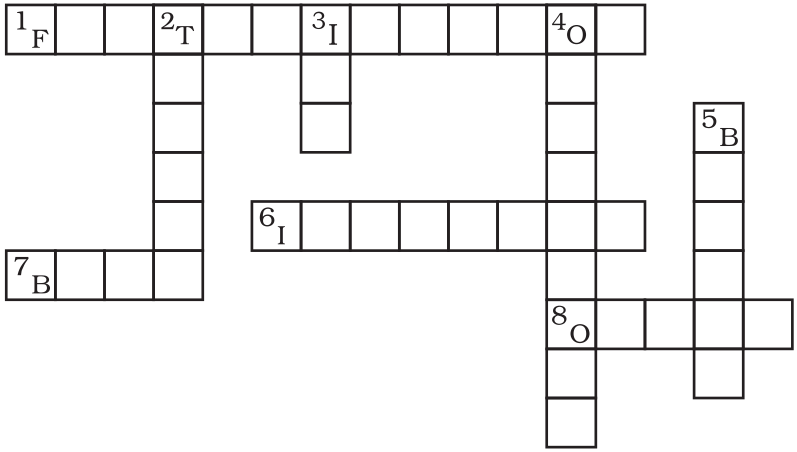
Complete the crossword puzzle using the hints given below.
Across:
$1.$ The process of the fusion of the gametes.
$6.$ The type of fertilisation in hen.
$7.$ The term used for bulges observed on the sides of the body of hydra.
$8.$ Eggs are produced here.
Down:
$2.$ Sperms are produced in these male reproductive organs.
$3.$ Another term for in vitro fertilisation.
$4.$ These animals lay eggs.
$5.$ A type of fission in amoeba.
​​​​​​​
Answer
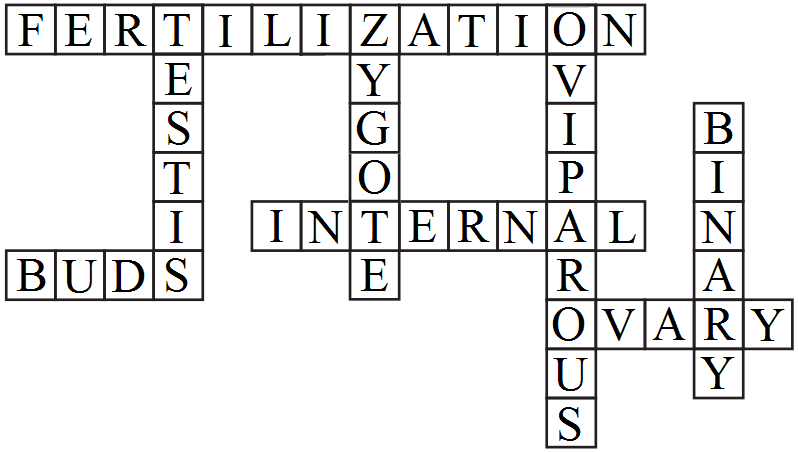
Across:
$1.$ Fertilization
$6.$ Internal
$7.$ Buds
$8.$ Ovary
Down:
$2.$ Testis
$3.$ Zygote
$4.$ Oviparous
$5.$ Binary
View full question & answer
Question 33 Marks
Explain the term ‘fertilization’. Describe the process of fertilization in human beings.
Answer
The fusion of male and female gametes to form zygote is known as fertilization. The process of fertilization takes place in the fallopian tube (oviduct). As sperm enter into the vagina through the process of copulation; it moves upwards and enter into the oviduct. In the oviduct, ovum fuse with the sperm to form zygote.
View full question & answer
Question 43 Marks
List some points about the discovery of cell.
Answer
$-$Cell, the basic structural and functional unit of life, was discovered by Robert Hooke in $1665.$
$-$He observed dead cells of a cork under magnifying device.
$-$The structure appeared to be like that of small rooms, arranged in a honeycomb pattern. Hence, the name cell.
$-$Further advancements in microscopy have led to description of cell in more details.
View full question & answer
Question 53 Marks
Discuss the advantages of asexual reproduction.
Answer
The advantages of reproduction are:
$-$It is a very rapid process, i.e. the progeny are produced very fast.
$-$A large number of progeny is produced in a single reproductive process.
$-$The new individuals are an exact copy of the parent, hence beneficial traits can be preserved.
$-$No mate is required, and they can reproduce in a wide range of environment.
View full question & answer
Question 63 Marks
What is meant by ‘cloning’? State whether gametes are involved in cloning or not. Name two animals which have been produced by cloning.
Answer
Cloning is the production of an exact copy of a cell, any other living part, or a complete organism. Yes, gametes are involved in cloning. Dolly and noah are two cloned animals.
View full question & answer
Question 73 Marks
In markets, eggs of birds are available but never eggs of dogs, why?
Answer
Birds are oviparous, i.e. lay eggs outside their body. So, it is easy to collect their eggs and these are thus available in market. On the contrary, dogs are viviparous, i.e. do not lay eggs but give birth to young ones. Their eggs are extremely small which remain inside their bodies.
View full question & answer
Question 83 Marks
What type of couples are helped to have babies by the in vitro fertilization technique?
Answer
In vitro fertilization technique is used to help those couples in having babies who can produce sperms and ovum but fertilization does not take place inside the woman’s body due to blocked oviducts.
View full question & answer
Question 93 Marks
How is reproduction in Hydra different from that in Amoeba?
Answer
Both Hydra and Amoeba reproduce asexually involving only single parent but the mode of reproduction is different. Hydra reproduces from bulges or buds arising from the parent body that grows’ and matures into another organism, i.e. by budding, while Amoeba reproduces by binary fission, i.e. splitting of parent organism to form two new organisms.
View full question & answer
Question 103 Marks
What is meant by an ‘embryo’? Can we identify the body features in an embryo?
Answer
The zygote divides repeatedly to give rise to a ball of cells. The cells then begin to form groups that develop into different tissues and organs of the body. This developing structure is termed an embryo. The stage of the embryo in which all the body parts can be identified is called a foetus.
View full question & answer
Question 113 Marks
Stages in the lifecycle of silkworm are given below. Write them in sequential order.
Answer
The stages in the life cycle of silkworm occurs in following sequence: This process of transformation from an immature form of an animal to its adult form in two or more distinct stages is called metamorphosis.
View full question & answer
Question 123 Marks
Describe the ‘in vitro fertilization’ technique of reproduction in humans.
Answer
In IVF or invitro fertilization technique, is a process by which an egg is fertilized by the sperm outside the body.
The process involves monitoring and stimulating a woman's ovulatory process, removing ovum or ova (egg or eggs) from the woman's ovaries and letting sperm fertilise them in a fluid medium in a laboratory.
View full question & answer
Question 133 Marks
What is meant by ‘reproduction’? why is it essential?
Answer
Reproduction is one of the important characteristics of living things. The ability of organism to produce young ones of its own kind is called reproduction. It is essential for the continuation of a species.
View full question & answer
Question 143 Marks
Although 2 cells called gametes fuse, the product formed is a single cell called zygote. Justify.
Answer
During fertilisation, only the nuclei of male and female gametes fuse. The sperm reaches to egg and only its nucleus enters the egg cell and fuses with the egg nucleus to form the single-celled structure called zygote. The cell formed consists of only one nucleus but is diploid in nature.
View full question & answer
Question 153 Marks
Observe the figure given as Fig. and answer the questions that follow.

$a.$ Label $A$ and $B.$
$b.$ Identify the process.
$c.$ What happens during this process and what is formed?
Answer
$a. A-$sperm, $B-$ovum $($egg$).$
$b.$ The process is fertilisation.
$c.$ During the process, the sperm nucleus fuses with the egg nucleus as a result of which a zygote is formed.
View full question & answer
Question 163 Marks
The eggs of frogs do not have shells for protection, yet they are safe in water, how?
Answer
Frog’s eggs are without any external covering or shell but a layer of jelly hold the eggs together, thus providing them protection. This jelly or gelatinous covering also protects them from drying up and prevents them from being eaten up by other animals or predators.
View full question & answer
Question 173 Marks
How can we say that fish exhibits external fertilisation?
Answer
Female fish lay eggs in water while male fish releases its sperms in water. Sperms swim and reach the eggs of fish, randomly due to water currents. When a sperm comes in contact with the viable egg, nuclei of both the cell fuses to form a zygote. This process of fertilisation takes place in water outside the female body, hence fertilisation is external in fishes.
View full question & answer
Question 183 Marks
Human male gamete has a tail but female gamete does not. Why?
Answer
The human male gamete, the sperm has to flow through the female reproductive tract to reach the fallopian tube, where it can fuse with the ovum. Thus, it requires an organ for rapid and efficient motility for transportation. The tail provides this function. The female gamete or the ovum has to travel very little distance, in which it is helped by the ovary and fallopian tube. Thus, it doesn't require any tail.
View full question & answer
Question 193 Marks
Define asexual reproduction. Name two methods of asexual reproduction in animals. Name two animals which reproduce by these asexual reproduction methods.
Answer
The type of reproduction in which only a single parent is involved is called asexual reproduction. Binary fission and budding are two methods of asexual reproduction in animals. Amoeba reproduce by binary fission and Hydra reproduce by budding.
View full question & answer