Questions · Page 4 of 5

M.C.Q. [I MARKS]

MCQ 1511 Mark
The speed of highly penetrating ultrasonic waves is:
  • A
    Lower than those of audible sound waves.
  • B
    Higher than those of audible sound waves.
  • C
    Much higher than those of audible sound waves.
  • Same as those of audible sound waves.
Answer
Correct option: D.
Same as those of audible sound waves.
The speed of sound waves is same in a particular medium.
View full question & answer
MCQ 1521 Mark
A key of mechanical piano is first struck gently and then struck again but much harder this time. In the second case:
  • Sound will be louder but pitch will not be different.
  • B
    Sound will be louder and the pitch will also be higher.
  • C
    Sound will be louder but pitch will be lower.
  • D
    Both loudness and pitch will remain unaffected.
Answer
Correct option: A.
Sound will be louder but pitch will not be different.
When the mechanical piano is struck harder the second time, we find sound will be louder but pitch remains the same because the frequency has not changed. The pitch depends on frequency of the particular key which is being hit and hence there would be no change in pitch of sound. In another words, when the key of a mechanical piano struck harder, the vibrations caused are more resulting in larger amplitude of the wave that propagates from the key. Loudness depends on the square of the amplitude of the wave. Amplitude is the size of the vibration, and this determines how loud the sound is. Larger vibrations make a louder sound. Pitch of the sound depends on the frequency of the wave which is not change when the key is struck harder.
View full question & answer
MCQ 1531 Mark
Choose the examples of soft sounds.
  • A
    Lawn mower
  • B
    Talking
  • C
    Thunder
  • Rustling leaves
Answer
Correct option: D.
Rustling leaves
View full question & answer
MCQ 1541 Mark
Speed is:
  • $\frac{\text{Distance Travelled}}{\text{Time}}$
  • B
    $\frac{\text{Time}}{\text{Distance Travelled}}$
  • C
    Distance Travelled $\times $ Time
  • D
    Time $\times $ Distance Travelled
Answer
Correct option: A.
$\frac{\text{Distance Travelled}}{\text{Time}}$
View full question & answer
MCQ 1551 Mark
Which of the following factor influence speed of sound most?
  • A
    Temperature
  • B
    Humidity
  • Nature of medium
  • D
    Source of sound
Answer
Correct option: C.
Nature of medium
View full question & answer
MCQ 1561 Mark
Meradona was standing on the cliff, $825\ m$ from the point, from where the gun was fired. After how long he will hear the echo? Speed of sound is taken as $330m/ s.$
  • A
    $1$ sec
  • B
    $2$ sec
  • C
    $4$ sec
  • $5$ sec
Answer
Correct option: D.
$5$ sec
View full question & answer
MCQ 1571 Mark
Which of the following statement is or are incorrect?
  • A
    Sound can travel through solids, liquids and gases.
  • B
    The sound of ringing telephone bell travels to us through the air in the room.
  • C
    Sound cannot travel through vacuum because vacuum has no molecules which can vibrate and carry sound waves.
  • None of the above.
Answer
Correct option: D.
None of the above.
View full question & answer
MCQ 1581 Mark
Cochlea is a part of $...........?$
  • Hearing organ
  • B
    Sound producing organ
  • C
    Muscular organ
  • D
    Air pollution
Answer
Correct option: A.
Hearing organ
View full question & answer
MCQ 1591 Mark
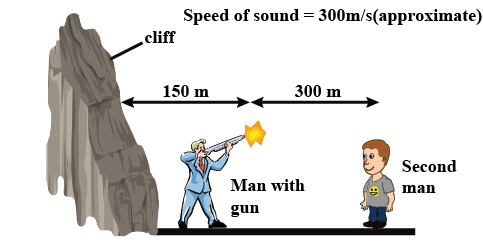
A man fires a gun $150\ m$ from a cliff. A second man who is standing $300\ m$ further away from the cliff hears the gun $1$ second after he sees the flash. The second man will hear the echo from the cliff:
  • A
    $1$ second after seeing the flash.
  • B
    $2$ seconds after hearing the gun.
  • $2$ seconds after seeing the flash.
  • D
    $4$ seconds after hearing the gun.
Answer
Correct option: C.
$2$ seconds after seeing the flash.
Echo will be heard when the sound of the gun gets reflected from the cliff, Thus the total distance travelled by the sound of gun, $S = x_1 + x_2 + x_3 = 150 + 150 + 300 = 600m v = 300m s^{−1}$
$\therefore\text{t}= \frac{\text{S}}{\text{U}}= \frac{600}{300}=\text{2s}$
View full question & answer
MCQ 1601 Mark
A pendulum oscillates $20$ times in $4$ seconds. Find its time period.
  • A
    $0.05$ sec.
  • B
    $0.001$ sec.
  • $0.2$ sec.
  • D
    $0.1$ sec
Answer
Correct option: C.
$0.2$ sec.
View full question & answer
MCQ 1621 Mark
Frequency $(ν)$ and time period $(T)$ are related as
  • $V \times T = 1$
  • B
    $V/ T = 1$
  • C
    $V = T/ 2$
  • D
    $V = T2$
Answer
Correct option: A.
$V \times T = 1$

Frequency is the reciprocal of the time period.
So, frequency and time period are related as $\text{v}=\frac{1}{\text{T}}$
$\therefore V \times T = 1.$

View full question & answer
MCQ 1631 Mark
An object vibrates with a frequency of $15$ hertz. Which of the following is true:
  • A
    It produces sound that we can hear.
  • B
    It does not produce sound.
  • It produces sound that we cannot hear.
  • D
    It produces sound that we can hear if we strain our ears.
Answer
Correct option: C.
It produces sound that we cannot hear.
View full question & answer
MCQ 1641 Mark
The sound above $...........$ is physically painful.
  • A
    $20dB$
  • B
    $40dB$
  • C
    $60dB$
  • $80dB$
Answer
Correct option: D.
$80dB$
View full question & answer
MCQ 1651 Mark
Which of the following sound is $\text{NOT}$ a cause of noise pollution:
  • A
    Loud speaker
  • B
    Horn of vehicle
  • C
    Explosion
  • Television
Answer
Correct option: D.
Television
Television has the lowest volume, out of the given, and it also doesn't disturb other people therefore generally it is not a cause of noise pollution.
Where other causes are generally very loud so they are the causes of noise pollution.
View full question & answer
MCQ 1661 Mark
A shehnai produces sound from:
  • A
    Vibrating strings
  • B
    Vibrating membrane
  • Vibrating air column
  • D
    None of these
Answer
Correct option: C.
Vibrating air column
View full question & answer
MCQ 1681 Mark
If the amplitude of a sound is doubled, then its ?
  • A
    Velocity is doubled
  • B
    Frequency is doubled
  • C
    Wavelength is doubled
  • None of the above
Answer
Correct option: D.
None of the above
The amplitude of a sound is independent of velocity, frequency, and wavelength.
So it can't be changed by changing any of them.
View full question & answer
MCQ 1691 Mark
Vibrating part of flute is:
  • Air$-$column
  • B
    Rubber band
  • C
    String
  • D
    Stretched membrane
Answer
Correct option: A.
Air$-$column
View full question & answer
MCQ 1701 Mark
Eardrum is a part of:
  • A
    Sound producing organ.
  • B
    Skeletal system.
  • Hearing organ.
  • D
    Reproductive organ.
Answer
Correct option: C.
Hearing organ.
View full question & answer
MCQ 1721 Mark
Fill in the blanks with the most appropriate option.
If a guitar string is pulled strongly, its amplitude of vibration $..............$ and the note heard is $..............$ If it is pulled lightly, its amplitude of vibration $..............$ and the note heard is $..............$
  • A
    $(i)$ Increases, $(ii)$ Louder, $(iii)$ Increases, $(iv)$ Louder.
  • B
    $(i)$ Decreases, $(ii)$ Softer, $(iii)$ Decreases, $(iv)$ Softer.
  • $(i)$ Increases, $(ii)$ Louder, $(iii)$ Decreases, $(iv)$ Softer.
  • D
    $(i)$ Decreases, $(ii)$ Softer, $(iii)$ Increases, $(iv)$ Louder.
Answer
Correct option: C.
$(i)$ Increases, $(ii)$ Louder, $(iii)$ Decreases, $(iv)$ Softer.
View full question & answer
MCQ 1731 Mark
When the amplitude is small, the sound produced is:
  • A
    Loud
  • Feeble
  • C
    Low pitched
  • D
    None of these
Answer
Correct option: B.
Feeble
View full question & answer
MCQ 1741 Mark
The human ear can hear sounds having frequency in range:
  • A
    Between $200 - 20,000Hz$
  • B
    Between $20 - 2000Hz$
  • C
    Between $200 - 2000Hz$
  • Between $20 - 20,000Hz$
Answer
Correct option: D.
Between $20 - 20,000Hz$
View full question & answer
MCQ 1751 Mark
Find the difference between a musical sound and noise.
  • A
    Amplitude
  • B
    Loudness
  • Vibrations
  • D
    All of the above
Answer
Correct option: C.
Vibrations
View full question & answer
MCQ 1761 Mark
When the amplitude of vibration is large, sound produced is:
  • A
    No sound
  • B
    Feeble
  • Loud
  • D
    No relation between amplitude and sound
Answer
Correct option: C.
Loud
View full question & answer
MCQ 1771 Mark
Speed of sound in solids is $...........$ the speed of sound in liquids.
  • A
    Same as
  • Greater than
  • C
    Less than
  • D
    Sometimes greater and sometimes less than
Answer
Correct option: B.
Greater than
View full question & answer
MCQ 1781 Mark
We can distinguish between the musical sounds produced by different singers on the basis of the characteristic of sound called:
  • A
    Frequency.
  • Timbre.
  • C
    Pitch.
  • D
    Loudness.
Answer
Correct option: B.
Timbre.
Timbre can distinguish between the musical sounds produced by different singers on the basis of the characteristic of sound.
View full question & answer
MCQ 1791 Mark
Vibration is also known as:
  • A
    Vibratory motion
  • B
    Translatory motion
  • Oscillatory motion
  • D
    None of these
Answer
Correct option: C.
Oscillatory motion
View full question & answer
MCQ 1801 Mark
To and fro or back and forth motion of an object is termed as $...........$
  • A
    Frequency
  • B
    Amplitude
  • Vibration
  • D
    Time period
Answer
Correct option: C.
Vibration
View full question & answer
MCQ 1811 Mark
Frequency of oscillations is:
  • A
    The number of oscillations per minute
  • B
    The number of oscillations per hour
  • The number of oscillations per second
  • D
    None of these
Answer
Correct option: C.
The number of oscillations per second
View full question & answer
MCQ 1821 Mark
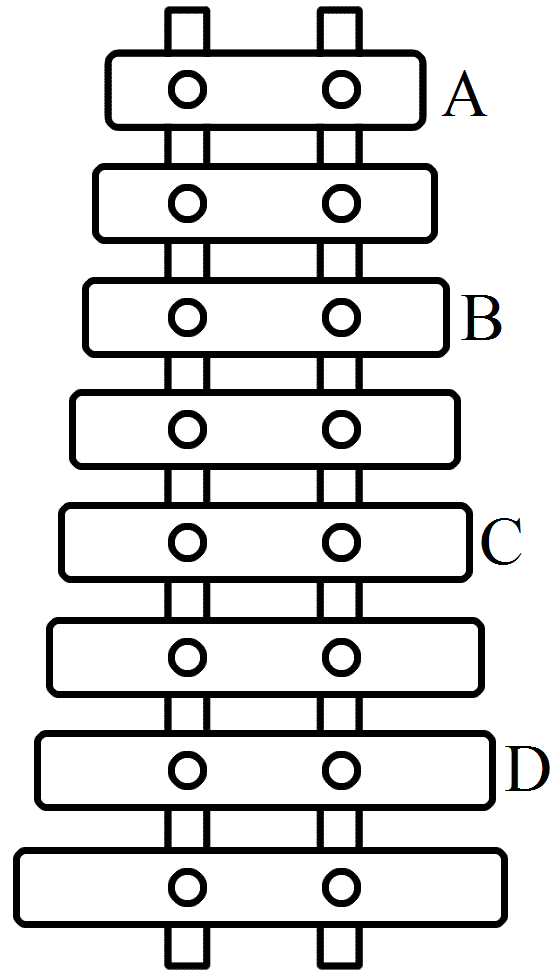
The picture shows a xylophone. $A, B, C$ and $D$ are the rods in it. Which of the following rods has high pitch of the sound and which has low frequency of vibrations?
  • A
    High pitch - $D$, Low frequency - $A$
  • B
    High pitch - $C$, Low frequency - $B$ and $C$
  • C
    High pitch - $A$ and $D$, Low frequency - $A$ and $D$
  • High pitch - $A$, Low frequency - $D$
Answer
Correct option: D.
High pitch - $A$, Low frequency - $D$

Pitch of sound depends on the frequency of vibrations. Smaller length vibrates faster, so the frequency increases and sound produced is of high pitch.

View full question & answer
MCQ 1831 Mark
Which of the following are used to study the growth of fetus inside the mother’s womb?
  • A
    Radio waves.
  • B
    $X-$rays.
  • Infrared waves.
  • D
    Sound waves.
Answer
Correct option: C.
Infrared waves.
Infra$-$red Waves are used to study the growth of fetus inside the mother’s womb.
View full question & answer
MCQ 1851 Mark
The loudness of sound is determined by its:
  • Amplitude of vibration.
  • B
    Ratio of amplitude and frequency of vibration.
  • C
    Frequency of vibration.
  • D
    Product of amplitude and frequency of vibration.
Answer
Correct option: A.
Amplitude of vibration.
Loudness of sound is determined by the amplitude of its vibration.
View full question & answer
MCQ 1861 Mark
Voice of man is heavy compared to a woman because
  • A
     Female vocal cord is longer
  • B
     Male vocal cord is shorter
  •  Male vocal cord is longer
  • D
     The concept is not related
Answer
Correct option: C.
 Male vocal cord is longer
View full question & answer
MCQ 1871 Mark
An ultrasound equipment works at frequency
  • A
     Higher than $20,000 \ Hz$
  • B
     Higher than $10,000 \ Hz$
  •  Lower than $20,000 \ Hz$
  • D
     Lower than $10,000 \ Hz$
Answer
Correct option: C.
 Lower than $20,000 \ Hz$
View full question & answer
MCQ 1881 Mark
Human can hear sound in the range of
  • A
    $ 200-2000 \ Hz$
  • $ 20-20,000 \ Hz$
  • C
    $ 2-20000 \ Hz$
  • D
    $ 2000-200000 \ Hz$
Answer
Correct option: B.
$ 20-20,000 \ Hz$
View full question & answer
MCQ 1891 Mark
When the amplitude of vibration is large, sound produced is
  • A
     No sound
  • B
     feeble
  •  loud
  • D
     No relation between amplitude and sound
Answer
Correct option: C.
 loud
View full question & answer
MCQ 1901 Mark
Above$ ........... dB$ the sound becomes physically painful
  • A
    $ 60$
  • B
    $ 40$
  • C
    $ 120$
  • $ 80$
Answer
Correct option: D.
$ 80$
View full question & answer
MCQ 1911 Mark
The number of oscillations per second is called
  • A
     Amplitude of oscillation
  • B
     Pitch of oscillation
  •  Frequency of oscillation
  • D
     None of the above
Answer
Correct option: C.
 Frequency of oscillation
View full question & answer
MCQ 1931 Mark
Vibration is also known as
  • A
     Vibratory motion
  • B
     Translatory motion
  •  Oscillatory motion
  • D
     None of these
Answer
Correct option: C.
 Oscillatory motion
View full question & answer
MCQ 1951 Mark
Sound is produced by
  • A
     Non$-$Vibrating objects only
  • B
     Vibrating and non$-$ vibrating objects
  • C
     Vibration has no relation to sound
  •  Vibrating objects only
Answer
Correct option: D.
 Vibrating objects only
View full question & answer
MCQ 1961 Mark
The velocity of sound at $20^\circ C$ is approximately
  • A
    $3400\ m/sec.$
  • $340\ m/sec.$
  • C
    $430\ m/sec$
  • D
    $304\ m/sec.$
Answer
Correct option: B.
$340\ m/sec.$
View full question & answer
MCQ 1971 Mark
The maximum displacement of a body from its mean position is called
  • amplitude
  • B
    oscillation
  • C
    periodic motion
  • D
    frequency
Answer
Correct option: A.
amplitude
View full question & answer
MCQ 1981 Mark
The number of vibrations made by a vibrating body in one second is
  • frequency
  • B
    noise
  • C
    loudness
  • D
    pitch
Answer
Correct option: A.
frequency
View full question & answer
MCQ 1991 Mark
Loudness of sound is determined by
  • A
    pitch
  • B
    frequency
  • amplitude
  • D
    time period
Answer
Correct option: C.
amplitude
View full question & answer
MCQ 2001 Mark
A pendulum oscillates $20$ times in $4$ seconds. Find its time period.
  • A
    $0.05 \sec.$
  • B
    $0.001 \sec.$
  • $0.2 \sec.$
  • D
    $0.1 \sec$
Answer
Correct option: C.
$0.2 \sec.$
View full question & answer