Question 15 Marks
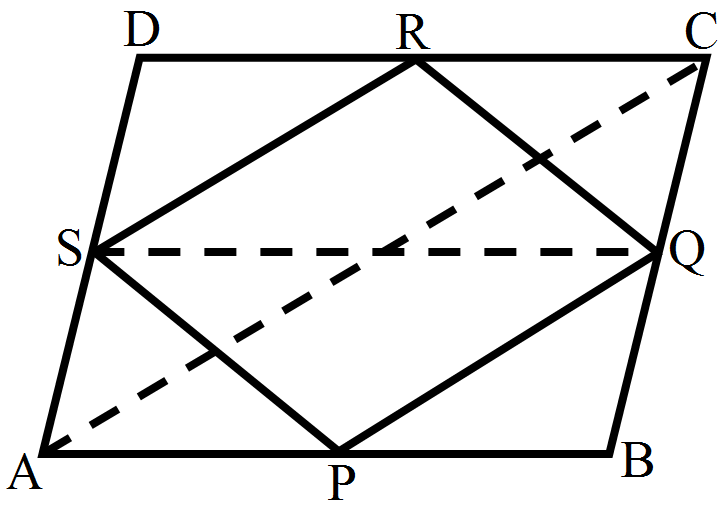
$P, Q, R, S$ are respectively the midpoints of the sides $AB, BC, CD$ and $DA$ of $||gm$ $ABCD$.
Show that $PQRS$ is a parallelogram and also show that $\text{ar}(||\text{gm PQRS})=\frac{1}{2}\times\text{ar}(||\text{gm ABCD}).$
Show that $PQRS$ is a parallelogram and also show that $\text{ar}(||\text{gm PQRS})=\frac{1}{2}\times\text{ar}(||\text{gm ABCD}).$
Answer
View full question & answer→Given: $ABCD$ is a parallelogram and $P, Q, R$ and $S$ are the moidpoints of sides $AB, BC, CD$ and $DA$, respectively.
To prove: $\text{ar}(||\text{gm PQRS})=\frac{1}{2}\times\text{ar}(||\text{gm ABCD})$
Proof: In $\triangle\text{ABC},$ $PQ\ ||\ AC$ and $\text{PQ}=\frac{1}{2}\times\text{AC}$ [By mid-point theorem] Again, in $\triangle\text{DAC},$ the points $S$ and $R$ are the mid-points of $AD$ and $DC$, respectively.
$\therefore$ $SR\ ||\ AC$ and $\text{SR}=\frac{1}{2}\times\text{AC}$ [By mid-point theorem]
Now, $PQ\ ||\ AC$ and $SR\ ||\ AC \Rightarrow PQ\ ||\ SR$ Also,
$\text{PQ}=\text{SR}=\frac{1}{2}\times\text{AC}$
$\therefore$ $PQ || SR$ and $PQ = SR$
Hence, $PQRS$ is a parallelogram Now, ar(parallelogram $PQRS$) $=\text{ar}(\triangle\text{PSQ})+\text{ar}(\triangle\text{SRQ})\dots(\text{i})$
Also, ar(parallelogram $ABCD$) = ar(parallelogram $ABQS$) + ar(parallelogram $SQCD$) $...(ii)$
$\triangle\text{PSQ}$ and parallelogram $ABQS$ are on the same base and between the same parallel lines.
So, $\text{ar}(\triangle\text{PSQ})=\frac{1}{2}\times\text{ar}(\text{parallelogram ABQS})\dots(\text{iii})$
Similary, $\triangle\text{SRQ}$ parallelogram $SQCD$ are on the same base and between the same parallel lines.
So, $\text{ar}(\triangle\text{SQR})=\frac{1}{2}\times\text{ar}(\text{parallelogram SQCD})\dots(\text{iv})$
Putting the value from $(iii)$ and $(iv)$ in $(i)$,
we get: ar(parallelogram $PQRS$) $=\frac{1}{2}\times\text{ar}(\text{parallelogram ABQS})\\+\frac{1}{2}\times\text{ar(parallelogram SQCD)}$ From $(ii)$,
we get: ar(parallelogram $PQRS$) $=\frac{1}{2}\times\text{ar(parallelogram ABCD)}$
To prove: $\text{ar}(||\text{gm PQRS})=\frac{1}{2}\times\text{ar}(||\text{gm ABCD})$
Proof: In $\triangle\text{ABC},$ $PQ\ ||\ AC$ and $\text{PQ}=\frac{1}{2}\times\text{AC}$ [By mid-point theorem] Again, in $\triangle\text{DAC},$ the points $S$ and $R$ are the mid-points of $AD$ and $DC$, respectively.
$\therefore$ $SR\ ||\ AC$ and $\text{SR}=\frac{1}{2}\times\text{AC}$ [By mid-point theorem]
Now, $PQ\ ||\ AC$ and $SR\ ||\ AC \Rightarrow PQ\ ||\ SR$ Also,
$\text{PQ}=\text{SR}=\frac{1}{2}\times\text{AC}$
$\therefore$ $PQ || SR$ and $PQ = SR$
Hence, $PQRS$ is a parallelogram Now, ar(parallelogram $PQRS$) $=\text{ar}(\triangle\text{PSQ})+\text{ar}(\triangle\text{SRQ})\dots(\text{i})$
Also, ar(parallelogram $ABCD$) = ar(parallelogram $ABQS$) + ar(parallelogram $SQCD$) $...(ii)$
$\triangle\text{PSQ}$ and parallelogram $ABQS$ are on the same base and between the same parallel lines.
So, $\text{ar}(\triangle\text{PSQ})=\frac{1}{2}\times\text{ar}(\text{parallelogram ABQS})\dots(\text{iii})$
Similary, $\triangle\text{SRQ}$ parallelogram $SQCD$ are on the same base and between the same parallel lines.
So, $\text{ar}(\triangle\text{SQR})=\frac{1}{2}\times\text{ar}(\text{parallelogram SQCD})\dots(\text{iv})$
Putting the value from $(iii)$ and $(iv)$ in $(i)$,
we get: ar(parallelogram $PQRS$) $=\frac{1}{2}\times\text{ar}(\text{parallelogram ABQS})\\+\frac{1}{2}\times\text{ar(parallelogram SQCD)}$ From $(ii)$,
we get: ar(parallelogram $PQRS$) $=\frac{1}{2}\times\text{ar(parallelogram ABCD)}$