Question 14 Marks
$\text{PQRS}$ is a rectangle inscribed in a quadrant of a circle of radius $13\ cm. A$ is any point on $PQ$. If $PS = 5\ cm$, then find $\text{ar}(\triangle\text{RAS}).$
AnswerGiven: Here from the given figure we get
$1. \text{PQRS}$ is a rectangle inscribed in a quadrant of a circle with radius $10\ cm$,
$2. PS = 5\ +cm$
$3. PR = 13\ cm ($radius of the quadrant$)$
To find: Area of $\triangle\text{RAS}.$
Calculation: In right $\triangle\text{PSR}, ($Using Pythagoras Theorem$)$
$PR^2 = PS^2 + SR^2 13^2 = 5^2 + SR^2 SR^2 = 13^2 - 5^2 SR^2 = 169 - 25 SR^2 = 144 SR = 12\ cm$
Area of Rectangle $\triangle=\frac{1}{2}\times$base$\times$height
Area of $\triangle\text{RAS}=\frac{1}{2}\times$base$\times$height
$=\frac{1}{2}\times\text{RS}\times\text{SP}$
$=\frac{1}{2}\times12\times5$
$=\frac{1}{2}\times60$
Area of $\triangle\text{RAS}=30\text{ cm}^2$
Hence we get the Area of $\triangle\text{RAS}=30\text{ cm}^2$
View full question & answer→Question 24 Marks
In figure, $ABC$ and $ABD$ are two triangles on the base $AB$. If line segment $CD$ is bisected by $AB$ at $O$, show that $\text{ar}(\triangle\text{ABC})=\text{ar}(\triangle\text{ABD}).$
AnswerGiven that $CD$ is bisected by $AB$ at $O$
To prove: $\text{ar}(\triangle\text{ABC})=\text{ar}(\triangle\text{ABD}).$
Construction: Draw $\text{CP}\perp\text{AB}$ and $\text{DQ}\perp\text{AB}.$
Proof: $\text{ar}(\triangle\text{ABC})=\frac{1}{2}\times\text{AB}\times\text{CP}\ ⋅⋅⋅⋅⋅ (1)$
$\text{ar}(\triangle\text{ABD})=\frac{1}{2}\times\text{AB}\times\text{DQ}\ ⋅⋅⋅⋅⋅ (2)$ In
$\triangle\text{CPO}$ and $\triangle\text{DQO}$ $\angle\text{CPO}=\angle\text{DQO}$ [Each $90^\circ$]
Given that, $CO = OD$ $\angle\text{CPO}=\angle\text{DQO}$ [Vertically opposite angles are equal]
Then, $\triangle\text{CPO}\cong\text{DQO}$ [By $AAS$ condition]
$\therefore$ $CP = DQ (3)$ $[C.P.C.T]$ Compare equation $(1), (2)$ and $(3)$
$\therefore\text{ar}(\triangle\text{ABC})=\text{ar}(\triangle\text{ABD}).$
View full question & answer→Question 34 Marks
In a $\triangle ABC$, if $L$ and $M$ are points on $AB$ and $AC$ respectively such that $LM \| BC$. Prove that:
$i. \text{ar}(\triangle\text{LCM})=\text{ar}(\triangle\text{LBM})$
$ii. \text{ar}(\triangle\text{LBC})=\text{ar}(\triangle\text{MBC})$
$iii. \text{ar}(\triangle\text{ABM})=\text{ar}(\triangle\text{ACL})$
$iv. \text{ar}(\triangle\text{LOB})=\text{ar}(\triangle\text{MOC})$
AnswerClearly triangles $\text{LMB}$ and $\text{LMC}$ are on the same base $LM$ and between the same parallels $LM$ and $BC$.
$\therefore\text{ar}(\triangle\text{LMB})=\text{ar}(\triangle\text{LMC})\ ...(1)$
We observe that triangles $\text{LBC}$ and $\text{MBC}$ are on the same base $BC$ and between same parallels $LM$ and $BC$.
$\therefore\text{ar}(\triangle\text{LBC})=\text{ar}(\triangle\text{MBC})\ ...(2)$
We have, $\text{ar}(\triangle\text{LMB})=\text{ar}(\triangle\text{LMC}) [$From $1]$
$\Rightarrow\text{ar}(\triangle\text{ALM})+\text{ar}(\triangle\text{LMB})$
$=\text{ar}(\triangle\text{ALM})+\text{ar}(\triangle\text{LMC})$.
$\Rightarrow\text{ar}(\triangle\text{ABM})=\text{ar}(\triangle\text{ACL})$
We have, $\text{ar}(\triangle\text{LBC})=\text{ar}(\triangle\text{MBC}) [$From $1]$
$\Rightarrow\text{ar}(\triangle\text{LBC})-\text{ar}(\triangle\text{BOC})$
$=\text{ar}(\triangle\text{MBC})-\text{ar}(\triangle\text{BOC})$
$\Rightarrow\text{ar}(\triangle\text{LOB})=\text{ar}(\triangle\text{MOC}).$
View full question & answer→Question 44 Marks
$\text{ABCD}$ is a parallelogram. $G$ is a point on $AB$ such that $AG = 2GB$ and $E$ is point on $DC$ such that $CE = 2DE$ and $F$ is the point of $BC$ such that $BF = 2FC$. Prove that:
$i. \text{ar}(\text{ADEG})=\text{ar}(\text{GBCE})$
$ii. \text{ar}{(\triangle\text{EGB}})=\frac{1}{6}\text{ar}(\text{ABCD})$
$iii. \text{ar}(\triangle\text{EFC})=\frac{1}{2}\text{ar}(\triangle\text{EBF})$
$iv. \text{ar}(\triangle\text{EBG})=\text{ar}(\triangle\text{EFC})$
$v.$ Find what portion of the parallelogram is the area of $\triangle\text{EFG}.$
Answer$\text{ABCD}$ is a parallelogram $AG = 2GB, CE = 2DE, BF = 2FC$
To prove: $\text{ABCD}$ is $||gm$ ar$(EBG)$ = ar$(EFC)$
$AB \| CD$
$(AB = CD)$
$\text{BG}=\frac{1}{3}\text{AB},\ \text{DE}=\frac{1}{3}\text{CD}$
$\therefore\ \text{BG}=\text{DE}$
$\therefore\ \text{ADEH}$ is $\|gm$ ar$(\|gm \text{ADEH}) = ar(\|gm \text{BCIG}) ...(i)$
$ar(\triangle\text{HEG}) = ar(\triangle\text{EGI}) ..(ii)$
$(\because$ diagonal of $\|gm$ divided into $2$ equal areas$) (i)$ and $(ii)$
$\therefore\text{ar}(\|\text{gm}\text{ ADEG})=\text{ar}(\|\text{gm}\text{ GBCE})$
Height, $h$ of $\|gm$
$\text{ABCD}$ and $\triangle\text{EGB}$ is Its same Base of $\triangle\text{EGB}=\frac{1}{3}\text{AB}$
area of $\text{ABCD} = h$
$\times$
$AB$
$\text{ar}(\triangle\text{EGB})=\frac{1}{6}\times\text{h}\times\frac{1}{3}\text{AB}=\frac{1}{6}\text{h}\times\text{AB}$
$\text{ar}(\text{EGB})=\frac{1}{6}$Area$(\text{ABCD})$ let dislaver between $EH$ and $CB = x$
$\text{ar}(\text{EBF})=\frac{1}{2}\times\text{BF}\times\text{x}=\frac{1}{2}\times\frac{2}{3}\text{BC}\times\text{x}=\frac{1}{3}\times\text{BC}\times\text{x}$
$\text{ar}(\text{EFC})=\frac{1}{2}\times\text{CF}\times\text{x}=\frac{1}{2}\times\frac{1}{3}\text{BC}\times\text{x}=\frac{1}{2}\times\text{ar}\times(\text{EBF})$
$\Rightarrow\text{ar}(\text{EFC})=\frac{1}{2}\times$ area of $\text{EBF}$
If $g =$ altitute from $AD$ to $BC$
$\text{ar}(\text{EFC})=\frac{1}{2}\times\frac{2}{3}\text{g}\times\frac{1}{3}\text{BC}=\frac{1}{9}\text{ar}(\text{ABCD})$
$\Rightarrow\text{ar}(\text{EFC})=\frac{2}{3}\text{ar}\text{ EBG}$
$\text{ar}(\text{EFG})=\text{ar}(\text{EGB})+\text{ar}(\text{FBF})+\text{ar}(\text{EFC})$
$=\frac{1}{6}\text{ABCD}+2\text{ar}(\text{EFC})+\text{ar}(\text{EFC})$
$=\frac{1}{6}\text{ABCD}+3\text{ar}(\text{EFC})$
$=\frac{1}{6}\text{ABCD}+\not3\times\frac{1}{\not9}\times\text{ABCD}$
$=\Big(\frac{1}{6}+\frac{1}{3}\Big)\text{ABCD}$
$=\Big(\frac{1+2}{6}\Big)\text{ABCD}$
$=\frac{1}{2}\text{ABCD}$
View full question & answer→Question 54 Marks
If $ABC$ and $BDE$ are two equilateral triangles such that $D$ is the mid-point of $BC$, then find $\text{ar}(\triangle\text{ABC}) : \text{ar}(\triangle\text{BDE}).$
AnswerGiven: $\triangle\text{ABC}$ is equilateral triangle.
$\triangle\text{BDE}$ is equilateral triangle. $D$ is the midpoint of $BC$.
To find: $\text{ar}(\triangle\text{ABC}):\text{ar}(\triangle\text{BDE})$
Proof: Let us draw the figure as per the instruction given in the question.
We know that area of equilateral triangle $=\frac{\sqrt3}{4}\times\text{a}^2,$
where a is the side of the triangle.
Let us assume that length of $BC$ is a cm.
This means that length of $BD$ is $\frac{\text{a}}{2}\text{cm},$
Since $D$ is the midpoint of $BC$.
$\therefore$ Area of equilateral $\triangle\text{ABC}=\frac{\sqrt3}{4}\times\text{a}^2\ ...(1)$
Area of equilateral $\triangle\text{BDE}=\frac{\sqrt3}{4}\times\Big(\frac{\text{a}^2}{2}\Big)\ ...(2)$
Now, $\triangle\text{ABC}:\triangle\text{BDE}=\frac{\sqrt3}{4}\times\text{a}^2:\frac{\sqrt3}{4}\times\Big(\frac{\text{a}^2}{2}\Big)$ [From $1$ and $2$] $=4:1$
Hence we get the result $\text{ar}(\triangle\text{ABC}):\text{ar}(\triangle\text{BDE})=4:1$
View full question & answer→Question 64 Marks
A point $D$ is taken on the side $BC$ of a $\triangle\text{ABC},$ such that $BD = 2DC$. Prove that $\text{ar}(\triangle\text{ABD})=2\text{ar}(\triangle\text{ADC}).$
AnswerGiven that, In $\triangle\text{ABC},$ $BD = 2DC$
To prove: $\text{ar}(\triangle\text{ADB})=2\text{ar}(\triangle\text{ADC}).$
Construction: Take a point $E$ on $BD$ such that $BE = ED$
Proof: Since, $BE = ED$ and $BD = 2\ DC$ Then, $BE = ED = DC$
We know that median of triangle divides it into two equal triangles.
$\therefore$ In $\triangle\text{ABD},$ $AE$ is the median.
Then, $\text{ar}(\triangle\text{ABD})=2\text{ar}(\triangle\text{AED})\ ...(1)$
In $\triangle\text{AEC},$ $AD$ is the median.
Then, $\text{ar}(\triangle\text{ADE})=2\text{ar}(\triangle\text{ADC})\ ...(2)$
Compare equation $1$ and $2$ $\text{ar}(\triangle\text{ABD})=2\text{ar}(\triangle\text{ADC}).$
View full question & answer→Question 74 Marks
In square $\text{ABCD}$, $P$ and $Q$ are mid-point of $AB$ and $CD$ respectively. If $AB = 8\ cm$ and $PQ$ and $BD$ intersect at $O$, then find area of $(\triangle\text{OPB}).$
AnswerGiven: Here from the given question we get
$1. \text{ABCD}$ is a square,
$2. P$ is the midpoint of $AB$.
$3. Q$ is the midpoint of $CD$.
$4. PQ$ and $BD$ intersect at $O$.
$5. AB = 8\ cm$.
To find: Area of $\triangle\text{OPB}.$
Calculation: Since $P$ is the midpoint of $AB$, $\text{BP}=\frac{1}{2}(\text{AB})$
$=\frac{1}{2}(8)$
$=4\text{ cm}$
$\text{BP}=4\text{ cm}\ ...(1)$
Area of triangle $=\frac{1}{2}\times$base$\times$height
Area of $\triangle\text{OPB}=\frac{1}{2}\times\text{BP}\times\text{PO} [$From $1]$
$=\frac{1}{2}\times4\times4$
$\Big(\text{PO}=\frac{1}{2}\text{AD},\text{APQD}$ is a rectangle$\Big)$
$=\frac{1}{2}\times16$
Area of $\triangle\text{OBP}=8\text{ cm}^2$
Hence we get the Area of $\triangle\text{OBP}=8\text{ cm}^2$
View full question & answer→Question 84 Marks
$ABCD$ is a parallelogram. $E$ is a point on $BA$ such that $BE = 2EA$ and $F$ is point on $DC$ such that $DF = 2FC$. Prove that $AECF$ is a parallelogram whose area is one third of the area of parallelogram $ABCD.$
AnswerDraw $FG \perp AB$
We have, $B E=2 E A$ and $D F=2 F C$
$\Rightarrow A B-A E=2 A E \text { and } D C-F C=2 F C$
$\Rightarrow A B=3 A E \text { and } D C=3 F C$
$\Rightarrow A E=\left(\frac{1}{3}\right) A B \text { and } F C=\left(\frac{1}{3}\right) D C \ldots$
But $A B=D C$ Then, $A E=F C$ [opposite sides of $\left.\|^{g m}\right]$
Thus, $A E=F C$ and $A E \| F C$
Then, $AECF$ is a parallelogram
Now, area of parallelogram $A E C F=A E \times F G$
$\Rightarrow \operatorname{ar}\left(\left\|\|^{gm} AECF\right)=\frac{1}{3} AB \times FG\right. \text { from (1) }$
$\Rightarrow 3 \operatorname{ar}\left(\left\|\|^{g m} AECF\right)=AB \times FG \ldots(2) And \operatorname{ar}\left(\|\left.\right|^{gm} ABCD\right)=AB \times FG \cdots(3) \text { Compare equation } 2 \text { and } 3\right.$
$\Rightarrow 3 \operatorname{ar}\left(\|^{g gm} AECF\right)=\operatorname{ar}\left(\| \|^{gm} ABCD\right)$
$\Rightarrow \operatorname{ar}\left(\|^{gm} AECF\right)=\frac{1}{3} \operatorname{ar}\left(\|^{gm} ABCD\right)$
View full question & answer→Question 94 Marks
$\text{ABC}$ is a triangle in which $D$ is the mid$-$point of $BC. E$ and $F$ are mid$-$points of $DC$ and $AE$ respectively. $IF$ area of $\triangle\text{ABC}$ is $16\ cm^2$, find the area of $\triangle\text{DEF}.$
AnswerGiven: Here from the given question we get
$1. \text{ABC}$ is a triangle
$2. D$ is the midpoint of $BC$
$3. E$ is the midpoint of $CD$
$4. F$ is the midpoint of $A$
Area of $\triangle\text{ABC}=16\text{ cm}^2$
To find:
Area of $\triangle\text{DEF}$ Calculation:
We know that , The median divides a triangle in two triangles of equal area.
For $\triangle\text{ABC},$
$AD$ is the median
Area of $\triangle\text{ADC}=\frac{1}{2}($Area of $\triangle\text{ABC})$
$=\frac{1}{2}(16)$
$=8\text{ cm}^2$
Area of $\triangle\text{ADE}=8\text{ cm}^2$
For $\triangle\text{ADC},$
$AE$ is the median.
Area of $\triangle\text{AED}=\frac{1}{2}($Area of $\triangle\text{ABC})$
$=\frac{1}{2}(8)$
$=4\text{ cm}^2$
Area of $\triangle\text{AED}=4\text{ cm}^2$ Similarly,
For $\triangle\text{AED},$
$DF$ is the median.
Area of $\triangle\text{DEF}=\frac{1}{2}($Area of $\triangle\text{AED})$
$=\frac{1}{2}(4)$
$=2\text{cm}^2$
Area of $\triangle\text{DEF}=2\text{ cm}^2$
Hence we get Area of $\triangle\text{DEF}=2\text{ cm}^2$
View full question & answer→Question 104 Marks
If $AD$ is a median of a triangle $ABC$, then prove that triangles $ADB$ and $ADC$ are equal in area. If $G$ is the mid-point of median $AD$, prove that $\text{ar}(\triangle\text{BGC})=\text{ar}(\triangle\text{AGC}).$
AnswerDraw $\text{AM}\perp\text{BC}$
Since, $AD$ is the median of $\triangle\text{ABC}$
$\therefore$ $BD = DC$
$\Rightarrow BD = AM = DC \times AM$
$\Rightarrow\Big(\frac{1}{2}\Big)(\text{BD}\times\text{AM})=\Big(\frac{1}{2}\Big)(\text{DC}\times\text{AM)}$
$\Rightarrow\text{ar}(\triangle\text{ABD})=\text{ar}(\triangle\text{ACD})\ ⋅⋅⋅ (1)$
In $\triangle\text{BGC},$ $GD$ is the median
$\Rightarrow\text{ar}(\triangle\text{BGD})=\text{ar}(\triangle\text{CGD})\ ⋅⋅⋅ (2)$
In $\triangle\text{ACD},$ $CG$ is the median
$\Rightarrow\text{ar}(\triangle\text{AGC})=\text{ar}(\triangle\text{CGD})\ ⋅⋅⋅ (3)$
From $(2)$ and $(3)$ we have,
$\text{ar}(\triangle\text{BGD})=\text{ar}(\triangle\text{AGC}).$
But, $\text{ar}(\triangle\text{BGC})=\text{ar}(\triangle\text{AGD}).$
$\text{ar}(\triangle\text{BGC})=\text{ar}(\triangle\text{AGC}).$
View full question & answer→Question 114 Marks
$\text{ABCD}$ is a parallelogram in which $BC$ is produced to $E$ such that $CE = BC. AE$ intersects $CD$ at $F.$
$i.$ Prove that $\text{ar}(\triangle\text{ADF})=\text{ar}(\triangle\text{ECF}).$
$ii.$ If the area of $\triangle\text{DFB}=3\text{cm}^2,$ find the area of $||^{gm}\text{ABCD}.$
AnswerIn triangles $\text{ADF}$ and $\text{ECF}$,
we have $\angle\text{ADF}=\angle\text{ECF}$
$[$Alternate interior angles,Since $AD \| BE]$
$AD = EC [$since $AD = BC = CE]$ And
$\angle\text{DFA}=\angle\text{CFA} [$Vertically opposite angles$]$
So, by $\text{AAS}$ congruence criterion,
we have $\triangle\text{ADF}\cong\triangle\text{ECF}$
$\Rightarrow\text{ar}(\triangle\text{ADF})=\text{ar}(\triangle\text{ECF})$ and $DF = CF$.
Now, $DF = CF$
$\Rightarrow BF$ is a median in $\triangle\text{BCD}.$
$\Rightarrow\text{ar}(\triangle\text{BCD})=2\text{ar}(\triangle\text{BDF})$
$\Rightarrow\text{ar}(\triangle\text{BCD})=2\times3\text{ cm}^2=6\text{ cm}^2$
Hence, area of a parallelogram $=2\text{ar}(\triangle\text{BCD})=2\times6\text{ cm}^2=12\text{ cm}$
View full question & answer→Question 124 Marks
$P$ is any point on base $BC$ of $\triangle\text{ABC}$ and $D$ is the mid-point of $BC. DE$ is drawn parallel to $PA$ to meet $AC$ at $E$. If $\text{ar}(\triangle\text{ABC})=12\text{cm}^2,$ then find area of $\triangle\text{EPC}.$
AnswerGiven: Area$(ABC) = 12cm^2$, $D$ is midpoint of $BC$ and $AP$ is parallel to $ED$.
We need to find area of the triangle $EPC$. Since, $AP || ED$, and
we know that the area of triangles between the same parallel and on the same base are equal.
So, Area$(APE)$ = Area$(APD)$
$\Rightarrow $ Area$(APM)$ + Area$(AME)$ = Area$(APM)$ + Area$(PMD)$
$\Rightarrow $ Area$(AME)$ = Area$(PMD) ....(1)$
Since, median divide triangles into two equal parts.
So, $\text{Area}(\text{ADC})=\frac{1}{2}\text{Area}(\text{ABC})=\frac{12}{2}=6\text{cm}^2$
$\Rightarrow $ Area$(ADC)$ = Area$(MDCE)$ + Area$(AME)$
$\Rightarrow $ Area$(ADC)$ = Area$(MDCE)$ + Area$(PMD)$ (from equation $(1)$)
$\Rightarrow $ Area$(ADC)$ = Area$(PEC)$
Therefore, Area$(PEC) = 6cm^2.$
View full question & answer→Question 134 Marks
In a $\triangle\text{ABC},$
$P$ and $Q$ are respectively the mid points of $AB$ and $BC$ and $R$ is the midpoint of $AP$. Prove that:
$i. \text{ar}(\triangle\text{PBQ})=\text{ar}(\triangle\text{ARC}).$
$ii. \text{ar}(\triangle\text{PRQ})=\frac{1}{2}\text{ar}(\triangle\text{ARC}).$
$iii. \text{ar}(\triangle\text{EQC})=\frac{3}{8}\text{ar}(\triangle\text{ABC}).$
AnswerWe know that each median of a triangle divides it into two triangles of equal area.
$i.$ Since $CR$ is the median of $\triangle\text{CAP}$
$\therefore\text{ar}(\triangle\text{CRA})=\Big(\frac{1}{2}\Big)\text{ar}(\triangle\text{CAP})\ ...(1)$
Also, $CP$ is the median of a $\triangle\text{CAB}$
$\therefore\text{ar}(\triangle\text{CAP})=\text{ar}(\triangle\text{CPB})\ ...(2)$
From $1$ and $2$, we get
$\therefore\text{ar}(\triangle\text{ARC})=\Big(\frac{1}{2}\Big)\text{ar}(\triangle\text{CPB})\ ...(3)$
$PQ$ is the median of a $\triangle\text{PBC}$
$\therefore\text{ar}(\triangle\text{CPB})=2\text{ar}(\triangle\text{PBQ})\ ...(4)$
From $3$ and $4$, we get
$\therefore\text{ar}(\triangle\text{ARC})=\text{ar}(\triangle\text{PBQ})\ ...(5)$
$ii.$ Since $QP$ and $QR$ medians of triangles $\text{QAB}$ and $\text{QAP}$ respectively
$\therefore\text{ar}(\triangle\text{QAP})=\text{ar}(\triangle\text{QBP})\ ...(6)$
And $\therefore\text{ar}(\triangle\text{QAP})=2\text{ar}(\triangle\text{QRP})\ ...(7)$
From $6$ and $7$, we get
$\therefore\text{ar}(\triangle\text{PRQ})=\Big(\frac{1}{2}\Big)\text{ar}(\triangle\text{PBQ})\ ...(8)$
From $5$ and $8$, we get
$\therefore\text{ar}(\triangle\text{PRQ})=\Big(\frac{1}{2}\Big)\text{ar}(\triangle\text{ARC})$
$iii.$ Since, $LR$ is a median of $\triangle\text{CAP}$
$\therefore\text{ar}(\triangle\text{ARC})=\Big(\frac{1}{2}\Big)\text{ar}(\triangle\text{CAD})$
$=\frac{1}{2}\times\Big(\frac{1}{2}\Big)\text{ar}(\triangle\text{ABC})$
$=\Big(\frac{1}{4}\Big)\text{ar}(\triangle\text{ABC})$
Since $RQ$ is the median of $\triangle\text{RBC}.$
$\therefore\text{ar}(\triangle\text{RQC})=\Big(\frac{1}{2}\Big)\text{ar}(\triangle\text{RBC})$
$=\Big(\frac{1}{2}\Big)\{\text{ar}(\triangle\text{ABC})−\text{ar}(\triangle\text{ARC})\}$
$=\Big(\frac{1}{2}\Big)\Big\{\text{ar}(\triangle\text{ABC})–\Big(\frac{1}{4}\Big)\text{ar}(\triangle\text{ABC)}\Big\}$
$=\Big(\frac{3}{8}\Big)\text{ar}(\triangle\text{ABC})$
View full question & answer→Question 144 Marks
In Q.No. $1$, if $AD = 6\ cm, CF = 10\ cm$, and $AE = 8\ cm$, find $AB$.
Answer

Area of parallelogram $ABCD = AD \times CF ...(1)$
Again area of parallelogram $ABCD = DC \times AE ...(2)$
Compare equation $(1)$ and equation $(2)$
$AD \times CF = DC \times AE$
$\Rightarrow 6 \times 10 = DC \times 8$
$\Rightarrow\text{DC}=\frac{6\times10}{8}=7.5\text{cm}$
$\therefore$ $AB = DC = 7.5\ cm$ [Opposite sides of $||$ gm] View full question & answer→Question 154 Marks
$D$ is the midpoint of side $BC$ of $\triangle\text{ABC}$ and $E$ is the midpoint of $BD$. If $O$ is the midpoint of $AE$, Prove that $\text{ar}(\triangle\text{BOE})=\frac{1}{8}\text{ar}(\triangle\text{ABC}).$
AnswerGiven that $D$ is the midpoint of sides $BC$ of triangle $ABC$ $E$ is the midpoint of $BD$ and $O$ is the midpoint of $AE$ Since $AD$ and $AE$ are the medians of triangles, $ABC$ and $ABD$ respectively
$\therefore\text{ar}(\triangle\text{ABD})=\Big(\frac{1}{2}\Big)\text{ar}(\triangle\text{ABC})\ ...(1)$
$\therefore\text{ar}(\triangle\text{ABE})=\Big(\frac{1}{2}\Big)\text{ar}(\triangle\text{ABD})\ ...(2)$
$OB$ is the median of triangle $ABE$
Therefore, $\therefore\text{ar}(\triangle\text{BOE})=\Big(\frac{1}{2}\Big)\text{ar}(\triangle\text{ABE})$
From $1, 2$ and $3$, we have
$\therefore\text{ar}(\triangle\text{BOE})=\Big(\frac{1}{8}\Big)\text{ar}(\triangle\text{ABC})$
View full question & answer→Question 164 Marks
$\text{PQRS}$ is a trapezium having $PS$ and $QR$ as parallel sides. $A$ is any point on $PQ$ and $B$ is a point on $SR$ such that $AB \| QR$. If area of $\triangle\text{PBQ}$ is $17\ cm^2$, find the area of $\triangle\text{ASR}.$
AnswerHere from the given figure we get
$1. \text{PQRS}$ is a trapezium having $PS \| QR$
$2. A$ is any point on $PQ$
$3. B$ is any point on $SR$
$4. AB \| QR$
$5.$ Area of $\triangle\text{BPQ}=17\text{ cm}^2$
T o find : Area of $\triangle\text{ASR}.$
Calculation: We know that ‘If a triangle and a parallelogram are on the same base and the same parallels, the area of the triangle is equal to half the area of the parallelogram’
Here we can see that$:\ $ Area$(\triangle\text{APB})=$Area$(\triangle\text{ABS})\ ...(1)$ And,
Area$(\triangle\text{AQR})=$Area$(\triangle\text{ABR})\ ...(2)$
Therefore, Area$(\triangle\text{ASR})=$Area$(\triangle\text{ABS})+$Area$(\triangle\text{ABR})$ From equation $(1)$ and $(2)$,
we have, Area($\triangle\text{ASR})=$Area$(\triangle\text{APB})+$Area$(\triangle\text{AQR})$
$\Rightarrow$ Area$(\triangle\text{ASR})=$Area$(\triangle\text{BPQ})=17\text{ cm}^2$
Hence, the area of the triangle $\triangle\text{ASR}$ is $17\text{ cm}^2.$ View full question & answer→Question 174 Marks
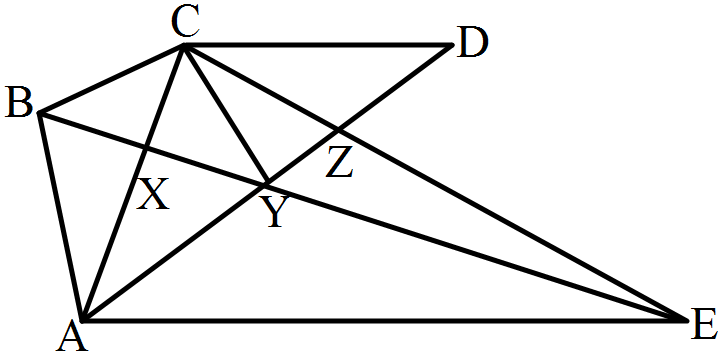
In the given figure, $CD \| AE$ and $CY \| BA$.
$i.$ Name a triangle equal in area of $\triangle\text{CBX}$
$ii.$ Prove that $\text{ar}(\triangle\text{ZDE})=\text{ar}(\triangle\text{CZA})$
$iii.$ Prove that $\text{ar}(\text{BCZY})=\text{ar}(\triangle\text{EDZ}).$
AnswerGiven:
$CD \| AE.$
$CY \| BA$.
To find:
Name a triangle equal in area of $\triangle\text{CBX}.$
$\text{ar}(\triangle\text{ZDE})=\text{ar}(\triangle\text{CZA}).$
$\text{ar}(\text{BCZY})=\text{ar}(\triangle\text{EDZ}).$
Proof:
$i.$ Since $\triangle BCY$ and $\triangle YCA$ are on the same base and between same parallel, so their area should be equal.
Therefore
$\text{ar}(\triangle\text{BCY})=\text{ar}(\triangle\text{YCA})$.
$\Rightarrow\text{ar}(\triangle\text{CBX})+\text{ar}(\triangle\text{XYC})$
$=\text{ar}(\triangle\text{XYC})+\text{ar}(\triangle\text{AXY})$.
$\Rightarrow\text{ar}(\triangle\text{CBX})=\text{ar}(\triangle\text{AXY})$.
Therefore area of triangle $CBX$ is equal to area of triangle $AXY$.
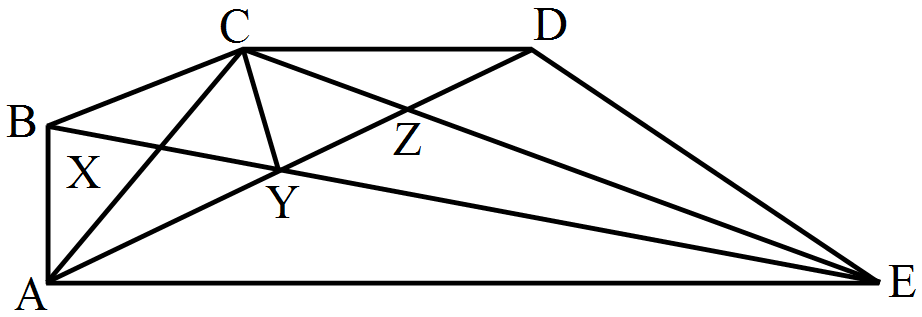
$ii. \triangle ADE$ and $\triangle ACE$ are on the same base $AE$ and between the same parallel $AE$ and $CD$.
$\Rightarrow\text{ar}(\triangle\text{ADE})=\text{ar}(\triangle\text{ACE})$.
$\Rightarrow\text{ar}(\triangle\text{ADE})-\text{ar}(\triangle\text{AZE})$
$=\text{ar}(\triangle\text{ACE})-\text{ar}(\triangle\text{AZE})$.
$\Rightarrow\text{ar}(\triangle\text{ZDE})=\text{ar}(\triangle\text{ACZ})$.
$iii.$ Triangle $ACY$ and $BCY$ are on the same base $CY$ and between same parallels $CY$ and $BA$. So we have $\text{ar}(\triangle\text{ACY})=\text{ar}(\triangle\text{BCY})$
Now we know that
$\text{ar}(\triangle\text{ACZ})=\text{ar}(\triangle\text{ZDE})$
$\Rightarrow\text{ar}(\triangle\text{ACY})+\text{ar}(\triangle\text{CYZ})=\text{ar}(\triangle\text{EDZ})$
$\Rightarrow\text{ar}(\triangle\text{BCY})+\text{ar}(\triangle\text{CYZ})=\text{ar}(\triangle\text{EDZ})$
$\Rightarrow\text{ar}(\triangle\text{BCY})=\text{ar}(\triangle\text{EDZ})$ View full question & answer→Question 184 Marks
In figure, $X$ and $Y$ are the mid points of $AC$ and $AB$ respectively, $QP || BC$ and $CYQ$ and $BXP$ are straight lines. Prove that $\text{ar}(\triangle\text{ABP})=\text{ar}(\triangle\text{ACQ}).$
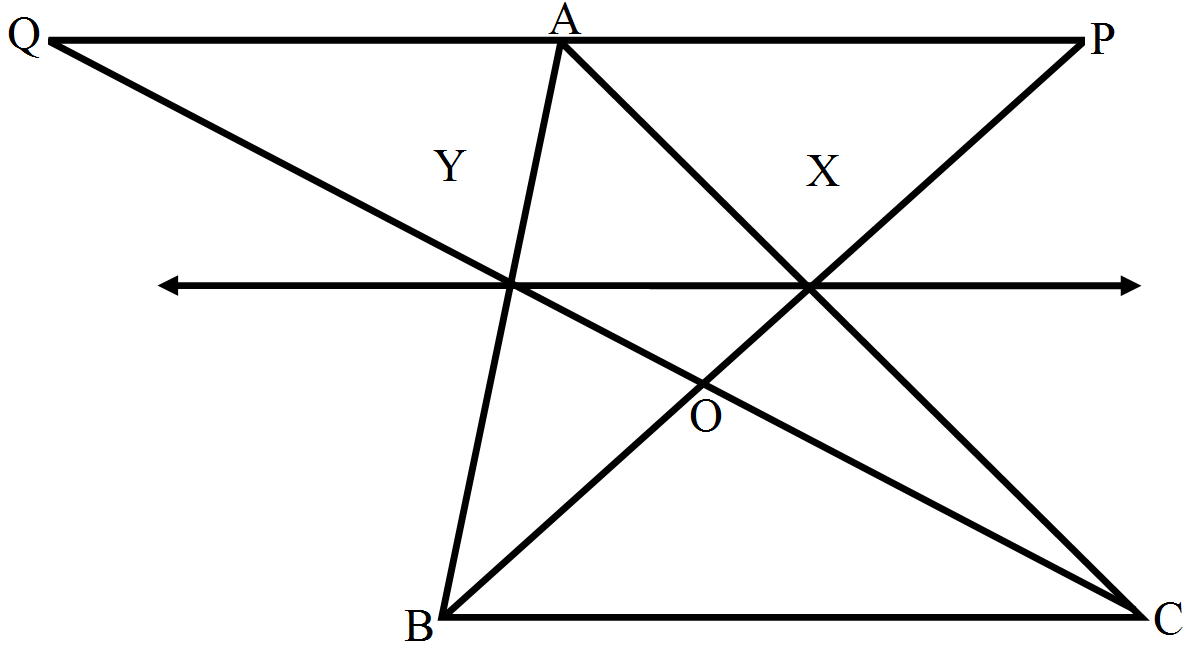
AnswerSince $X$ and $Y$ are the mid points of $AC$ and $AB$ respectively.
Therefore, $XY || BC$ Clearly, triangles $BYC$ and $BXC$ are on the same base $BC$ and between the same parallels $XY$ and $BC$ $\therefore\text{ar}(\triangle\text{BYC})=\text{ar}(\triangle\text{BXC})$
$\Rightarrow\text{ar}(\triangle\text{BYC})-\text{ar}(\triangle\text{BOC})$
$\ =\text{ar}(\triangle\text{BXC})-\text{ar}(\triangle\text{BOC})$
$\Rightarrow\text{ar}(\triangle\text{BOY})=\text{ar}(\triangle\text{COX})$
$\Rightarrow\text{ar}(\triangle\text{BOY})+\text{ar}(\triangle\text{XOY})$
$\ =\text{ar}(\triangle\text{COX})+\text{ar}(\triangle\text{XOY})$
$\Rightarrow\text{ar}(\triangle\text{BXY})=\text{ar}(\triangle\text{CXY})\ ...(1)$
We observed that the quadrilaterals $XYAP$ and $XYAQ$ are on the same base $XY$ and between same parallels $XY$ and $PQ$.
$\therefore\text{ar}(\text{quad}.\ \text{XYAP})=\text{ar}(\text{quad}\text{ XYQA})\ ...(2)$ Adding $1$ and $2$,
we get $\therefore\text{ar}(\triangle\text{BXY})+\text{ar}(\text{quad}.\text{ XYAP})$
$\ =\text{ar}(\triangle\text{CXY})+\text{ar}(\text{quad}\text{ XYQA})$
$\Rightarrow\text{ar}(\triangle\text{ABP})=\text{ar}(\triangle\text{ACQ})$
View full question & answer→Question 194 Marks
$A B C D$ is a parallelogram. $P$ is the mid-point of $A B$. $B D$ and $C P$ intersect at $Q$ such that $C Q: Q P=3: 1$. If $\operatorname{ar}(\triangle PBQ )=10\ cm^2$, find the area of parallelogram $ABCD$ .
Answer
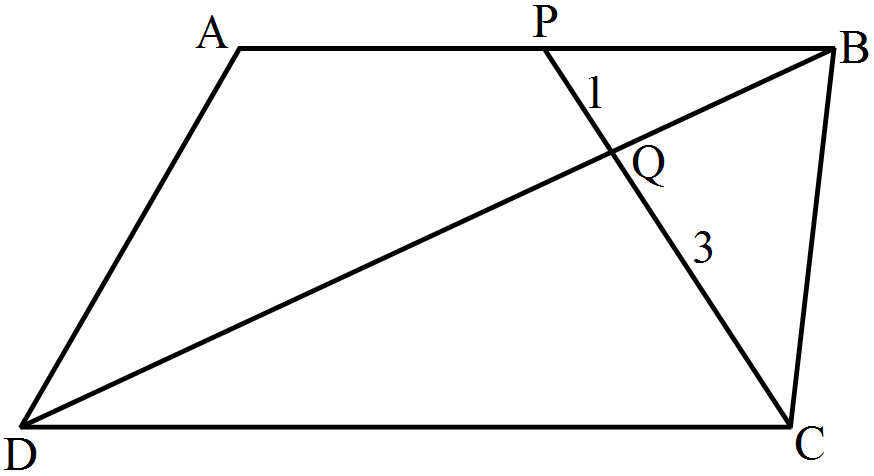
Given: $A B C D$ is a parallelogram. $P$ is a mid point of $A B, B D$ and $C P$ intersect at $Q$ such that $C Q: Q P=3: 1$
To find: the area of parallelogram $A B C D$.
As we know
$CQ: QP=3: 1$
$\text { or } \frac{CQ}{QP}=\frac{3}{1}$
Or $3 Q P=C Q \ldots E q 1$
and also
$\Rightarrow\frac{1}{2}\times\text{PB}\times\text{QP}=10\text{cm}^2$
$\Rightarrow\frac{1}{2}\times\text{PB}\times\frac{\text{CQ}}{3}=10\text{cm}^2$ [From eq $1$]
$\Rightarrow\frac{1}{2}\times\text{PB}\times\text{CQ}=3\times10\text{cm}^2$
$\Rightarrow\frac{1}{2}\times\text{PB}\times\text{CQ}=30\text{cm}^2$
but Area(triangle $PBQ$) + Area(triangle $CBQ$) = Area(triangle $PBC$)
$\Rightarrow 10\ cm^2 + 30\ cm^2 = 40cm^2$
therefore Area(triangle $P B C$ ) $=40 cm^2$
Since $P$ is the mid point of $A B$
therefore $C P$ is the median of triangle $A B C$
thus Area(triangle PBC ) $=$ Area(triangle APC )
Or Area(triangle $A P C$ ) $=40 cm^2$
thus area of triangle $A B C=40+40=80\ cm^2$
Area of parallelogram $ABCD=160\ cm^2$ View full question & answer→