Questions

M.C.Q

🎯

Test yourself on this topic

17 questions · timed · auto-graded

MCQ 11 Mark
In $\triangle\text{ABC, BC = AB}$ and $\angle\text{B}=80^{\circ}.$ Then, $\angle\text{A = ?}$
  • $50^\circ$
  • B
    $40^\circ$
  • C
    $100^\circ$
  • D
    $80^\circ$
Answer
Correct option: A.
$50^\circ$
In $\triangle\text{ABC,}$
$\text{BC = AB}$
$\Rightarrow\angle\text{A}=\angle\text{C}$ (angles opposite to equal sides are equal)
Now, $\angle\text{A}+\angle\text{B}+\angle\text{C}=180^{\circ}$
$\Rightarrow\angle\text{A}+80^{\circ}+\angle\text{A}=180^{\circ}$
$\Rightarrow2\angle\text{A}+100^{\circ}$
$\Rightarrow\angle\text{A}=50^{\circ}$
View full question & answer
MCQ 21 Mark
In $\triangle\text{ABC}$ and $\triangle\text{DEF,}$ it is given that $\angle\text{B}=\angle\text{E}$ and $\angle\text{C}=\angle\text{F}.$ In order that $\triangle\text{ABC}\cong\triangle\text{DEF},$ we must have:
  • A
    $AB = DF$
  • B
    $AC = DE$
  • $BC = EF$
  • D
    $\angle\text{A}=\angle\text{D}$
Answer
Correct option: C.
$BC = EF$
In $\triangle\text{ABC}$ and $\triangle\text{DEF},$
$\angle\text{B}=\angle\text{E}$ and $\angle\text{C}=\angle\text{F}$
So, the induded sides should be equal for the triangle to be congruent by the $ASA$ congruence criterion.
Thus, we must have $BC = EF.$
View full question & answer
MCQ 31 Mark
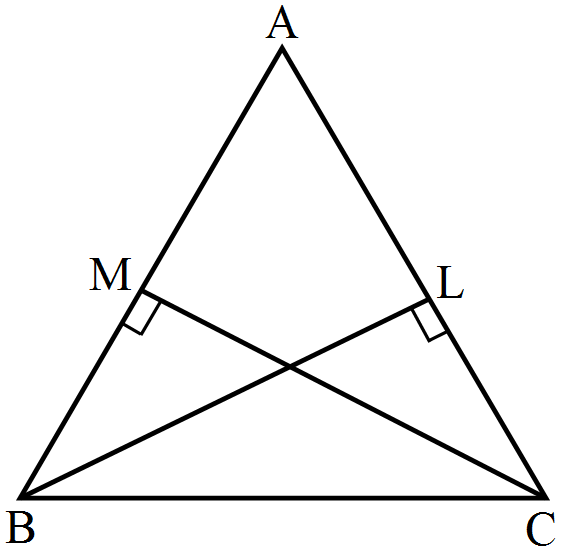
If the altitudes from two vertices of a triangle to the opposite sides are equal, then the triangle is:
  • A
    Equilateral
  • Isosceles
  • C
    Scalene
  • D
    Right-angled
Answer
Correct option: B.
Isosceles

A $\triangle\text{ABC}$ is given in which $\text{BL}\perp\text{AC}$ and $\text{CM}\perp\text{AB}$ such that $\text{BL = CM.}$
TO prove: $\text{AB = AC}$
In $\triangle\text{ABL}$ and $\triangle\text{AMC,}$
$\text{BL = CM}$ ...(Given)
$\angle\text{ALB}=\angle\text{AMC} ...($Each is $90^\circ )$
$\angle\text{LAB}=\angle\text{MAC}$ ...(Common angle)
$\therefore\triangle\text{ABL}$ and $\triangle\text{AMC} ...(AAS$ congruence criterion$)$
$\Rightarrow\text{AB = AC} ...(C.P.C.T.)$
Hence, the $\triangle\text{ABC}$ is an Isosceles triangle.
View full question & answer
MCQ 41 Mark
Which of the following is not a criterion for congruence of triangles$?$
  • $SSA$
  • B
    $SAS$
  • C
    $ASA$
  • D
    $SSS$
Answer
Correct option: A.
$SSA$
$SSA$ is not a criterion for congruence of triangles.
View full question & answer
MCQ 51 Mark
In $\triangle\text{ABC,}$ if $\angle\text{C}>\angle\text{B},$ then:
  • A
    $BC > AC$
  • $AB > AC$
  • C
    $AB < AC$
  • D
    $BC < AC$
Answer
Correct option: B.
$AB > AC$
We know that in a triangle, the greater angle has the longer side opposite to it.
In $\triangle\text{ABC},$
$\angle\text{C}>\angle\text{B}$
$\Rightarrow\text{AB > AC}$
View full question & answer
MCQ 61 Mark
In $\triangle\text{ABC}$ and $\triangle\text{DEF,}$ it is given that $AB = DE$ and $BC = EF.$ In order that $\triangle\text{ABC}\cong\triangle\text{DEF},$ we must have:
  • A
    $\angle\text{A}=\angle\text{D}$
  • $\angle\text{B}=\angle\text{E}$
  • C
    $\angle\text{C}=\angle\text{F}$
  • D
    none of these
Answer
Correct option: B.
$\angle\text{B}=\angle\text{E}$
In $\triangle\text{ABC}$ and $\triangle\text{DEF},$
$AB = DE$ and $BC = EF$
SO, the induded angles should be equal for the triangle to be congurent by the $SAS$ congruence criterion.
Thus, we must have $\angle\text{B}=\angle\text{E}.$
View full question & answer
MCQ 71 Mark
In $\triangle\text{ABC, }\angle\text{C}=\angle\text{A}, BC = 4\ cm$ and $AC = 5\ cm. $ then, $AB =?$
  • $4\ cm$
  • B
    $5\ cm$
  • C
    $8\ cm$
  • D
    $2.5\ cm$
Answer
Correct option: A.
$4\ cm$
In $\triangle\text{ABC,}$
$\angle\text{C}=\angle\text{A}$
$\Rightarrow\text{AB = BC} ($sides opposite to equal angles are equal$)$
$\Rightarrow\text{AB = 4cm}$
View full question & answer
MCQ 81 Mark
Two sides of a triangle are of length $4\ cm$ and $2.5\ cm.$ The length of the third side of the triangle cannot be:
  • A
    $6\ cm$
  • $6.5\ cm$
  • C
    $5.5\ cm$
  • D
    $6.3\ cm$
Answer
Correct option: B.
$6.5\ cm$
The sum of any two sides of a triangle is greater than the third side.
Since, $4\ cm + 2.5\ cm = 6.5\ cm$
The length of third side of a triangle cannot be $6.5\ cm.$
View full question & answer
MCQ 91 Mark
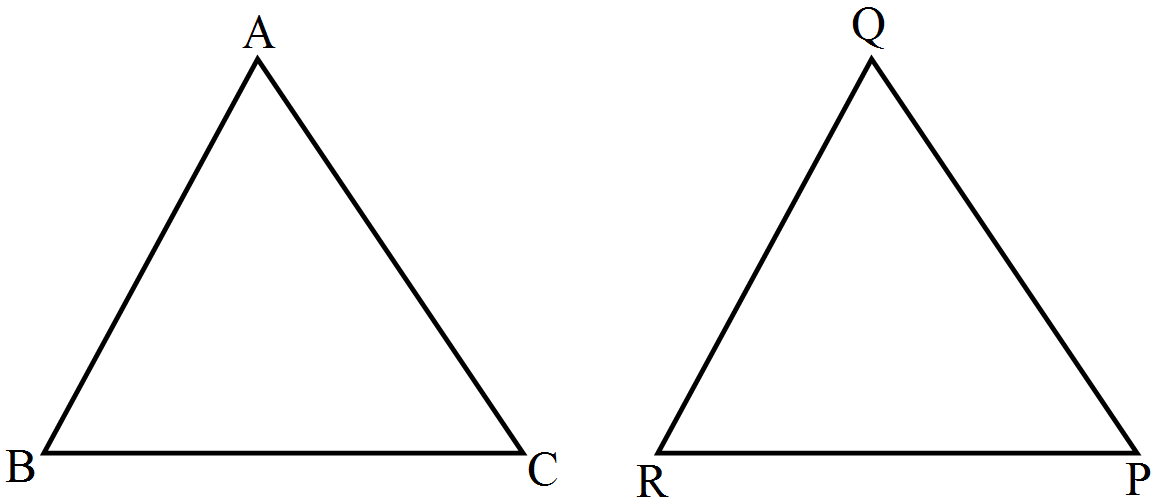
In $\triangle\text{ABC}$ and $\triangle\text{PQR},$ it is given that $AB = AC, \angle\text{C}=\angle\text{P}$ and $\angle\text{B}=\angle\text{Q}.$ Then, the two triangles are:
  • Isosceles but not congruent
  • B
    Isosceles and congruent
  • C
    Congruent but not isosceles
  • D
    Neither congruent nor isosceles
Answer
Correct option: A.
Isosceles but not congruent
In $\triangle\text{ABC}$ and $\triangle\text{PQR},$
$\text{AB = AC}$
$\Rightarrow\angle\text{B}=\angle\text{C}$
Since $\angle\text{C}=\angle\text{P}$ and $\angle\text{B}=\angle\text{Q}$
$\Rightarrow\angle\text{P}=\angle\text{Q}$
$\Rightarrow\text{RQ = RP}$
So, the two triangle are isosceles.
But it is not possible to prove them congruent.
View full question & answer
MCQ 101 Mark
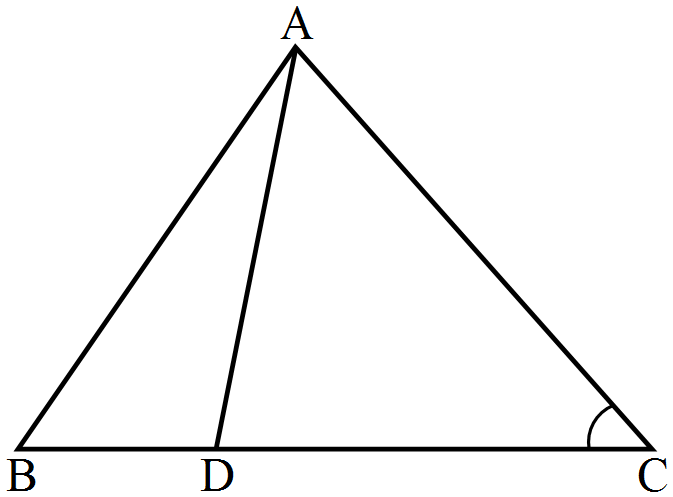
In the given figure, $AB > AC.$ Then which of the following is true$?$
  • A
    $AB < AD$
  • B
    $AB = AD$
  • $AB > AD$
  • D
    Cannot be determined
Answer
Correct option: C.
$AB > AD$
Given $\text{AB > AC}$
$\therefore\angle\text{ACB}>\angle\text{ABC}$ ...(We know that, if two sides of a triangle unequal, then the longer side has the greater angle opposite to it.)
$\angle\text{ADB}>\angle\text{ACD}$ ...(Exterior angle of a triangle is greater that the interior opposite angles)
$\therefore\angle\text{ADB}>\angle\text{ACB}>\angle\text{ABC}$
$\therefore\angle\text{ADB}>\angle\text{ABD}$
$\therefore\text{AB > AD}$
View full question & answer
MCQ 111 Mark
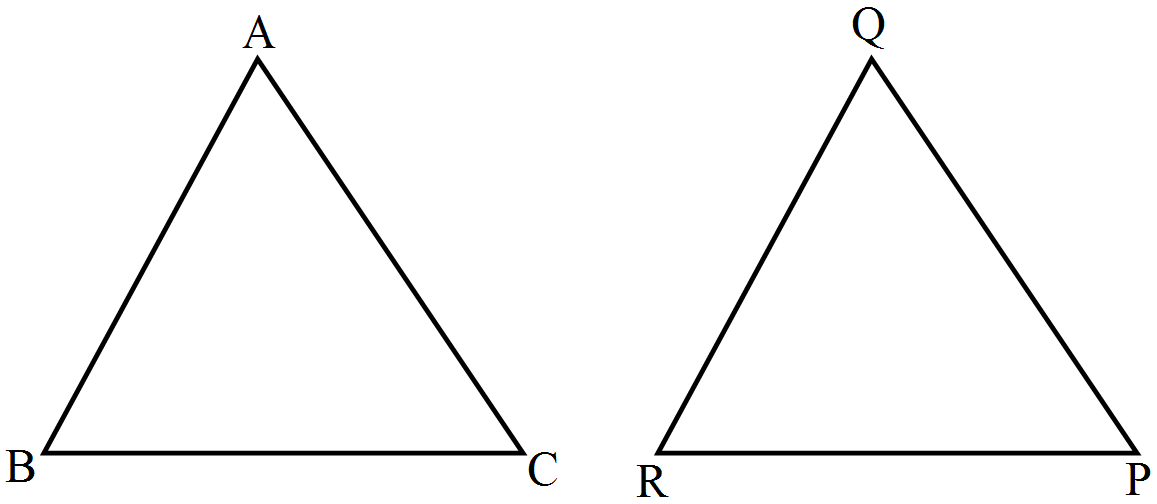
If $AB = QR, BC = RP$ and $CA = PQ,$ then which of the following holds$?$
  • A
    $\triangle\text{ABC}\cong\triangle\text{PQR}$
  • B
    $\triangle\text{CBA}\cong\triangle\text{PQR}$
  • $\triangle\text{CAB}\cong\triangle\text{PQR}$
  • D
    $\triangle\text{BCA}\cong\triangle\text{PQR}$
Answer
Correct option: C.
$\triangle\text{CAB}\cong\triangle\text{PQR}$

Given that,
$\text{AB = QR, BC = RP}$ and $\text{CA = PQ}$
So, $\text{A}\leftrightarrow\text{Q, B}\leftrightarrow\text{R}$ and $\text{C}\leftrightarrow\text{P}$
$\therefore\triangle{\text{CAB}}\cong\triangle\text{PQR}$
View full question & answer
MCQ 121 Mark
In $\triangle\text{ABC, AB = AC}$ and $\angle\text{B}=50^{\circ}.$ Then, $\angle\text{A = } ?$
  • A
    $40^\circ$
  • B
    $50^\circ$
  • $80^\circ$
  • D
    $130^\circ$
Answer
Correct option: C.
$80^\circ$
In $\triangle\text{ABC,}$
$\text{AB = AC}$
$\Rightarrow\angle\text{C}=\angle\text{B}$ (angles opposite to equal sides are equal)
$\Rightarrow\angle\text{C}=50^{\circ}$
Now, $\angle\text{A}+\angle\text{B}+\angle\text{C}=180^{\circ}$
$\Rightarrow\angle\text{A}+50^{\circ}+50^{\circ}=180^{\circ}$
$\Rightarrow\angle\text{A}=80^{\circ}$
View full question & answer
MCQ 131 Mark
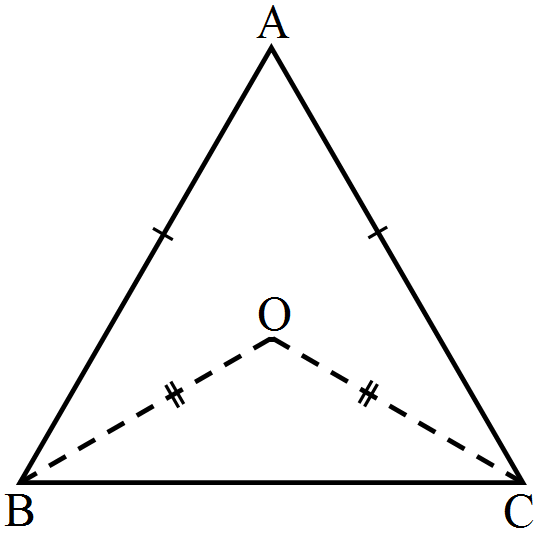
In the given figure, $AB = AC$ and $OB = OC.$ Then, $\angle\text{ABO}:\angle\text{ACO} = ?$
  • $1 : 1$
  • B
    $2 : 1$
  • C
    $1 : 2$
  • D
    None of these
Answer
Correct option: A.
$1 : 1$
In $\triangle\text{ABC},$
$\text{AB = AC}\Rightarrow\angle\text{ABC}=\angle\text{ACB}...(\text{i})$
In $\triangle\text{OBC},$
$\text{OB = OC} \Rightarrow\angle\text{OBC}=\angle\text{OCB}...(\text{ii})$
Subtraction (ii) from (i), we get
$\Rightarrow\angle\text{ABO}=\angle\text{ACO}$
So, $\angle\text{ABO}:\angle\text{ACO}=1:1$
View full question & answer
MCQ 141 Mark
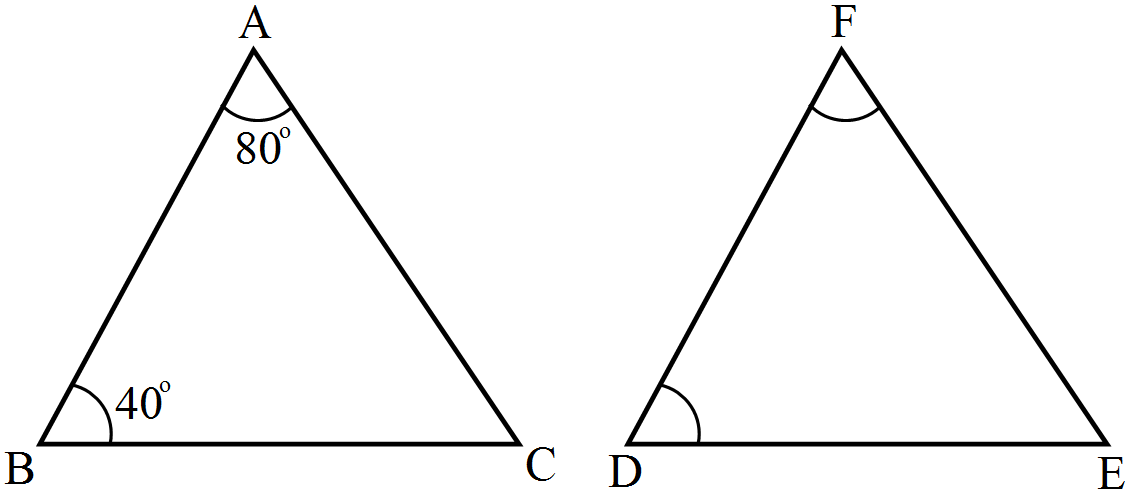
It is given that$\triangle\text{ABC}\cong\triangle\text{FDE}$ in which $AB = 5\ cm, \angle\text{B}=40^{\circ},\angle\text{A}=80^{\circ}$ and $FD = 5\ cm.$ Then, which of the following is true$?$
  • A
    $\angle\text{D}=60^{\circ}$
  • $\angle\text{E}=60^{\circ}$
  • C
    $\angle\text{F}=60^{\circ}$
  • D
    $\angle\text{D}=80^{\circ}$
Answer
Correct option: B.
$\angle\text{E}=60^{\circ}$
Given $\triangle\text{ABC}\cong\triangle\text{FDE}$
$\angle\text{A}=\angle\text{F}=80^{\circ}$ ...(C.P.C.T.)
$\angle\text{B}=\angle\text{D}=40^{\circ}$ ...(C.P.C.T.)
$\angle\text{A}+\angle\text{B}+\angle\text{C}=180^{\circ}$ ...(Angle sum property)
$\Rightarrow80^{\circ}+40^{\circ}+\angle\text{C}=180^{\circ}$
$\Rightarrow\angle\text{C}=60^{\circ}$
$\therefore\angle\text{E}=\angle\text{C}=60^{\circ}$
$\therefore\angle\text{E}=60^{\circ}$
View full question & answer
MCQ 151 Mark
If $\triangle\text{ABC}\cong\triangle\text{PQR}$ then which of the following is not true$?$
  • $BC = PQ$
  • B
    $AC = PR$
  • C
    $BC = QR$
  • D
    $AB = PQ$
Answer
Correct option: A.
$BC = PQ$

Since $ABC$ is not congruent to $RPQ, BC = PQ$ is not true.
View full question & answer
MCQ 161 Mark
Which is true$?$
  • A
    A triangle can have two right angles.
  • B
    A triangle can have two obtuse angles.
  • A triangle can have two acute angles.
  • D
    An exterior angle of a triangle is less than either of the interior opposite angles.
Answer
Correct option: C.
A triangle can have two acute angles.
We know that, by the angle sum property,
the sum of all the angles of a triangle is $180^\circ ...(i)$
So, if two angles are right angles, then their sum is $180^\circ .$
So, the measure of the third angle is zero, which is not possible.
Thus, $(a)$ is not true.
View full question & answer
MCQ 171 Mark
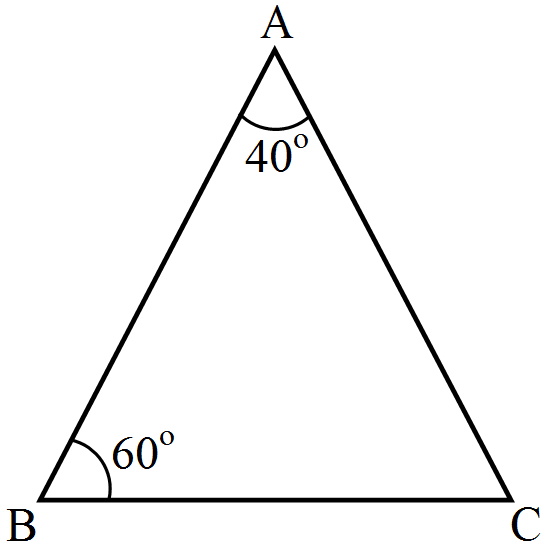
In $\triangle\text{ABC, }\angle\text{A}=40^{\circ}$ and $\angle\text{B}=60^{\circ}.$ Then the longest side of $\triangle\text{ABC}$ is:
  • A
    $BC$
  • B
    $AC$
  • $AB$
  • D
    cannot be determined
Answer
Correct option: C.
$AB$

In $\triangle\text{ABC},$
$\angle\text{A}+\angle\text{B}+\angle\text{C}=180^{\circ}$ ...(Using Angle Sum Property)
$\Rightarrow40^{\circ}+60^{\circ}+\angle\text{C}=180^{\circ}$
$\Rightarrow\angle\text{C}=80^{\circ}$
We know that, the greater angle has the longest side opposite to it.
Since $\angle\text{A}<\angle\text{B}<\angle\text{C, }\text{BC < AC < AB}.$
So, the longest side is $AB.$
View full question & answer
M.C.Q - MATHS STD 9 Questions - Vidyadip