Questions

4 Marks Questions

🎯

Test yourself on this topic

11 questions · timed · auto-graded

Question 14 Marks
The perimeter of an isosceles triangle is $32\ cm$. The ratio of the equal side to its base is $3 : 2$. Find the area of the triangle.
Answer
As the sides of the equal to the base of an isosceles triangle is $3: 2$, so let the sides of an isosceles triangle be $3 x, 3 x$ and $2 x$
Now, perimeter of triangle $=3 x+3 x+2 x=8 x$
Given perimeter of triangle $=32 m$
$\therefore 8 x=32, x=32 \div 8=4 cm$
So, the sides of the isosecles triangle are $(3 \times 4) cm ,(3 \times 4) cm ,(2 \times 4) cm$ i.e, $12 cm, 12 cm$ and $8 \ cm$
$\therefore\ \text{s}=\frac{12+12+8}{2}=\frac{32}{2}=16\text{cm}$
Area of triangular flyover $=\sqrt{\text{s}(\text{s}-\text{a})(\text{s}-\text{b})(\text{s}-\text{c})}$
$=\sqrt{16(16-12)(16-12)(16-8)}$
$=\sqrt{16\times4\times4\times8}$
$=\sqrt{4\times4\times4\times4\times4\times2}$
$=4\times4\times2\sqrt{2}$
$=32\sqrt{2}\text{cm}^2$
View full question & answer
Question 24 Marks
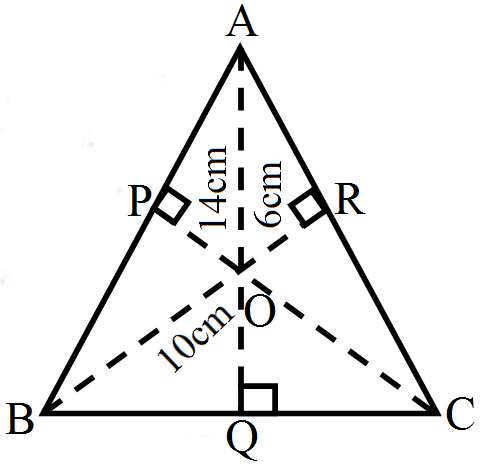
From a point in the interior of an equilateral triangle, perpendiculars are drawn on the three sides. The lengths of the perpendiculars are $14\ cm, 10\ cm$ and $6cm$. Find the area of the triangle.
Answer
Let sides of an equilateral triangle be a m. $\text{Area of }\triangle\text{OAB}=\frac{1}{2}\times\text{AB}\times\text{OP}$
$=\frac{1}{2}\times\text{a}\times14=7\text{a cm}^2$
$\text{Area of }\triangle\text{OBC}=\frac{1}{2}\times\text{BC}\times\text{OQ}$
$=\frac{1}{2}\times\text{a}\times10=5\text{a cm}^2$
$\text{Area of }\triangle\text{OAC}=\frac{1}{2}\times\text{AC}\times\text{OR}$
$=\frac{1}{2}\times\text{a}\times6=3\text{a cm}^2$

 $\therefore$ Area of an equilateral $\triangle\text{ABC}=\text{Area of}(\triangle\text{OAB}+\triangle\text{OBA}+\triangle\text{OAC})$
$=(7\text{a}+5\text{a}+3\text{a})=15\text{a cm}^2$
We have, semi-permeter, $\text{s}=\frac{\text{a}+\text{a}+\text{a}}{2}$
$\text{s}=\frac{3\text{a}}{2}\text{cm}$
$\therefore$ Area of an equilateral $\triangle\text{ABC}=\sqrt{\text{s}(\text{s}-\text{a})(\text{s}-\text{b})(\text{s}-\text{c})}$ [by Heron's formula]
$=\sqrt{\frac{3\text{a}}{2}\Big(\frac{3\text{a}}{2}-\text{a}\Big)\Big(\frac{3\text{a}}{2}-\text{a}\Big)\Big(\frac{3\text{a}}{2}-\text{a}\Big)}$
$=\sqrt{\frac{3\text{a}}{2}\times\frac{\text{a}}{2}\times\frac{\text{a}}{2}\times\frac{\text{a}}{2}}=\frac{\sqrt{3}}{4}\text{a}^2$ From eqs. (iv) and (v) $\frac{\sqrt{3}}{4}\text{a}^2=15\text{a}$
$\Rightarrow\ \text{a}=\frac{15\times4}{\sqrt{3}}\times\frac{\sqrt{3}}{\sqrt{3}}=\frac{60\sqrt{3}}{3}=20\sqrt{3}\text{cm}$ On putting $\text{a}=20\sqrt{3}$ in eq. (v),
​​​​​​​we get $\text{Area of }\triangle\text{ABC}=\frac{\sqrt{3}}{4}\big(20\sqrt{3}\big)^2$
$=\frac{\sqrt{3}}{4}\times400\times3$
$=300\sqrt{3}\text{cm}^2$ Hence, the area of an equilateral triangle is $300\sqrt{3}\text{cm}^2$
View full question & answer
Question 34 Marks
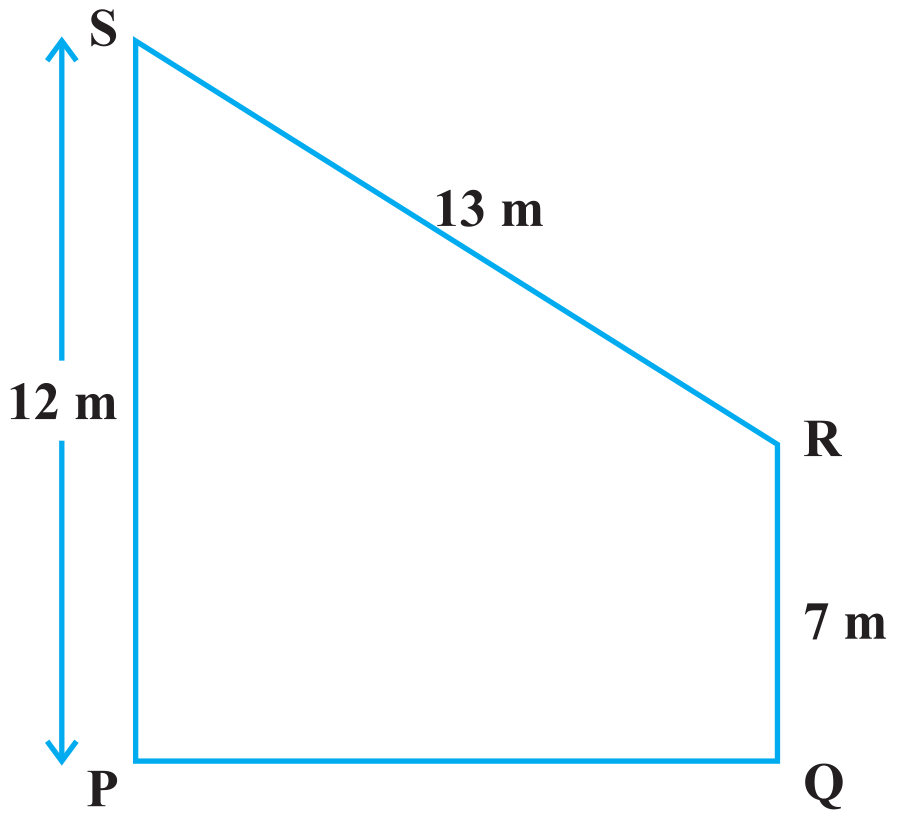
Find the area of the trapezium $PQRS$ with height $PQ$ given in:
Answer
Draw $\text{RT}\perp\text{PS}$ from the it is clear that, $ST = PS - PT = 12m - 7m = 5m$
Now, from right triangle $RTS,$
we have $RS^2 = RT^2 + ST^2$
$\Rightarrow RT^2 = RS^2 - ST^2$
$\Rightarrow RT^2 = (13)^2 - 5^2$
$\therefore$ $RT^2= 169 - 25 = 144$
$\Rightarrow\text{RT}=+\sqrt{144}=12\text{m}$
Now area of trapezium PQRS $=\frac{1}{2}(\text{PS}+\text{QR})\times\text{RT}$
$=\frac{1}{2}(12+7)\times12$
 $=\frac{1}{2}\times19\times12=14\text{m}^2$
View full question & answer
Question 44 Marks
A rhombus shaped sheet with perimeter $40\ cm$ and one diagonal $12\ cm$, is painted on both sides at the rate of Rs. $5$ per $m^2$. Find the cost of painting.
Answer
Let $ABCD$ be a rhombus having each side equal to x cm.

i.e., $AB = BC = CD = DA = x$ cm
Given, perimeter of a rhombus $= 40 \therefore\text{ AB}+\text{BC}+\text{CD}+\text{DA}=40$
$\Rightarrow\ \text{x}+\text{x}+\text{x}+\text{x}=40$
$\Rightarrow4\text{x}=40$
$\Rightarrow\text{x}=\frac{40}{4}$
$\therefore\ \text{x}=10\text{cm}$ In $\triangle\text{ABC},$
let $\text{a}=\text{AB}=10\text{cm},\text{ b}=\text{BC}=10\text{cm}$ and $\text{c}=\text{AC}=12\text{cm}$
Now, semi-perimeter of a
$\triangle\text{ABC},\text{ s}=\frac{\text{a}+\text{b}+\text{c}}{2}$
$=\frac{10+10+12}{2}=\frac{32}{2}=16\text{cm}$
$\therefore\text{ Area of }\triangle\text{ABC}=\sqrt{\text{s}(\text{s}-\text{a})(\text{s}-\text{b})(\text{s}-\text{c})}$ [by Heron's formula]
$=\sqrt{16(16-10)(16-10)(16-12)}$
$=\sqrt{16\times6\times6\times4}$
$=4\times6\times2=48\text{cm}^2$
$\because$ Cost of painting of the sheet of $1cm^2 = Rs. 5cm$
$\therefore$ Cost of painting of the sheet of $96cm^2 = 96 \times 5 = Rs. 480$
Hence, the cost of the painting of the sheet for both sides
$= 2 \times 480 = Rs. 960$
View full question & answer
Question 54 Marks
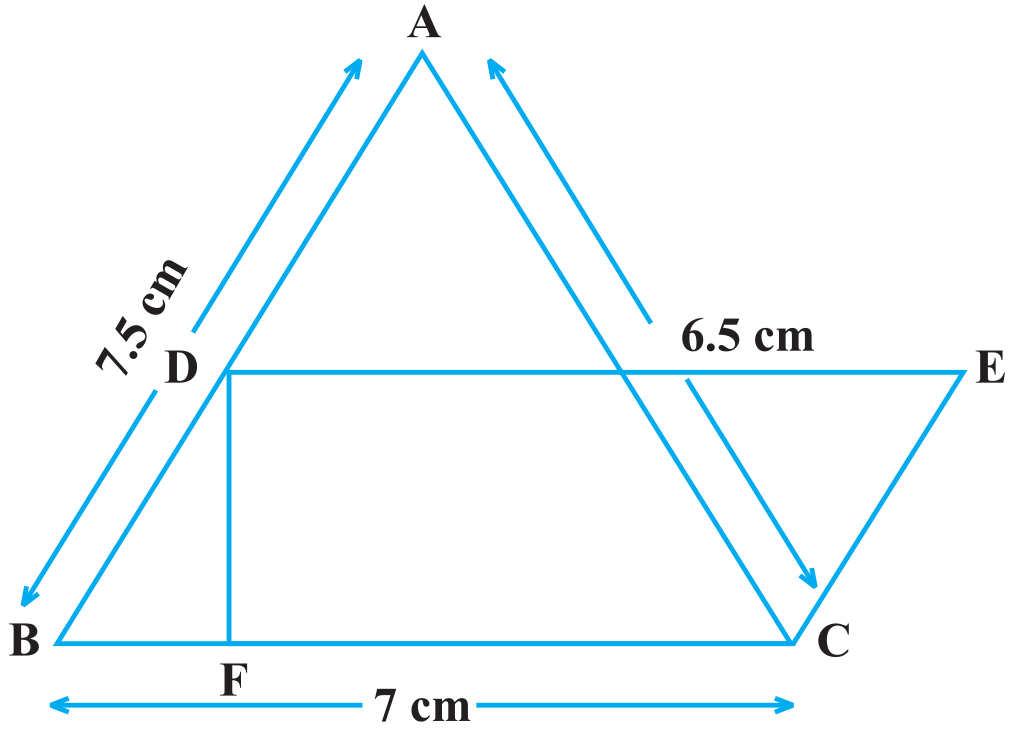
In $\triangle\text{ABC}$ has sides $AB = 7.5\ cm, AC = 6.5\ cm$ and $BC = 7\ cm$. On base $BC$ a parallelogram $DBCE$ of same area as that of $\triangle\text{ABC}$ is constructed. Find the height $DF$ of the parallelogram.
Answer
Now, first determine the area of $\triangle\text{ABC}$
The sides of a traingle are $\text{AB} = \text{a} = 7.5\text{cm,} \text{ BC} = \text{b} = 7\text{cm} \text{ and}\text{ CA} = 6.5\text{cm}$
Now, semi-perimeter of a traingle, $\text{S} = \frac{\text{a+b+c}}{2} = \frac{\text{7.5+7+6.5}}{2}=\frac{21}{2}=10.5\text{cm}$
$\therefore\ \text{Area of }\triangle\text{ABC}=\sqrt{\text{s}(\text{s}-\text{a})(\text{s}-\text{b})(\text{s}-\text{c})}$ [by Heron's formula] $=\sqrt{10.5(10.5-7.5)(10.5-7)(10.5-6.5)}$
$=\sqrt{10.5\times3\times3.5\times4}$
$=\sqrt{441}=21\text{cm}^2$
Now, area of parallelogram $BCED$ = Base \times Height $=\text{BC}\times\text{DF}=7\times\text{DF}$
According to the question, Area of $\triangle\text{ABC}$ = Area of parallelogram $BCED$
​​​​​​​ $\Rightarrow\ 21=7\times\text{DF}$ [from eqs. $(i)$ and $(ii)]$
$\Rightarrow\text{DF}=\frac{21}{4}=3\text{cm}$
Hence, the height of parallelogrom is $3\ cm.$
View full question & answer
Question 64 Marks
The perimeter of a triangular field is $420\ m$ and its sides are in the ratio $6 : 7 : 8$. Find the area of the triangular field.
Answer
Given, perimeter of a triangular field is $420m$ and its sides are in the ratio $6 : 7 : 8.$
Let sides of a triangular field be $a = 6x, b = 7x$ and $c = 8x$
Perimeter of a triangular field, $2s = a + b + c$
$\Rightarrow 420 = 6x + 7x + 8x$
$\Rightarrow 420 = 21x$
$\Rightarrow\text{x}=\frac{420}{21}=20\text{m}$
$\therefore$ Sides of a triangular filed are, $\text{a}=6\times20=120\text{m}$
$\text{b}=7\times20=140\text{m}$ and $\text{c}=8\times20=160\text{m}$
Now, semi-perimeter, $\text{s}=\frac{\text{a}+\text{b}+\text{c}}{2}$
$=\frac{120+140+160}{2}$
$=\frac{420}{2}=210\text{m}$
$\therefore$ Area of a triangular field $=\sqrt{\text{s}(\text{s}-\text{a})(\text{s}-\text{b})(\text{s}-\text{c})}$ [by Heron's formula] $=\sqrt{210(210-120)(210-140)(210-160)}$
$=\sqrt{210\times90\times70\times50}$
$=100\sqrt{21\times9\times7\times5}$
$=100\sqrt{7\times3\times3^2\times7\times5}$
$=100\times7\times3\times\sqrt{15}$
$=2100\sqrt{15}\text{m}^2$
Hence, the area of triangle field is $2100\sqrt{15}\text{m}^2$
View full question & answer
Question 74 Marks
The perimeter of a triangle is $50\ cm$. One side of a triangle is $4\ cm$ longer than the smaller side and the third side is $6\ cm$ less than twice the smaller side. Find the area of the triangle.
Answer
Let the smaller side of the triangle be $x \ cm.$
therefore, the second side will be $(x + 4)\ cm$, and third side is $(2x - 6)\ cm.$
Now, perimeter of triangle $= x + (x + 4) + (2x - 6) = (4x - 2)cm$
Also, perimeter of triangle = 50cm. $4\text{x}=52, \text{x}=52\div4=13$
Therefore, the three sides are $13\ cm, 17\ cm, 20\ cm$
Semiperimeter of triangle $=\text{s}=\frac{13 +17+20}{2}=\frac{50}{2}=25\text{cm}$
$\therefore\text{area of }\Delta=\sqrt{25(25-13)(25-17)(25-20)}$
$=\sqrt{25\times12\times8\times5}=\sqrt{5\times5\times4\times3\times4\times2\times5}$
$=5\times4\sqrt{3\times2\times5}=20\sqrt{30}\text{cm}^2$
View full question & answer
Question 84 Marks
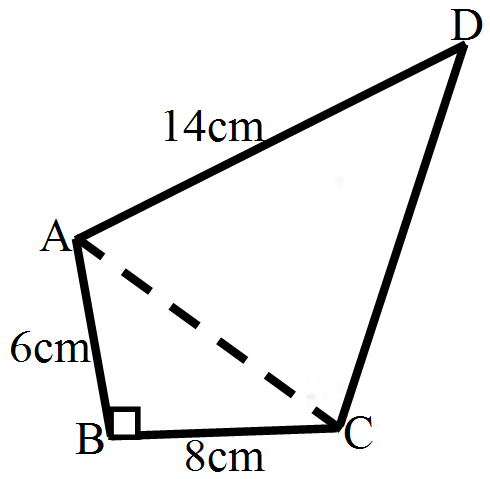
The sides of a quadrilateral $ABCD$ are $6\ cm, 8\ cm, 12\ cm$ and $14\ cm$ (taken in order) respectively, and the angle between the first two sides is a right angle. Find its area.
Answer
Given $ABCD$ is a quadrilateral having sides $AB = 6cm, BC = 8cm, CD = 12cm$ and $DA = 14cm.$
Now, join $AC.$

We have, ABC is a right angled triangle at B.
Now, $AC^2 = AB^2 + BC^2 = 6^2 + 8^2 = 36 + 64 = 100$
$\Rightarrow AC = 10cm$
$\therefore$ Area of quadrillateral $\text{ABCD}=\text{Area of }\triangle\text{ABC}+\text{Area of }\triangle\text{ACD}$
Now, $\text{area of }\triangle\text{ABC}=\frac{1}{2}\times\text{AB}\times\text{BC}$
$\Big[\because\ \text{area of triangle}=\frac{1}{2}(\text{base}\times\text{height})\Big]$
$=\frac{1}{2}\times6\times8=24\text{cm}^2$ In $\triangle\text{ACD},\ \text{AC}=\text{a}=10\text{cm},\text{ CD}=\text{b}=12\text{cm}$ and, $\text{DA}=\text{c}=14\text{cm}$
Now, semi-perimeter of, $\triangle\text{ACD},\text{s}=\frac{\text{a}+\text{b}+\text{c}}{2}$
$=\frac{10+12+14}{2}=\frac{36}{2}=18\text{cm}$
$\text{Area of }\triangle\text{ACD}=\sqrt{\text{s}(\text{s}-\text{a})(\text{s}-\text{b})(\text{s}-\text{c})}$ [by Heron's formula]
$=\sqrt{18(18-10)(18-12)(18-14)}$
$=\sqrt{18\times8\times6\times4}$
$=\sqrt{(3)^2\times2\times4\times2\times3\times2\times4}$
$=3\times4\times2\sqrt{3\times2}$
$=24\sqrt{6}\text{cm}^2$
View full question & answer
Question 94 Marks
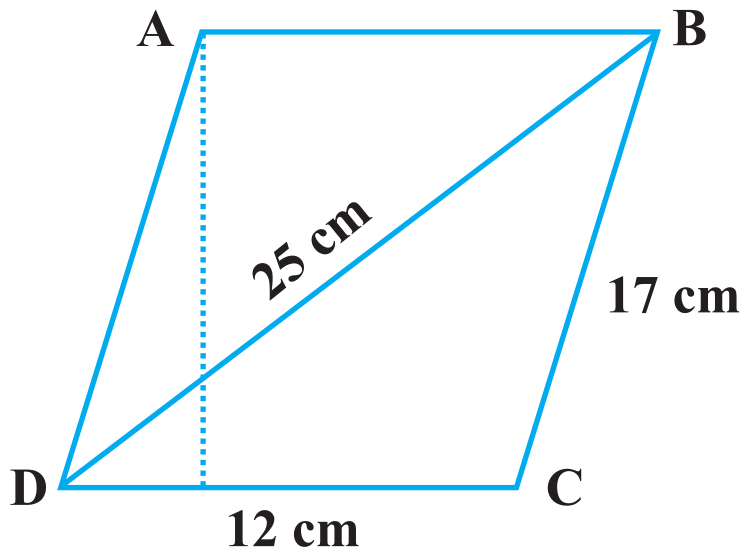
Find the area of a parallelogram given in also find the length of the altitude from vertex $A$ on the side $DC.$
Answer
Area of parallelogram, $\text{ABCD}=2(\text{Area of }\triangle\text{BCD})$
Now, the sides of a $\triangle\text{BCD}\text{ are a}=12\text{cm},\text{ b}=17\text{cm and c}=25\text{cm}$
$\therefore$ Semi-permimeter of $\triangle\text{BCD},\ \text{s}=\frac{\text{a}+\text{b}+\text{c}}{2}=\frac{12+17+25}{2}=\frac{54}{2}=27\text{cm}$
$\therefore\ \text{Area of }\triangle\text{BCD}=\sqrt{\text{s}(\text{s}-\text{a})(\text{s}-\text{b})(\text{s}-\text{c})}$ [by Heron's formula]
$=\sqrt{27(27-12)(27-17)(27-25)}$
$=\sqrt{27\times15\times10\times2}$
$=\sqrt{9\times3\times3\times5\times5\times2\times2}$
$=3\times3\times5\times2\text{cm}^2$ Area of parallelogram $ABCD = 2 \times 90 = 180cm^2 ....(ii)$
Let altitude of a parallelogram be h.
Also, area of parallelogram $ABCD =$ Base \times Altitude
$\Rightarrow180=\text{DC}\times\text{h}$ [from Eq. $(ii)]$
$\Rightarrow180=12\times\text{h}$
$\therefore\ \text{h}=\frac{180}{12}=15\text{cm}$
Hence, the area of parallelogram is $180cm^2$ and the length of altitude is $15cm.$
View full question & answer
Question 104 Marks
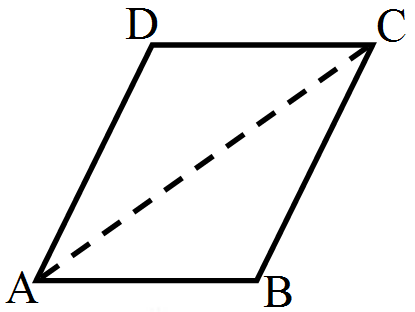
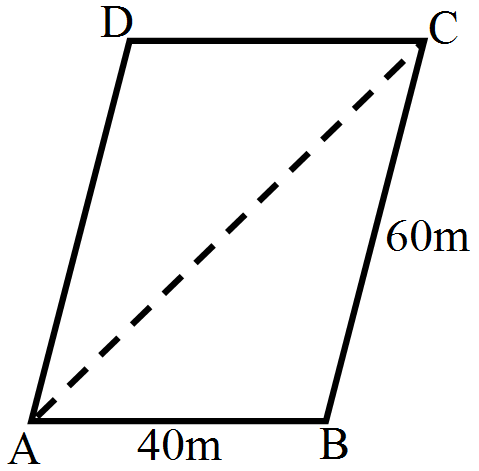
A field in the form of a parallelogram has sides $60\ m$ and $40\ m$ and one of its diagonals is $80\ m$ long. Find the area of the parallelogram.
Answer
Let the field be $ABCD.$

Since diagonal of a parallelogram bisect into two triangle of equal areas.
Therefore, Area of the parallelogram $\text{ABCD}=2(\text{area of }\triangle\text{ABC})\ ...(\text{i})$
Now, the sides of $\triangle\text{ABC}$ are $\text{a}=40\text{m},\text{ b}=60\text{m and c}=80\text{m}$
$\therefore$ Semi-perimeter of $\triangle\text{ABC},$
$\text{s}=\frac{\text{a}+\text{b}+\text{c}}{2}$
$=\frac{40+60+80}{2}$
$=\frac{180}{2}=90\text{m}$
$\therefore\ \text{Area of }\triangle\text{ABC}=\sqrt{\text{s}(\text{s}-\text{a})(\text{s}-\text{b})(\text{s}-\text{c})}$ [By Heron's formula]
$=\sqrt{90(90-40)(90-60)(90-80)}$
$=\sqrt{90\times50\times30\times10}$
$=\sqrt{3\times30\times5\times10\times30\times10}$
$=300\sqrt{15}\text{cm}^2$
$=1161.895\text{m}^2$ Form equation $(i),$
we get Area of parallelogrom
$ABCD = 2 \times 1161.895 = 2323.79m^2​​​​​​​$
View full question & answer
Question 114 Marks
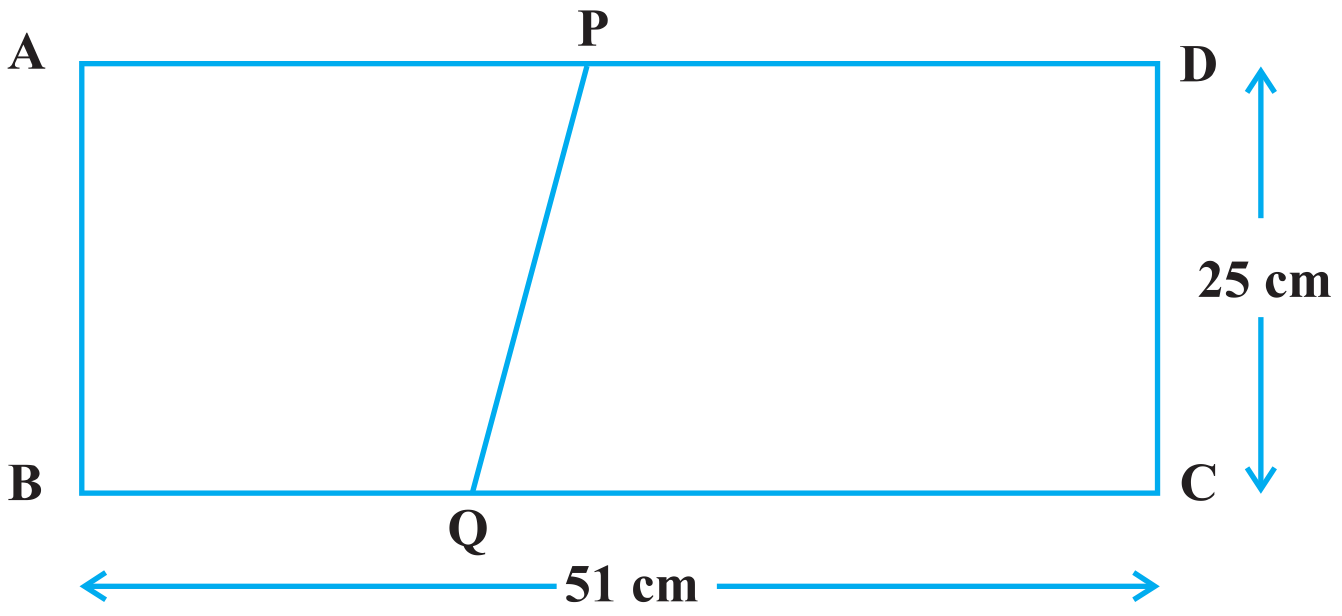
The dimensions of a rectangle $A B C D$ are $51 cm \times 25 cm$. A trapezium $PQCD$ with its parallel sides $QC$ and $PD$ in the ratio $9: 8$, is cut off from the rectangle as shown in the if the area of the trapezium $PQCD$ is $\frac{5}{6}$ th part of the area of the rectangle, find the lengths $QC$ and $PD.$​​​​​​​
Answer
$ABCD$ is a rectangle in which $CD = 25cm$ and $BC = 51cm$
Since parallel sides $QC$ and $PD$ are in the ratio $9 : 8,$
so let $QC = 9x$ and $PD = 8x$
Now, are of trapezium $\text{PQCD}=\frac{1}{2}\times(9\text{x}+8\text{x})\times25\text{cm}^2$
$=\frac{1}{2}\times17\text{x}\times25$
Area of rectangle $ABCD = BC \times CD = 51 \times 25 $It is given that area of trapezium
$\text{PQCD}=\frac{5}{6}\times\text{Area of rectangle ABCD}$
$\therefore\ \frac{1}{2}\times17\text{x}\times25=\frac{5}{6}\times51\times25$
$\Rightarrow\text{x}=\frac{5}{6}\times51\times25\times2\times\frac{1}{17\times25}=5$
Hence, the length $QC = 9x = 9 \times 5 = 45cm$ And the lengthb $PD = 8x = 8 \times 5 = 40cm$
View full question & answer