Questions

True False[1 Marks ]

🎯

Test yourself on this topic

9 questions · timed · auto-graded

Question 11 Mark
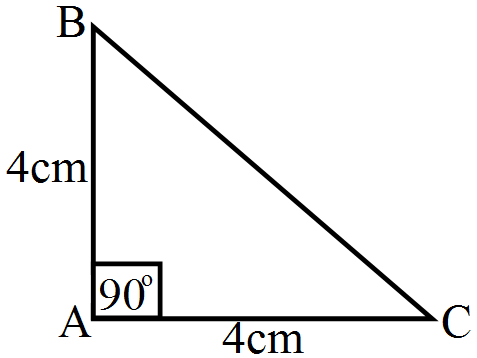
Write True or False and justify your answer: The area of $\triangle A B C$ is $8 cm^2$ in which $A B=A C=4 cm$ and $\angle A=90^{\circ}$
Answer
True.Solution:
$\text{Area of }\triangle=\frac{1}{2}\times\text{base}\times\text{height}$ $=\frac{1}{2}\times4\times4=8\text{cm}^2$ Hence, the given statement is true.
View full question & answer
Question 21 Mark
Write True or False and justify your answer: The cost of levelling the ground in the form of a triangle having the sides $51m, 37m$ and $20m$ at the rate of Rs. $3per ~m^2$ is $Rs. 918.$
Answer
Let sides of a triangle be $a = 51m, b = 37m$ and $c = 20m$
Now, semi-perimeter of triangle,
$\text{s}=\frac{\text{a}+\text{b}+\text{c}}{2}=\frac{51+37+20}{2}$ $=\frac{108}{2}=54\text{m}$
$\therefore$ Area of a triangle
$=\sqrt{\text{s}(\text{s}-\text{a})(\text{s}-\text{b})(\text{s}-\text{c})} [$by Heron's formula$]$
$=\sqrt{54(54-51)(54-37)(54-20)}$
$=\sqrt{54\times3\times17\times34}$
$=\sqrt{9\times3\times2\times3\times17\times17\times2}$
$=3\times3\times2\times17=306\text{m}^2$
$\because$ Cost of levelling per $m^2 = Rs. 3$
$\therefore$ Cost of leavelling per $306\ m^2 = 3 × 306 = Rs. 918$
View full question & answer
Question 31 Mark
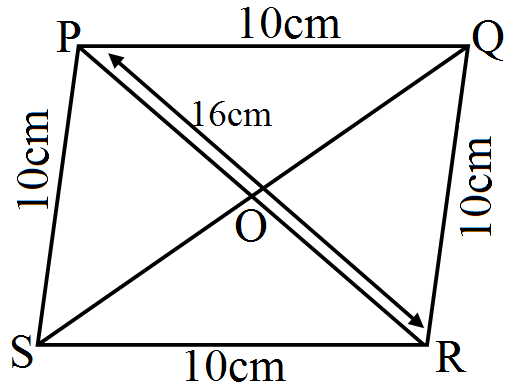
Write True or False and justify your answer: If the side of a rhombus is $10\ cm$ and one diagonal is $16\ cm$, the area of the rhombus is $96\ cm^2.$
Answer
Given, side of a rhombus $PQRS$ is $10\ cm$ and one of the diagonal is $16\ cm.$ i.e., $PQ = QR = RS = SP = 10\ cm$ and $PR = 16\ cm$

 In $\triangle\text{POQ},\text{ PO}^2=\text{OP}^2+\text{OQ}^2$ [by Pythagoras theorem] [since, the diagonal of rhombus bisects each other at $90^\circ $]
$\Rightarrow OQ^2 = PQ^2 - OP^{2}$
$ \Rightarrow OQ^2 = (10)^2 - (8)^2$
$\Rightarrow OQ^2 = 100 - 64 = 36$
$\Rightarrow OQ = 6cm$ [taking positive square root because length is always positive]
$SQ =2 \times OP = 2 \times 6= 12\ cm$
$\text{Area of the rhombus}=\frac{1}{2}(\text{Product of diagonals})$
$=\frac{1}{2}(\text{OS}\times\text{PR})$
$=\frac{1}{2}\times12\times16$
$=96\text{cm}^2$
View full question & answer
Question 41 Mark
Write True or False and justify your answer:In a triangle, the sides are given as 1$1\ cm, 12\ cm$ and $13\ cm$. The length of the altitude is $10.25\ cm$ corresponding to the side having length $12\ cm.$
Answer
We have the length of the altitude corresponsing to the side having length $12\ cm$
$2\text{s}=11\text{cm}+12\text{cm}+13\text{cm}=36\text{cm}$
$\Rightarrow\text{s}=36\div2=18\text{cm}$
$\text{Area of }\triangle=\sqrt{\text{s}(\text{s}-\text{a})(\text{s}-\text{b})(\text{s}-\text{c})}$
$=\sqrt{18(18-11)(18-12)(18-13)}$
$=\sqrt{18\times7\times6\times5}$
$=\sqrt{2\times3\times3\times7\times2\times3\times5}$
$=2\times3\sqrt{105}$
$=6\sqrt{105}\text{cm}^2$
$\text{Length of altitude}=\frac{2\text{Area of }\triangle}{\text{Base}}$
$=\frac{2\times6\sqrt{105}}{12}=\sqrt{105}=10.25\text{cm}$
Hence, the given statement is true.
View full question & answer
Question 51 Mark
Write True or False and justify your answer: The area of the equilateral triangle is $20\sqrt{3}\text{cm}^2$ whose each side is 8cm.
Answer
False.Solution:
$\text{Area of equilateral }\triangle=\frac{\sqrt{3}}{4}(\text{side})^2$ $=\frac{\sqrt{3}}{4}(8)^2=\frac{\sqrt{3}}{4}\times64=16\sqrt{3}\text{cm}^2$ Hence, the given statement is false.
View full question & answer
Question 61 Mark
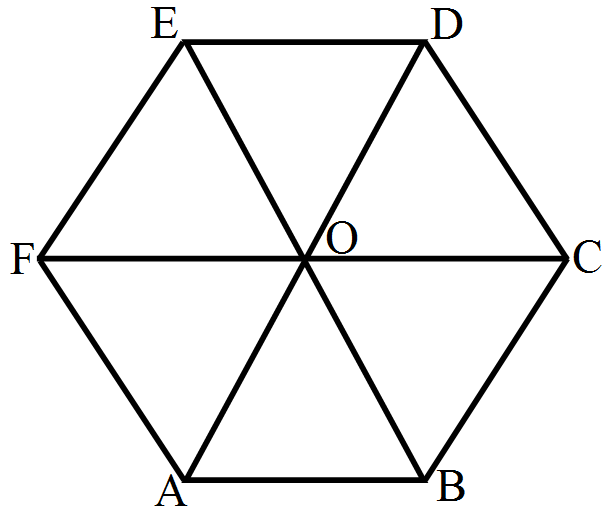
Write True or False and justify your answer:The area of a regular hexagon of side ‘a’ is the sum of the areas of the five equilateral triangles with side a.
Answer
False.Solution:
We see a regular hexagon is divided into six equilateral triangles. So, the area of the regular hexagon is divided side ‘a’ is the sum of area of the six equilateral triangles with side a. Hence, the given statement that the area of a regular hexagon of side ‘a’ is the sum of the areas of the five equilateral triangles with side a, is false.
View full question & answer
Question 71 Mark
Write True or False and justify your answer: The area of a triangle with base $4\ cm$ and height $6\ cm$ is $24\ cm^2$
Answer
We know that, area of a triangle $=\frac{1}{2}(\text{Base}\times\text{Height})$
Here Base $= 4\ cm$ and Height $= 6\ cm$
$\therefore$ Area of a triangle $=\frac{1}{2}\times4\times6=12\text{cm}^2$
View full question & answer
Question 81 Mark
Write True or False and justify your answer: The area of the isosceles triangle is $\frac{5}{4}\sqrt{11}\text{cm}^2,$ if the perimeter is $11\ cm$ and the base is $5\ cm.$
Answer
Let equal of an isosceles triangle be b. $\therefore$ Perimeter of a triangle, $2\text{s}=\text{b}+\text{b}+5$
$\big[\because\ 2\text{s}=\text{a}+\text{b}+\text{c}\big]$
$\therefore\ 11=2\text{b}+5$
$\Rightarrow2\text{b}=11-5$
$\Rightarrow2\text{b}=6$
$\Rightarrow\text{b}=\frac{6}{2}=3\text{cm}$ We know that,
area of an isosceles triangle,
$=\frac{\text{a}}{4}\sqrt{4\text{b}^2-\text{a}^2}$
Here, sides of triangle are $a = 5cm$ and $b = 3cm$
$\therefore$ Area of an isosceles triangle $=\frac{5\sqrt{4(3)^2-(5)^2}}{4}$
$=\frac{5\sqrt{4\times9-25}}{4}$
$=5\frac{\sqrt{36-25}}{4}$
$=\frac{5\sqrt{11}}{4}\text{cm}^2$
View full question & answer
Question 91 Mark
Write True or False and justify your answer: The base and the corresponding altitude of a parallelogram are $10 \ cm$ and $3.5 \ cm $, respectively. The area of the parallelogram is $30 \ cm^2$.
Answer
The base of the parallelogram is $10\ cm$ and the corresponding altitude is $3.5\ cm .$
Area of $\| gm =$ base $\times$ corresponding altitude $=10\ cm \times 3.5\ cm=35\ cm^2$
Hence, the given statement is false.
View full question & answer