MCQ 11 Mark
The slant height of a cone is increased by $10 \%$. If the radius remains the same, the curved surface area is increased by:
- ✓
$10 \%$
- B
$12.1 \%$
- C
$20 \%$
- D
$21 \%$
AnswerCorrect option: A. $10 \%$
$C.S.A$ of a cone $=\pi\text{rl}$
If $l' = 1 + 10 \%$ of $l$
$=\text{l}+\frac{10}{100}\times\text{l}$
$=\text{l}+\frac{\text{l}}{10}$
And, $r' = r$
$\text{C.S.A.}=\pi\text{r}\Big(\text{l}+\frac{\text{l}}{10}\Big)=\frac{11}{10}\pi\text{rl}$
So, increase in $C.S.A$. $=\frac{\frac{11}{10}\pi\text{rl}-\pi\text{rl}}{\pi\text{rl}}\times100\%=10\%$
View full question & answer→MCQ 21 Mark
The ratio of the volume of a right circular cylinder and a right circular cone of the same base and height, is:
- A
$1 : 3$
- ✓
$3 : 1$
- C
$4 : 3$
- D
$3 : 4$
AnswerCorrect option: B. $3 : 1$
Volume of a right circular cylinder of height $H$ and radius $R$ $=\pi\text{R}^2\text{H}=\text{v}_1$
Volume of a cone of height $H$ and radius $R$ $=\frac{1}3{}\pi\text{R}^2\text{H}=\text{v}_2$
$\frac{\text{v}_1}{\text{v}_2}=\frac{\pi\text{R}^2\text{H}}{\frac{1}{3}\pi\text{R}^2\text{H}}=\frac{3}{1}=3:1$
View full question & answer→MCQ 31 Mark
If $h$, $S$ and $V$ denote respectively the height, curved surface area and volume of a right circular cone, then $3\pi\text{V}\text{h}^3-\text{S}^2\text{h}^2+\text{9V}^2$ is equal to:
- A
$8$
- ✓
$0$
- C
$4\pi$
- D
$32\pi^2$
AnswerFor a cone,
$\text{V}=\frac{1}{3}\pi\text{R}^2\text{h}$
$S$ = curved Surface Area $=\pi\text{R}\text{L}$
$\text{L}=\sqrt{\text{h}^2+\text{R}^2}$
$3\pi\text{V}\text{h}^3-\text{S}^2\text{h}^2+\text{9V}^2$
$=3\pi\Big(\frac{1}{3}\pi\text{R}^2\text{h}\Big)\text{h}^3-\pi^2\text{R}^2\big(\text{h}^2+\text{R}^2\big)\text{h}^2\\+9\times\frac{1}{9}\pi^2\text{R}^4\text{h}^2$
$=\pi^2\text{R}^2\text{h}^4-\pi^2\text{R}^2\text{h}^4-\pi^2\text{R}^4\text{h}^2+\pi^2\text{R}^4\text{h}^2$
$=0$
View full question & answer→MCQ 41 Mark
The height of a solid cone is $12\ cm$ and the area of the circular base is $64\pi\text{cm}^2.$ A plane parallel to the base of the cone cuts through the cone $9\ cm$ above the vertex of the cone, the areas of the base of the new cone so formed is:
- A
$9\pi\text{cm}^2$
- B
$16\pi\text{cm}^2$
- C
$25\pi\text{cm}^2$
- ✓
$36\pi\text{cm}^2$
AnswerCorrect option: D. $36\pi\text{cm}^2$
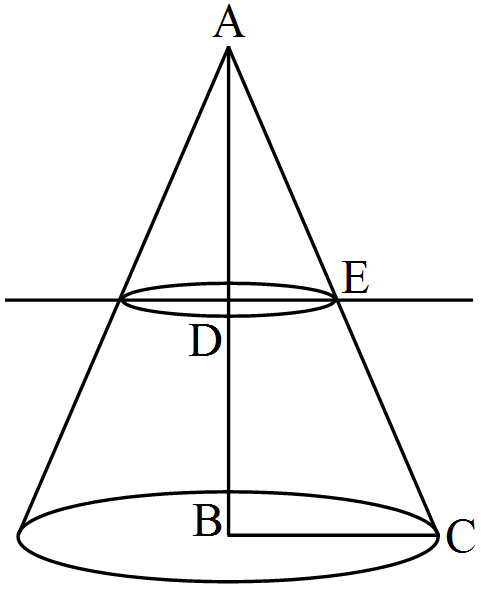
$AB = 12\ cm$
Area of circular Base $=\pi\text{r}^2=64\pi$
$\Rightarrow r = 8\ cm$
$AD = 9\ cm$
Consider $\triangle\text{ADE}$ and $\triangle\text{ABC},$
$\angle\text{DAE}=\angle\text{BAC}$ (common)
$\angle\text{ADE}=\angle\text{ABC}$ (each $90^\circ$)
$\angle\text{AED}=\angle\text{ACB}$ (Third angle will also be same)
Hence $\triangle\text{ADE}\sim\triangle\text{ABC}$
So $\frac{\text{AD}}{\text{AB}}=\frac{\text{DE}}{\text{BC}}$
$\Rightarrow\frac{9}{12}=\frac{\text{DE}}{8}$
$\Rightarrow\text{DE}=6\text{cm}$
Radius of base of new cone $= 6\ cm$
$\Rightarrow $ Area $=\pi(6)^2=36\pi\text{cm}^2$ View full question & answer→MCQ 51 Mark
A right circular cylinder and a right circular cone have the same radius and the same volume. The ratio of the height of the cylinder to that of the cone is:
- A
$3 : 5$
- B
$2 : 5$
- C
$3 : 1$
- ✓
$1 : 3$
AnswerCorrect option: D. $1 : 3$
Volume of a right circular cylinder $=\pi\text{R}^2_1\text{H}_1=\text{v}_1$
Volume of a right circular cone $=\frac{1}3{}\pi\text{R}^2_2\text{H}_2=\text{v}_2$
If $\mathrm{V}^1=\mathrm{V}^2$ and $\mathrm{R}^1=\mathrm{R}^2$, then
$\pi\text{R}^2_1\text{H}_1=\frac{1}3{}\pi\big(\text{R}^2_1\big)\text{H}_2$
$\Rightarrow\frac{\text{H}_1}{\text{H}_2}=\frac{1}{3}$
View full question & answer→MCQ 61 Mark
If the base radius and the height of a right circular cone are increased by $20 \%$, then the percentage increase in volume is approximately:
AnswerLet the radius of the cone $= R$ and height $= H$
Then, volume $=\frac{1}{3}\pi\text{R}^2\text{H}$
Now, $R' = R + 20 \%$ of $R$ $=\text{R}+\frac{\text{R}}{5}=\frac{\text{6R}}{5}$
$H' = H + 20 \%$ of $H$ $=\text{H}+\frac{\text{H}}{5}=\frac{\text{6H}}{5}$
New volume, $\text{v}'=\frac{1}{3}\pi\text{R}'^2\text{H}'$
$=\frac{1}{3}\pi\Big(\frac{6\text{r}}{5}\Big)^2\Big(\frac{6\text{H}}{5}\Big)$
$=\frac{216}{125}\Big(\frac{1}{3}\pi\text{R}^2\text{H}\Big)$
$=\frac{216}{125}\text{v}$
$ \%$ increase in volume $=\frac{\text{v}'-\text{v}}{\text{v}}\times100$
$=\frac{\frac{216\text{v}}{125}-\text{v}}{\text{v}}\times100$
$=\frac{91}{125}\times100$
$=72.8\%$
$\approx73\%$
View full question & answer→MCQ 71 Mark
A solid cylinder is melted and cast into a cone of same radius. The heights of the cone and cylinder are in the ratio:
- A
$9 : 1$
- B
$1 : 9$
- ✓
$3 : 1$
- D
$1 : 3$
AnswerCorrect option: C. $3 : 1$
Volume of cylinder = volume of cone
$\Rightarrow\pi\text{r}^2\text{h}_1=\frac{1}{3}\pi\text{r}^2\text{h}_2$ (Let Radius be r for both)
$\Rightarrow\frac{\text{h}_1}{\text{h}_2}=\frac{1}{3}$
$\Rightarrow\frac{\text{h}_2(\text{cone})}{\text{h}_1(\text{cylinder})}=\frac{3}{1}$
View full question & answer→MCQ 81 Mark
The total surface area of a cone of radius $\frac{\text{r}}{2}$ and length $2l$, is:
- A
$2\pi\text{r}(\text{l}+\text{r})$
- ✓
$\pi\text{r}\Big(\text{l}+\frac{\text{r}}4{}\Big)$
- C
$\pi\text{r}(\text{l}+\text{r})$
- D
$2\pi\text{r}\text{l}$
AnswerCorrect option: B. $\pi\text{r}\Big(\text{l}+\frac{\text{r}}4{}\Big)$
Total surface area of a cone $=\pi\text{R}(\text{L}+\text{R})$
Where, $R$= Radius and $L$ = Slant height
$\therefore\text{T.S.A.}=\pi\Big(\frac{\text{r}}{2}\Big)\Big(\text{2l}+\frac{\text{r}}{2}\Big)$
$=\pi\text{r}\Big(\text{l}+\frac{\text{r}}{4}\Big)$
View full question & answer→MCQ 91 Mark
If a cone is cut into two parts by a horizontal plane passing through the mid-point of its axis, the axis, the ratio of the volumes of upper and lower part is:
- A
$1 : 2$
- B
$2 : 1$
- ✓
$1 : 7$
- D
$1 : 8$
AnswerCorrect option: C. $1 : 7$
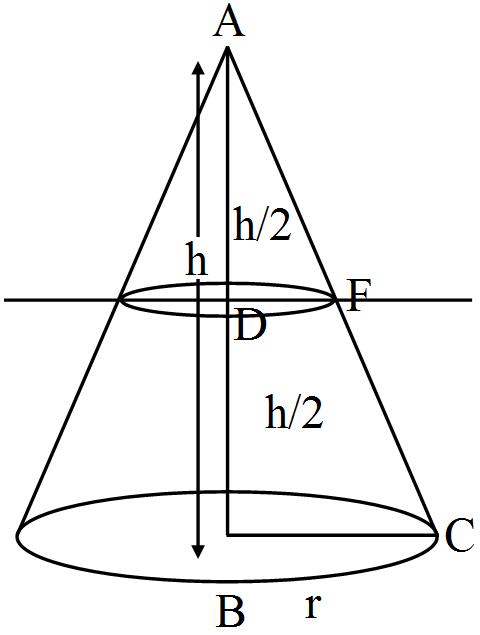
$\frac{\text{AD}}{\text{AB}}=\frac{\text{DF}}{\text{BC}}$
$\Rightarrow\frac{\frac{\text{h}}2{}}{\frac{\text{h}}{2}+\frac{\text{h}}{2}}=\frac{\text{DF}}{\text{BC}}$
$\Rightarrow\frac{\text{DF}}{\text{BC}}=\frac{1}{2}$
$\Rightarrow\text{DF}=\frac{\text{BC}}{2}=\frac{\text{r}}{2}$
Volume of full cone $=\frac{1}3{}\pi\text{r}^2\text{h}$
Volumeof small cone formed $=\frac{1}{3}\pi\Big(\frac{\text{r}}{2}\Big)^2\frac{\text{h}}{2}$
$=\frac{1}{3}\pi\frac{\text{r}^2}{4}\frac{\text{h}}{2}$
$=\frac{1}{8}\Big(\frac{\pi\text{r}^2\text{h}}{3}\Big)$
Ratio of volume of two parts $=\frac{\text{Volume of small cone}}{\text{Volume of full cone}-\text{Volume of small cone}}$
$=\frac{\frac{1}{8}\Big(\frac{\pi\text{r}^2\text{h}}{3}\Big)}{\frac{\pi\text{r}^2\text{h}}{3}-\frac{\pi\text{r}^2\text{h}}{8\times3}}$
$=\frac{1}{7}$ View full question & answer→MCQ 101 Mark
If the height and radius of a cone of volume $V$ are doubled, then the volume of the cone, is:
Answer$\text{V}=\frac{1}{3}\pi\text{R}^2\text{H}$
If $R' = 2R$ and $H' = 2H$, then
$\text{V}'=\frac{1}{3}\pi(\text{2R})^2(\text{2H})$
$=8\Big(\frac{1}{3}\pi\text{R}^2 \text{H}\Big)$
$=\text{8V}$
$\Rightarrow\text{V}'=\text{8V}$
View full question & answer→MCQ 111 Mark
The area of the curved surface of a cone of radius $2r$ and slant height $\frac{\text{l}}{2},$ is:
AnswerCorrect option: A. $\pi\text{rl}$
Curved surface area of a cone of radius $'r'$ and slant height $'l'$ $=\pi\text{rl}$
Now, if $r' = 2r$ and $\text{l}'=\frac{1}{2},$ then
$C.S.A$ $=\pi(\not2\text{r})\Big(\frac{\text{l}}{\not2}\Big)=\pi\text{rl}$
View full question & answer→MCQ 121 Mark
The diameters of two cones are equal. If their slant heights are in the ratio $5 : 4$, the ratio of their curved surface areas, is:
- A
$4 : 5$
- B
$25 : 16$
- C
$16 : 25$
- ✓
$5 : 4$
AnswerCorrect option: D. $5 : 4$
Curved Surface Area of cone $=\pi\text{RL}$
Where, $R$ = radius and $L$ = slant height
Ratio of $C.S.A.$ of two cones,
$\text{C.S.A}_1:\text{C.S.A}_2=\pi\text{R}_1\text{L}_1:\pi\text{R}_2\text{L}_2$
If $\frac{\text{L}_1}{\text{L}_2}=\frac{5}{4},$ then $\frac{2\text{R}_1}{2\text{R}_2}=1\ (\because\text{R}_1=\text{R}_2)$
$\Rightarrow\frac{\text{C.S.A}_1}{\text{C.S.A}_2}=\frac{\pi\text{R}_1\text{L}_1}{\pi\text{R}_2\text{L}_2}$
$\Rightarrow\frac{\text{C.S.A}_1}{\text{C.S.A}_2}=\frac{\text{R}_1}{\text{R}_2}\times\frac{5}{4}$
$\Rightarrow\frac{\text{C.S.A}_1}{\text{C.S.A}_2}=\frac{5}{4}$
View full question & answer→MCQ 131 Mark
If the heights of two cones are in the ratio of $1 : 4$ and the radii of their bases are in the ratio $4 : 1$, then the ratio of their volumes is:
- A
$1 : 2$
- B
$2 : 3$
- C
$3 : 4$
- ✓
$4 : 1$
AnswerCorrect option: D. $4 : 1$
Let the volume of cone 1 $=\frac{1}{3}\pi\text{R}_1^2\text{H}_1=\text{V}_1$
Let the volume of cone 2 $=\frac{1}{3}\pi\text{R}_2^2\text{H}_2=\text{V}_2$
$\frac{\text{V}_1}{\text{V}_2}=\frac{\frac{1}{3}\pi\text{R}_1^2\text{H}_1}{\frac{1}{3}\pi\text{R}_2^2\text{H}_2}=\frac{\text{R}_1^2}{\text{R}_2^2}\frac{\text{H}_1}{\text{H}_2}$ $\Big\{\frac{\text{H}_1}{\text{H}_2}=\frac{1}{4},\frac{\text{R}_1}{\text{R}_2}=\frac{4}{1}\ (\text{given})\Big\}$
$=\Big(\frac{4}{1}\Big)^2\Big(\frac{4}{1}\Big)$
$=\frac{4}{1}$
$\Rightarrow\text{V}_1:\text{V}_2=4:1$
View full question & answer→MCQ 141 Mark
The curved surface area of one cone is twice that of the other while the slant height of the latter is twice that of the former. The ratio of their radii is:
- A
$2 : 1$
- ✓
$4 : 1$
- C
$8 : 1$
- D
$1 : 1$
AnswerCorrect option: B. $4 : 1$
Let the Curved Surface Area of one cone $=\pi\text{R}_1(\text{L})_1$
where, L = Slant height, $R$ = Radius
Curved Surface Area of other cone $=\pi\text{R}_2(\text{L})_2$
Now, $\pi\text{R}_1(\text{L})_1=2\pi\text{R}_2(\text{L})_2$ and $\mathrm{L}_2=2 \mathrm{~L}_1$
$\Rightarrow\pi\text{R}_1\text{L}_1=2\pi\text{R}_2(2\text{L}_1)$
$\Rightarrow\frac{\text{R}_1}{\text{R}_2}=\frac{4}{1}$
View full question & answer→MCQ 151 Mark
If the volume of two cones are in the ratio $1 : 4$ and their diameters are in the ratio $4 : 5$, then the ratio of their heights, is:
- A
$1 : 5$
- B
$5 : 4$
- C
$5 : 16$
- ✓
$25 : 64$
AnswerCorrect option: D. $25 : 64$
Let the volume of $1^{st}$ cone $=\frac{1}{3}\pi\text{R}_1^2\text{H}_1=\text{v}_1$
Let the volume of $2^{nd}$ cone $=\frac{1}{3}\pi\text{R}_2^2\text{H}_2=\text{v}_2$
$\frac{\text{v}_1}{\text{v}_2}=\frac{\text{R}_1^2\text{H}_1}{\text{R}_2^2\text{H}_2}=\frac{1}{4}$ and
$\frac{\text{d}_1}{\text{d}_2}=\frac{4}5{}$
$\Rightarrow\frac{\text{2R}_1}{\text{2R}_2}=\frac{4}{5}$
$\Rightarrow\frac{\text{R}_1}{\text{R}_2}=\frac{4}5{}$
$\Rightarrow\Big(\frac{4}{5}\Big)^2\frac{\text{H}_1}{\text{H}_2}=\frac{1}{4}$
$\Rightarrow\frac{\text{H}_1}{\text{H}_2}=\frac{25}{64}$
View full question & answer→MCQ 161 Mark
The number of surfaces of a cone has, is:
AnswerA cone has two surfaces as follows: one curved surface and another bottom surface.
View full question & answer→MCQ 171 Mark
If the radius of the base of a right circular cone is $3r$ and its height is equal to the radius of the base, then its volume is:
AnswerCorrect option: D. $9\pi\text{r}^3$
Volume of cone $=\frac{1}{3}\pi\text{R}^2\text{H}$
where, $R$ = Radius of base, $H$ = height
If $R = 3r, H = R = 3r,$
Then $\text{V}=\frac{1}{3}\times\pi\times(\text{3r})^2\times\text{3r}=9\pi\text{r}^3$
View full question & answer→MCQ 181 Mark
The total surface area of a cone of radius $\frac{r}{2}$ and length $2 l$, is
AnswerCorrect option: B. $\pi r\left(l+\frac{r}{4}\right)$
View full question & answer→MCQ 191 Mark
An edge of a cube measures $r cm$. If the largest possible risht circular cone is cut out this cube, then the colume of the cone (in $cm ^3$ ) is
- A
$\frac{1}{3} \pi r^3$
- B
$\frac{2}{3} \pi r^3$
- C
$\frac{1}{6} \pi r^3$
- ✓
$\frac{1}{12} \pi r^3$
AnswerCorrect option: D. $\frac{1}{12} \pi r^3$
(d) $\frac{1}{12} \pi r^3$
We observe that: Height of the cone $=r cm$ and, diameter of the base $=r cm$.
$\therefore \quad \text { Volume of the cone }=\frac{1}{3} \pi\left(\frac{r}{2}\right)^2 r=\frac{1}{12} \pi r^3$
View full question & answer→MCQ 201 Mark
If the volume of a right circular cone of height 9 cm is $48 \pi cm^3$. then the diameter of its base is
Answer(b) 8
Let $r$ be the radius of the base. Then,
$\text { Volume }=48 \pi cm^3 \Rightarrow \frac{1}{3} \pi r^2 \times 9=48 \pi \Rightarrow r^2=16 \Rightarrow r=4$
Hence, diameter of base $=8 cm$.
View full question & answer→MCQ 211 Mark
If the base radius of a cone is doubled and its height is halved, then which of the following is true regarding its volume?
Answer(c) increase by 100%
Let $r$ be the base radius and $h$ be the height of a cone. Then, its volume $V$ is given by
$y=\frac{1}{3} \pi r^2 h$. Let $V_1$ be the volume of a cone of base radius $2 r$ and height $\frac{h}{2}$. Then
$V_1=\frac{1}{3} \pi(2 r)^2 \times \frac{h}{2}=2\left(\frac{1}{3} \pi r^2 h\right)=2 V$
$\therefore \quad$ Percentage increase in volume $=\frac{V_1-V}{V} \times 100 \%=\frac{2 V-V}{V} \times 100=100 \%$
View full question & answer→MCQ 221 Mark
If the volumes of two cones be in the ratio $1: 4$ and the radii of their bases be in the ratio $4: 5$, then the ratio of their heights is
- A
$1: 5$
- B
$5: 4$
- C
$25: 16$
- ✓
$25: 64$
AnswerCorrect option: D. $25: 64$
(d) $25: 64$
Let the radii of bases of two cones be $r_1, r_2$ and their heights be $h_1, h_2$. Let $V_1, V_2$ be the volumes of two cones. Then,
$V_1=\frac{1}{3} \pi r_1^2 h_1 \text { and } V_2=\frac{1}{3} \pi r_2^2 h_2$
It is given that $V_1: V_2=1: 4$ and $r_1: r_2=4: 5$.$
\therefore \quad \frac{V_1}{V_2}=\frac{1}{4} \Rightarrow \frac{\frac{1}{3} \pi r_1^2 h_1}{\frac{1}{3} \pi r_2^2 h_2}=\frac{1}{4} \Rightarrow\left(\frac{r_1}{r_2}\right)^2\left(\frac{h_1}{h_2}\right)=\frac{1}{4} \Rightarrow\left(\frac{4}{5}\right)^2 \frac{h_1}{h_2}=\frac{1}{4} \Rightarrow \frac{h_1}{h_2}=\frac{25}{64}$
View full question & answer→MCQ 231 Mark
The radii of the bases of a cylinder and a cone are in the ratio $3: 4$ and their heights are in the ratio $2: 3$. Then their volumes are in the ratio
- ✓
$9: 8$
- B
$8: 9$
- C
$3: 4$
- D
$4: 3$
AnswerCorrect option: A. $9: 8$
(a) $9: 8$ | Cylinder | Cone |
| Base radius | 3x | 4x |
| Height | 2y | 3y |
| Volume | $V_1=\pi(3 x)^2 \times 2 y$ | $V_2=\frac{1}{3} \pi(4 x)^2 \times 3 y$ |
$V_1: V_2=18 \pi x^2 y: 16 \pi x^2 y=9: 8$ View full question & answer→MCQ 241 Mark
The curved surface area of one cone is twice that of the other while the slant height of the later is twice that of the former. The ratio of their radii is
- A
$2: 1$
- ✓
$4: 1$
- C
$8: 1$
- D
$1: 1$
AnswerCorrect option: B. $4: 1$
(b) $4: 1$| | Cone I | Cone II |
| Base radius | $r_1$ | $r_2$ |
| Height | $h_1$ | $h_2$ |
| Slant height | $l_1$ | $l_2$ |
| Curved surface area | $S_1=\pi r_1 l_1$ | $S_2=\pi r_2 l_2$ |
It is given that
$\begin{array}{ll}& S_1=2 S_2 \Rightarrow r_1 l_1=2 r_2 l_2 \Rightarrow r_1 l_1=2 r_2\left(2 l_1\right) \\
\Rightarrow & \pi r_1 l_1=2 \pi r_2 l_2 \Rightarrow r_1=4 r_2 \Rightarrow r_1: r_2=4: 1\end{array} \quad\left[\because l_2=2 l_1 \text { (given) }\right]$ View full question & answer→MCQ 251 Mark
If the area of the base of a conical tent is $154 m^2$ and its volume is $1232 m^3$, then the height of the tent is
Answer(c) 24 cm
Let the radius of the base and height of the cone be $r$ and $h$ respectively. It is given that
$\begin{array}{l}\text { Area of the base }=154 m^2 \text { and, Volume }=\frac{1}{3} \pi r^2 h \\
\Rightarrow \quad \pi r^2=154 \text { and } \frac{1}{3} \pi r^2 h=1232 \Rightarrow \frac{1}{3} \times 154 \times h=1232\Rightarrow h=24 m\end{array}$
View full question & answer→MCQ 261 Mark
If the total surface area of a right circular cone of slant height 13 cm is $90 \pi cm^2$, then the radius of its base is
Answer(b) 5 cm
Let $r$ be the radius of the base. It is given that $l=13 cm$ and total surface area $=90 \pi cm^2$.
$\therefore \quad \pi r(l+r)=90 \pi \Rightarrow r(13+r)=90 \Rightarrow r^2+13 r-90=0 \Rightarrow(r+18)(r-5)=0\Rightarrow r-5=0 \Rightarrow r=5 cm .$
View full question & answer→MCQ 271 Mark
The height of a cone is 16 cm and its base radius is 12 cm. The curved surface area and total surface area are in the ratio
- ✓
$5: 8$
- B
$8: 5$
- C
$5: 3$
- D
$3: 5$
AnswerCorrect option: A. $5: 8$
(a) $5: 8$
We have, $h=16 cm, r=12 cm$. Let $l$ be the slant height of the cone. Then,
$\begin{aligned}& l=\sqrt{r^2+h^2} \Rightarrow l=\sqrt{12^2+16^2}=\sqrt{144+256}=\sqrt{400}=20 \\
\therefore \quad & \frac{\text { Curved surface area }}{\text { Total surface area }}=\frac{\pi r l}{\pi r(r+l)}=\frac{l}{l+r}=\frac{20}{20+12}=\frac{5}{8}\end{aligned}$
View full question & answer→MCQ 281 Mark
If the diameter of the base of a cone of height 24 cm is 14 cm , then its curved surface area is
- A
$704 cm^2$
- B
$616 cm^2$
- ✓
$550 cm^2$
- D
$528 cm^2$
AnswerCorrect option: C. $550 cm^2$
(c) $550 cm^2$
We have, $r=7 cm$ and $h=24$.
Let $l$ be the slant height of the cone. Then,
$\begin{array}{ll}& l^2=r^2+h^2 \Rightarrow l^2=49+576 \Rightarrow l^2=625 \Rightarrow l=25 \\
\therefore \quad & \text { Curved surface area }=\pi r l=\frac{22}{7} \times 7 \times 25 cm^2=550 cm^2\end{array}$
View full question & answer→MCQ 291 Mark
If a cone is cut into two parts by a horizontal plane passing through the mid-point of its axis, the ratio of the volumes of upper and lower part is
- A
$1: 2$
- B
$2: 1$
- ✓
$1: 7$
- D
$1: 8$
AnswerCorrect option: C. $1: 7$
View full question & answer→MCQ 301 Mark
If $h, S$ and $V$ denote respectively the height, curved surface area and volume of a right circular cone, then $3 \pi V h^3-S^2 h^2+9 V^2$ is equal to
View full question & answer→MCQ 311 Mark
If the base radius and the height of a right circular cone are increased by $20 \%$, then the percentage increase in volume is approximately
View full question & answer→MCQ 321 Mark
The height of a solid cone is 12 cm and the area of the circular base is $64 \pi cm^2$. A plane parallel to the base of the cone cuts through the cone 9 cm above the vertex of the cone, the area of the base of the new cone so formed is
- A
$9 \pi cm^2$
- B
$16 \pi cm^2$
- C
$25 \pi cm^2$
- ✓
$36 \pi cm^2$
AnswerCorrect option: D. $36 \pi cm^2$
View full question & answer→MCQ 331 Mark
The slant height of a cone is increased by $10 \%$. If the radius remains the same, the curved surface area is increased by
- ✓
$10 \%$
- B
$12.1 \%$
- C
$20 \%$
- D
$21 \%$
AnswerCorrect option: A. $10 \%$
View full question & answer→MCQ 341 Mark
The curved surface area of one cone is twice that of the other while the slant height of the latter is twice that of the former. The ratio of their radii is
- A
$2: 1$
- ✓
$4: 1$
- C
$8: 1$
- D
$1: 1$
AnswerCorrect option: B. $4: 1$
View full question & answer→MCQ 351 Mark
The diameters of two cones are equal. If their slant heights are in the ratio $5: 4$, the ratio of their curved surface areas, is
- A
$4: 5$
- B
$25: 16$
- C
$16: 25$
- ✓
$5: 4$
AnswerCorrect option: D. $5: 4$
View full question & answer→MCQ 361 Mark
A right circular cylinder and a right circular cone have the same radius and the same volume The ratio of the height of the cylinder to that of the cone is
- A
$3: 5$
- B
$2: 5$
- C
$3: 1$
- ✓
$1: 3$
AnswerCorrect option: D. $1: 3$
View full question & answer→MCQ 371 Mark
The ratio of the volume of a right circular cylinder and a right circular cone of the same base and height, is
- A
$1: 3$
- ✓
$3: 1$
- C
$4: 3$
- D
$3: 4$
AnswerCorrect option: B. $3: 1$
View full question & answer→MCQ 381 Mark
If the height and radius of a cone of volume $V$ are doubled, then the volume of the cone, is
View full question & answer→MCQ 391 Mark
If the heights of two cones are in the ratio of $1: 4$ and the radii of their bases are in the ratio $4: 1$, then the ratio of their volumes is
- A
$1: 2$
- B
$2: 3$
- C
$3: 4$
- ✓
$4: 1$
AnswerCorrect option: D. $4: 1$
View full question & answer→MCQ 401 Mark
If the volumes of two cones are in the ratio $1: 4$ and their diameters are in the ratio $4: 5$, then the ratio of their heights, is
- A
$1: 5$
- B
$5: 4$
- C
$5: 16$
- ✓
$25: 64$
AnswerCorrect option: D. $25: 64$
View full question & answer→MCQ 411 Mark
If the radius of the base of a right circular cone is $3 r$ and its height is equal to the radius of the base, then its volume is
- A
$\frac{1}{3} \pi r^3$
- B
$\frac{2}{3} \pi r^3$
- C
$3 \pi r^3$
- ✓
$9 \pi r^3$
AnswerCorrect option: D. $9 \pi r^3$
View full question & answer→MCQ 421 Mark
A solid cylinder is melted and cast into a cone of same radius. The heights of the cone and cylinder are in the ratio
- A
$9: 1$
- B
$1: 9$
- ✓
$3: 1$
- D
$1: 3$
AnswerCorrect option: C. $3: 1$
View full question & answer→MCQ 431 Mark
The area of the curved surface of a cone of radius 2r and slant height $\frac{l}{2}$, is
- ✓
$\pi r l$
- B
2$\pi r l$
- C
$\frac{1}{2} \pi r l$
- D
$\pi(r+l) r$
AnswerCorrect option: A. $\pi r l$
View full question & answer→MCQ 441 Mark
The number of surfaces of a cone has, is