MCQ 11 Mark
A cylindrical piece of maximum volume has to be cut out of an iron cube of edge $4\ cm.$ Then, the maximum volume of the iron cylinder is:
- A
$24\pi\text{cm}^3$
- ✓
$16\pi\text{cm}^3$
- C
$32\pi\text{cm}^3$
- D
$28\pi\text{cm}^3$
AnswerCorrect option: B. $16\pi\text{cm}^3$
So here, radius would be half of edge of cube, or diameter of rod $=$ edge of cube
$r = 2\ cm$
$h = 4\ cm$
So, volume $=\pi\text{r}^2\text{h}$
$=\pi\times2\times2\times4$
$=16\pi\text{cm}^2$
View full question & answer→MCQ 21 Mark
If a spherical balloon grows to twice its radius when inflated, then the ratio of the volume of the inflated balloon to the original balloon is:
- A
$5 : 1$
- B
$4 : 1$
- ✓
$8 : 1$
- D
$6 : 1$
AnswerCorrect option: C. $8 : 1$
Volume of the inflated balloon : Volume of the original balloon
$=\frac{4}{3}\pi(2\pi\text{r})^3:\frac{4}{3}\pi(\text{r})^3$
$=8:1$
View full question & answer→MCQ 31 Mark
The total surface area of a cube is $96\ cm^2$. The volume of the cube is:
- A
$8\ cm^3$
- B
$27\ cm^3$
- ✓
$64\ cm^3$
- D
$512\ cm^3$
AnswerCorrect option: C. $64\ cm^3$
We know that,
Total surface area of a cube $= 6a^2$
$⇒ 96 = 6a^2$
$\Rightarrow\text{a}^2=\frac{96}{6}$
$⇒ a^2 = 16$
$⇒ a = 4\ cm$
Now,
Volume of the cube $= a^3$
$= 4^3$
$= 64\ cm^3$
View full question & answer→MCQ 41 Mark
Volume of a cuboid is $12\ cm^3$. The volume $($in $cm^3)$ of a cuboid whose side are doubled of the above cuboid is:
AnswerLet,
$l →$ Length of the first cuboid
$b →$ Breadth of the first cuboid
$h →$ Height of the first cuboid
Volume of the cuboid is $12\ cm^3$
Dimensions of the new cuboid are,
Lenghth $(L) = 2l$
Breadth $(B) = 2b$
Height $(H) = 2h$
We are asked to find the volume of the new cuboid
We know that,
Volume of the new cuboid,
$V' = LBH$
$= (2l)(2b)(2h)$
$= 8(lbh)$
$= 8V \{$Since, $V = lbh\}$
$= 8 × 12 \{$Since, $V = 12\ cm^3\}$
$= 96\ cm^3$
Thus, volume of the new cuboid is $96\ cm^3$.
Hence, the correct option is $(d).$
View full question & answer→MCQ 51 Mark
A cube whose volume is $\frac{1}{8}$ cubic centimeter is placed on top of a cube whose volume is $1\ cm^3$. The two cubes are then placed on top of a third cube whose volume is $8\ cm^3$. The height of the stacked cubes is:
- A
- B
$3\ cm$
- ✓
$3.5\ cm$
- D
$7\ cm$
AnswerCorrect option: C. $3.5\ cm$
Let $a, b, c.$ be the sides of three cubes
Then $a^3 =\frac{1}{8}\Rightarrow\text{a}=\frac{1}{2}$
$b^3= 1 ⇒ b = 1$
$c^3 = 8 ⇒ c = 2,$
Now height of resulting cube
$0.5 + 1 + 2 = 3.5\ cm$
View full question & answer→MCQ 61 Mark
The cost of constructing a wall $8m$ long, $4m$ high and $10\ cm$ thick at the rate of $₹ 25$ per m$^3$ is:
- A
$₹ 16$
- B
$₹ 80$
- ✓
$₹ 160$
- D
$₹ 320$
AnswerCorrect option: C. $₹ 160$
Dimensions of the wall are,
Length $(l) = 8m$
Breadth $(b) = 20\ cm$
$= 0.2m$
Height $(h) = 4\ cm$
Volume of the hall,
$V = lbh$
$= 8 × 4 × 0.2$
$= 6.4m^3$
Cost of building the wall is $₹ 160.$
Hence, the correct option is $(c).$
View full question & answer→MCQ 71 Mark
Write the correct answer in the following: The number of planks of dimensions $(4m × 50\ cm × 20\ cm)$ that can be stored in a pit which is $16m$ long, $12m$ wide and $4m$ deep is:
- A
$1900$
- ✓
$1920$
- C
$1800$
- D
$1840$
AnswerCorrect option: B. $1920$
Volume of pit $= (16 × 12 × 4)m^3$
Volume of a plank $= (4 × 0.5 × 0.2)m^3$
Required number of planks $=\frac{\text{Volume of pit}}{\text{Volume of a plank}}$
$=\frac{16\times12\times4}{4\times0.5\times0.2}=1920$
Hence, $(b)$ is the correct answer.
View full question & answer→MCQ 81 Mark
The slant height of a cone is increased by $10\%.$ If the radius remains the same, the curved surface area is increased by:
- ✓
$10\%$
- B
$12.1\%$
- C
$20\%$
- D
$21\%$
AnswerCorrect option: A. $10\%$
$C.S.A$ of a cone $=\pi\text{rl}$
If $l' = 1 + 10\%$ of $l$
$=\text{l}+\frac{10}{100}\times\text{l}$
$=\text{l}+\frac{\text{l}}{10}$
And, $r' = r$
$\text{C.S.A.}=\pi\text{r}\Big(\text{l}+\frac{\text{l}}{10}\Big)=\frac{11}{10}\pi\text{rl}$
So, increase in $C.S.A. =\frac{\frac{11}{10}\pi\text{rl}-\pi\text{rl}}{\pi\text{rl}}\times100\%=10\%$
View full question & answer→MCQ 91 Mark
The cost of painting a cubical box of side 3m at the rate of $Rs. 2$ per sq. m is:
- A
$Rs. 112$
- B
$Rs. 125$
- C
$Rs. 120$
- ✓
$Rs. 108$
AnswerCorrect option: D. $Rs. 108$
Given: Side of the cube $(a) = 3m$
\therefore Surface Area of Cube $= 6a^2 = 6 × 3 × 3 = 54\ sq. cm$
Now, Cost of painting the cubical box of $1\ sq. m = Rs. 2$
\therefore Cost of painting the cubical box of $54\ sq. m = 54 × 2 = Rs. 108$
View full question & answer→MCQ 101 Mark
The volume of a right circular cone of height $24\ cm$ is $1232\ cm^3$. Its curved surface area is:
- A
$1254\ cm^2$
- B
$704\ cm^2$
- ✓
$550\ cm^2$
- D
$462\ cm^2$
AnswerCorrect option: C. $550\ cm^2$
We know that,
Volume of cone $=\frac{1}{3}\pi\text{r}^2\text{h}$
$\Rightarrow1232=\frac{1}{3}\pi\text{r}^2\text{h}$
$\Rightarrow1232=\frac{1}{3}\times\frac{22}{7}\times\text{r}^2\times24$
$\Rightarrow\text{r}^2=\frac{7\times3\times1232}{24\times22}$
$\Rightarrow\text{r}^2=49$
$\Rightarrow\text{r}=7\text{cm}$
$\Rightarrow r=7 \mathrm{~cm} \text { and } h=24 \mathrm{~cm}$
$I^2=r^2+h^2$
$\Rightarrow I^2=7^2+24^2$
$\Rightarrow I^2=49+576$
$\Rightarrow I^2=625$
$\Rightarrow I=25$
Curved surface area $=\pi\text{rl}$
$=\frac{22}{7}\times7\times25$
$=550\text{cm}^2$
View full question & answer→MCQ 111 Mark
The ratio of the volume of a right circular cylinder and a right circular cone of the same base and height, is:
- A
$1 : 3$
- ✓
$3 : 1$
- C
$4 : 3$
- D
$3 : 4$
AnswerCorrect option: B. $3 : 1$
Volume of a right circular cylinder of height $H$ and radius $R =\pi\text{R}^2\text{H}=\text{v}_1$
Volume of a cone of height $H$ and radius $R =\frac{1}3{}\pi\text{R}^2\text{H}=\text{v}_2$
$\frac{\text{v}_1}{\text{v}_2}=\frac{\pi\text{R}^2\text{H}}{\frac{1}{3}\pi\text{R}^2\text{H}}=\frac{3}{1}=3:1$
View full question & answer→MCQ 121 Mark
If a solid sphere of radius $10\ cm$ is moulded into $8$ spherical solid balls of equal radius, then the surface area of each ball (in sq.cm) is:
- ✓
$100\pi$
- B
$75\pi$
- C
$60\pi$
- D
$50\pi$
AnswerCorrect option: A. $100\pi$
Volume of solid sphere $=\frac{4}{3}\pi(10)^3=\frac{4000\pi}{3}\text{cm}^3$
Vomule 8 solid sphere of radius (say) $\text{r}=8\times\frac{4}{3}\pi\text{r}^3=\frac{32\pi\text{r}^3}{3}\text{cm}^3$
Now, $\frac{32\pi\text{r}^3}{3}=\frac{4000\pi}{3}$
$\Rightarrow\text{r}=\Big(\frac{1000}{8}\Big)^\frac{1}{3}=\frac{10}{2}=5\text{cm}$
Surface Area of each small ball $=4\pi\text{r}^2=4\pi(5)^2=100\pi\text{ cm}^2 $
Hence, correct option is $(a).$
View full question & answer→MCQ 131 Mark
If $r$ is the radius and $h$ is height of the cylinder the volume will be:
AnswerCorrect option: B. $\pi\text{r}^2\text{h}$
It is given that $r$ is the radius and $h$ is the height of the cylinder.
We know that the volume of cylinder is given by the formula
$\text{V}=\pi\text{r}^2\text{h}$
View full question & answer→MCQ 141 Mark
The number of surfaces of a cone has, is:
AnswerThe surface or faces that a cone has are:
$(i)$ Base, $(ii)$ Slanted surface
So, the number of surfaces that a cone has is $2.$
View full question & answer→MCQ 151 Mark
The diameter of the base of a cylinder is $6\ cm$ and its height is $14\ cm.$ The volume of the cylinder is:
- A
$198\ cm^3$
- ✓
$396\ cm^3$
- C
$495\ cm^3$
- D
$297\ cm^3$
AnswerCorrect option: B. $396\ cm^3$
Given, $d = 6\ cm$
$r = 3\ cm$
$h = 14\ cm$
Now,
Volume of the cylinder $=\pi\text{r}^2\text{h}$
$=\frac{22}{7}\times3\times3\times14$
$=396\text{cm}^3$
View full question & answer→MCQ 161 Mark
The diameter of the base of a cylinder of curved surface area $88\ cm^2$ and height $14\ cm$ is:
- A
$1.5\ cm$
- B
$1\ cm$
- ✓
$2\ cm$
- D
$25\ cm$
AnswerCorrect option: C. $2\ cm$
$CSA$ of cylinder $=2\pi\text{rh}$
$88=2\times\frac{22}{7}\times\text{r}\times14$
$\text{r}=\frac{88\times7}{2\times22\times14}$
$\text{r}=1\text{cm}$
Hence Diameter of base $= 2\ cm.$
View full question & answer→MCQ 171 Mark
Write the correct answer in the following: A cone is $8.4\ cm$ high and the radius of its base is $2.1\ cm.$ It is melted and recast into a sphere. The radius of the sphere is:
- A
$4.2\ cm$
- ✓
$2.1\ cm$
- C
$2.4\ cm$
- D
$1.6\ cm$
AnswerCorrect option: B. $2.1\ cm$
Given, height of a cone $= 8.4\ cm$
Radius of the base of cone $= 2.1\ cm$
Volume of a cone $ = \frac{1}{3}\pi\text{r}^2\text{h}=\frac{1}{3}\times\pi(2.1)^2\times8.4$
$=\frac{1}{3}\times\pi\times2.1\times2.1\times8.4=\pi\times4.41\times2.8\text{cm}^3$
Since, cone is melted and recast into a sphere.
let the radius of a sphere be $R.$
Then, Volume of a sphere $=$ Volume of a cone
$\Rightarrow\frac{4}{3}\pi\text{r}^3=\pi\times4.41\times2.8$
$\Rightarrow\text{r}^3=\frac{4.41\times2.8\times3}{4}$
$\Rightarrow\text{r}^3=4.41\times0.7\times3$
$\Rightarrow\text{r}^3=4.41\times2.1$
$\therefore\text{r}=2.1$
Hence, the radius of the sphere is $2.1\ cm.$
View full question & answer→MCQ 181 Mark
If $h, S$ and $V$ denote respectively the height, curved surface area and volume of a right circular cone, then $3\pi\text{V}\text{h}^3-\text{S}^2\text{h}^2+\text{9V}^2$ is equal to:
- A
$8$
- ✓
$0$
- C
$4\pi$
- D
$32\pi^2$
AnswerFor a cone,
$\text{V}=\frac{1}{3}\pi\text{R}^2\text{h}$
$S =$ curved Surface Area $=\pi\text{R}\text{L}$
$\text{L}=\sqrt{\text{h}^2+\text{R}^2}$
$3\pi\text{V}\text{h}^3-\text{S}^2\text{h}^2+\text{9V}^2$
$=3\pi\Big(\frac{1}{3}\pi\text{R}^2\text{h}\Big)\text{h}^3-\pi^2\text{R}^2\big(\text{h}^2+\text{R}^2\big)\text{h}^2\\+9\times\frac{1}{9}\pi^2\text{R}^4\text{h}^2$
$=\pi^2\text{R}^2\text{h}^4-\pi^2\text{R}^2\text{h}^4-\pi^2\text{R}^4\text{h}^2+\pi^2\text{R}^4\text{h}^2$
$=0$
View full question & answer→MCQ 191 Mark
If each edge of cuboid of surface area S is doubled, then surface area of the new cuboid is:
AnswerLet,
$l →$ Length of the first cuboid
$b →$ Breadth of the first cuboid
$h →$ Height of the first cuboid
And,
$L → $ Length of the new cuboid
$B →$ Breadth of the new cuboid
$H →$ Height of the new cuboid
We know that,
$L = 2l$
$B = 2b$
$H = 2h$
Surface area of the first cuboid,
$S' = 2(LB + BH + HL)$
$= 2[(2l)(2b) + (2b)(2h) + (2h)(2l)]$
$= 2(4lb + 4bh + 4hl)$
$= 4[2(lb + bh + hl)]$
$= 4S$
The surface area of the new cuboid is $4S.$
So, the correct choice is $(b).$
View full question & answer→MCQ 201 Mark
A solid metallic cylinder of base radius $3\ cm$ and height $5\ cm$ is melted to make n solid cones of height $1\ cm$ and base radius $1\ mm$. The value of $n$ is.
- A
$450$
- B
$4500$
- ✓
$13500$
- D
$1350$
AnswerCorrect option: C. $13500$
Radius of cylinder $= 3\ cm.$
Height $= 5\ cm$
Radius of cone$= 1\ mm = 0.1\ cm$
Height $= 1\ cm$
Volume of cylinder $=$ number of cones $×$ Volume of cone
$\pi\text{R}^2\text{h}=\text{n}\times\frac{1}{3}\pi\text{r}^2\text{h}$
$\pi32\times5=\text{n}\times\frac{1}{3}\pi\times0.1^2\times1$
$45=\text{n}\times\frac{1}{3}\times(.1)^2\times1$
$45=\text{n}\times\frac{1}{100}$
$\text{n}=13500$
$13500$
View full question & answer→MCQ 211 Mark
The number of planks of dimensions $(4m × 5m × 2m)$ that can be stored in a pit which is $40m$ long, $12m$ wide and $16m$ deep, is.
AnswerVolume of a cuboid $=$ Length $×$ Breadth $×$ Height
Volume of pit $= 40m × 12m × 16m = 7680m^3$
Volume of plank $= 4m × 5m × 2m = 40m^3$
No. of planks $=\frac{\text{Volume of pit }}{\text{Volume of plank }}=\frac{7680}{40}=192$
View full question & answer→MCQ 221 Mark
The height of a solid cone is $12\ cm$ and the area of the circular base is $64\pi\text{cm}^2.$ A plane parallel to the base of the cone cuts through the cone $9\ cm$ above the vertex of the cone, the areas of the base of the new cone so formed is:
- A
$9\pi\text{cm}^2$
- B
$16\pi\text{cm}^2$
- C
$25\pi\text{cm}^2$
- ✓
$36\pi\text{cm}^2$
AnswerCorrect option: D. $36\pi\text{cm}^2$
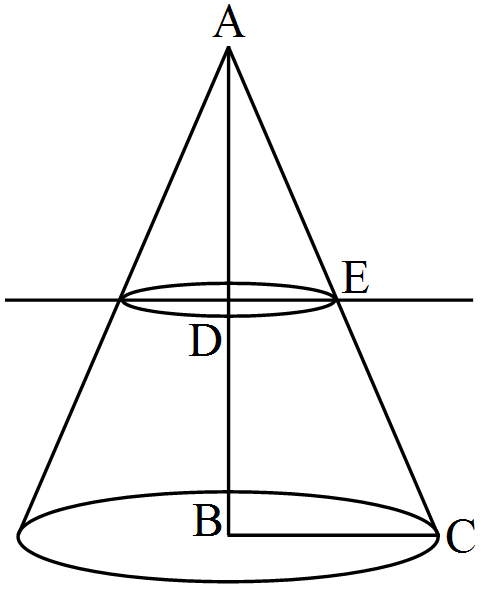
$AB = 12\ cm$
Area of circular Base $=\pi\text{r}^2=64\pi$
$⇒ r = 8\ cm$
$AD = 9\ cm$
Consider $\triangle\text{ADE}$ and $\triangle\text{ABC},$
$\angle\text{DAE}=\angle\text{BAC}$ (common)
$\angle\text{ADE}=\angle\text{ABC} ($each $90^\circ )$
$\angle\text{AED}=\angle\text{ACB}$ (Third angle will also be same)
Hence $\triangle\text{ADE}\sim\triangle\text{ABC}$
So $\frac{\text{AD}}{\text{AB}}=\frac{\text{DE}}{\text{BC}}$
$\Rightarrow\frac{9}{12}=\frac{\text{DE}}{8}$
$\Rightarrow\text{DE}=6\text{cm}$
Radius of base of new cone $= 6\ cm$
$⇒$ Area $=\pi(6)^2=36\pi\text{cm}^2$ View full question & answer→MCQ 231 Mark
The volume of a cube is $512\ cm^3$. Its total surface area is:
- A
$256\ cm^2$
- ✓
$384\ cm^2$
- C
$512\ cm^2$
- D
$64\ cm^2$
AnswerCorrect option: B. $384\ cm^2$
Volume of the cube $= a^3$
$⇒ 512 = a^3$
$⇒ a = 8\ cm$
Now,
Total surface area of a cube $= 6a^2$
$= 6 × (8)^2$
$= 6 × 64$
$= 384\ cm^2$
View full question & answer→MCQ 241 Mark
A hemispherical bowl of radius $9\ cm$ contains a liquid. This liquid is to be filled into cylindrical small bottles of diameter $3\ cm$ and height $4\ cm.$ How many bottles will be needed to empty the bowl$?$
AnswerVolume of a hemisphere $=\frac{2}{3}\pi\text{r}^3=\frac{2}{3}\pi(9)^3\text{cm}^3$
Volume of cylinder $=\pi\text{r}^2\text{h}$
Volume of a cylinderical bottle $=\pi(1.5)^2\times4$
No. of bottles required $=\frac{\text{Volume of a hemisphere}}{\text{Volume of a cylinderical bottle}}$
$=\frac{\frac{2}{3}\pi(9)^2}{\pi(1.5)^2\times4}$
$=\frac{81\times3}{2.25\times1.5\times2}=54$
Thus, total $54$ bottals are required.
View full question & answer→MCQ 251 Mark
In a cylinder, if radius is doubled and height is halved, curved surface area will be:
Answercurved surface area of a cylinder of radius $'r'$ and heightn $'h'$ is given by $\text{A}=2\pi\text{rh}$
Now, if $r' = 2r$ and $\text{h}'=\frac{\text{h}}{2}$
Then $\text{A}'=2\pi\times(2\text{r})\times\frac{\text{h}}{2}$
$=2\pi\text{rh}=\text{A}$
$⇒ C.S.A.$ remains the same.
View full question & answer→MCQ 261 Mark
The number of cubes of side $3\ cm$ that can be cut from a cuboid of dimensions $10\ cm × 9\ cm × 6\ cm,$ is:
AnswerWe have the cuboid of dimensions $10\ cm × 9\ cm × 6\ cm.$
We are to find how many cubs with edge $3\ cm$ can be cut from the given cuboid
Let us cut this cuboid into following two cuboids
$9\ cm × 9\ cm × 6\ cm$
And
$1\ cm × 9\ cm × 6\ cm$
So, the number of cubes of sides $3\ cm$, that can be cut from the firest cuboid,
$=\frac{9\text{cm}\times9\text{cm}\times6\text{cm}}{3\text{cm}\times3\text{cm}\times3\text{cm}}$
$= 18$
We can not cut single cube of side $3\ cm$ from the second cuboid of dimension $1\ cm × 9\ cm × 6\ cm$
Hence, this much volume is useless for us.
So, we can cut maximum $18$ cubes of side $3\ cm$ from the cuboid of dimensions $10\ cm × 9\ cm × 6\ cm.$
Hence, the correct option is $(c).$
View full question & answer→MCQ 271 Mark
The volume of a right circular cone of height $24\ cm$ is $1232\ cm^3$. Its curved surface area is.
- A
$704\ cm^2$
- B
$1254\ cm^2$
- ✓
$550\ cm^2$
- D
$462\ cm^2$
AnswerCorrect option: C. $550\ cm^2$
Radius of cone $= r\ cm$
Volume of cone $=\frac{1}{3}\pi\text{r}^2\text{h}$
$\Rightarrow1232=\frac{1}{3}\times\frac{22}{7}\times\text{r}^2\times24$
$\Rightarrow\text{r}^2=\frac{1232\times3\times7}{22\times24}=49$
$\Rightarrow\text{r}=\sqrt{49}=7\text{cm}$
Area of curved surface area $=\pi\text{rl}$
$\text{l}=\sqrt{\text{r}^2+\text{h}^2}=\sqrt{7^2+24^2}=\sqrt{49+576}=\sqrt{625}=25$
$\therefore\frac{22}{7}\times7\times25=550\text{cm}^2$
View full question & answer→MCQ 281 Mark
The height of a cylinder is $14\ cm$ and its curved surface area is $264\ cm^2$. The volume of the cylinder is:
- A
$308\ cm^3$
- ✓
$396\ cm^3$
- C
$1232\ cm^3$
- D
$1848\ cm^3$
AnswerCorrect option: B. $396\ cm^3$
Given,
Height $= 14\ cm$
Curved surface area $= 264\ cm^2$
Now,
Curved surface area $=2\pi\text{rh}$
$\Rightarrow264=2\times\frac{22}{7}\times\text{r}\times14$
$\Rightarrow264=88\times\text{r}$
$\Rightarrow\text{r}=\frac{264}{88}$
$\Rightarrow\text{r}=3\text{cm}$
Volume $=\pi\text{r}^2\text{h}$
$=\frac{22}{7}\times3\times3\times14$
$=396\text{cm}^3$
View full question & answer→MCQ 291 Mark
If the perimeter of one of the faces of a cube is $40\ cm,$ then its volume is:
- ✓
$1000$ cubic cm
- B
$600$ cubic cm
- C
$6000$ cubic cm
- D
$1600$ cubic cm
AnswerCorrect option: A. $1000$ cubic cm
Perimeter of one face of a cube $= 4a = 40\ cm ($where $a =$ side of the cube$)$ sides of face of a cube $= 4$
Therefore, side of the cube $=\frac{4\text{a}}{4}=\frac{40}{4}=10\text{cm}$
Therefore, volume of the cube $= a^3 = 10^3 = 1000$ cubic cm
View full question & answer→MCQ 301 Mark
If the surface area of a sphere is $144\pi\text{m}^2$ then its volume $($in $m^3) $ is:
- A
$300\pi$
- B
$188\pi$
- C
$316\pi$
- ✓
$288\pi$
AnswerCorrect option: D. $288\pi$
Surface area of a sphere $=4\pi\text{r}^2$
Given, surface area of a sphere is $144\pi\text{m}^2$
$\Rightarrow4\pi\text{r}^2=144\pi$
$\Rightarrow\text{r}=6\text{m}$
Volume of the sphere $=\big(\frac{4}{3}\big)\times\pi\times6^3$
$\Rightarrow$ Volume of the sphere $=288\pi\text{m}^3$
View full question & answer→MCQ 311 Mark
A conical vessel whose internal depth is $42\ cm$ and internal diameter is $48\ cm$ is full of water. If $1$ cubic dm of water weight $1\ kg$ wt, then the weight of water in the conical vessel is:
- A
$26.5$ kg wt.
- B
$25.5$ kg wt.
- C
$25.65$ kg wt.
- ✓
$25.344$ kg wt.
AnswerCorrect option: D. $25.344$ kg wt.
Volume of conical vessel $=\frac{1}{3}\times\pi\times\text{r}^2\times\text{h}$
$=\frac{1}{3}\times\frac{22}{7}\times24\times24\times42$
$= 25344\ cm^3$
$= 25.344\ dm^3 (1\ dm^3 =1000\ cm^3)$
$= 25.344\ Kg\ wt. (1\ kg - wt = 1\ dm^3)$
View full question & answer→MCQ 321 Mark
The length, breadth and height of a cuboid are $15m, 6m$ and $5dm$ respectively. The lateral surface area of the cuboid is:
- A
$210m^2$
- B
$45m^2$
- C
$90m^2$
- ✓
$21m^2$
AnswerCorrect option: D. $21m^2$
Lateral surface area of the cuboid $= [2(l + b) × h)]$
$=\big(2(15+6)\times\frac{5}{10}\big)\text{m}^2=21\text{m}^2$
View full question & answer→MCQ 331 Mark
Two cylindrical jars have their diameters in the ratio $3 : 1,$ but height $1 : 3.$ Then the ratio of their volumes is:
- A
$1 : 4$
- B
$1 : 3$
- ✓
$3 : 1$
- D
$2 : 5$
AnswerCorrect option: C. $3 : 1$
Let $V_1$ and $V_2$ be the volume of the two cylinders with radius $r_1$ and height $h_1$, and radius $r_2$ and height $h_2$,
Where, $\frac{2\text{r}_1}{2\text{r}_2}=\frac{3}{1},\frac{\text{h}_1}{\text{h}_2}=\frac{1}{3}$
So,
$\text{V}_1=\pi\text{r}^2_1\text{h}_1\ ...(\text{i})$
Now,
$\text{V}_2=\pi\text{r}^2_2\text{h}_2\ ...(\text{ii})$
From equation $(i)$ and $(ii),$ we have
$\frac{\text{V}_1}{\text{V}_2}=\Big(\frac{\text{r}_1}{\text{r}_2}\Big)^2\Big(\frac{\text{h}_1}{\text{h}_2}\Big)$
$\Rightarrow\frac{\text{V}_1}{\text{V}_2}=\Big(\frac{\text{2r}_1}{\text2{r}_2}\Big)^2\Big(\frac{\text{h}_1}{\text{h}_2}\Big)$
$\Rightarrow\frac{\text{V}_1}{\text{V}_2}=\big(3\big)^2\Big(\frac{1}{3}\Big)=\frac{3}{1}$
View full question & answer→MCQ 341 Mark
A beam $9m$ long, $40\ cm$ wide and $20\ cm$ high is made up of iron which weighs $50\ kg$ per cubic metre. The weight of the beam is:
- A
$27\ kg$
- B
$48\ kg$
- ✓
$36\ kg$
- D
$56\ kg$
AnswerCorrect option: C. $36\ kg$
Volume of the beam $=$ length $×$ breadth $×$ height
$=9\times\frac{40}{100}\times\frac{20}{100}$
$...\Big(1\text{cm}=\frac{1}{100}\text{m}\\\Rightarrow40\text{cm}=\frac{40}{100}\text{m}\ \text{and}\ 20\text{cm}=\frac{20}{100}\text{m}\Big)$
$=\frac{18}{25}\text{cm}^3$
Weight of the beam $=\frac{18}{25}\times50$
$=36\text{kg}$
View full question & answer→MCQ 351 Mark
The length of the longest rod that can be fitted in cubical vessel of edge $10\ cm$ long, is:
- A
$10\text{cm}$
- B
$10\sqrt{2}\text{cm}$
- ✓
$10\sqrt{3}\text{cm}$
- D
$20\text{cm}$
AnswerCorrect option: C. $10\sqrt{3}\text{cm}$
The longest rod that can be fitted in the cubical vessel is its diagonal.
side of the cube $(l) = 10\ cm$
So, the diagonal of the cube,
$=\sqrt{3}\text{l}$
$=10\sqrt{3}\text{cm}$
So, the length of the longest rod that can be fitted in the cubical box is $10\sqrt{3}\text{cm}.$
Hence, the correct choice is $(c).$
View full question & answer→MCQ 361 Mark
The lateral surface area of a cylinder is.
- A
$\pi\text{rh}$
- B
$\pi\text{r}^2\text{h}$
- C
$2\pi\text{r}^2$
- ✓
$2\pi\text{rh}$
AnswerCorrect option: D. $2\pi\text{rh}$
The lateral surface area of a cylinder is equal to its curved surface area.
$\therefore$ Lateral surface area of a cylinder $=2\pi\text{rh}$
View full question & answer→MCQ 371 Mark
The volume of a cone is $1570\ cm^3$. If it is $15\ cm$ high then its base area is:
- A
$413\ cm^2$
- ✓
$314\ cm^2$
- C
$514\ cm^2$
- D
$415\ cm^2$
AnswerCorrect option: B. $314\ cm^2$
Volume of cone $=\frac{1}{3}\times\pi\times\text{r}^2\times\text{h}$
$1570=\frac{1}{3}\times\pi\times\text{r}^2\times15$
$\pi\text{r}^2=314\text{cm}^2$
Base area is $314\ cm^3$
View full question & answer→MCQ 381 Mark
The area of the curved surface of a cone of radius $2r$ and slant height $\frac{1}{2}$, is:
AnswerCorrect option: D. $\pi\text{rl}$
The formula of the curved surface area of a cone with base radius $'r'$ and slant height $'1'$ us given as
Curved Surface Area $=\pi\text{rl}$
Hence the base radius is given as $'2r'$ and the slant height is given as $\frac{1}{2}$
Substituting these values in the above equation we have
Curved Surface Area $=\frac{(\pi)(2)(\text{r})(l))}{2}$
$=\pi\text{rl}$
View full question & answer→MCQ 391 Mark
A cuboid is $12\ cm$ long, $9\ cm$ broad and $8\ cm$ high. Its total surface area is:
- A
$276\ cm^2$
- ✓
$552\ cm^2$
- C
$864\ cm^2$
- D
$432\ cm^2$
AnswerCorrect option: B. $552\ cm^2$
Total surface area of the cuboid $= 2(lb + bh + lh)\ cm^2$
$= 2(12 × 9 + 8 × 9 + 12 × 8)\ cm^2$
$= 2(108 + 72 + 96)\ cm^2$
$= 552\ cm^2$
View full question & answer→MCQ 401 Mark
The number of litres that a cuboidal water tank of dimensions $6m × 5m × 4.5m$ can hold is:
- A
$135\ l$
- ✓
$135000\ l$
- C
$270000\ l$
- D
$270\ l$
AnswerCorrect option: B. $135000\ l$
Volume of water it can hold $=$ Volume of water tank
$= l × b × h$
$= 6 × 5 × 4.5$
$= 135m^3$
$= 135000$ litres $(1m^3 = 1000$ litres$)$
View full question & answer→MCQ 411 Mark
The ratio of the volume of a right circular cylinder and a right circular cone of the same base and height, is:
- A
$4 : 3$
- B
$3 : 4$
- ✓
$3 : 1$
- D
$1 : 3$
AnswerCorrect option: C. $3 : 1$
The formula of the volume of a cone with base radius $'r'$ and vertical height $'h'$ is given as
Volume of cone $=\frac{1}{3\pi\text{r}^2\text{h}}$
And, the formula of the volume of a cylinder with base radius $'r'$ and vertical height $'h'$ is given as
Volume of cylinder $=\pi\text{r}^2\text{h}$
Now, substituting these to arrive at the ratio between the volume of a cylinder and the volume of a cone,
$\text{We get }\frac{\text{Volume of cylinder}}{\text{Volume of cone}}=\frac{3\pi\text{r}^2\text{h}}{\pi\text{r}^2\text{h}}$
$=\frac{3}{1}$
View full question & answer→MCQ 421 Mark
Two steel sheets each of length $a_1$ and breadth $a_2$ are used to prepare the surfaces of two right circular cylinders one having volume $v_1$ and height $a_2$ and other having volume $v_2$ and height $a_1$. Then,
AnswerCorrect option: A. $a_2 v_1=a_1 v_2$
Let the radius of the base of the cylinder be $r$ and $R$.
Now, let sheet with length $a_1$ be used to form a cylinder with volume $v_1$
So,
$2 \pi r=a_1$
$\Rightarrow r=\frac{a_1}{2 \pi}$
Volume $V _1=\pi r ^2 h=\pi\left(\frac{ a _1}{2 \pi}\right)^2 a _2=\frac{ a _1^2 a _2}{74 \pi}$
Similarly, let sheet with length $a_2$ be used to form cylinder with volume $v _2$
So,
$2 \pi r=a_1$
$\Rightarrow r=\frac{a_1}{2 \pi}$
Volume $V _1=\pi r ^2 h=\pi\left(\frac{ a _1}{2 \pi}\right)^2 a _2=\frac{ a _1^2 a _2}{74 \pi}$
Now, $\frac{v_1}{V_2}=\frac{a_1^2 a_2}{a_2^2 a_2}=\frac{a_1}{a_2}$
$\Rightarrow V _1 a _2= V _2 a _1$
View full question & answer→MCQ 431 Mark
The height of a cone is $21\ cm$ and its slant height is $28\ cm.$ The volume of the cone is.
- A
$7564\ cm^3$
- B
$7356\ cm^3$
- ✓
$7546\ cm^2$
- D
$7506\ cm^3$
AnswerCorrect option: C. $7546\ cm^2$
Volume of cone $=\frac{1}{3}\pi\text{r}^2\text{h}$
Slant height $=\text{L}=\sqrt{\text{r}^2+\text{h}^2}$
Subsitituting values we get $=\text{r}=\sqrt{343}\text{cm}$
Volume of cones $=\frac{1}{3}\times\frac{22}{7}\times343\times21=7546\text{cm}^3$
View full question & answer→MCQ 441 Mark
$10$ cubic metres clay is unformly speed on a load of areas, the rise in the level of the groud is:
- ✓
$1\ cm$
- B
$10\ cm$
- C
$100\ cm$
- D
$1000\ cm$
AnswerCorrect option: A. $1\ cm$
Volume of the clay to be speed,
$V = 10m^3$
Area on which the clay is speed
$A = 10arc$
$= 1000m^2$
Let,
$h →$ Rise in the level of the ground
We know that,
$V = A × h$
$\text{h}=\frac{\text{V}}{\text{A}}$
$=\frac{10}{1000}$
$=0.01\times100\text{cm}$
Rise in the level of the ground is $1\ cm.$
Hence, the correct optin is $(a).$
View full question & answer→MCQ 451 Mark
How much cloth $2.5m$ wide will be required to make a conical tent having base radius $7m$ and height $24m?$
- A
$180m$
- B
$120m$
- ✓
$220m$
- D
$550m$
AnswerCorrect option: C. $220m$
Let the length of the required cloth be $L\ m$ and its breadth be $B\ m.$
Here, $B = 2.5m$
Radius of the conical tent $= 7m$
Height of the tent $= 24m$
Area of cloth required $=$ curved surface area of the conical tent
$\Rightarrow\text{L}\times\text{B}=\pi\text{rl}$
$\Rightarrow\text{L}\times\text{B}=\pi\text{rl}$
$\Rightarrow\text{L}\times2.5=\frac{22}{7}\times7\times\sqrt{7^2+24^2}$
$\Rightarrow2.5\text{L}=22\times\sqrt{49}+576$
$\therefore\text{L}=\frac{22\times25}{2.5}=220\text{m}$
View full question & answer→MCQ 461 Mark
If the length of a diagonal of a cube is $8\sqrt{3}\text{cm}$ then its surface area is:
- A
$192\ cm^2$
- ✓
$384\ cm^2$
- C
$768\ cm^2$
- D
$512\ cm^2$
AnswerCorrect option: B. $384\ cm^2$
Diagonal $=\text{s}\sqrt{3}$ Where $s =$ side
Here $s = 8$
Surface area of cube $= 6a^2 = 6 × 8 × 8 = 384\ cm^2$
View full question & answer→MCQ 471 Mark
If the radius of the base of a right circular cylinder is halved, keeping the same height, then the ratio of the volume of the reduced cylinder to the volume of the original cylinder is:
- A
$2 : 1$
- ✓
$1 : 4$
- C
$1 : 2$
- D
$4 : 1$
AnswerCorrect option: B. $1 : 4$
Volume of reduced cylinder $:$ Volume of original cylinder
$\pi\big(\frac{\text{r}}{2}\big)^2\text{h}:\pi(\text{r})^2\text{h}$
$1:4$
View full question & answer→MCQ 481 Mark
The height $h$ of a cylinder equals the circumference of the cylinder. In terms of $h$ what is the volume of the cylinder?
AnswerCorrect option: A. $\frac{\text{h}^3}{4\pi}$
Circumference of cylinder $=2\pi\text{r}$
Height $= h$
Volume $\pi\text{r}^2\text{h}=\pi\Big(\frac{\text{h}^2}{4\pi^2}\Big)\text{h}=\frac{\text{h}^3}{4\pi}$
View full question & answer→MCQ 491 Mark
How many persons can be accommodated in a dining hall of dimensions $(20m × 15m × 4.5m)$, assuming that each person requires $5m^3$ of air$?$
AnswerVolume of a cuboid $=$ Length $×$ Breadth $×$ Height
Volume of hall $ = 20m × 15m × 4.5m = 1350m^3$
Volume of air required by $1$ person $= 5m^3$
No. of persons $=\frac{\text{Volume of hall}}{\text{Volume of air required by 1 person }}=\frac{1350}{5}=270$
View full question & answer→MCQ 501 Mark
The length, breadth and height of a cuboid are $15\ cm, 12\ cm$ and $4.5\ cm$ respectively. Its volume is:
- A
$243\ cm^3$
- B
$405\ cm^3$
- ✓
$810\ cm^3$
- D
$603\ cm^3$
AnswerCorrect option: C. $810\ cm^3$
Volume of a cuboid $=$ length $×$ breadth $×$ height
$= 15 × 12 × 4.5$
$= 810\ cm^3$
View full question & answer→