Questions

3 Marks Question

Take a timed test

8 questions · self-marked practice — reveal the answer and mark yourself.

Question 13 Marks
Distinguish between Competitive and Allosteric inhibition.
Answer
Competitive inhibitionAllosteric inhibition
No regulatory function.Regulation of the metabolic activity by stopping the excess formation of the product.
Binds with the active site.Binds with some other site except active site.
Inhibitor shows a very close resemblance to the substrate in the structural organization.Inhibitor shows no resemblance to the substrate.
Inhibitor - not a product of a metabolic pathway.Inhibitor-produce of the metabolic pathway.
View full question & answer
Question 23 Marks
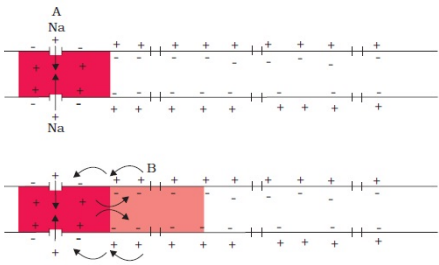
Examine the following diagram and answer the following questions:

Image
i. What is the diagram representing?
ii. When point A becomes permeable to Na¹, what change occurs in the polarity of the membrane.
iii. What is the potential difference at point A called ?
Answer
i. It is representing impulse conduction through an axon.
ii. Na moves inside the membrane and polarity of the membrane is reversed at point A.
iii. The potential difference at point A is known as the action potential.
View full question & answer
Question 33 Marks
What is hypertension? List its causative factors.
Answer
Hypertension is another name for high blood pressure which is the force exerted by the blood against the walls of the blood vessels. The pressure depends on the work being done by the heart and the resistance of the blood vessels.
Some of its Causative factors are:
i. Age: The risk of high blood pressure increases as a person becomes older because the blood vessels become less flexible.
ii. Ethnic background: African-American people have a higher risk of developing hypertension than other people. Hypertens also presents more severely in African-American people and is less responsive to certain medications.
iii. Obesity and being overweight: People who are overweight or have obesity are more likely to develop high blood pressure.
View full question & answer
Question 43 Marks
Write a note on regulation of cardiac activity.
Answer
The normal activities of the heart are intrinsically regulated, i.e., autoregulated by the specialised muscles, (nodal tissue). Thus, the heart is known as a myogenic heart.
The neurogenic heartbeat is initiated by a nerve impulse, e.g., annelids and most arthropods.
The rate of its formation and conduction is regulated by the following
i. Neural Regulation: In medulla oblongata, a special neural centre is present, which can moderate, the cardiac function thro the Autonomic Nervous System (ANS).
ii. Hormonal Regulation: Adrenaline and noradrenaline hormones secreted by the medulla of adrenal gland has a significant role in regulating heartbeat and thus increasing the cardiac output. The noradrenaline accelerates the heartbeat, while adrenaline does this function at the time of emergency
View full question & answer
Question 53 Marks
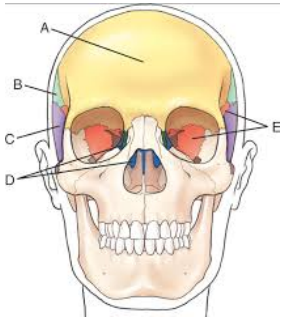
Given below is a diagram of the human cranial bones. Answer the following questions:

Image

i. Identify the different parts labelled from A to E of cranial bones.
ii. Name the only movable bone in the skull of man?
iii. Due to the presence of which pigment skeletal muscles are categorised into red and white muscles?
Answer
1. The different parts of cranial bones are as follows:
1. A-FRONTAL
2. B-PARIETAL
3. C-TEMPORAL
4. D-OCCIPITAL
5. Ε-ΕΤΗΜOID
2. The mandible is the only movable bone in the skull of the man.
3. On the basis of the presence or absence of a red pigment called myoglobin, the skeletal muscles are classified into red and white muscles.
View full question & answer
Question 63 Marks
i. What is meant by bioassay? Name the two bioassays that are used to examine auxin activity in plants.
ii. Name the hormone that acts as an antagonist to abscisic acid. From which microorganism was it extracted initially? List two bioassays of this growth hormone.
Answer
i. A bioassay means "the evaluation of the effect of a substance on a living organism under controlled conditions. "Two bioassays used to examine auxin activity in plants are the following:
a. The avena Curvature Test and
b. Root Growth Inhibition Test.
ii. Abscisic acid (ABA): It is a phytohormone that acts antagonist to gibberellins. Gibberellin was initially extracted from the fungus named Gibberella fujikuroi. Two bioassays of this growth hormone are the following:
a. Shoot elongation is some dwarf stems and
b. Barley Endosperm test.
View full question & answer
Question 73 Marks
Comment upon the habitats and external features of animals belonging to class, amphibia.
Answer
The amphibians are adapted to dual/ double mode of life that is on land as well as in water called amphibians animals. Adults move on land by the limbs and breath by lungs. There are no marine forms. Aquatic forms e.g. Newt and Salamanders have gills. Frogs and toads are terrestrial. Toad occurs on dry land but the frog is found near water in marshy zones. Tree frogs like Hyla and Rhacophorus are arboreal (live on the trees). They do not have a tail but adhesive discs on toes and web, frog produces in water.
View full question & answer
Question 83 Marks
Bryophytes are found in which diverse habitats. Describe briefly.
Answer
Bryophytes commonly grow in moist, shaded areas in hills. These are also called amphibians of the plant kingdom because, these can live in soil, but are dependent on water for sexual reproduction.
Some bryophytes grow in diverse habitats, such as
i. Aquatic, e.g. Riccia, Ricciocarpus, Riella
ii. Epiphyte, e.g. Radula, Dendroceros
iii. Saprophyte, e.g. Buxbaumia, Cryptothalius
iv. Dry habitats, e.g. Polytrichum
v. Deserts, e.g., Tortula desertorum
vi. Dry rocks, e.g., Porella
View full question & answer