Questions · Page 1 of 2

2 Marks Questions

Take a timed test

50 questions · self-marked practice — reveal the answer and mark yourself.

Question 12 Marks
Distinguish between: Dense regular and dense irregular connective tissues.
Answer
 
Dense regular connective tissues
 
Dense irregular connective tissues
1.
In dense regular connective tissues, collagen fibres are present in rows between parallel bundles of fibres.
1.
In dense irregular connective tissues, fibres are arranged irregularly.
2.
They are present in tendons and ligaments.
2.
They are present in the skin.
View full question & answer
Question 22 Marks
Distinguish between the followings: Prostomium and peristomium.
Answer
Prostomium
Peristomium
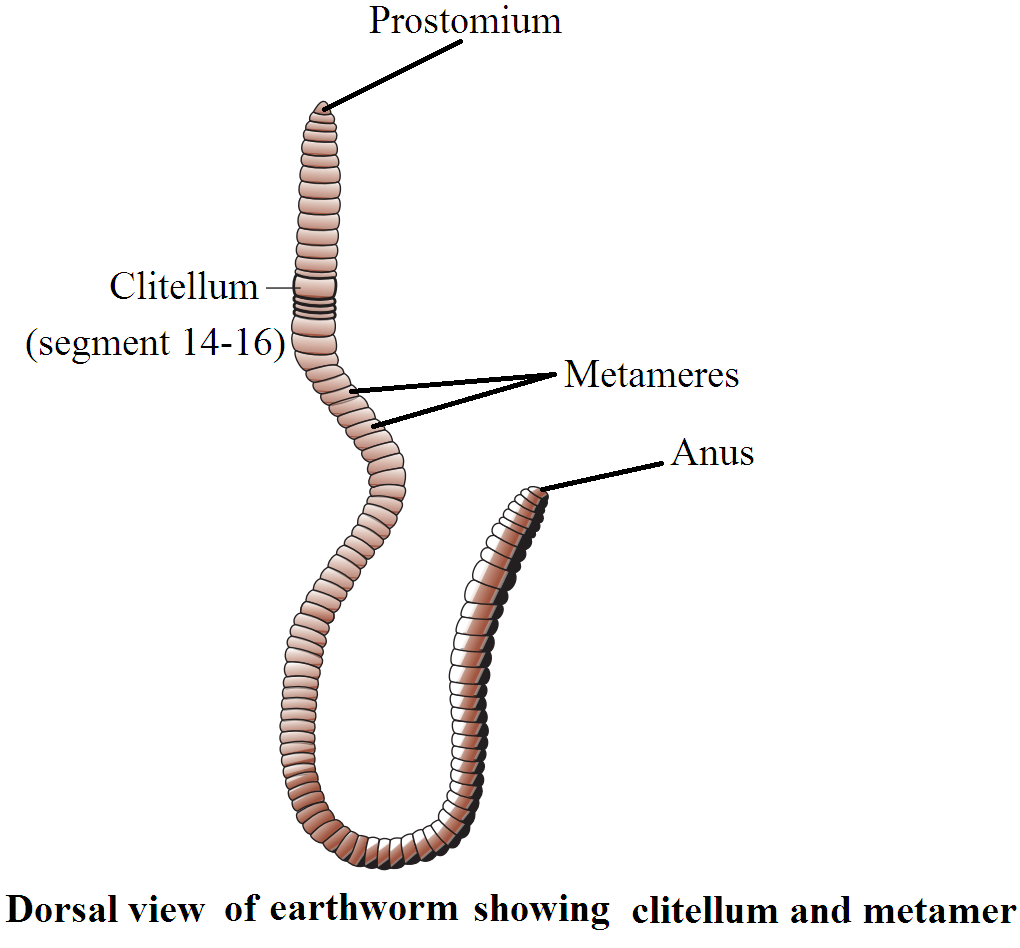
Prostomium is a small fleshy lobe, which overhangs the mouth of an earthworm. It helps the organism push into the soil and is sensory in function.
The first body segment in the earthworm is called the peristomium. It surrounds the mouth opening.
View full question & answer
Question 32 Marks
Distinguish between the followings: Septal nephridium and pharyngeal nephridium.
Answer
Septal nephridium
Septal nephridium
They are present on both sides of inter-segmental septa behind the $15^{th}$ segment. They open into the intestines. They are present as three paired tufts in the fourth, fifth, and sixth segments.
View full question & answer
Question 42 Marks
Describe sensory and motor nerve fibres.
Answer
  1. Afferent (Sensory) Nerve Fibres: The afferent nerve fibres carry the nerve impulses from the sense organs to the central nervous system (brain and spinal cord).
  2. Efferent (Motor) Nerve Fibres: They carry nerve impulses from the central nervous system to the effector organs (muscles and glands).
View full question & answer
Question 52 Marks
Name the type of connective tissue that serves as a support framework for epithelium. Mention the cell types in it.
Answer
Areolar connective tissue serves as a support framework for epithelium. It contains mast cells, macrophages and fibroblasts.
View full question & answer
Question 62 Marks
What is the difference between voluntary and involuntary muscles?
Answer
Striated muscles are also known as voluntary muscles. All those movements which are under our conscious control, are facilitated by voluntary muscles. Smooth muscles are also known as involuntary muscles. All movements, which are beyond our conscious control, are facilitated by involuntary muscles. Cardiac muscle is also involuntary in nature.
View full question & answer
Question 72 Marks
Describe the form, size, colour and symmetry of cockroach.
Answer
Form- Elongated, ovoid, dorsoventrally, flattened body. Size- About 38 mm long and about 12 mm wide. Colour- Brown or black in colour. Symmetry- Bilateral.
View full question & answer
Question 82 Marks
Name the parts of the body where smooth or non-striated muscles are present.
Answer
Smooth muscles are found in the walls of all body viscera i.e., gastrointestinal tract, respiratory tract, urinary tract, reproductive tract. They are therefore, also called visceral muscles. These muscles are also present in the walls of blood vessels, dermis, iris and ciliary body of the eye, etc.
View full question & answer
Question 92 Marks
Name the different cell junctions found in tissues.
Answer
Different cell junctions found in tissues are followed:
  1. Tight junctions.
  2. Adhering junctions.
  3. Gap junctions.
View full question & answer
Question 102 Marks
Distinguish between: Vital capacity and Total lung capacity.
Answer
 
Vital capacity
(VC)
 
Total lung capacity
(TLC)
1.
It is the maximum volume of air that can be exhaled after a maximum inspiration. It includes IC and ERV.
1.
It is the volume of air in the lungs after maximum inspiration. It includes IC, ERV, and residual volume.
2.
It is about 4000 mL in the human lungs.
2.
It is about 5000 – 6000 mL in the human lungs.
View full question & answer
Question 112 Marks
Answer the following:
  1. Name the excretory organs of cockroach.
  2. Where are these located?
  3. What is their function?
  4. Which other excretory organs also help in excretion?
Answer
  1. Malpighian tubules.
  2. The Malpighian tubules are located at the junction of midgut and hindgut.
  3. They collect the nitrogenous wastes from the body fluid, convert them into uric acid and pass it into the hindgut.
  4. Nephrocytes, fat bodies and urecose glands also help in excretion.
View full question & answer
Question 122 Marks
What are the terms given below are related to? Also Explain the terms:
  1. Coxa.
  2. Trochanter.
Answer
These are the parts of legs of cockroach.
  1. Coxa: It is a small, hard podomere, which articulates with the thoracic segment in between the pleuron and the sternum.
  2. Trochanter: It is a hard, small podomere which lies next to the coxa.
View full question & answer
Question 132 Marks
Where are sderites present in cockroach?
Answer
In each segment of cockroach body, i.e., head, thorax and abdomen, exoskeleton has hardened plates called sclerites, that are joined to each other by thin and flexible arthrodial membrane.
View full question & answer
Question 142 Marks
How is the lymph formed? What is its composition?
Answer
Lymph is derived from the tissue fluid by means of fine and irregular lymph capillaries. Though the composition of the lymph varies, about 94% of the lymph is water and 6% is dissolved substances, i.e., proteins, fat drops, carbohydrates, non-protein nitrogenous wastes, hormones, inorganic salts, gases, etc.
View full question & answer
Question 152 Marks
What are glandular epithelium? Give one example of each of the two types of glandular epithelium.
Answer
The columnar or aiboidal epithelial cells which are specialised for secretion constitute glandular epithelium.Example:
Unicellular - goblet cells in alimentary canal Multicellular - salivary glands
View full question & answer
Question 162 Marks
Describe the features of exoskeleton of cockroach.
Answer
The entire body of cockroach is covered by a hard chitinous exoskeleton(brown in colour) made of tough plates called sclerites. These are formed of chitin, a polymer of acetoglucosamine polysaccharide molecule. The exoskeleton protects the body and provides space for the attachment of muscles.
View full question & answer
Question 172 Marks
What is the unique feature of cardiac muscles? Explain.
Answer
The intercalated discs are unique and distinguishing features of the cardiac muscles. They are dark and zig-zag partitions between the adjacent cardiac muscle cells. These discs serve as the firm adhesion between the adjacent cells, electrical coupling to spread the excitation as well as contraction.
View full question & answer
Question 182 Marks
How will you distinguish between tendons and ligaments?
Answer
Differences between tendons and ligaments are:
S. No.
Tendons
Ligaments
1.
The tendons are dense regular connective tissues, which attach the muscles to bones.
The ligaments are dense regular connective tissues, which attach the bones at the joints.
2.
It is formed of white fibrous connective tissue
It is formed of yellow elastic connective tissue.
View full question & answer
Question 202 Marks
How is a brood pouch formed in a female cockroach? Name the parts present it.
Answer
  1. Brood pouch in a female cockroach is formed by the boat-shaped 7th sternum and the 8th and 9th sterna.
  2. It contains a gonopore at its anterior end, spermathecal pores and collaterial glands.
View full question & answer
Question 212 Marks
How does a gap junction facilitate intercellular communication?
Answer
Gap junctions facilitate intercellular communication by allowing small signaling molecules to pass from cell to cell. These are fine hydrophilic channels between two adjacent animal cells that are formed with the help of two protein cylinders called connexus. Each connexus consists of six proteins subunits that surround a hydrophilic channel. pH and concentration controls, opening or closing of channels.
View full question & answer
Question 222 Marks
Name the type of epithelium found in the proximal convoluted tubule of nephrons. What is the advantage of this tissue being present there?
Answer
  1. Brush-bordered cuboidal epithelium is present in the PCT.
  2. Here, its main function is absorption of substances from the filtrate.
  3. The microvilli on the cells increase the surface area for absorption.
View full question & answer
Question 232 Marks
Name the specific tissue that lines the bronchioles. State any one advantage of this tissue being present there.
Answer
  1. Ciliated epithelium lines the bronchioles.
  2. The ciliary movement propels the particles, free cells or mucus in a specific direction over the epithelial surface.
View full question & answer
Question 242 Marks
Where are tendons and sheets of white fibrous connective tissue located? What role they play in tissue?
Answer
Sheets are located in the dermis of skin, periosteum of the bone, perichondrium of cartilage, pericardium of heart, etc. Sheets provide strength. Tendons are located between skeletal muscles and bones. They connect muscles with bones.
View full question & answer
Question 252 Marks
Name the tissue that performs the following functions:
  1. Coagulation.
  2. Transmission of message.
  3. Clearing dead cells.
  4. Haemopoiesis.
Answer
  1. Blood platelets.
  2. Nervous tissue.
  3. Monocytes (blood), macrophages (cells of connective tissue).
  4. Red bone marrow (skeletal tissue).
View full question & answer
Question 262 Marks
Earthworms are bisexual, still the self-fertilisation is not possible in them. Explain.
Answer
Earthworms are protandrous, i.e., the testes mature earlier than the ovaries. Self-fertilisation is not possible in them because of the relative position of the openings of male and female reproductive organs.
View full question & answer
Question 272 Marks
How is a brood pouch formed in a female cockroach? Name the parts present in it.
Answer
  1. Brood pouch in a female cockroach is formed by the boat-shaped 7th sternum and the 8th and 9th sterna.
  2. It contains a gonopore at its anterior end, spermathecal pores and collaterial glands.
View full question & answer
Question 282 Marks
Write four functions of bones.
Answer
  1. They provide place for attachment of muscles and help in movement and locomotion.
  2. Bone marrow is the site of manufacture of blood cells.
  3. Bones provide protection and support to the soft tissues/ organs.
  4. The long bones of the limbs serve the weight bearing function.
  5. They provide the main structural frame of the body.
View full question & answer
Question 292 Marks
Differentiate between smooth muscles and cardiac muscles.
Answer
 
Smooth Muscles
Cardiac Muscles
1
Cells are spindle shaped.
Cells are cylindrical and branched.
2
Striations are absent.
Striations are present, but faint.
3
Intercalated discs are absent.
Intercalated discs are present.
4
They do not have automatic rhythmicity.
They have automatic rhythmicity.
View full question & answer
Question 302 Marks
Differentiate between bone and cartilage.
Answer
S.No.
Bone
Cartilage
1
It is a solid, non- pliable connective tissue.
It is a solid, pliable connective tissue.
2
Osteocytes occur singly in a lacuna.
Chondrocytes occur in clusters of 2 or 3 in each lacuna.
3
Matrix is deposited with salts of calcium and phosphorus.
No calcium and phosphorus salts are present in the matrix.
4
Haversian systems are present.
Haversian systems are absent.
5
Matrix is in the form of concentric lamellae.
Matrix does not show any concentric lamellae.
View full question & answer
Question 312 Marks
How is the gizzard in the alimentary canal of a cockroach suitable for grinding the food?
Answer
  1. The gizzard has an outer layer of thick circular muscles.
  2. The inner thick layer of cuticle forms six chitinous plate-like teeth.
  3. The movement with the help of muscles and the teeth-like structures help in grinding the food.
View full question & answer
Question 322 Marks
What is the difference between cutaneous and pulmonary respiration?
Answer
Cutaneous respiration means diffusion of gases through the skin. This type of respiration occurs in insects which have no respiratory organs. Pulmonary respiration is the respiration through lungs. For example: Humans, etc.
View full question & answer
Question 332 Marks
State the number of segments in earthworm which are covered by a prominent dark band or clitellum.
Answer
Segments 14-16 are covered by a prominent dark band of glandular tissue called clitellumin a mature earthworm. This secretes mucus and albumen that help formation of cocoon and is used for fertilization of eyes and sperms.
View full question & answer
Question 342 Marks
From where the given structures originate?
  1. Axon.
  2. Osteocytes.
  3. Chondroblasts.
  4. Tendons.
Answer
  1. Axon: It is a very long fibre that develops from the cyton of a single neuron.
  2. Osteocytes: These are the bone cells that occur entrapped inside the matrix.
  3. Chondroblasts: These are the special resident cells of the skeletal connective tissue.
  4. Tendons: These are white fibrous cords, which connect muscles to bones.
View full question & answer
Question 352 Marks
Explain the terms:
  1. sclerites.
  2. arthroidal membrane.
Answer
  1. Sclerites: The body of cockroach is externally covered by hard brown chitinous plates called sclerites, which constitute the exoskeleton.
  2. Arthroidal membrane: The sclerites are joined with one another by thin flexible, soft articular membrane called arthroidal membrane.
View full question & answer
Question 362 Marks
Describe the features of exoskeleton of cockroach.
Answer
The entire body of cockroach is covered by a hard chitinous exoskeleton (brown in colour) made of tough plates called sclerites. These are formed of chitin, a polymer of acetoglucosamine polysaccharide molecule.The exoskeleton protects the body and provides space for the attachment of muscles
View full question & answer
Question 372 Marks
What is the location of testes in cockroach? Why male cockroach releases a musky odour and from where it is released?
Answer
Testes in cockroach are located under the $5^{\text {th }}$ and $6^{\text {th }}$ abdominal terga. The musky odour comes from the secretions of conglobate gland in male cockroach. This odour enables the female cockroach to locate the male cockroach for mating.
View full question & answer
Question 382 Marks
Define the terms me:
  1. Setae.
  2. Nephridia.
  3. Srmathecae.
Answer
  1. Locomotory organs of earthworm.
  2. Excretory organs of earthworm.
  3. Study segmentation in the morphology of earthworm.
View full question & answer
Question 392 Marks
Mention four sites in an adult human body, where cartilage is present.
Answer
  1. Tip of nose.
  2. Pinna of ear.
  3. Between adjacent vertebrae in the vertebral column.
  4. Joints in the limbs.
View full question & answer
Question 402 Marks
How is ciliated epithelium different from brush bordered epithelium?
Answer
S. No.
Ciliated Epithelium
Brush-Bordered Epithelium
1
The cells bear cilia on their free surface.
The cells bear microvilli on their free surface.
2
Ciliated epithelium helps in the movement of substances by the ciliary action in a particular direction.
Microvilli increase the area of absorption.
View full question & answer
Question 412 Marks
What is pseudostratified epithelium?
Answer
Pseudostratified epithelium is a type of simple epithelium tissues.
View full question & answer
Question 422 Marks
Write the location of neuroglia cells. List their functions.
Answer
Neuroglia cells are packed around the neurons in brain, spinal cord and ganglia. Neuroglia cells have various functions like myeline formation, transport of materials to neurons, maintenance of ionic balance and phagocytosis.
View full question & answer
Question 432 Marks
The body of sponges does not possess tissue level of organization though it is made of thousands of cells. Comment.
Answer
The level of organization in sponges is of cellular level. The cells in sponges do not organize to form tissue, although they possess thousands of independently associated cells. The cells may be solitary or colonial and function more or less independently. The cells show division of labor for performing specialized functions.
View full question & answer
Question 442 Marks
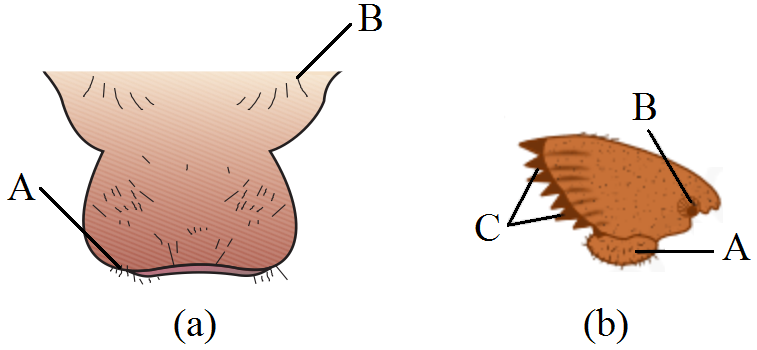
Identify the following mouth parts of cockroach and label (A, B) and (C) in both (a) and (b).
Answer
  1. Labrum- A- Sensory setae B-Muscles.
  2. Mandible– A– Prostheca, B-Condyle, C-Denticles.
View full question & answer
Question 452 Marks
Match the followings and choose the correct option.
S. No.
Adipose tissue
S. No.
Nose
A.
Fluid connective tissue
1.
Blood
B.
Hyaline cartilage
2.
Skin
D.
Stratified epihelium
3.
Fat storage
C.
Stratified epithelium
4.
Fat storage
 
 
A
B
C
D
(a)
1
2
3
4
(b)
4
2
1
3
(c)
3
1
4
2
(d)
2
1
4
3
Answer
  1. (4), (2), (1), (3).
Explanation:
Adipose tissue stores fat, stratified epithelium forms the upper layer of skin, hyaline cartilage is a part of nose and blood is a type of fluid connective tissue.
View full question & answer
Question 462 Marks
Why are blood, bone and cartilage called connective tissue?
Answer
Connective tissue connects different tissues or organs and provides support to various structures of animal body. Bone and cartilage are called connective tissues because they support and protect the various organs. Blood is a fluid connective tissue which transports the materials from one place to the other.
View full question & answer
Question 472 Marks
Special venous connection between liver and intestine and between kidney and intestine is found in frog, what are they called?
Answer
Special venous connection between liver and intestine is known as - Hepatic portal system. Special Venous connection between kidney and intestine is known as - Renal portal system.
View full question & answer
Question 482 Marks
What are the two types of fibres found in the connective tissue? Mention their functions.
Answer
  1. Collagen fibres and elastin fibres are found in the connective tissue.
  2. They provide tensile strength, flexibility and elasticity to the tissues.
  3. They also prevent displacement of organs.
View full question & answer
Question 492 Marks
Stratified epithelial cells have limited role in secretion. Justify their role in our skin.
Answer
As the name suggests, stratified epithelium is made up of many strata of layers. The main role of stratified epithelium is protection against mechanical and chemical stresses. Hence, this tissue has limited role in secretion.
View full question & answer
Question 502 Marks
Mention the role of crop, gizzard, tracheoles and compound eyes in cockroach.
Answer
Crop: It stores the food temporarily. Gizzard: It is the site where the food particles are ground. Tracheoles: Exchange of gases occurs in these. Compound eyes: They are meant for nocturnal vision (mosaic vision)
View full question & answer