Question 12 Marks
Nitric oxide reacts with $Br _2$ and gives nitrosyl bromide as per reaction given below :
$2 NO ( g )+ Br _2(g) \rightleftharpoons 2 NOBr ( g )$
When 0.087 mol of NO and 0.0437 mol of $Br _2$ are mixed in a closed container at constant temperature, 0.0518 mol of NOBr is obtained at equilibrium. Calculate equilibrium amount of NO and $Br _2$.
Answer$2 NO ( g )+ Br _2(g) \longrightarrow 2 NOBr ( g )$
According to stoichiometry, 2 mole of NO react with 1 mole of $Br _2$ and form 2 mole of NOBr .

Moles at equilibrium $0.087- x 0.0437-\frac{ x }{2} \quad x$
(as $x=0.0518$ given)
Hence on equilibrium
$\begin{array}{l}{[ NO ]=0.087-0.0518= 0 . 0 3 5 2 ~ m o l } \\ {\left[ Br _2\right]=0.0437-\frac{0.0518}{2}= 0 . 0 1 7 8 ~ m o l }\end{array}$ View full question & answer→Question 22 Marks
What is the minimum volume of water required to dissolve 1 gm of calcium sulphate at 298 $K ?\left(\right.$ For calcium sulphate, $\left.K_{\text {sp }}=9.1 \times 10^{-6}\right)$
View full question & answer→Question 32 Marks
Explain why pure liquids and solids can be ignored while writing the equilibrium constant expression?
AnswerFor pure liquid or solid :
$=\frac{\text { Moles of substance }}{\text { Volume of substance }}=\frac{\text { Mass of substance }}{\text { Molar mass } \times \text { Volume }}$
$=\frac{\text { Density of substance }}{\text { Molar mass }}$
At constant temperature the density and molar mass of pure liquid and solid are constants. Hence, molar concentration will be constant and this do not depend on quantity of substance. Hence while writing equilibrium constant expression pure liquids and solids are neglected.
View full question & answer→Question 42 Marks
The solubility product constant of $Ag _2 CrO _4$ and AgBr are $1.1 \times 10^{-12}$ and $5.0 \times 10^{-13}$ respectively. Calculate the ratio of the molarities of their saturated solutions.
Answer(i) $Ag _2 CrO _4(s) \rightleftharpoons \underset{2 s}{2 Ag ^{+}( aq )}+\underset{ s }{ CrO _4^{2-}( aq )}$
$\begin{array}{l} K _{ sp }=\left[ Ag ^{+}\right]^2\left[ CrO _4^{2-}\right] \\ K _{ sp }=(2 s)^2(s)=4 s^3\end{array}$
$s =\left(\frac{ K _{ sp }}{4}\right)^{\frac{1}{3}}=\left(\frac{1.1 \times 10^{-12}}{4}\right)^{\frac{1}{3}}=6.5 \times 10^{-5} M$
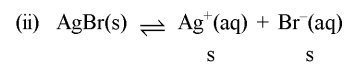
$K_{s p}=s^2, s=\sqrt{K_{s p}}$
$s =\left(5.0 \times 10^{-13}\right)^{\frac{1}{2}}=7.07 \times 10^{-7} M$
Ratio of molarity $=\frac{\left[ Ag _2 CrO _4\right]}{[ AgBr ]}$
$=\frac{6.5 \times 10^{-5}}{7.07 \times 10^{-7}}=91.9$ View full question & answer→Question 52 Marks
Calculate the pH of the resultant mixture :
10 mL of $0.01 M H _2 SO _4+10 mL$ of 0.01 M $Ca ( OH )_2$
AnswerMillimoles of $H _2 SO _4=10 \times 0.01=0.1$
Millimoles of $Ca ( OH )_2=10 \times .01=0.1$
$\begin{array}{cl} Ca ( OH )_2 & + H _2 SO _4 \longrightarrow CaSO _4+2 H _2 O \\ 0.1 & 0.1\end{array}$
In mixture of $Ca ( OH )_2$ and $H _2 SO _4$ millimoles are equal.
Hence solution will be neutral.
Hence $\quad pH =7$
View full question & answer→Question 62 Marks
Ionic product of water at 310 K is $2.7 \times$ $10^{-14}$. What is the pH of neutral water at this temperature?
AnswerIonic product of water :
$K _{ w }=\left[ H _3 O ^{+}\right]\left[ OH ^{-}\right]$
For pure water $\left[ H _3 O ^{+}\right]=\left[ OH ^{-}\right]$
Hence $K _{ w }=\left[ H _3 O ^{+}\right]^2$
$\left[ H _3 O ^{+}\right]=\sqrt{ K _{ w }}=\sqrt{2.7 \times 10^{-14}}$
$=1.643 \times 10^{-7} mol L ^{-1}$
$pH =-\log \left[ H ^{+}\right]=-\log \left[ H _3 O ^{+}\right]$
$=-\log \left(1.643 \times 10^{-7}\right)$
$=7-\log (1.643) \quad(\log 1.643=0.2156)$
$pH =7-0.2156=6.78$
$pH =6.78$
View full question & answer→Question 72 Marks
A 0.02 M solution of pyridinium hydrochloride has $pH =3.44$. Calculate the ionization constant of pyridine.
Answer
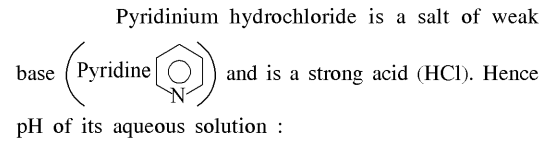
$pH =\frac{1}{2}\left( pK _{ w }- pK _{ b }-\log c \right)$
$pH =3.44 \quad c =0.02$
$3.44=\frac{1}{2}\left(14+\log K_b-\log 0.02\right)$
$6.88=14+\log K_b+1.7$
$\log K_b=6.88-14-1.7$
$\log K_b=-8.82=\overline{9} \cdot 18$
$K _{ b }=\operatorname{antilog} \overline{9} \cdot 18=1.5 \times 10^{-9}$
$K _{ b }=1.5 \times 10^{-9}$ $\qquad$ antilog $0.18=15$ View full question & answer→Question 82 Marks
The ionization constant of nitrous acid is $4.5 \times 10^{-4}$. Calculate the pH of 0.04 M sodium nitrite solution and also its degree of hydrolysis.
AnswerSodium nitrite $\left( NaNO _2\right)$ is a salt made of a strong base $( NaOH )$ and a weak acid $\left( HNO _2\right)$ and the degree of hydrolysis for it $=h$
$h =\sqrt{\frac{ K _{ W }}{ K _{ a } \times c }}=\sqrt{\frac{1 \times 10^{-14}}{4.5 \times 10^{-4} \times 0.04}}$,$h =2.36 \times 10^{-5}$
$\left( c =0.04 M , K _{ a }=4.5 \times 10^{-4}\right)$
Formula of $pH :( WA + SB )$
$pH =\frac{1}{2}\left[ pK _{ w }+ pK _{ a }+\log c \right]$
$pH =\frac{1}{2}\left[14-\log \left(4.5 \times 10^{-4}\right)+\log 0.04\right]$
$pH =\frac{1}{2}[14+3.3468-1.398]$
$(\log 4.5=0.6532$ and $\log 0.04=-1.398)$
$pH =7.97$
View full question & answer→Question 92 Marks
Calculate the pH of the solution :
1 mL of 13.6 M HCl is diluted with water to give 1 litre of solution.
AnswerFor $HCl , M = N$ (normality)
$N _1 V_1= N _2 V_2$
$\begin{array}{r} N _1=13.6, \quad N_2=?, \quad V_1=1 ml \\ V _2=100 mL(1 \text { lit. })\end{array}$
On increasing ionisation concentration will decrease
$\begin{array}{l}13.6 \times 1= N _2 \times 1000 \\ N_2=1.36 \times 10^{-2}\end{array}$
$[ HCl ]=\left[ H ^{+}\right]= N _2=1.36 \times 10^{-2}$
$\begin{array}{l} pH =-\log \left(1.36 \times 10^{-2}\right) \\ pH =2-\log 1.36 \quad(\log 1.36=0.1335) \\ pH =2-0.1335\end{array}$
$\begin{array}{r} pH =1.866 \\ pH =1.87\end{array}$
View full question & answer→Question 102 Marks
Calculate the pH of the solution :
0.3 g of NaOH dissolved in water to give 200 mL of solution.
AnswerConcentration of NaOH
$[ M ]=\frac{0.3 g}{40 g mol ^{-1} \times 0.2 L}=3.75 \times 10^{-2}$
$( V =200 ml =0.2 L)$
$($ Molar mass of $NaOH =40)$
$[ NaOH ]=\left[ OH ^{-}\right]=3.75 \times 10^{-2}$
(strong base)
$\left[ H ^{+}\right]=\frac{1 \times 10^{-14}}{3.75 \times 10^{-2}}$
$\left[ H ^{+}\right]=2.66 \times 10^{-13}$
$pH =-\log 10^{-13}-\log 2.66$
$pH =13-0.4249$
$pH =12.57(\log 2.66=0.4249)$
View full question & answer→Question 112 Marks
Calculate the pH of the solution :
0.3 g of $Ca ( OH )_2$ dissolved in water to give 500 mL of solution.
AnswerMolarity of $Ca ( OH )_2$
$( M )=\frac{0.3 g}{74 g mol ^{-1} \times 0.5 L}$
$\begin{array}{l}\left(\text { Molar mass of } Ca ( OH )_2=74\right) \\ \qquad M =8.108 \times 10^{-3} M \end{array}$
$( V =500 ml =0.5 L)$
$Ca ( OH )_2 \stackrel{+ H _2 O }{\rightleftharpoons} Ca ^{2+}+2 OH ^{-}$
$\left(100 \%\right.$ ionisation) $\left[ OH ^{-}\right]=2 \times M$
$=2 \times\left(8.108 \times 10^{-3}\right)$
$\left[ OH ^{-}\right]=1.6216 \times 10^{-2}$
$\left[ H ^{+}\right]=\frac{10^{-14}}{1.6216 \times 10^{-2}}=6.166 \times 10^{-13}$
$pH =-\log \left[ H ^{+}\right]$
$pH =-\log \left(6.166 \times 10^{-13}\right)$
$pH =13-\log 6.166(\log 6.166=0.7830)$
$pH =13-0.7830$
$pH =12.21$
View full question & answer→Question 122 Marks
Calculate the pH of the solution :
2 g of TlOH dissolved in water to give 2 litre of solution.
AnswerMolarity of TlOH
$( M )=\frac{\text { Mass of substance }( g )}{\text { Molar mass }\left( g mol ^{-1}\right) \times \text { Volume }( L )}$
$($ Molar mass of $TlOH =221)$
$M =\frac{2(g)}{221 g mol ^{-1} \times 2(L)}=4.52 \times 10^{-3} M$
$\begin{aligned} {\left[ OH ^{-}\right]=[ TlOH ]=4.52 } & \times 10^{-3} M \\ & (100 \% \text { ionisation })\end{aligned}$
$\left[ H ^{+}\right]=\frac{ K _{ w }}{\left[ OH ^{-}\right]}=\frac{1 \times 10^{-14}}{4.52 \times 10^{-3}}=2.21 \times 10^{-12}$
$pH =-\log \left[ H ^{+}\right]$
$pH =-\log \left(2.21 \times 10^{-12}\right)$
$pH =12-\log 2.21 \quad(\log 2.21=0.3424)$
$pH =12-0.3424=11.65$
View full question & answer→Question 132 Marks
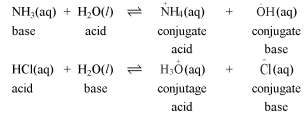
The species : $H _2 O , HCO _3^{-}, HSO _4^{-}$and $NH _3$ can act both as Bronsted acids and bases. For each case give the corresponding conjugate acid and base.
View full question & answer→Question 142 Marks
What is meant by the conjugate acidbase pair? Find the conjugate acid/base for the following species :
$HNO _2, CN ^{-}, HCIO _4, F^{-}, OH ^{-}, CO _3^{-2}$, and $S ^{2-}$
AnswerIn a pair of acid and base when there is a difference of one proton then it is known as conjugate acid-base pair. On decreasing one proton from acid, conjugate base and on adding one proton to base, conjugate acid will form.| $HNO _2$ | Conjugate base $NO _2^{-}$ | $OH ^{-}$ | Conjugate acid $H _2 O$ |
| $CN ^{-}$ | Conjugate acid HCN | $CO _3^{-2}$ | Conjugate acid $HCO _3^{-}$ |
| $HClO _4$ | Conjugate base $ClO _4^{-}$ | $S ^{-2}$ | Conjugate acid $HS ^{-}$ |
| $F ^{-}$ | Conjugate acid HF | | |
View full question & answer→Question 152 Marks
The reaction, $CO ( g )+3 H _2(g) \rightleftharpoons CH _4(g)$ $+ H _2 O ( g )$ is at equilibrium at 1300 K in a 1 L flask. It also contain 0.30 mol of $CO , 0.10 mol$ of $H _2$ and 0.02 mol of $H _2 O$ and an unknown amount of $CH _4$ in the flask. Determine the concentration of $CH _4$ in the mixture. The equilibrium constant, $K_c$ for the reaction at the given temperature is $3 . 9 0$.
AnswerFor this reaction :
$K _{ c }=\frac{\left[ CH _4\right]\left[ H _2 O \right]}{[ CO ]\left[ H _2\right]^3}$
$V =1$ litre, Hence moles are mol $L ^{-1}$.
$K _{ c }=3.90,\left[ CH _4\right]=?, \quad\left[ H _2 O \right]=0.02$
$[ CO ]=0.30,\left[ H _2\right]=0.1$
On putting values :
$3.90=\frac{\left[ CH _4\right][0.02]}{[0.30][0.1]^3}$
$\left[ CH _4\right]=\frac{3.90 \times 0.30 \times[0.1]^3}{.02}$
$\left[ CH _4\right]=5.85 \times 10^{-2} M$
View full question & answer→Question 162 Marks
The value of $K_c$ for the reaction $3 O_2(g)$ $\rightleftharpoons 2 O _3(g)$ is $2.0 \times 10^{-50}$ at $25^{\circ} C$. If the equilibrium concentration of $O _2$ in air at $25^{\circ} C$ is $1.6 \times 10^{-2}$, what is the concentration of $O _3$ ?
AnswerFor reaction $3 O _2(g) \rightleftharpoons 2 O _3(g)$
$K _{ c }=2.0 \times 10^{-50},\left[ O _2\right]=1.6 \times 10^{-2}$
$K _{ c }=\frac{\left[ O _3\right]^2}{\left[ O _2\right]^3}, 2.0 \times 10^{-50}=\frac{\left[ O _3\right]^2}{\left(1.6 \times 10^{-2}\right)^3}$
$\left[ O _3\right]^2=\left(2.0 \times 10^{-50}\right) \times\left(1.6 \times 10^{-2}\right)^3$
$\left[ O _3\right]^2=8.19 \times 10^{-56}$
$\left[ O _3\right]=2.86 \times 10^{-28} M$
View full question & answer→Question 172 Marks
Dihydrogen gas used in Haber's process is produced by reacting methane from natural gas with high temperature steam. The first stage of two stage reaction involves the formation of CO and $H _2$. In second stage, CO formed in first stage is reacted with more steam in water gas shift reaction,
$CO ( g )+ H _2 O ( g ) \rightleftharpoons CO _2(g)+ H _2(g)$
If a reaction vessel at $400^{\circ} C$ is charged with an equimolar mixture of CO and steam such that $p _{ co }=$ $p _{ H _2 O }=4.0$ bar, what will be the partial pressure of $H _2$ at equilibrium? $K _{ p }=10.1$ at $400^{\circ} C$.
Answer
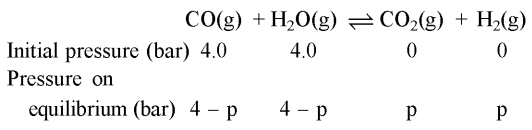
(Let partial pressure of $H _2$ on equilibrium $= p$ bar)
$K_p=\frac{p_{ CO _2} \times p_{ H _2}}{p_{ CO } \times p_{ H _2 O }}=\frac{p \times p}{(4-p)(4-p)}$
$K_p=\frac{p^2}{(4-p)^2}$
$10.1=\frac{p^2}{(4-p)^2}$
$\sqrt{10.1}=\frac{p}{4-p}$
$3.18=\frac{p}{4-p}, p=3.04$ bar
Hence $\quad p_{ H _2}=3.04$ bar View full question & answer→Question 182 Marks
At a certain temperature and total pressure of $10^5 Pa$, iodine vapour contains $40 \%$ by volume of I atoms
$
I _{ 2 }( g ) \rightleftharpoons 2 I ( g )
$
Calculate $K_p$ for the equilibrium.
AnswerMoles of $I_2$ and I are proportional to volume. According to question ratio of $I _2$ and $I 60: 40$ (3:2)
Total moles $=3+2=5$
Partial pressure of $I _2$
$=\frac{\text { Moles of } I _2}{\text { Total moles }} \times p ($ total pressure $)$
$=\frac{3}{5} \times 10^5 Pa=6 \times 10^4 Pa$
Partial pressure of $(I)=\frac{2}{5} \times 10^5 Pa$
$=4 \times 10^4 Pa$
For reaction $I _2(g) \rightleftharpoons 2 I ( g )$
$K _{ p }=\frac{\left( p _{ I }\right)^2}{ p _{ I _2}}=\frac{\left(4 \times 10^4\right)^2}{6 \times 10^4}=2.666 \times 10^4$
$=2.67 \times 10^4$
$K_p=2.67 \times 10^4$
View full question & answer→Question 192 Marks
Describe the effect of :
(a) addition of $H _2$
(b) addition of $CH _3 OH$
(c) removal of CO
(d) removal of $CH _3 OH$
on the equilibrium of the reaction :
$
2 H_2(g)+CO(g) \rightleftharpoons CH_3 OH(g)
$
Answer(i) On adding $H _2$ equilibrium moves in forward direction.
(ii) On increasing $CH _3 OH$, equilibrium moves in backward direction.
(iii) On removing CO , equilibrium moves in backward direction.
(iv) On removing $CH _3 OH$, reaction will proceed in backward direction.
View full question & answer→Question 202 Marks
Dihydrogen gas is obtained from natural gas by partial oxidation with steam as per following endothermic reaction :
$CH _4(g)+ H _2 O ( g ) \rightleftharpoons CO ( g )+3 H _2(g)$
(a) Write as expression for $K_p$ for the above reaction.
(b) How will the values of $K_p$ and composition of equilibrium mixture be affected by
(i) increasing the pressure
(ii) increasing the temperature
(iii) using a catalyst?
Answer(a) $K _{ p }=\frac{ p _{ CO } \times\left( p _{ H _2}\right)^3}{ p _{ CH _4} \times p _{ H _2 O }}$
(b) (i) According to Le Chatelier's principle, on increasing pressure equilibrium will proceed in backward direction (moles of gases are less) but there will be no effect on $K_p$ and equilibrium composition also remain unaffected.
(ii) This reaction is endothermic. Hence, on increasing temperature, reaction will move in forward direction and value of $K_p$ increases. Hence, equilibrium composition will be effected and concentration of product will be more.
(iii) There will be no effect of catalyst on $K_p$ and equilibrium composition remains same. But in presence of catalyst equilibrium is gained soon.
View full question & answer→Question 212 Marks
Does the number of moles of reaction products increase, decrease or remain same when each of the following equilibria is subjected to a decrease in pressure by increasing the volume?
(a) $PCl _5(g) \rightleftharpoons PCl _3(g)+ Cl _2(g)$
(b) CaO (s) $+ CO _2$ (g) $\rightleftharpoons CaCO _3$ (s)
(c) $3 Fe ( s )+4 H _2 O ( g ) \rightleftharpoons Fe _3 O _4(s)+4 H _2(g)$
AnswerAccording to Le Chatelier's principle :
(a) On reducing pressure rate of forward reaction increases. Hence, number of moles of product increases.
(b) On reducing pressure, rate of backward reaction increases. Hence moles of product decreases.
(c) There will be no effect of pressure on this reaction as number of moles remains constant ( $\Delta n ( g )$ $=0$ ).
View full question & answer→Question 222 Marks
Calculate (a) $\Delta G^{\ominus}$ and (b) the equilibrium constant for the formation of $NO _2$ from NO and $O _2$ at 298 K
$NO ( g )+\frac{1}{2} O _2(g) \rightleftharpoons NO _2(g)$
where
$\begin{array}{l}\Delta_{ f } G^{\ominus}\left( NO _2\right)=52.0 kJ / mol \\ \Delta_{ f } G^{\ominus}( NO )=87.0 kJ / mol \\ \Delta_{ f } G^{\ominus}\left( O _2\right)=0 kJ / mol \end{array}$
Answer(a) $\Delta_l G^{\ominus}=\Sigma \Delta_l G^{\ominus}{ }_{\text {(product) }}-\Sigma \Delta_l G^{\ominus}{ }_{\text {(reactant) }}$
$=\Delta_{ f } G ^{\ominus}\left( NO _2\right)-\left[\Delta_{ f } G ^{\ominus}( NO )\right.$$\left.+\frac{1}{2} \Delta_1 G^{\ominus}\left(O_2\right)\right]$
$=52.0-\left(87.0+\frac{1}{2} \times 0\right)$
$=-35.0 kJ mol L ^{-1}$
(b) $-\Delta G ^{\ominus}=2.303 RT \log K$
$(-35000)=2.303 \times 8.314 \times 298 \times \log K$
$\log K=6.1341$
$K =$ Antilog $6.1341=1.361 \times 10^6$
View full question & answer→Question 232 Marks
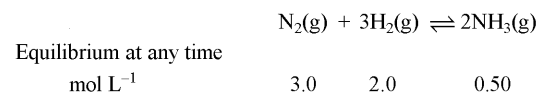
Equilibrium constant, $K_c$ for the reaction $N _2(g)+3 H _2(g) \rightleftharpoons 2 NH _3(g)$ at 500 K is 0.061
At a particular time, the analysis shows that composition of the reaction mixture is $3.0 mol L ^{-1} N_2$, $2.0 mol L ^{-1} H _2$ and $0.5 mol L ^{-1} NH _3$. Is the reaction at equilibrium? If not in which direction does the reaction tend to proceed to reach equilibrium?
View full question & answer→Question 242 Marks
A sample of pure $PCl _5$ was introduced into an evacuated vessel at 473 K . After equilibrium was attained, concentration of $PCl _5$ was found to be $0.5 \times 10^{-1} mol L ^{-1}$. If value of $K _{ c }$ is $8.3 \times 10^{-3}$, what are the concentration of $PCl _3$ and $Cl _2$ at equilibrium?
$PCl _5(g) \rightleftharpoons PCl _3(g)+ Cl _2(g)$
Answer
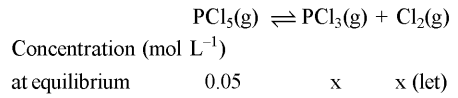
$K _{ c }=\frac{\left[ PCl _3\right]\left[ Cl _2\right]}{\left[ PCl _5\right]}$
$8.3 \times 10^{-3}=\frac{( x )( x )}{[0.05]}$
$\begin{aligned} x ^2 & =8.3 \times 10^{-3} \times 0.05 \\ x & =2 \times 10^{-2}=0.02\end{aligned}$
$\left[ PCl _3\right]= x =0.02 M ,\left[ Cl _2\right]= x =0.02 M$
or $0.02 mol L ^{-1}$ View full question & answer→Question 252 Marks
At 700 K , equilibrium constant for the reaction :
$H _2(g)+ I _2(g) \rightleftharpoons 2 HI ( g )$
is 54.8 . If $0.5 mol L ^{-1}$ of $HI ( g )$ is present at equilibrium at 700 K , what are the concentration of $H _2(g)$ and $I _2(g)$ assuming that we initially started with $HI ( g )$and allowed it to reach equilibrium at 700 K ?
Answer$H _2(g)+ I _2(g) \rightleftharpoons 2 HI ( g )$
Let moles of both $H _2$ and $I _2$ at equilibrium at $=x$
$\begin{array}{llll}\text { Mole at equilibrium } & x & x & 0.5\end{array}$
$K _{ c }=\frac{[ HI ]^2}{\left[ H _2\right]\left[ I _2\right]}=\frac{(0.5)^2}{( x )( x )}$
$54.8=\frac{(0.5)^2}{x^2}, x=0.06754=0.068$
Hence at equilibrium
$\begin{array}{l}{\left[ H _2\right]=0.068 mol L ^{-1}} \\ {\left[ I _2\right]=0.068 mol L ^{-1}}\end{array}$
View full question & answer→Question 262 Marks
One mole of $H _2 O$ and one mole of CO are taken in 10 L vessel and heated to 725 K . At equilibrium $40 \%$ of water (by mass) reacts with CO according to the equation,
$H _2 O ( g )+ CO ( g ) \rightleftharpoons H _2(g)+ CO _2(g)$
Calculate the equilibrium constant for the reaction.
Answer
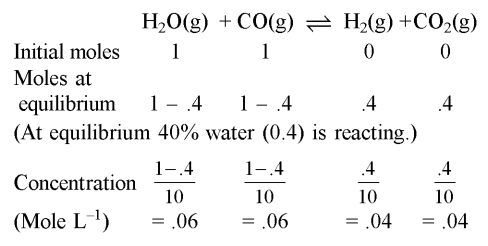
$K _{ c }=\frac{\left[ H _2\right]\left[ CO _2\right]}{\left[ H _2 O \right][ CO ]}=\frac{(.04)(.04)}{(.06)(.06)}$
$K _{ c }=0.44$ View full question & answer→Question 272 Marks
A mixture of 1.57 mol of $N _2, 1.92 mol$ of $H _2$ and 8.13 mol of $NH _3$ is introduced into a 20 L reaction vessel at 500 K . At this temperature, the equilibrium constant, $K_c$ for the reaction $N_2(g)+$ $3 H _2(g) \rightleftharpoons 2 NH _3(g)$ is $1.7 \times 10^2$. Is the reaction mixture at equilibrium? If not, what is the direction of the net reaction?
Answer$N _2(g)+3 H _2(g) \rightleftharpoons 2 NH _3(g)$
$Q _{ c }($ reation quotient $)=\frac{\left[ NH _3\right]^2}{\left[N_2\right]\left[ H _2\right]^3}$
$Q _{ c }=\frac{\left(\frac{8.13 mol L ^{-1}}{20}\right)^2}{\left(\frac{1.57 mol L ^{-1}}{20}\right)\left(\frac{1.92 mol L ^{-1}}{20}\right)^3}$
$=\frac{(8.13)^2 \times(20)^2}{(1.57)(1.92)^3}$
$Q _{ c }=2.379 \times 10^3, \quad K_{ c }=1.7 \times 10^2 K$ (given)
As $Q_{ c } \neq K_{ c }$ Hence it is not in equilibrium.
$Q_{ c }>K_{ c }$ Hence reaction moves in backward direction.
View full question & answer→Question 282 Marks
A sample of $HI ( g )$ is placed in flask at a presence of 0.2 atm . At equilibrium the partial pressure of $HI ( g )$ is 0.04 atm . What is $K _p$ for the given equilibrium?
$2 H I ( g ) \rightleftharpoons H _2( g )+ I _2( g )$
Answer\begin{array}{llcc}
\text { } & 2 HI(g) \rightleftharpoons & H_2(g)+ & I_2(g) \\
\text { Initial pressure } & 0.2 atm & 0 & 0
\end{array}
Let at equilibrium x moles of HI are dissociated.
Pressure at equilibrium $0.2- x \quad \frac{ x }{2} \quad \frac{ x }{2}$
Hence $\quad x=0.16, \frac{x}{2}=0.08$
$K _{ p }=\frac{ p _{ H _2} \times p _{ I _2}}{\left( p _{ HI }\right)^2}=\frac{\frac{ x }{2} \times \frac{ x }{2}}{(0.2- x )^2}$
According to question $(0.2- x =0.04)$
$K _{ p }=\frac{0.08 \times 0.08}{(.04)^2}=4.0$
$K _{ p }=4.0$
View full question & answer→Question 292 Marks
At $450 K, K _{ p }=2.0 \times 10^{10}$ bar for the given reaction at equilibrium.
$2 SO _2(g)+ O _2(g) \rightleftharpoons 2 SO _3(g)$
What is $K_c$ at this temperature?
AnswerFor reaction given in question
$\Delta n(g)=2-3=-1$
$K _{ p }= K _{ c }( RT )^{\Delta n}$
$K _{ c }=\frac{ K _{ p }}{( RT )^{\Delta n }}=\frac{2.0 \times 10^{10} bar }{\left(0.0831 L bar K ^{-1} mol^{-1} bar \times 450 K\right)^{-1}}$
$K_c=2 \times 10^{10}(0.0831 \times 450)$
$K _{ c }=7.47 \times 10^{11} L mol ^{-1}$
$K _{ c }=7.47 \times 10^{11} m^{-1}$
View full question & answer→Question 302 Marks
Capsule of $1 ml ; 1 N HCl$ is breaked and added in a container and volume of solution becomes 1000 ml , then what will be the pH of solution?
Answer$\begin{aligned} \text { Sol. : } & N _1 V_1 \\ 1 \times & = N _2 V_2 \\ 1 \times 1 & = N _2 \times 1000 \\ & N_2\end{aligned}=10^{-3}=\left[ H ^{+}\right]$
View full question & answer→Question 312 Marks
Calculate pH of $10^{-8} N KOH$ solution.
AnswerKOH is a strong acid. For this
$
N=\left[OH^{-}\right]=10^{-8}
$
Hence
$
\begin{array}{l}
pOH=-\log \left[OH^{-}\right] \\
\text {pOH }=-\log 10^{-8} \\
\text { pOH }=8 \text { hence } pH=6
\end{array}
$
This is not possible because pH of base can't be less than 7.
As it is very dilute solution, hence in it $\left[ OH ^{-}\right]$in water must be added which is $10^{-7}$.
$
\begin{array}{ll}
\text { Hence } & {\left[OH^{-}\right]=10^{-7}+10^{-8}} \\
& {\left[OH^{-}\right]=10^{-7}(1+0.1)} \\
& {\left[OH^{-}\right]=10^{-7}(1.1)} \\
& pOH=-\log 10^{-7}-\log 1.1 \\
& pOH=7-(0.0414)(\log 1.1=0.0414) \\
& pOH=7-0.0414 \\
& pOH=6.95 \\
& pOH e \\
& pH=14-pOH \\
& pH=14-6.95=7.05
\end{array}
$
View full question & answer→Question 322 Marks
Calculate pH of 0.01 M HCOONa solution, if value of $K$ is $2 \times 10^{-4}$
AnswerHCOONa, is a salt formed by weak acid and strong base. Hence pH of its solution :
$
\begin{aligned}
pH & =\frac{1}{2} pK_{w}+\frac{1}{2} pK_{a}+\frac{1}{2} \log C \\
K_{w} & =1 \times 10^{-14} \text { Hence } pK_{w}=-\log 10^{-14}=14 \\
pK_{a} & =-\log K_{a}=-\log 10^{-4}-\log 2 \\
pK_{a} & =4-0.3010 \\
pK_{a} & =3.6990
\end{aligned}
$
Hence,
$
\begin{array}{l}
pH=\frac{1}{2}(14)+\frac{1}{2}(3.6990)+\frac{1}{2} \log 10^{-2} \\
pH=7+1.8495+\frac{1}{2}(-2) \\
pH=8.8495-1 \\
pH=7.8495
\end{array}
$
View full question & answer→Question 332 Marks
If in 500 ml of buffer solution 0.004 mole HCl are added then its pH is decreased by 0.04 , then what will be the buffer capacity of buffer solution?
AnswerMoles of HCl formed in 500 ml solution
$
=0.004
$
Hence moles of HCl in 1 lit volume
$
\begin{array}{l}
=2 \times 0.004 \\
=0.008
\end{array}
$
Hence, Buffer capacity $=\frac{\text { Added moles }}{\text { Charge in } pH }$
$
=\frac{0.008}{0.04}=0.2
$
View full question & answer→Question 342 Marks
The dissociation constant of HCOOH and $CH _3 COOH$ is $2 \times 10^{-4}$ and $1.8 \times 10^{-5}$ respectively then calculate the isohydric concentration of HCOOH with $0.03 N CH _3 COOH$.
AnswerFor isohydric solutions :
$
\begin{aligned}
\frac{C_1}{C_2} & =\frac{K_2}{K_1} \\
\frac{C_1}{0.03} & =\frac{1.8 \times 10^{-5}}{2 \times 10^{-4}}
\end{aligned}
$
Concentration of $HCOOH \left( C _1\right)=\frac{0.03 \times 1.8 \times 10^{-5}}{2 \times 10^{-4}}$
$
\begin{array}{l}
\quad=\frac{5.4 \times 10^{-7}}{2 \times 10^{-4}} \\
C_1=2.7 \times 10^{-3}=0.0027 N
\end{array}
$
View full question & answer→Question 352 Marks
Calculate pH of 0.1 M solution of $HCOONH _4$, if $pK _{ a }$ of $HCOOH =3.6$ and $pK _{ b }$ of $NH _4 OH =4.8$.
Answer$HCOONH _4$ is a salt formed by weak acid and weak base. Hence pH of solution :
$
\begin{array}{l}
pH=7+\frac{1}{2} pK_{n}-\frac{1}{2} pK_{b} \\
pH=7+\left(\frac{1}{2} \times 306\right)-\frac{1}{2}(4.8) \\
pH=7+1.8-2.4 \\
pH=6.4
\end{array}
$
View full question & answer→Question 362 Marks
The $K_{\text {sp }}$ of PbS is $4 \times 10^{-28}$. If $\left[ Pb ^{+2}\right]=4 \times$ $10^{-27}$ then what will be the minimum concentration of $S ^{-2}$ to precipitation PbS ?
Answer Where minimum word is used, there ionic product is taken equal to $K _{ sp }$.
$
\begin{aligned}
PbS & \rightleftharpoons Pb^{+2}+S^{-2} \\
K_{sp} & =\left[Pb^{+2}\right]\left[S^{-2}\right] \\
{\left[S^{-2}\right] } & =\frac{K_{sp}}{\left[Pb^{+2}\right]} \\
{\left[S^{-2}\right] } & =\frac{4 \times 10^{-28}}{4 \times 10^{-27}}=10^{-1}
\end{aligned}
$
View full question & answer→Question 372 Marks
If the $K _{\text {sp }}$ of AgCl is $4 \times 10^{-8}$ then in 15 lit of its saturated solution, how much AgCl is added?
Answer$\begin{array}{r}\text { Sol. : } K _{ sp }= s ^2, s=\sqrt{ K _{ sp }}=\sqrt{4 \times 10^{-8}}=2 \times 10^{-4} \\ s=\frac{\text { Mass of } 1 \text { lit. }}{\text { Molecular mass }}, 2 \times 10^{-4}=\frac{x gm }{143.5}\end{array}$
then $\quad x=143.5 \times 2 \times 10^{-4}\left( gm L ^{-1}\right)$
Hence, weight of AgCl in 15 lit. solution
$
\begin{array}{l}
=143.5 \times 2 \times 10^{-4} \times 15 \\
=4.305 \times 10^{-1}
\end{array}
$
View full question & answer→Question 382 Marks
What will be the pH of a mixture of $\frac{ N }{10} HCl$
$
(100 ml)+\frac{N}{2} 20 HNO_3(200 ml)+\frac{M}{60} H_2 SO_4(300 ml) ?
$
Answer$\frac{ M }{60} H _2 SO _4=\frac{1}{60} \times 2=\frac{1}{30} \times N$
all are strong bases. Hence,
$
\begin{array}{l}
NV=N_1 V_1+N_2 V_2+N_3 V_3 \\
N \times 600=\frac{1}{10} \times 100+\frac{1}{20} \times 200+\frac{1}{30} \times 300 \\
{[V=\text { Total volume }=600 ml] } \\
N \times 600=10+10+10 \\
N=\frac{30}{600}=\frac{1}{20}=0.05 \\
=5 \times 10^{-2}=\left[H^{+}\right] \\
pH=2-\log 5 \\
pH=2-0.6990=1.3010(\log 5=0.6990)
\end{array}
$
View full question & answer→Question 392 Marks
In 20 ml 0.2 N KOH , how much ml of 0.1 $N H _2 SO _4$ is added so that solution becomes neutral?
Answer$\begin{aligned} KOH & H _2 SO _4 \\ N_1 V_1 & = N _2 V_2 \\ 0.2 \times 20 & =0.1 \times V _2 \\ V_2 & =40 ml \end{aligned}$
View full question & answer→Question 402 Marks
Two solutions of $pH , 2$ and 3 are mixed in same volume then what will be the pH of resulting solution?
Answer $pH =2$, then $\left[ H ^{+}\right]=10^{-2}$
If $pH =3$, then $\left[ H ^{+}\right]=10^{-3}$
The volume on adding both solutions become doubled. Hence, concentration becomes half.
$
\begin{aligned}
{\left[H^{+}\right] } & =\frac{10^{-2}+10^{-3}}{2} \\
{\left[H^{+}\right] } & =\frac{10^{-2}\left(1+10^{-1}\right)}{2}=\frac{10^{-2} \times 1.1}{2} \\
{\left[H^{+}\right] } & =10^{-2} \times 0.55=10^{-3} \times 5.5 \\
pH & =-\log 10^{-3}-\log 5.5 \\
pH & =3-0.7404 \quad(\log 5.5=0.7404) \\
pH & =2.2596
\end{aligned}
$
View full question & answer→Question 412 Marks
The $\left[ OH ^{-}\right]$of two weak bases are $10^{-1}$ and $10^{-2} mol /$ lit respectively then what will be the ratio of dissociation constants of it?
Answer$
\begin{aligned}
\frac{\left[OH^{-}\right]_1}{\left[OH^{-}\right]_2}=\sqrt{\frac{K_{b_1}}{K_{b_2}}}=\frac{\left(10^{-1}\right)^2}{\left(10^{-2}\right)^2} & =\frac{K_{b_1}}{K_{b_2}} \\
& =\frac{100}{1}=100: 1
\end{aligned}
$
View full question & answer→Question 422 Marks
What will be the pOH of $\frac{ M }{100} \quad H _2 SO _4$ solution ?
Answer $\frac{ M }{100} H _2 SO _4=0.01 M H _2 SO _4$
By ionisation of $H _2 SO _4, 2 H ^{+}$ions are obtained.
Hence $0.01 M =0.01 \times 2=0.02 N$
Therefore
$
\begin{aligned}
{\left[H^{+}\right] } & =0.02=10^{-2} \times 2 \\
pH & =-\log 10^{-2}-\log 2 \\
pH & =2-0.3010 \quad(\log 2=0.3010) \\
pH & =1.6990
\end{aligned}
$
As $pH + pOH =14$
Hence
$
\begin{array}{l}
pOH=14-pH \\
pOH=14-1.6990 \\
pOH=12.3010
\end{array}
$
View full question & answer→Question 432 Marks
6.8 gm NaOH is dissolved in water to prepare
2 litre solution, then calculate pH of solution.
AnswerMolarity of $NaOH ( M )$
$
\begin{array}{l}
=\frac{\text { Mass of substance }(g)}{\text { Molar mass }} \times \text { Volume of solution }(L) \\
\text { Mass of substance }=8 g \\
\text { Volume of solution }=2 L \\
\text { Molar mass of } NaOH=23+16+1=40
\end{array}
$
Hence
$
\begin{array}{l}
M=\frac{8}{40 \times 2}=0.1 \\
M=0.1
\end{array}
$
Hence $N =0.1$ because acidity of $NaOH =1$
Hence
$
\begin{aligned}
{\left[OH^{-}\right] } & =0.1=10^{-1} \\
{\left[H^{+}\right] } & =\frac{K_{w}}{[\overline{OH}]}=\frac{10^{-14}}{10^{-1}}=10^{-13} \\
pH & =-\log \left[H^{+}\right]=-\log 10^{-13} \\
pH & =13
\end{aligned}
$
View full question & answer→Question 442 Marks
Calculate the following :
(i) ionization constant of water
(ii) number of $H ^{+}$in 1 litre water.
Answer (i) Ionic product of water $K _{ w }= K \times\left[ H _2 O \right]$
$
\begin{array}{l}
\text { Ionisation constant of water }(K)=\frac{K_w}{\left[H_2 O\right]} \\
K_{w}=1.0 \times 10^{-14} \text { and }\left[H_2 O\right]=55.5 M \\
\qquad K=\frac{1 \times 10^{-14}}{55.5}=1.8 \times 10^{-16}
\end{array}
$
$\begin{array}{l}\text { (ii) Concentration of } H ^{+} \text {ion in one litre water } \\ \quad \begin{aligned} & =1 \times 10^{-7} M \end{aligned} \\ \begin{array}{l} \text { Hence number of } H ^{+} \text {ions } \\ =\text { Concentration } \times \text { Avogadro's number } \\ =1 \times 10^{-7} \times 6.022 \times 10^{23} \\ =6.022 \times 10^{16}\end{array}\end{array}$
View full question & answer→Question 452 Marks
In a container of 5 L volume, in a vessel at 1250 K temperature following reaction takes place :
$
CO(g)+H_2 O(g) \rightleftharpoons CO_2(g)+H_2(g)
$
Initially one-one mole of CO and $H _2 O$ is taken and at equilibrium 0.4 mole $H _2 O$ remains then calculate equilibrium constant.
Answer $\quad CO ( g )+ H _2 O ( g ) \rightleftharpoons CO _2(g)+ H _2(g)$
Initial moles $1 \quad 1 \quad 0 \quad 0$
At equilibrium $0.4 mol H _2 O$ remains i.e. 0.6 mol $H _2 O$ react. Hence,
Moles at $\begin{array}{lllll}\text { equilibrium } & 1-0.6 & 1-0.6 & 0.6 & 0.6\end{array}$
Concentration at equilibrium
Mole/Volume $\frac{0.4}{5} \quad \frac{0.4}{5} \quad \frac{0.6}{5} \quad \frac{0.6}{5}$
Hence, Equilibrium concentration :
$
\begin{array}{l}
K_{c}=\frac{\left[CO_2\right]\left[H_2\right]}{[CO]\left[H_2 O\right]} \\
K_{c}=\frac{\left(\frac{0.6}{5}\right)\left(\frac{0.6}{5}\right)}{\left(\frac{0.4}{5}\right)\left(\frac{0.4}{5}\right)}=\frac{0.6 \times 0.6}{0.4 \times 0.4} \\
K_{c}=\frac{0.36}{0.16}=2.25
\end{array}
$
View full question & answer→Question 462 Marks
At 523 K temperature following reaction $PCl _5(g) \rightleftharpoons PCl _3(g)+ Cl _2(g)$ value of $K _{ p }$ is 2.35 atm then calculate value of $K_c \cdot\left(R=0.082 L\right.$ atm degree ${ }^{-1}$ $mol ^{-1}$.
Answer$
\begin{aligned}
K_{p} & =K_{c}(RT)^{\Delta n} \\
\Delta n & =(1+1)-1=1 \\
K_{c} & =\frac{K_{p}}{(RT)^{\Delta_{n}}}=\frac{2.35}{(0.082 \times 523)^1} \\
K_{c} & =\frac{2.35}{42.88}=5.48 \times 10^{-2}
\end{aligned}
$
View full question & answer→Question 472 Marks
For reaction $N _2(g)+3 H _2(g) \rightleftharpoons 2 NH _3(g)$ at 673 K temperature the value of $K _{ c }$ is 0.75 then calculate the value of $K _{ p ^*}\left(K=0.082 L\right.$ atm degree ${ }^{-1}$ $mol ^{-1}$.
AnswerWe know that
$
K_{p}=K_{c}(RT)^{An}
$
Hence $\quad \begin{aligned} \Delta n & =2-(1+3)=-2 \\ K_{ p } & =0.75 \times(0.082 \times 673)^{-2} \\ K_{ p } & =\frac{0.75}{(0.082 \times 673)^2} \\ K_{ p } & =\frac{0.75}{(55.186)^2}=\frac{0.75}{3045.49} \\ K_{ p } & =2.46 \times 10^{-4}\end{aligned}$
View full question & answer→Question 482 Marks
If the amount of ionization of 0.01 M aqueous solution of $NH _3$ is $2 \%$, then calculate its dissociation constant.
Answer The degree of dissociation of $NH _3\left( NH _4 OH \right)$ is a weak base. Hence its dissociation constant :
$
\begin{aligned}
K_{b} & =\frac{C \alpha^2}{1-\alpha} \\
C & =0.01 M \text { and } \alpha=\frac{2}{100}=0.02 \\
K_{b} & =\frac{0.01 \times(0.02)^2}{1-0.02} \\
& =\frac{\left(1 \times 10^{-2}\right) .\left(4 \times 10^{-4}\right)}{0.98} \\
K_{b} & =\frac{4 \times 10^{-6}}{0.98}=4.08 \times 10^{-6}
\end{aligned}
$
View full question & answer→Question 492 Marks
For the solution of salt made from weak acid and strong base, give the relationship between $K_b, K_w$ and $K_a$, the amount of hydrolysis and the formula to determine the pH of solution.
AnswerAn example of a salt made from a weak acid and strong base is $CH _3 COONa$. In its solution, acetate ion hydrolysed with water to form acetic acid and $OH ^{-}$. Hence it is called anionic hydrolysis.
$
CH_3 COO^{-}(aq)+H_2 O(l) \rightleftharpoons CH_3 COOH(aq)+OH^{-}(aq)
$
Due to $OH ^{-}$ions, the solution is alkaline and pH of solution is more than 7 .
For this hydrolysis :
$
K_{w}=\text { ionic product of water }
$
(i)
$
\begin{aligned}
K_{h}=\frac{K_{w}}{K_{a}} \quad K_{h} & =\text { hydrolysis constant } \\
K_{a} & =\text { acid dissociation }
\end{aligned}
$
(ii) Degree of hydrolysis :
$
h=\sqrt{\frac{K_{h}}{c}} \text { or } h=\sqrt{\frac{K_{w}}{K_{a \times c}}}
$
(iii) pH of solution :
$
pH=\frac{1}{2}\left(pK_{w}+pK_{a}+\log c\right)
$
View full question & answer→Question 502 Marks
What is buffer solution? It is of how many types?
Answer Buffer solution : The solution whose pH remains unchanged when some amount of acid or base is added on it is known as buffer solution.
Hence buffer resist the change in pH . This process is known as buffer mechanism.
Buffer solution are of two types :
(i) Mixed buffer and (ii) Simple buffer solution
(i) Mixed buffer solution : It is of two types :
(a) Acidic buffer (b) Basic buffer
(a) Acidic buffer : A mixture formed by weak acid and when this weak acid react with strong base, is known as acidic buffer.
Ex. : Mixture of $CH _3 COOH$ and $CH _3 COONa$.
(b) Basic buffer : A mixture formed by weak base and reaction of weak base and strong acid is basic buffer.
Ex. : Mixture of $NH _4 OH$ and $NH _4 Cl$.
(ii) Simple buffer solution : Buffer formed by weak acid and weak base is simple buffer.
Ex. : $CH _3 COONH _4$.
View full question & answer→Question 512 Marks
Write the equations which shows the amphoteric nature of water.
Question 522 Marks
Explain the Lewis concept of acid and base? How it is different from Bronsted-Lowry concept? Explain.
Answer According to Lewis the substance which accept electron pair are known as acid and which donate lone pair electron are bases.
In this way definition of base is similar for BronstedLowry and Lewis concept as in both concepts base gives lone pair electron.
Hence according to Lewis acids are proton losing substances.
Generally between Lewis acid and base a coordination bond is formed.
$
\begin{array}{l}
BF_3+NH_3 \longrightarrow\left[BF_3 \longleftarrow NH_3\right] \\
\begin{array}{l}
\text { Lewis } \\
\text { acid }
\end{array} \\
\begin{array}{l}
\text { Lewis } \\
\text { base }
\end{array}
\end{array}
$
View full question & answer→Question 532 Marks
Why is dil. HCl added before passing $H _2 S$ gas into II group of alkaline radicals?
Answer On adding dil. HCl to II group of alkaline radicals, common ion effect due to which ionization of $H _2 S$ decreases, and obtained $S ^2$ concentration decreases and only II group radicals are precipitated otherwise with II group, IV group radicals get also precipitated, if present.
View full question & answer→Question 542 Marks
Give the uses and example of acid base indicator.
AnswerPhenolphtalien, bromothimol blue are acidbase indicator. With help of this in acid-base Fitration, end point is calculated.
Ex. : Phenolphthalein is colourless in acidic medium and pink in basic medium.
$
\begin{array}{l}
Hph(aq)+H_2 O(l) \rightleftharpoons H_3 O^{+}(aq) \\
\text { Conjugate } \\
\text { Colourless }
\end{array}+\begin{array}{c}
\text { acid }
\end{array}
$
View full question & answer→Question 552 Marks
What will be the effect of catalyst on equilibrium? Explain.
Answer There will be no effect of catalyst on equilibrium because catalyst increase the rate of forward and backward reaction with same rate. It decreases the activation energy of forward and backward reaction uniformly.
View full question & answer→Question 562 Marks
In any reversible reaction what is the effect of pressure on it?
Answer The effect of pressure is applicable only on gaseous reaction.
(i) Gaseous reaction in which $\Delta n _{ g }=0$, they will not have any effect on change in pressure because in both sides the pressure remains same.
Example : $H _2(g)+ I _2(g) \rightleftharpoons 2 HI ( g )$
(ii) The gaseous reaction in which $\Delta n =+ ve$ or -ve i.e. there is a difference between moles of reactant and product in reaction then in that on increasing pressure reaction will move in that direction where gaseous moles are less.
$
\text { (a) } \begin{aligned}
& \Delta n=-ve \\
& CO(g)+3 H_2(g) \rightleftharpoons CH_4(g)+H_2 O(g) \\
& \Delta n=2-4=-2
\end{aligned}
$
In this reaction on increasing pressure reaction will move in forward direction.
(b)
$
\begin{array}{l}
\Delta n=+ve \\
C_{(s)}+CO_2(g) \rightleftharpoons 2 CO(g) \Delta n=(2-1)=+1
\end{array}
$
In this on increasing pressure reaction will move in backward direction as moles of reactant is less than that of product.
View full question & answer→Question 572 Marks
Write the general characteristics of equilibrium in any physical process.
Answer Equilibrium in any physical process has the following characteristics :
i Equilibrium is established only in a cloud system at a certain temperature.
ii At equilibrium both the opposite reactions occur at the same rate. These have a dynamic but permanent state.
iii All measurable properties of the system are constant. When equilibrium is established in any physical process, then stability of melting point, vapour pressure etc., identify equilibrium.
iv The value of various quantities at any time shows to what extent the process has progressed before reaching equilibrium.
View full question & answer→Question 582 Marks
AnswerHenry's Law At constant temperature, in the given quantity of solvent, the amount of gas dissolved in a given volume is directly proportional to pressure of gas. On increasing temperature, the quantity decreases.
Hence:
$\begin{aligned} & m \propto p \\ & m = kp \end{aligned}$
where m quantity of dissolved gas
k = Henry's constant and p = Pressure of gas
View full question & answer→Question 592 Marks
Explain Solid-liquid equilibrium.
AnswerConversion of ice to water is an example of solid-liquid equilibrium.
$\underset{\text { ice }}{ H _2 O ( s )} \rightleftharpoons \underset{\text { water }}{ H _2 O (l)}$
In a container (thermos flask) at 273 K temperature and on one atmospheric pressure, ice and water are in equilibrium. 273 K , is the melting point of ice and freezing point of water. At equilibrium, with time there is no change in mass of ice and water. Because rate of formation of water from ice is equal to rate of formation of ice from water.
View full question & answer→Question 602 Marks
Explain Arrhenius theory of acid and base with example.
Answer According to Arrhenius acids are those substances which gives $H ^{+}$when they get dissociated in water while base gives $OH ^{-}$.
Example :
Acids : $HX ^{-}( aq ) \rightleftharpoons H ^{+}( aq )+ X ^{-}( aq )$
$
HCl(aq)+H_2 O(l) \longrightarrow H_3 O^{\oplus}(aq)+Cl^{( }(aq)
$
In aqueous solution $H ^{+}$do not remain free else it exist in form of hydronium ion $\left( H _3 O ^{+}\right)$.
$
\text { Bases: } NaOH(aq) \xrightarrow{+H_2 O} Na^{+}(aq)+OH^{-}(aq)
$
View full question & answer→Question 612 Marks
Give important characters of equilibrium.
AnswerThe important characteristics of equilibrium constant are :
(i) The equilibrium constant expression will be useful when the concentration of reactant and product became constant at equilibrium.
(ii) The value of equilibrium constant do not depend on initial concentration of reactant and product.
(iii) The equilibrium constant of backward reaction is reciprocal of equilibrium constant of forward reaction.
(iv) The equilibrium constant ( K ) of a reaction is related to equilibrium constant of the corresponding reaction whose equation is obtained by multiplying or dividing the equation of original reaction by small integer.
(v) The value of equilibrium constant is fixed for any chemical reaction expressed by a balanced equation, i.e. it depends on the stoichiometry of the reaction and the nature of the reactants and products.
(vi) The value of equilibrium constant for any reaction is constant at a certain temperature, i.e. it depends on temperature.
View full question & answer→Question 622 Marks
In reaction $P + Q \rightleftharpoons R + S$, the initial concentration $P$ is double of initial concentration of Q . At equilibrium the concentration $R$ is three times of $Q$, then calculate equilibrium constant for the reaction.
View full question & answer→Question 632 Marks
Derive the necessary equation to calculate pH of weak acid.
AnswerThe ionisation of weak acid take place as :
HX $( aq )+ H _2 O (l) \rightleftharpoons H _3 O ^{+}( aq )+ X ^{-}( aq )$
Initial
concen-
$\begin{array}{lllll}\text { tration }( M ) & c & \text { Excess } & 0 & 0\end{array}$
If degree of ionisation $=\alpha$
Concentration at
$K_{a}=\frac{\left[H^{+}\right]\left[X^{-}\right]}{[HX]}$
$K_{a}=\frac{(c \alpha)(c \alpha)}{(c-c \alpha)}$
$K_{a}=\frac{c \alpha^2}{1-\alpha}$
$\alpha \ll 1$ hence $K_a=c \alpha^2$
$
\alpha=\sqrt{\frac{K_{a}}{c}}
$
$
pH=-\log \left[H^{+}\right]
$
To calculate $pH \quad\left[ H ^{+}\right]= c \alpha$.
$
\begin{array}{l}
{\left[H^{+}\right]=c \sqrt{\frac{K_{a}}{c}}} \\
{\left[H^{+}\right]=\sqrt{c \cdot K_{a}}}
\end{array}
$
or
$
pH=\frac{1}{2} p_{ka}-\frac{1}{2} \log c
$
View full question & answer→Question 642 Marks
(a) Differentiate between dissociation and ionization.
(b) What is the relationship between dielectric constant of solvent and electrostatic force between ions?
Question 652 Marks
What is saturated solution? In this solution which states have equilibrium between them?