Question 13 Marks
What is the maximum concentration of equimolar solutions of ferrous sulphate and sodium sulphide so that when mixed in equal volumes, there is no precipitation of iron sulphide? (For iron sulphide, $\left.K_{s p}=6.3 \times 10^{-18}\right)$
View full question & answer→Question 23 Marks
Equal volumes of 0.002 M solutions of sodium iodate and cupric chlorate are mixed together. Will it lead to precipitation of copper iodate? (For cupric iodate $K_{s p}=7.4 \times 10^{-8}$ )
Answer
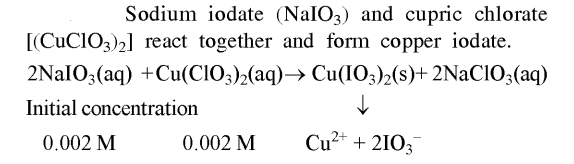
When same volume of both solutions are mixed then volume of mixture get doubles and concentration will get halved.
$\begin{array}{l}{\left[ IO _3^{-}\right]=0.002 / 2=0.001 M } \\ {\left[ Cu ^{2+}\right]=0.002 / 2=0.001 M }\end{array}$
$\begin{array}{l}\text { Ionization product of } Cu \left( IO _3\right)_2 \\ \qquad \begin{aligned} & =\left[ Cu ^{2+}\right]\left[ IO _3^{-}\right]^2 \\ & =0.001 \times(0.001)^2 \\ & =1 \times 10^{-9}\end{aligned}\end{array}$
The ionic product of $Cu \left( IO _3\right)_2\left(1 \times 10^{-9}\right)$ is less than that of its $K _{ sp }\left(7.4 \times 10^{-8}\right)$. Hence copper iodate will not precipitated. View full question & answer→Question 33 Marks
Calculate the pH of the resultant mixture :
10 mL of $0.1 M H _2 SO _4+10 mL$ of 0.1 M KOH
AnswerMillimoles of $H _2 SO _4=10 \times 0.1=1$
Millimoles of $KOH =10 \times 0.1=1$
$
2 KOH+H_2 SO_4 \longrightarrow K_2 SO_4+2 H_2 O
$
2 moles 1 mole
According to balanced equation, 1 millimole of KOH react with 0.5 millimole $H _2 SO _4$ and 0.5 millimole $H _2 SO _4$ remain whose molarity
$=\frac{0.5}{20}=2.5 \times 10^{-2}$
Total volume of mixture $=20 ml$
$\begin{aligned} \text { From } H _2 SO _4\left[ H ^{+}\right] & =2 \times \text { molarity } \\ & =2 \times 2.5 \times 10^{-2}\end{aligned}$
$\left[ H ^{+}\right]=5 \times 10^{-2}$
$\begin{array}{l} pH =-\log \left[ H ^{+}\right]=-\log \left(5 \times 10^{-2}\right) \\ pH =2-\log 5 \quad(\log 5=0.6990)\end{array}$
$pH =1.3$
View full question & answer→Question 43 Marks
The pH of 0.1 M solution of cyanic acid (HCNO) is 2.34. Calculate the ionization constant of the acid and its degree of ionization in the solution.
Answer$pH =-\log \left[ H ^{+}\right]$
$\log \left[ H ^{+}\right]=- pH =-2.34=\overline{3} .66$
$
\left[H^{+}\right]=\operatorname{antilog}(\overline{3} .66)=4.57 \times 10^{-3} M
$
$($ antilog $0.66=457)$
HCNO is a weak acid. Hence for this :
$
\left[H^{+}\right]=c \alpha
$
Degree of dissociation $\alpha=\frac{\left[ H ^{+}\right]}{ c }=\frac{4.57 \times 10^{-3}}{0.1}$
$=4.57 \times 10^{-2}==0.0457$
$HCNO + H _2 O \rightleftharpoons H _3 O ^{+}+\stackrel{\ominus}{ C } NO$
Dissociation constant $\left( K _{ a }\right)=\frac{\left[ H _3 O ^{+}\right]^2}{[ HCNO ]}$
$K _{ a }=\frac{\left[ H _3 O ^{+}\right]^2}{ C } K _{ a }=\frac{\left(4.57 \times 10^{-3}\right)^2}{0.1}$
$=2.088 \times 10^{-4}=2.09 \times 10^{-4}$
View full question & answer→Question 53 Marks
The solubility of $Sr ( OH )_2$ at 298 K is $19.23 g / L$ of solution. Calculate the concentration of strontium and hydroxyl ions and the pH of the solution.
AnswerMolar mass of $Sr ( OH )_2$
$\begin{array}{l}=87.6+(16 \times 2)+(1 \times 2) \\ =121.6 g mol ^{-1}\end{array}$
Molarity of $Sr ( OH )_2$
$=\frac{19.23 g}{121.6 g mol ^{-1} \times 1(L)}=0.1581 mol L ^{-1}$
$\begin{array}{l}\text { Concentration of } Sr ^{+2} \text { at } 100 \% \text { ionization } \\ \qquad=\left[ Sr ^{2+}\right]=0.1581 M \end{array}$
Hence $\left[ OH ^{-}\right]=2 \times 0.1581=0.3162 M$
because $Sr ( OH )_2 \rightleftharpoons Sr ^{2+}+2 OH ^{\ominus}$
$\left[ H ^{+}\right]=\frac{ K _{ w }}{\left[ OH ^{-}\right]}=\frac{1 \times 10^{-14}}{0.316}$
$=3.165 \times 10^{-14} mol L ^{-1}$
$pH =-\log \left[ H ^{+}\right]=-\log \left(3.165 \times 10^{-14}\right)$
$pH =14-\log 3.165$
$pH =13.50 \quad(\log 3.165=0.5)$
View full question & answer→Question 63 Marks
If 0.561 g of KOH is dissolved in water to give 200 mL of solution at 298 K . Calculate the concentration of potassium, hydrogen and hydroxyl ions. What is its pH ?
AnswerConcentration $( M )\left( mol L ^{-1}\right)$
$=\frac{\text { Mass of } KOH }{\text { Molar mass of } KOH } \times \frac{1000}{\text { Volume of solution }( mL )}$
Molar mass of $KOH =56 g mol ^{-1}$,
$M=\frac{0.561}{56} \times \frac{1000}{200}=0.05 M$
KOH is a strong base. Hence in aqueous solution it get completely dissociated.
Hence $\left[ K ^{+}\right]=[ KOH ]=\left[ OH ^{-}\right]=0.05 M$
$\left[ H ^{+}\right]=\frac{ K _{ w }}{\left[ OH ^{-}\right]}=\frac{1 \times 10^{-14}}{0.05}=2 \times 10^{-13} M$
$pH =-\log \left[ H ^{+}\right]=-\log \left(2 \times 10^{-13}\right)$
$pH =13-\log 2$
$pH =12.7 \quad(\log 2=0.3010)$
View full question & answer→Question 73 Marks
Calculate the hydrogen ion concentration in the following biological fluids whose oH are given below :
(a) Human muscle fluid, 6.83
(b) Human stomach fluid, 1.2
(c) Human blood, 7.38
(d) Human saliva, 6.4.
Answer(a) (Human muscular fluid)
$
pH=-\log \left[H^{+}\right]
$
$\log \left[ H ^{+}\right]=- pH =-6.83=\overline{7} .17$
$\left[ H ^{+}\right]=\operatorname{antilog} \overline{7} .17=1.48 \times 10^{-7} M$
(Antilog $0.17=148$ )
(b) (Human stomach liquid)
$\log \left[ H ^{+}\right]=-1.2=\overline{2} .8$
$\left[ H ^{+}\right]=\operatorname{antilog}(\overline{2} \cdot 8)=6.31 \times 10^{-2} M$
(Antilog $0.8=631$ ) $=0.063 M$
(c) (Human blood)
$\log \left[ H ^{+}\right]=-7.38=\overline{8} \cdot 62$
$\left[ H ^{+}\right]=\operatorname{antilog} \overline{8} \cdot 62=4.17 \times 10^{-8} M$
$($ Antilog $0.62=417)$
(d) (Human saliva)
$\log \left[ H ^{+}\right]=-6.4=\overline{7} \cdot 6$
$\begin{aligned} {\left[ H ^{+}\right]=} & \operatorname{antilog}(\overline{7} \cdot 6)=3.98 \times 10^{-7} M \\ & (\text { Antilog } 0.6=398)\end{aligned}$
View full question & answer→Question 83 Marks
The ionization constant of dimethylamine is $5.4 \times 10^{-4}$. Calculate its degree of ionization in its 0.02 M solution. What percentage of dimethylamine is ionized if the solution is also 0.1 M in NaOH ?
AnswerDimethylamine is a weak base, for this degree of dissociation :
$\alpha=\sqrt{\frac{K_b}{c}}$
$K _{ b }=5.4 \times 10^{-4}, \quad c =0.02 M$
$\alpha=\sqrt{\frac{5.4 \times 10^{-4}}{0.02}}=0.164$
Let the degree of dissociation of 0.1 M NaOH is $\alpha^1$, then
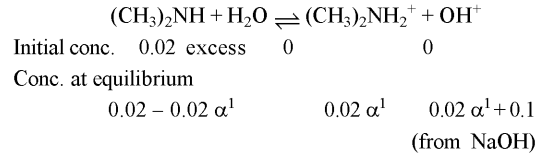
$\begin{array}{l}{\left[\left( CH _3\right)_2 NH \right]=0.02-0.02 \alpha^1 \approx 0.02} \\ {\left[ OH ^{-}\right]=0.02 \alpha^1+0.1 \approx 0.1}\end{array}$
$\left(0.02 \alpha^1\right.$ << 0.1)
$\left[\left( CH _3\right)_2 NH _2^{+}\right]=0.02 \alpha^1$
$K _{ b }=\frac{\left[\left( CH _3\right)_2 NH _2^{+}\right]\left[ OH ^{-}\right]}{\left( CH _3\right)_2 NH }=\frac{\left(0.02 \alpha^1\right)(0.1)}{0.02}$
$5.4 \times 10^{-4}=\frac{\left(0.02 \alpha^1\right)(0.1)}{0.02}$
Degree of ionization $\alpha^1=5.4 \times 10^{-3}=0.0054$
$\%$ ionization $=0.0054 \times 100=0.54 \%$ View full question & answer→Question 93 Marks
The pH of 0.005 M codeine $\left( C _{18} H _{21} NO _3\right)$ solution is 9.95 . Calculate its ionization constant and $p K_b$.
AnswerpH of codeine $=9.95$
Hence $pOH =14-9.95=4.05$
Hence $\log \left[ OH ^{-}\right]=- pOH =-4.05=\overline{5} .95$
$\left[ OH ^{-}\right]=$Antilog $\overline{5} .95$
$\left[ OH ^{-}\right]=8.91 \times 10^{-5} \quad($ Antilog $0.95=8910)$
Codeine is a base (B). Hence its ionization takes place as :
$B + H _2 O \rightleftharpoons BH ^{+}+ OH ^{-}$
Base dissociation constant $\left( K _{ b }\right)=\frac{\left[ BH ^{+}\right]\left[ OH ^{-}\right]}{[ B ]}$
$=\frac{\left[ OH ^{-}\right]^2}{[B]}\left(\right.$ because $\left.\left[ OH ^{-}\right]=\left[ BH ^{+}\right]\right)$
$K _{ b }=\frac{\left(8.91 \times 10^{-5}\right)^2}{0.005}=1.58 \times 10^{-6}$
$=1.6 \times 10^{-6}$
$K _{ b }=1.6 \times 10^{-6}$
$p K_b=-\log K_b=-\log \left(1.6 \times 10^{-6}\right)$
$pK _{ b }=6-\log 1.6 \quad(\log 1.6=0.2041)$
$\begin{array}{l} pK _{ b }=6-0.2041 \\ pK _{ b }=5.8\end{array}$
View full question & answer→Question 103 Marks
Find out the value of $K_c$ for each of the following equilibria from the value of $K_p$ :
(i) $2 NOCl ( g ) \rightleftharpoons 2 NO ( g )+ Cl _2(g)$;$K_p=1.8 \times 10^{-2}$ at 500 K
(ii) $CaCO _3(s) \rightleftharpoons CaO ( s )+ CO _2(g) ;$$K_p=167$ at 1073 K
Answer(i) $2 NOCl ( g ) \rightleftharpoons 2 NO ( g )+ Cl _2(g)$
$\Delta n(g)=3-2=1 K_{ p }=1.8 \times 10^{-2} atm$
$R =0.0821 L atm K ^{-1} mol^{-1}, T=500 K$
$\begin{array}{l} K _{ p }= K _{ c }( RT )^{\Delta n} \\ K_{ c }= K _{ p } /( RT )^{\Delta n}\end{array}$
$=\frac{1.8 \times 10^{-2} atm}{\left(0.0821 L atm K ^{-1} mol^{-1} \times 500 K^1\right)}$
$=4.384 \times 10^{-4}$
$K _{ c }=4.38 \times 10^{-4}$
(ii) $CaCO _3(s) \rightleftharpoons CaO ( s )+ CO _2(g)$
$\Delta n(g)=1-0=1, K_{ p }=167 atm$
$R =0.0821 L atm K ^{-1} mol^{-1} T=1073 K$
$K _{ p }= K _{ c }( RT )^{\Delta n}$
$K _{ c }=\frac{ K _{ p }}{( RT )^{\Delta n }}$
$=\frac{167 atm}{\left(0.0821 L atm K ^{-1} mol^{-1} \times 1073 K\right)^1}=1.895$
$K _{ c }=1.89=1.90$
View full question & answer→Question 113 Marks
It has been found that the pH of a 0.01 M solution of an organic acid is 4.15 . Calculate the concentration of the anion, the ionization constant of the acid and its $pK _{ a }$.
Answer$HA \stackrel{+ H _2 O }{\rightleftharpoons} H ^{+}+ A ^{-}$
$pH =-\log \left[ H ^{+}\right]$
or $\quad \log \left[ H ^{+}\right]=- pH =-4.15=\overline{5} .85$
$\left[ H ^{+}\right]=\operatorname{antilog} \overline{5} .85=7.079 \times 10^{-5} M$
(Antilog $0.85=7079$ )
Hence $\left[ A ^{-}\right]=\left[ H ^{+}\right]=7.079 \times 10^{-5} M =7.08 \times 10^{-5}$
Ionization constant
$K _{ a }=\frac{\left[ H ^{+}\right]\left[ A ^{-}\right]}{[ HA ]}, \quad[ HA ]=0.01 M$
$K _{ a }=\frac{\left(7.08 \times 10^{-5}\right)^2}{0.01}$
$K _{ a }=5.08 \times 10^{-7}$
$pK _{ a }=-\log K _{ a }$
$pK _{ a }=-\log \left(5.08 \times 10^{-7}\right)$
$pK _{ a }=7-0.7059 \quad(\log 5.08=0.7059)$
$pK _{ a }=6.29$
View full question & answer→Question 123 Marks
The ionization constant of acetic acid is $1.74 \times 10^{-5}$. Calculate the degree of dissociation of acetic acid in its 0.05 M solution. Calculate the concentration of acetate ion in the solution and its pH .
Answer$CH _3 COOH \rightleftharpoons CH _3 COO ^{-}+ H ^{+}$
$K _{ a }=\frac{\left[ CH _3 COO ^{-}\right]\left[ H ^{+}\right]}{\left[ CH _3 COOH \right]}$
$CH _3 COOH$ is a weak acid. Hence its ionization will be less. Hence its initial concentration is considered as equilibrium concentration and
$\left[ CH _3 COO ^{-}\right]=\left[ H ^{+}\right]$
Hence $K_a=\frac{\left[ H ^{+}\right]^2}{\left[ CH _3 COOH \right]},\left[ H ^{+}\right]=\sqrt{K_a\left[ CH _3 COOH \right]}$
$\left[ H ^{+}\right]=\sqrt{1.71 \times 10^{-5} \times(0.05)}$
$\left[ H ^{+}\right]=\left[ CH _3 COO ^{-}\right]=9.327 \times 10^{-4}=9.33 \times 10^{-4} M$
$=0.00093 M$
pH of solution $=-\log \left[ H ^{+}\right]$
$pH =-\log \left(10^{-4} \times 9.33\right)$
$=4-0.9699$
$(\log 9.33=0.9699) pH =3.03$
View full question & answer→Question 133 Marks
The ionization constant of $HF , HCOOH$ and HCN at 298 K are $6.8 \times 10^{-4}, 1.8 \times 10^{-4}$ and 4.8 $\times 10^{-9}$ respectively. Calculate the ionization constants of the corresponding conjugate base.
AnswerFor a conjugate acid-base pair :
$K_a \times K_b=K_w\left(1 \times 10^{-14}\right)$
$K _{ b }=\frac{ K _{ w }}{ K _{ a }}$
(i) For conjugate base $F ^{-}$of H.F. $K _{ b }=\frac{ K _{ w }}{ K _{ a }}$
$=\frac{1 \times 10^{-14}}{6.8 \times 10^{-4}}=1.47 \times 10^{-11}=1.5 \times 10^{-11}$
(ii) For conjugate base $HCOO ^{\ominus}$ of HCOOH
$K _{ b }=\frac{ K _{ w }}{ K _{ a }}$
$=\frac{1 \times 10^{-14}}{1.8 \times 10^{-4}}=5.55 \times 10^{-11}=5.6 \times 10^{-11}$
(iii) For conjugage base $\overline{ C } N$ of HCN
$K _{ b }=\frac{ K _{ w }}{ K _{ a }}$
$=\frac{1 \times 10^{-14}}{4.8 \times 10^{-9}}=2.08 \times 10^{-6}$
View full question & answer→Question 143 Marks
View full question & answer→Question 153 Marks
At 473 K , equilibrium constant $K_c$ for decomposition of phosphorus pentachloride, $PCl _5$ is $8.3 \times 10^{-3}$. If decomposition is depicted as,
$PCl _5(g) \rightleftharpoons PCl _3(g)+ Cl _2(g) \Delta_{ r } H ^{\ominus}=124.0 kJ mol ^{-1}$
(a) Write an expression for $K_c$ for the reaction.
(b) What is the value of $K_c$ for the reverse reaction at the same temperature?
(c) What would be the effect on $K_c$ if (i) more $PCl _5$ is added (ii) pressure is increased (iii) the temperature is increased?
Answer(a) For reaction $PCl _{5(g)} \rightleftharpoons PCl _{3(g)}+ Cl _{2(g)}$
$K _{ c }=\frac{\left[ PCl _3\right]\left[ Cl _2\right]}{\left[ PCl _5\right]}=8.3 \times 10^{-3}$
(b) $K _{ c }$ for backward reaction
$K _{ c }^{\prime}=\frac{1}{\text { For forward reaction }}$
$=\frac{1}{8.3 \times 10^{-3}}$
$K _{ c }^{\prime}=120.48$
(c) (i) On adding more $PCl _5, K_{ c }$ remains unaffected.
(ii) On increasing pressure, $K _{ c }$ remains unaffected.
(iii) For this reaction $\Delta_r H ^{\ominus}=+ ve$ (endothermic reaction). Hence on increasing temperature reaction proceeds in forward direction and value of $K_c$ increases.
View full question & answer→Question 163 Marks
The equilibrium constant for the following reaction is $1.6 \times 10^5$ at 1024 K
$H _2( g )+ B r _2( g ) \rightleftharpoons 2 H B r ( g )$
Find the equilibrium pressure of all gases if 10.0 bar of HBr is introduced into a sealed container at 1024 K .
Answer
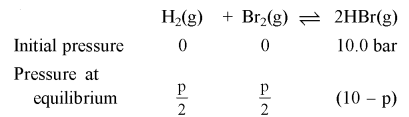
As product is taken initially, reaction will proceed in backward direction and let at p bar of HBr react at equilibrium.
$K _{ p }=\frac{ p _{ HBr }^2}{ p _{ H _2} \times p _{ Br _2}}$
$1.6 \times 10^5=\frac{10-p}{p / 2 \times p / 2}$
On taking square root both sides :
$4 \times 10^2=\frac{10-p}{p / 2}$
$200 p=10-p$
$p =\frac{10}{201} bar$
$p _{ H _2}= p / 2=\frac{1}{2}\left(\frac{10}{201}\right) bar =2.5 \times 10^{-2} bar$
$p _{ Br _2}= p / 2=2.5 \times 10^{-2}$ bar
$p _{ HBr }=10- p \approx 10$ bar (because p < < < 10) View full question & answer→Question 173 Marks
Which of the following reactions will get affected by increasing the pressure? Also, mention whether change will cause the reaction to go into forward or backward direction.
(i) $COCl _2(g) \rightleftharpoons CO ( g )+ Cl _2(g)$
(ii) $CH _4(g)+2 S_2(g) \rightleftharpoons CS _2(g)+2 H _2 S( g )$
(iii) $CO _2(g)+ C ( s ) \rightleftharpoons 2 CO ( g )$
(iv) $2 H _2(g)+ CO ( g ) \rightleftharpoons CH _3 OH ( g )$
(v) $CaCO _3(s) \rightleftharpoons CaO ( s )+ CO _2(g)$
(vi) $4 NH _3(g)+5 O _2(g) \rightleftharpoons 4 NO ( g )+6 H _2 O ( g )$
AnswerReactions in which $\Delta n ( g ) \neq 0$ i.e. the moles of gaseous product and reactant are not same. When we increase pressure it will effect rate of reaction. Hence reaction (i), (iii), (iv), (v) and (vi) are effected. According to Le Chatelier's principle on increasing pressure at equilibrium reaction will proceed in that direction where gaseous product is less.
(i) $\Delta n ( g )=+1$ Hence reaction will move in backward direction.
(ii) $\Delta n ( g )=0$ There will be no effect of pressure on reaction.
(iii) $\Delta n =+1$ Reaction will move in backward direction.
(iv) $\Delta n =-2$ Reaction will move in forward direction.
(v) $\Delta n =+1$ Reaction will move in backward direction.
(vi) $\Delta n =+1$ Reaction will move in backward direction.
View full question & answer→Question 183 Marks
Ethyl acetate is formed by the reaction between ethanol and acetic acid and the equilibrium is represented as :
$CH _3 COOH ( l )+ C _2 H _5 OH ( l ) \rightleftharpoons CH _3 COOC _2 H _5( l )$$+ H _2 O ( l )$
(i) Write the concentration ratio (reaction quotient) $Q_c$, for this reaction (note : water is not in excess and is not a solvent in this reaction).
(ii) At 293 K , if one starts with 1.00 mol of acetic acid and 0.18 mol of ethanol, there is 0.171 mol of ethyl acetate in the final equilibrium mixture. Calculate the equilibrium constant.
(iii) Starting with 0.5 mol of ethanol and 1.0 mol of acetic acid and maintaining it at $293 K, 0.214 mol$ of ethyl acetate is found after sometime. Has equilibrium been reached?
Answer(i) $Q_{ o }$ (concentration ratio)
$=\frac{\left[ CH _3 COOC _2 H _5\right]\left[ H _2 O \right]}{\left[ CH _3 COOH \right]\left[ C _2 H _5 OH \right]}$
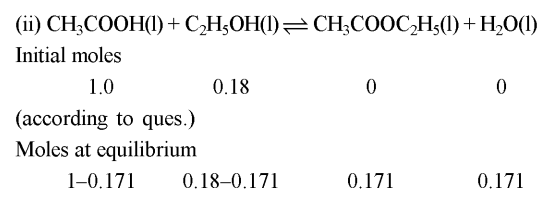
Volume is not given. Hence 1 lit. is considered.
$K _{ c }=\frac{\left[ CH _3 COOC _2 H _5\right]\left[ H _2 O \right]}{\left[ CH _3 COOH \right]\left[ C _2 H _5 OH \right]}$
$K _{ c }=\frac{0.171 \times 0.171}{(1-0.171)(0.18-0.171)}$
$K _{ c }=\frac{0.171 \times 0.171}{0.829 \times 0.009}=\frac{0.02924}{0.00746}$
$K _{ c }=3.919=3.92$
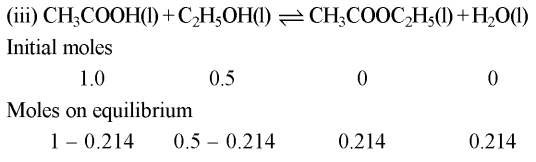
$Q_c=\frac{0.214 \times 0.214}{0.786 \times 0.286}=0.2037=0.204$
$Q _{ c }< K _{ c }$ Hence equilibrium will not established. View full question & answer→Question 193 Marks
$K_p=0.04 atm$ at 899 K for the equilibrium shown below. What is the equilibrium concentration of $C _2 H _6$ when it is placed in a flask at 4.0 atm pressure and allowed to come to equilibrium?
$
C_2 H_6(g) \rightleftharpoons C_2 H_4(g)+H_2(g)
$
Answer
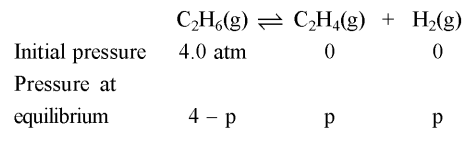
$K _{ p }=\frac{ p _{ C _2 H _4 \times} p _{ H _2}}{ p _{ C _2 H _6}}$
$0.04=\frac{ p \times p }{4- p }$
$p ^2=0.04(4- p )$
$p ^2=0.16-0.04 p$
$p^2+0.04 p-0.16=0$
$p =0.38$
$p =\frac{(-0.04) \pm \sqrt{0.0016-4(-0.16)}}{2}$
$=\frac{(-0.04)+0.8}{2}=\frac{0.76}{2}=0.38$
Hence at equilibrium
$\left[ C _2 H _6\right]=4-0.38=3.62 atm$. View full question & answer→Question 203 Marks
What is the equilibrium concentration of each of the substances in the equilibrium when the initial concentration of ICl was 0.78 M ?
$2 ICl ( g ) \rightleftharpoons I _2(g)+ Cl _2(g) ; \quad K _{ c }=0.14$
Answer
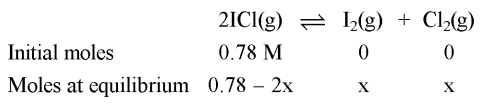
(Let at equilibrium 2 x moles of ICl reacts.)
$K _{ c }=\frac{\left[ I _2\right]\left[ Cl _2\right]}{[ ICl ]^2}$
$0.14=\frac{( x )( x )}{(0.78-2 x)^2}$
$\sqrt{0.14}=\frac{ x }{(0.78-2 x )}$
$0.374=\frac{x}{0.78-2 x}$
$x=0.2917-0.748 x$
$x+0.748 x=0.2917$
$x(1+0.748)=0.2917$
$x =\frac{0.2917}{1.748}$
$x =0.1668=1.167 M$
Hence at equilibrium
$\left[ I _2\right]=\left[ Cl _2\right]=0.167 M$
$[ ICl ]=0.78-2 \times 0.167=0.446 M$. View full question & answer→Question 213 Marks
A liquid is in equilibrium with its vapour in a sealed container at a fixed temperature. The volume of the container is suddenly increased.
(a) What is the initial effect of the change on vapour pressure?
(b) How do rates of evaporation and condensation change initially?
(c) What happens when equilibrium is restored finally and what will be the final vapour pressure?
Answer(a) The volume of vessel is increase. Hence, initially the vapour pressure will decrease.
(b) The rate of evaporation will increase as more space becomes available due to increase in volume but rate of condensation will decrease.
(c) When equilibrium is re-established, the rate of evaporation and rate of condensation will become equal and ultimately the same vapour pressure will be established because the vapour pressure of every liquid is fixed at fixed temperature.
View full question & answer→