Questions

Case study (4 Marks)

Take a timed test

4 questions · self-marked practice — reveal the answer and mark yourself.

Question 14 Marks
Read the passage given below and answer the following questions from (i) to (v).
A system in thermodynamics refers to that part of universe in which observations are made and remaining universe constitutes the surroundings. The surroundings include everything other than the system. System and the surroundings together constitute the universe. The universe = The system + The surroundings However, the entire universe other than the system is not affected by the changes taking place in the system. Therefore, for all practical purposes, the surroundings are that portion of the remaining universe which can interact with the system. Usually, the region of space in the neighbourhood of the system constitutes its surroundings.
The wall that separates the system from the surroundings is called boundary.
Types of the System We, further classify the systems according to the movements of matter and energy in or out of the system.
  1. Open System In an open system, there is exchange of energy and matter between system and surroundings. The presence of reactants in an open beaker is an example of an open system. Here the boundary is an imaginary surface enclosing the beaker and reactants.
  2. Closed System In a closed system, there is no exchange of matter, but exchange of energy is possible between system and the surroundings. The presence of reactants in a closed vessel made of conducting material e.g., copper or steel is an example of a closed system.
  3. Isolated System In an isolated system, there is no exchange of energy or matter between the system and the surroundings. The presence of reactants in a thermos flask or any other closed insulated vessel is an example of an isolated system.
The State of the System The system must be described in order to make any useful calculations by specifying quantitatively each of the properties such as its pressure (p), volume (V), and temperature (T) as well as the composition of the system. We need to describe the system by specifying it before and after the change. You would recall from your Physics course that the state of a system in mechanics is completely specified at a given instant of time, by the position and velocity of each mass point of the system. In thermodynamics, a different and much simpler concept of the state of a system is introduced. It does not need detailed knowledge of motion of each particle because, we deal with average measurable properties of the system. We specify the state of the system by state functions or state variables. The state of a thermodynamic system is described by its measurable or macroscopic (bulk) properties. We can describe the state of a gas by quoting its pressure (p), volume (V), temperature (T), amount (n) etc. Variables like p, V, T are called state variables or state functions because their values depend only on the state of the system and not on how it is reached. In order to completely define the state of a system it is not necessary to define all the properties of the system; as only a certain number of properties can be varied independently. This number depends on the nature of the system. Once these minimum number of macroscopic properties are fixed, others automatically have definite values. The state of the surroundings can never be completely specified; fortunately it is not necessary to do so.
By conventions of IUPAC in chemical thermodynamics. The q is positive, when heat is transferred from the surroundings to the system and the internal energy of the system increases and q is negative when heat is transferred from system to the surroundings resulting in decrease of the internal energy of the system.
Let us consider the general case in which a change of state is brought about both by doing work and by transfer of heat. We write change in internal energy for this case as: $ \triangle{\text{U}}=\text{q}+\text{w}$
For a given change in state, q and w can vary depending on how the change is carried out. However, $\text{q}+\text{w}=\triangle{\text{U}}$ will depend only on initial and final state. It will be independent of the way the change is carried out. If there is no transfer of energy as heat or as work (isolated system) i.e., if w = 0 and q = 0, then $ \triangle{\text{U}}=0.$ The equation i.e., $ \triangle{\text{U}}=\text{q}+\text{w}$ is mathematical statement of the first law of thermodynamics, which states that The energy of an isolated system is constant. It is commonly stated as the law of conservation of energy i.e., energy can neither be created nor be destroyed.
  1. $\triangle\text{U}=\ ....$
  1. q + w
  2. q + v
  3. q + m
  4. q + z
  1. Which of the following is not an example of state variable?
  1. Pressure
  2. Ionic radius
  3. Volume
  4. Amount
  1. $\triangle\text{U}=\text{q}+\text{w}$ is termed as …
  1. Third law of thermodynamics
  2. Second law of thermodynamics
  3. First law of thermodynamics
  4. None of above
  1. A … in thermodynamics refers to that part of universe in which observations are made.
  1. Universe
  2. System
  3. Surrounding
  4. Boundary
  1. Which of the following is a type if system ?
  1. Open system
  2. Closed system
  3. Lsolated system
  4. All the above
Answer
  1. (a) q + w
  1. (b) Ionic radius
  1. (c) First law of thermodynamics.
  1. (b) System
  1. (d) All the above
View full question & answer
Question 24 Marks
Read the passage given below and answer the following questions from (i) to (v).

$\frac{1}{2}\text{N}_2(\text{g})+\frac{3}{2}\text{H}_2(\text{g})=\text{NH}_3(\text{g});\triangle_\text{r}\text{H}^\ominus=-46.1\text{kJ}\text{mol}^{-1}$

$\frac{1}{2}\text{H}_2(\text{g})+\frac{1}{2}\text{Cl}_2(\text{g})=\text{HCl}(\text{g});\triangle_\text{r}\text{H}^\ominus=-92.32\text{kJ}\text{mol}^{-1}$

$\text{H}_2(\text{g})+\frac{1}{2}\text{O}_2(\text{g})\rightarrow\text{H}_2\text{O}(\text{l});\triangle_\text{r}\text{H}^\ominus=-285.8\text{kJ}\text{mol}^{-1}$

A spontaneous process is an irreversible process and may only be reversed by some external agency.

If we examine the phenomenon like flow of Water down hill or fall of a stone on to the Ground, we find that there is a net decrease in Potential energy in the direction of change. By Analogy, we may be tempted to state that a Chemical reaction is spontaneous in a given Direction, because decrease in energy has Taken place, as in the case of exothermic Reactions. For example:

The decrease in enthalpy in passing from Reactants to products may be shown for any Exothermic reaction on an enthalpy diagram. Thus, the postulate that driving force for a Chemical reaction may be due to decrease in Energy sounds ‘reasonable’ as the basis of Evidence so far ! Now let us examine the following reactions:

$\frac{1}{2}\text{N}_2(\text{g})+\text{O}_2(\text{g})\rightarrow\text{NO}_2(\text{g});\triangle_\text{r}\text{H}^\ominus=+33.2\text{kJ}\text{mol}^{-1}$

$\text{C}(\text{graphite,s})+2\text{s}(\text{l})\rightarrow\text{CS}_2(\text{l});\triangle_\text{r}\text{H}^\ominus=+128.5\text{kJ}\text{mol}^{-1}$

Therefore, it becomes obvious that while decrease in enthalpy may be a contributory factor for spontaneity, but it is not true for all cases .

Whenever heat is added to the system, it increases molecular motions causing increased randomness in the system. Thus heat (q) has randomising influence on the system. Temperature is the measure of average chaotic motion of particles in the system. The entropy change is inversely proportional to the temperature. $\triangle\text{S}$ is related with q and T for a reversible reaction as:

$\triangle\text{S}=\frac{\text{q}_\text{rev}}{\text{T}}$

The total entropy change $(\triangle\text{S}_\text{total})$ for the system and surrounding of a spontaneous process is given by $\triangle\text{S}_\text{total}=\triangle\text{S}_\text{system}+\triangle\text{S}_\text{surr}.0$

When a system is in equilibrium, the entropy is maximum, and the change in entropy,$\triangle\text{S}=0.$ We can say that entropy for a spontaneous process increases till it reaches maximum and at equilibrium the change in entropy is zero. Since entropy is a state property, we can calculate the change in entropy of a reversible process by

$\triangle\text{S}_{\text{sys}}=\frac{\text{q}_\text{rev,rew}}{\text{T}}$

G = H – TS

Gibbs function, G is an extensive property and a state function. The change in Gibbs energy for the system, $\triangle\text{G}_{\text{sys}}$can be written as

$\therefore\triangle\text{G}_{\text{sys}}=\triangle\text{H}_{\text{sys}}-\text{T}\triangle\text{S}_{\text{sys}}-\text{S}_\text{sys}\triangle\text{T}$

At constant temperature, $\triangle\text{T}=0$

$\triangle\text{G}_{\text{sys}}=\triangle\text{H}_{\text{sys}}-\text{T}\triangle\text{S}_{\text{sys}}$

Usually the subscript ‘system’ is dropped and we simply write this equation as

$\triangle\text{G}=\triangle\text{H}–\text{T}\triangle\text{S}$

Thus, Gibbs energy change = enthalpy change – temperature × entropy change,

and is referred to as the Gibbs equation, one of the most important equations in chemistry. Here, we have considered both terms together for spontaneity: energy (in terms of $\triangle\text{H}$) and entropy ($\triangle\text{s},$ a measure of disorder) as indicated earlier. Dimensionally if we analyse, we find that $\triangle\text{G}$ has units of energy because, both $\triangle\text{H}$ and the $\text{T}\triangle\text{S}$ are energy terms, since $\text{T}\triangle\text{S}=(\text{K}) (\text{J/K}) = \text{J}.$ Now let us consider how $\triangle\text{G}$ is related to reaction spontaneity. We know, $\triangle\text{S}_\text{systeam}+\triangle\text{S}_\text{surrounding}$ If the system is in thermal equilibrium with The surrounding, then the temperature of the Surrounding is same as that of the system. Also, increase in enthalpy of the surrounding Is equal to decrease in the enthalpy of the System. Therefore, entropy change of Surroundings,

$\triangle\text{S}_\text{surr}=\frac{\triangle\text{H}_\text{surr}}{\text{T}}-\frac{\triangle\text{H}_\text{sys}}{\text{T}}$

$\triangle\text{S}_\text{total}=\text{S}_\text{sys}+\Big(-\frac{\triangle\text{H}_\text{sys}}{\text{T}}\Big)$

Rearrangine the above equation:

$\text{T}\triangle\text{S}_{\text{total}}=\text{T}\triangle\text{S}_{\text{sys}}-\triangle\text{H}_{\text{sys}}$

For spontaneous process,

$\triangle\text{S}_\text{total}>0,$ so

$\text{T}\triangle\text{S}_{\text{sys}}-\triangle\text{H}_{\text{sys}}>\text{O}$

$\Rightarrow-(\triangle\text{H}_{\text{sys}}-\text{T}\triangle\text{S}_{\text{sys}})$

Using equation, the above equation can Be written as:

$-\triangle\text{G}>\text{O}$

$\triangle\text{G}=\triangle\text{H}-\text{T}\triangle\text{S},0$

$\triangle\text{H}_\text{sys}$

Is the enthalpy change of a reaction, $\text{T}\triangle\text{S}_\text{sys}$ Is the energy which is not available to Do useful work. So $\triangle\text{G}$ is the net energy Available to do useful work and is thus a Measure of the ‘free energy. For this reason, it Is also known as the free energy of the reaction. $\triangle\text{G}$ gives a criteria for spontaneity at Constant pressure and temperature.

If $\triangle\text{G}$ is negative (< 0), the process is

b) If $\triangle\text{G}$ is positive (> 0), the process is non

Entropy and Second Law of Thermodynamics – For an isolated system the change in energy remains constant. Therefore, increase in entropy in such systems is the natural direction of a spontaneous change. This, in fact is the second law of thermodynamics. Like first law of thermodynamics, second law can also be stated in several ways. The second law of thermodynamics explains why spontaneous exothermic reactions are so common. In exothermic reactions heat released by the reaction increases the disorder of the surroundings and overall entropy change is positive which makes the reaction spontaneous.

Absolute Entropy and Third Law of Thermodynamics Molecules of a substance may move in a straight line in any direction, they may spin like a top and the bonds in the molecules may stretch and compress. These motions of the molecule are called translational, rotational and vibrational motion respectively. When temperature of the system rises, these motions become more vigorous and entropy increases. On the other hand when temperature is lowered, the entropy decreases. The entropy of any pure crystalline substance approaches zero as the temperature approaches absolute zero. This is called third law of thermodynamics. This is so because there is perfect order in a crystal at absolute zero. The statement is confined to pure crystalline solids because theoretical arguments and practical evidences have shown that entropy of solutions and super cooled liquids is not zero at 0K. The importance of the third law lies in the fact that it permits the calculation of absolute values of entropy of pure substance from thermal data alone. For a pure substance, this can be done by summing q T rev increments from 0K to 298K. Standard entropies can be used to calculate standard entropy changes by a Hess’s law type of calculation.

$\text{A}+\text{B}\rightleftharpoons\text{C}+\text{D};$ is $\triangle_\text{r}\text{G}=0$

A knowledge of the sign and Magnitude of the free energy change of a Chemical reaction allows: Prediction of the spontaneity of the Chemical reaction. Prediction of the useful work that could Be extracted from it. So far we have considered free energy Changes in irreversible reactions. Let us now Examine the free energy changes in reversible Reactions.‘Reversible’ under strict thermodynamic Sense is a special way of carrying out a Process such that system is at all times in  Perfect equilibrium with its surroundings. When applied to a chemical reaction, the Term ‘reversible’ indicates that a given Reaction can proceed in either direction Simultaneously, so that a dynamic Equilibrium is set up. This means that the Reactions in both the directions should proceed with a decrease in free energy, which seems impossible. It is possible only if at equilibrium the free energy of the system is minimum. If it is not, the system would spontaneously change to configuration of lower free energy. So, the criterion for equilibrium

Gibbs energy for a reaction in which all reactants and products are in standard state, $\triangle_\text{r}\text{G}=0$ is related to the equilibrium constant of the reaction as follows:

$0=\triangle_\text{r}\text{G}^{\ominus}+\text{RT}\text{ln}\text{K}$

or $\triangle_\text{r}\text{G}^{\ominus}=-\text{RT}\text{ln}\text{K}$

or $\triangle_\text{r}\text{G}^{\ominus}=-2.303\text{RT}\log\text{K}$

We also know that

$\triangle_\text{r}\text{G}^{\ominus}=\triangle_\text{r}\text{H}^{\ominus}-\text{T}\triangle_\text{r}\text{S}^{\ominus}-\text{RT}\text{ln}\text{K}$

For strongly endothermic reactions, the value of $\triangle_\text{r}\text{H}^\phi$ may be large and positive. In such a case, value of K will be much smaller than 1 and the reaction is unlikely to form much product. In case of exothermic reactions, $\triangle_\text{r}\text{H}^\phi$  is large and negative, and $\triangle_\text{r}\text{G}^\phi$ is likely to be large and negative too. In such cases, K will be much larger than 1. We may expect strongly exothermic reactions to have a large K, and hence can go to near completion. $\triangle_\text{r}\text{G}^\phi$ also depends upon $\triangle_\text{r}\text{S}^\phi,$ if the changes in the entropy of reaction is also taken into account, the value of K or extent of chemical reaction will also be affected, depending upon whether $\triangle_\text{r}\text{S}^\phi$ Is positive or Negative, It is possible to obtain an estimate of $\triangle{\text{G}}^0$  From the measurement of $\triangle{\text{H}}^0$ And $\triangle{\text{S}}^0,$ And then calculate K at any temperature For economic yields of the products. If K is measured directly in the Laboratory, value of $\triangle{\text{G}}^0$ At any other Temperature can be calculated.

  1. A spontaneous process is an … process.
  1. Irreversible
  2. Reversible
  3. Partially irreversible
  4. Partially reversible
  1. $\triangle\text{S}_\text{systeam}+\triangle\text{S}_\text{surrounding}$
  1. < 0
  2. > 0
  3. = 0
  4. None of above
  1. When a system is in equilibrium, the entropy is maximum, and the change in entropy, $\triangle{\text{S}}.....0.$
  1. <
  2. >
  3. =
  4. None of above
  1. … does not discriminate between reversible and irreversible process:
  1. $\triangle\text{H}$

  2. $\triangle\text{S}$

  3. $\triangle\text{G}$

  4. $\triangle\text{U}$

  1. $\text{T}\triangle\text{S}=\ ...$
  1. Kg
  2. J
  3. M
  4. lit
Answer
  1. (a) Irreversible
  1. (b) > 0
  1. (c) =
  1. (d) $\triangle\text{U}$
  1. (b) J
View full question & answer
Question 34 Marks

A process or change is said to be reversible, if a change is brought out in such a way that the process could, at any moment, be reversed by an infinitesimal change. A reversible process proceeds infinitely slowly by a series of equilibrium states such that system and the surroundings are always in near equilibrium with each other. Processes  other than reversible processes are known as irreversible processes.

Isothermal and free expansion of an ideal gas For isothermal (T = constant) expansion of an ideal gas into vacuum; w = 0 since pex = 0. Also, Joule determined experimentally that q = 0; therefore, $\triangle\text{U}=0, \triangle =+\text{Uqw}$ can be expressed for isothermal irreversible and reversible changes as follows:

  1. For isothermal irreversible change

$\text{q}=-\text{w}=\text{nRTIn}\frac{\text{V}_\text{f}}{\text{V}_{\text{i}}}$

$=2.303\ \text{nRT}\log\frac{\text{V}_\text{f}}{\text{V}_{\text{i}}}$

  1. For isothermal reversible change
  2. For adiabatic change, q = 0

$\triangle\text{U}=\text{w}_{\text{ad}}$

In thermodynamics, a distinction is made between extensive properties and intensive properties. An extensive property is a property whose value depends on the quantity or size of matter present in the system. For example, mass, volume, internal energy, enthalpy, heat capacity, etc. are extensive properties. Those properties which do not depend on the quantity or size of matter present are known as intensive properties. For example temperature, density, pressure etc. are intensive properties. A molar property, χm, is the value of an extensive property χ of the system for 1 mol of the substance. If n is the amount of matter, χ χ m = n is independent of the amount of matter. Other examples are molar volume .

Measurement of $\triangle\text{U}$ and $\triangle{Η}$: Calorimetry We can measure energy changes associated with chemical or physical processes by an experimental technique called calorimetry. In calorimetry, the process is carried out in a vessel called calorimeter, which is immersed in a known volume of a liquid. Knowing the heat capacity of the liquid in which calorimeter is immersed and the heat capacity of calorimeter, it is possible to determine the heat evolved in the process by measuring temperature changes. Measurements are made under two different conditions: i) at constant volume, qV ii) at constant pressure, qP

Explain the determination of DeltaU of a reaction calorimetrically.

∆U Measurements For chemical reactions, heat absorbed at constant volume, is measured in a bomb calorimeter. Here, a steel vessel (the bomb) is immersed in a water bath. The whole device is called calorimeter. The steel vessel is immersed in water bath to ensure that no heat is lost to the surroundings. A combustible substance is burnt in pure dioxygen supplied in the steel bomb. Heat evolved during the reaction is transferred to the water around the bomb and its temperature is monitored. Since the bomb calorimeter is sealed, its volume does not change i.e., the energy changes associated with reactions are measured at constant volume. Under these conditions, no work is done as the reaction is carried out at constant volume in the bomb calorimeter. Even for reactions involving gases, there is no work done as $\triangle\text{v}=0$ Temperature change of the calorimeter produced by the completed reaction is then converted to qV, by using the known heat capacity of the calorimeter with the help of equation

b)$\triangle{Η}$ Measurements Measurement of heat change at constant pressure (generally under atmospheric pressure) can be done in a calorimeter shown in Figure. We know that $\triangle{Η}=\text{qp}$ (at constant p) and, therefore, heat absorbed or evolved, qP at constant pressure is also called the heat of reaction or enthalpy of reaction, $\triangle\text{rΗ}$ In an exothermic reaction, heat is evolved, and system loses heat to the surroundings. Therefore, qP will be negative and ∆rH will also be negative. Similarly in an endothermic reaction, heat is absorbed, qP is positive and $\triangle\text{rΗ}$ will be positive.

THERMODYNAMICS - NCERT Class 11 Chemistry

  1. For adiabatic change, q = 0 then …
  1. $\triangle\text{U}=\text{w}_{\text{ad}}$

  2. $\triangle\text{U}=\text{q}+\text{w}$

  3. $\triangle\text{U}=\text{w}-\text{q}$

  4. $\triangle\text{U}=\text{w}_{\text{rev}}$

  1. The technique for measure energy changes associated with chemical or physical processes by an experimental technique called …
  1. Colourimetry
  2. Calorimetry
  3. Titration
  4. Photometry
  1. A property whose value depends on the quantity or size of matter present in the system is known as …
  1. Extensive
  2. Intensive
  3. Reversible
  4. Irreversible
  1. If there is no work done …
  1. V = 0
  2. V = 1
  3. V = 2
  4. V = 3
  1. In an endothermic reaction, heat is absorbed, qP  is … and $\triangle\text{rΗ}$ will be …
  1. Positive, Positive
  2. Negative, Negative
  3. Positive, Negative
  4. Negative, Positive
Answer
  1. (a) $\triangle\text{U}=\text{w}_{\text{ad}}$
  1. (b) Calorimetry
  1. (a) Extensive
  1. (b) V = 1
  1. (a) Positive, Positive
View full question & answer
Question 44 Marks

Read the passage given below and answer the following questions from (i) to (v).

In a chemical reaction, reactants are converted into products and is represented by, Reactants → Products The enthalpy change accompanying a reaction is called the reaction enthalpy. The enthalpy change of a chemical reaction, is given by the symbol $\triangle\text{rH}.$

$\triangle\text{rH}$ = (sum of enthalpies of products) – (sum  of enthalpies of reactants)

$\sum\limits_\text{t}\text{a}_{\text{t}}\text{H}_\text{products}-\sum\limits_\text{t}\text{b}_\text{t}\text{H}_\text{reactants}$

Here symbol ∑ (sigma) is used for summation and ai and bi  are the stoichiometric coefficients of the products and reactants respectively in the balanced chemical equation. For example, for the reaction

$\text{CH}_4(\text{g})+2\text{O}_2(\text{g})\rightarrow\text{CO}_2(\text{g})+2\text{H}_2\text{O}(\text{l})$

$\triangle_\text{r}\text{H}=\sum\limits_\text{t}\text{a}_{\text{t}}\text{H}_\text{products}-\sum\limits_\text{t}\text{b}_\text{t}\text{H}_\text{reactants}$

$=[\text{H}_\text{m}(\text{CO}_2,\text{g})+2\text{H}_\text{m}(\text{H}_2\text{O},\text{l})]-[\text{H}_\text{m}(\text{CH}_4,\text{g})+2\text{H}_\text{m}(\text{O}_2,\text{g})]$

where Hm is the molar enthalpy. Enthalpy change is a very useful quantity. Knowledge of this quantity is required when one needs to plan the heating or cooling required to maintain an industrial chemical reaction at constant temperature. It is also required to calculate temperature dependence of equilibrium constant.

Standard Enthalpy of Reactions Enthalpy of a reaction depends on the conditions under which a reaction is carried out. It is, therefore, necessary that we must specify some standard conditions. The standard enthalpy of reaction is the enthalpy change for a reaction when all the participating substances are in their standard states. The standard state of a substance at a specified temperature is its pure form at 1 bar. For example, the standard state of liquid ethanol at 298K is pure liquid ethanol at 1 bar; standard state of solid iron at 500K is pure iron at 1 bar. Usually data are taken at 298K. Standard conditions are denoted by adding the superscript 0 to the symbol $\triangle\text{H},$ e.g., $\triangle\text{H}^\phi$

Enthalpy Changes during Phase Transformations Phase transformations also involve energy changes. Ice, for example, requires heat for melting. Normally this melting takes place at constant pressure (atmospheric pressure) and during phase change, temperature remains constant (at 273K).

$\text{H}_2\text{O}(\text{s})\rightarrow\text{H}_2\text{O}(\text{l});\triangle_{\text{fus}}\text{H}^\phi=6.00\text{kJ}\ \text{mol}^{-1}$

Here $\triangle\text{vap}\text{H}^\phi$  is enthalpy of fusion in standard state. If water freezes, then process is reversed and equal amount of heat is given off to the surroundings. The enthalpy change that accompanies melting of one mole of a solid substance in standard state is called standard enthalpy of fusion or molar enthalpy of fusion, $\triangle\text{fus}\text{H}0.$Melting of a solid is endothermic, so all enthalpies of fusion are positive. Water requires heat for evaporation. At constant temperature of its boiling point Tb  and at constant pressure:

$\text{H}_2\text{O}(\text{l})\rightarrow\text{H}_2\text{O}(\text{g});\triangle_{\text{vap}}\text{H}^\phi=+40.79\text{kJ}\ \text{mol}^{-1}$

$\triangle\text{vap}\text{H}^\phi$ is the standard enthalpy of vaporisation. Amount of heat required to vaporize one mole of a liquid at constant temperature and under standard pressure (1bar) is called its standard enthalpy of vaporization or molar enthalpy of vaporization, $\triangle\text{vap}\text{H}^\phi.$ Sublimation is direct conversion of a solid into its vapour. Solid CO2  or ‘dry ice’ sublimes at 195K with $\triangle\text{sub}\text{H}^\phi=25.2\text{kJ}\text{mol}^{–1};$ naphthalene sublimes slowly and for this $\triangle\text{sub}\text{H}0= 73.0\text{kJ}\text{mol}^{–1}.$ Standard enthalpy of sublimation, $\triangle\text{sub}\text{H}^\phi$ is the change in enthalpy when one mole of a solid substance sublimes at a constant temperature and under standard pressure (1bar). The magnitude of the enthalpy change depends on the strength of the intermolecular interactions in the substance undergoing the phase transfomations. For example, the strong hydrogen bonds between water molecules hold them tightly in liquid phase. For an organic liquid, such as acetone, the intermolecular dipole-dipole interactions are significantly weaker. Thus, it requires less heat to vaporise 1 mol of acetone than it does to vaporize 1mol of water.

Standard Enthalpy of Formation The standard enthalpy change for the formation of one mole of a compound from its elements in their most stable states of aggregation (also known as reference states) is called Standard Molar Enthalpy of Formation. Its symbol is $\triangle\text{f}\text{H}^\phi$ where the subscript ‘ f ’ indicates that one mole of the compound in question has been formed in its standard state from its elements in their most stable states of aggregation. The reference state of an element is its most stable state of aggregation at 25°C and 1 bar pressure.

Hess’s Law of Constant Heat Summation We know that enthalpy is a state function, therefore the change in enthalpy is independent of the path between initial state (reactants) and final state (products). In other words, enthalpy change for a reaction is the same whether it occurs in one step or in a series of steps. This may be stated as follows in the form of Hess’s Law. If a reaction takes place in several steps then its standard reaction enthalpy is the sum of the standard enthalpies of the intermediate reactions into which the overall reaction may be divided at the same temperature. Let us understand the importance of this law with the help of an example. Consider the enthalpy change for the reaction

$\text{C}(\text{graphite,s})+\frac{1}{2}\text{O}_2(\text{g})\rightarrow\text{CO}(\text{g});\triangle_\text{r}\text{H}^{\ominus}=?$

Although CO(g) is the major product, some CO2  gas is always produced in this reaction. Therefore, we cannot measure enthalpy change for the above reaction directly. However, if we can find some other reactions involving related species, it is possible to calculate the enthalpy change for the above reaction. Let us consider the following reactions:

$\text{C}(\text{graphite,s})+\text{O}_2(\text{g}) \rightarrow\text{CO}_2(\text{g});\triangle\text{r}\text{H}^{\phi}=–393.5\text{kJ}\text{mol}^{–1}(\text{i})$

$\text{CO}(\text{g})+\frac{1}{2}\text{O}_2(\text{g})\rightarrow\text{CO}_2(\text{g})\triangle_\text{r}\text{H}^{\phi}=-283.0\text{kJ}\text{mol}^{-1}(\text{ii})$

We can combine the above two reactions in such a way so as to obtain the desired reaction. To get one mole of CO(g) on the right, we reverse equation (ii). In this, heat is absorbed instead of being released, so we change sign of $\triangle\text{r}\text{H}^\phi$ value

$\text{CO}_2(\text{g})\rightarrow\text{CO}(\text{g})+\frac{1}{2}\text{O}_2(\text{g});\triangle\text{r}\text{H}^{\phi}=+283.0\text{kJ}\text{mol}^{-1}...(\text{iii})$

Adding equation (i) and (iii), we get the desired equation,

$\text{C}(\text{graphite,s})+\frac{1}{2}\text{O}_2(\text{g})\rightarrow\text{CO}(\text{g});$

for which $\triangle_\text{r}\text{H}^{\phi}=(-393.5+283.0)=-110.5\text{kJ}\text{mol}^{-1}$

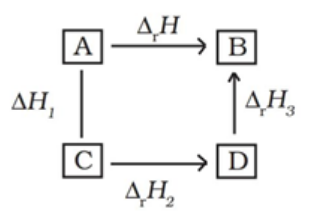
In general, if enthalpy of an overall reaction A → B along one route is $\triangle\text{rH}$ and$​​\triangle\text{rH}_1,\triangle\text{rH}_2,\triangle\text{rH}_3$ representing enthalpies of reactions leading to same product, B along another route, then we have

$\triangle\text{rH}=​​\triangle\text{rH}_1+\triangle\text{rH}_2+\triangle\text{rH}_3$

It can be represented as:

  1. The enthalpy change of a chemical reaction, is given by the symbol …
  1. $\triangle\text{rH}$

  2. $\triangle\text{rG}$

  3. $\triangle\text{rF}$

  4. $\triangle\text{rR}$'

  1. The molar enthalpy is denoted by:
  1. Hk
  2. Hm
  3. Hl
  4. Hn
  1. …is enthalpy of fusion in standard state.
  1. $\triangle\text{fus}\text{H}^{\phi}$

  2. $\triangle_\text{r}\text{H}^{\phi}$

  3. $\triangle\text{vap}\text{H}^{\phi}$

  4. $\triangle\text{w}\text{H}^{\phi}$

  1. Solid CO2or ‘dry ice’ sublimes at..
  1. 100K
  2. 195K
  3. 150K
  4. 200K
  1. … is the standard enthalpy of vaporisation.
  1. $\triangle\text{fus}\text{H}^{\phi}$

  2. $\triangle_\text{r}\text{H}^{\phi}$

  3. $\triangle\text{vap}\text{H}^{\phi}$

  4. $\triangle\text{w}\text{H}^{\phi}$

Answer
  1. (a) $\triangle\text{rH}$
  1. (b) Hm
  1. (a) $\triangle\text{fus}\text{H}^{\phi}$
  1. (b) 195K
  1. (c) $\triangle\text{vap}\text{H}^{\phi}$
View full question & answer