Let A and B be the positions of the two flag posts and P(x, y) be the position of the man.
Accordingly, PA + PB = 10
We know that if a point moves in-plane in such a way that the sum of its distance from two fixed points is constant, then the path is an ellipse and this constant value is equal to the length of the major axis of the ellipse.
Therefore, the path described by the man is an ellipse where the length of the major axis is 10m, while points A and B are the foci.
Taking the origin of the coordinate plane as the center of the ellipse, while taking the major axis along the x-axis, 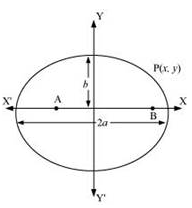
The equation of the ellipse will be of the form $\frac{x^{2}}{a^{2}}+\frac{y^{2}}{b^{2}}=1$, where a is the semi-major axis.
Accordingly, 2a = 10 $\Rightarrow$ a = 5
Distance between the foci = 2ae = 2c = 8
$\Rightarrow$ c = 4
On using the relation, c = $\sqrt{a^{2}-b^{2}}$, we get,
4 = $\sqrt{25-b^{2}}$
$\Rightarrow$ 16 = 25 – b2
$\Rightarrow$ b2 = 25 -1 6 = 9
$\Rightarrow$ b = 3
Put value of a and b in $\frac{x^{2}}{a^{2}}+\frac{y^{2}}{b^{2}}=1$.
$\frac{x^{2}}{5^{2}}+\frac{y^{2}}{3^{2}}=1$ $\Rightarrow$ $\frac{x^{2}}{25}+\frac{y^{2}}{9}=1$.
Questions
3 Marks Question
Take a timed test
27 questions · self-marked practice — reveal the answer and mark yourself.
Question 13 Marks
A man running a racecourse notes that the sum of the distances from the two flag posts from him is always 10 m and the distance between the flag posts is 8 m. Find the equation of the path traced by the man.
Answer
View full question & answer→Question 23 Marks
A rod of length 12 m moves with its ends always touching the coordinates axes. Determine the equation of the locus of a point P on the rod, which is 3 cm from the end in contact with the X-axis.
Answer
View full question & answer→Let l be the length of the rod and which at any position meet X-axis at A (a, 0) and also meets the Y-axis at B (0, b), therefore we have
l2 = a2 + b2
$\Rightarrow$ (12)2 = a2 + b2 ...(i) [$\because$ l = 12]
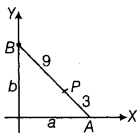
Let P be the point on AB which is 3 cm from A and hence 9 cm from B.
This means that the point P divides AB in ratio 3 : 9 i.e., 1 : 3.
If P = (x, y), then by section formula, we have
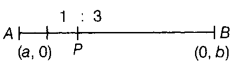
(x, y) = $\left( \frac { 1 \times 0 + 3 \times a } { 1 + 3 } , \frac { 1 \times b + 3 \times 0 } { 1 + 3 } \right)$
$\Rightarrow$ (x, y) = $\left( \frac { 3 a } { 4 } , \frac { b } { 4 } \right)$
$\Rightarrow$ x = $\frac { 3 a } { 4 }$ , y = $\frac { b } { 4 }$ $\Rightarrow$ a = $\frac { 4 x } { 3 }$ and b = 4y
On putting the values of a and b in Equation (i), we get
144 = $\left( \frac { 4 x } { 3 } \right) ^ { 2 }$ + (4y)2
$\Rightarrow$ $\frac { x ^ { 2 } } { 81 } + \frac { y ^ { 2 } } { 9 }$ = 1
which is required equation.
Question 33 Marks
An arc is in the form of a semi-ellipse. It is 8 m wide and 2 m high at the centre. Find the height of the arch at a point 1.5 m from one end.
Answer
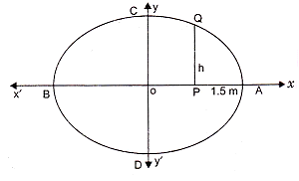
View full question & answer→Here width of elliptical arch = 8 m.
$\therefore$ AB = 8 m 2a = 8 $\Rightarrow$ a = 4
Height at the centre = 2 m
$\therefore$ OB = 2 $\Rightarrow$ b = 2
The axis is of the ellipse is x-axis.
So the equation of ellipse in standard form is $\frac{{{x^2}}}{{{a^2}}} + \frac{{{y^2}}}{{{b^2}}} = 1$
$\therefore \frac{{{x^2}}}{{{{(4)}^2}}} + \frac{{{y^2}}}{{{{(2)}^2}}} = 1 \Rightarrow \frac{{{x^2}}}{{16}} + \frac{{{y^2}}}{4} = 1$
Now AP = 1.5 m OP = OA - AP = 4 - 1.5 = 2.5m
Let PQ = h
$\therefore$ Coordinate of Q are (2.5, h)
Since the point Q lies on the ellipse $\frac{{{x^2}}}{{16}} + \frac{{{y^2}}}{4} = 1$
$\therefore \frac{{{{(2.5)}^2}}}{{16}} + \frac{{{h^2}}}{4} = 1 \Rightarrow \frac{{{h^2}}}{4} ={ 1}-\frac{ 6.25}{{16}}$$ \Rightarrow {h^2} = \frac{{9.75 \times 4}}{{16}} = \frac{{9.75}}{4}$
$\Rightarrow$ h2 = 2.44 $\Rightarrow$ h = $\sqrt{2.44}$ = 1.56 m approx.
$\therefore$ AB = 8 m 2a = 8 $\Rightarrow$ a = 4
Height at the centre = 2 m
$\therefore$ OB = 2 $\Rightarrow$ b = 2
The axis is of the ellipse is x-axis.
So the equation of ellipse in standard form is $\frac{{{x^2}}}{{{a^2}}} + \frac{{{y^2}}}{{{b^2}}} = 1$
$\therefore \frac{{{x^2}}}{{{{(4)}^2}}} + \frac{{{y^2}}}{{{{(2)}^2}}} = 1 \Rightarrow \frac{{{x^2}}}{{16}} + \frac{{{y^2}}}{4} = 1$
Now AP = 1.5 m OP = OA - AP = 4 - 1.5 = 2.5m
Let PQ = h
$\therefore$ Coordinate of Q are (2.5, h)
Since the point Q lies on the ellipse $\frac{{{x^2}}}{{16}} + \frac{{{y^2}}}{4} = 1$
$\therefore \frac{{{{(2.5)}^2}}}{{16}} + \frac{{{h^2}}}{4} = 1 \Rightarrow \frac{{{h^2}}}{4} ={ 1}-\frac{ 6.25}{{16}}$$ \Rightarrow {h^2} = \frac{{9.75 \times 4}}{{16}} = \frac{{9.75}}{4}$
$\Rightarrow$ h2 = 2.44 $\Rightarrow$ h = $\sqrt{2.44}$ = 1.56 m approx.
Question 43 Marks
The cable of a uniformly loaded suspension bridge hangs in the form of a parabola. The roadway which is horizontal and 100 m long is supported by vertical wires attached to the cable, the longest wire being 30 m and the shortest being 6 m. Find the length of a supporting wire attached to the roadway 18 m from the middle.
Answer
View full question & answer→Let AOB be the cable of uniformly loaded suspension bridge. Let AL and BM be the longest wires of length 30 m each. Let OC be the shortest wire of length 6 m and LM be the roadway.
Now AL = BM = 30 m, OC = 6 m and LM = 100 m.
$\therefore$ LC = CM = $\frac{1}{2}$LM= 50 m
Let O be the vertex and axis of the parabola be y-axis. So the equation of parabola in standard form is x2 = 4ay
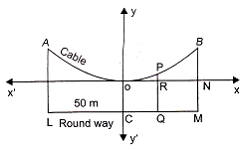
Coordinates of point B are (50, 24)
Since point B lies on the parabola x2 = 4ay
$\therefore$ (50)2 = 4a × 24 ⇒ a = $\frac{{2500}}{{4 \times 24}} = \frac{{625}}{{24}}$
So equation of parabola is ${x^2} = \frac{{4 \times 625}}{{24}}y \Rightarrow {x^2} = \frac{{625}}{6}y$
Let length of the supporting wire PW at a distance of 18 m be h.
$\therefore$ OR = 18 m and PR = PQ – QP = PQ - OC = h - 6
Coordinates of point P are (18, h - 6)
Since the point P lies on parabola ${x^2} = \frac{{625}}{6}y$
$\therefore$ (18)2 = $\frac{{625}}{6}$ (h - 6) ⇒ 324 $\times$ 6 = 625h - 3750
$\Rightarrow$ 625 h = 1944 + 3750 $\Rightarrow h = \frac{{5694}}{{625}}$ = 9.11 m approx.
Now AL = BM = 30 m, OC = 6 m and LM = 100 m.
$\therefore$ LC = CM = $\frac{1}{2}$LM= 50 m
Let O be the vertex and axis of the parabola be y-axis. So the equation of parabola in standard form is x2 = 4ay
Coordinates of point B are (50, 24)
Since point B lies on the parabola x2 = 4ay
$\therefore$ (50)2 = 4a × 24 ⇒ a = $\frac{{2500}}{{4 \times 24}} = \frac{{625}}{{24}}$
So equation of parabola is ${x^2} = \frac{{4 \times 625}}{{24}}y \Rightarrow {x^2} = \frac{{625}}{6}y$
Let length of the supporting wire PW at a distance of 18 m be h.
$\therefore$ OR = 18 m and PR = PQ – QP = PQ - OC = h - 6
Coordinates of point P are (18, h - 6)
Since the point P lies on parabola ${x^2} = \frac{{625}}{6}y$
$\therefore$ (18)2 = $\frac{{625}}{6}$ (h - 6) ⇒ 324 $\times$ 6 = 625h - 3750
$\Rightarrow$ 625 h = 1944 + 3750 $\Rightarrow h = \frac{{5694}}{{625}}$ = 9.11 m approx.
Question 53 Marks
An arc is in the form of a parabola with its axis vertical. The arch is 10 m high and 5 m wide at the base. How wide is it 2 m from the vertex of the parabola?
Answer
View full question & answer→Let AB be the parabolic arch having O as the vertex and OY as the axis.
The parabola is of the form x2 = 4ay
Now CD = 5 m $\Rightarrow$ OD = 2.5 m
BD = 10 m
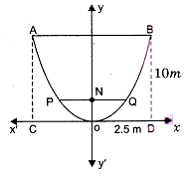
$\Rightarrow$ Coordinates of point B are (2.5, 10)
Since the point B lies on the parabola x2 = 4ay
$\therefore {(2.5)^2} = 4a \times 10 \Rightarrow a = \frac{{6.25}}{{40}} = \frac{{625}}{{4000}} = \frac{5}{{32}}$
$\therefore$ Equation of parabola is ${x^2} = 4 \times \frac{5}{{32}}y$
$ \Rightarrow {x^2} = \frac{5}{8}y$
Let PQ = d ⇒ NQ = $\frac{d}{2}$
$\therefore$ Coordinates of Point Q are $\left( {\frac{d}{2},2} \right)$
Since point Q lies on the parabola ${x^2} = \frac{5}{8}y$
$\therefore {\left( {\frac{d}{2}} \right)^2} = \frac{5}{8} \times 2 \Rightarrow \frac{{{d^2}}}{4} = \frac{5}{4} \Rightarrow {d^2} = 5 \Rightarrow d = \sqrt 5$
Thus width of arc $ = \sqrt 5 \;m$ = 2.24m approx.
The parabola is of the form x2 = 4ay
Now CD = 5 m $\Rightarrow$ OD = 2.5 m
BD = 10 m
$\Rightarrow$ Coordinates of point B are (2.5, 10)
Since the point B lies on the parabola x2 = 4ay
$\therefore {(2.5)^2} = 4a \times 10 \Rightarrow a = \frac{{6.25}}{{40}} = \frac{{625}}{{4000}} = \frac{5}{{32}}$
$\therefore$ Equation of parabola is ${x^2} = 4 \times \frac{5}{{32}}y$
$ \Rightarrow {x^2} = \frac{5}{8}y$
Let PQ = d ⇒ NQ = $\frac{d}{2}$
$\therefore$ Coordinates of Point Q are $\left( {\frac{d}{2},2} \right)$
Since point Q lies on the parabola ${x^2} = \frac{5}{8}y$
$\therefore {\left( {\frac{d}{2}} \right)^2} = \frac{5}{8} \times 2 \Rightarrow \frac{{{d^2}}}{4} = \frac{5}{4} \Rightarrow {d^2} = 5 \Rightarrow d = \sqrt 5$
Thus width of arc $ = \sqrt 5 \;m$ = 2.24m approx.
Question 63 Marks
Find the coordinates of the foci, the vertices, the length of major axis, the minor axis, the eccentricity and the length of the latus rectum of the ellipse.
4x2 + 9y2 = 36
4x2 + 9y2 = 36
Answer
View full question & answer→The equation of given ellipse is 4x2 + 9y2 = 36
i.e. $\frac{{4{x^2}}}{{36}} + \frac{{9{y^2}}}{{36}} = 1 \Rightarrow \frac{{{x^2}}}{9} + \frac{{{y^2}}}{4} = 1$
Now 9 > 4 $\Rightarrow$ a2 = 9 and b2 = 4
So the equation of ellipse in standard form is $\frac{{{x^2}}}{{{a^2}}} + \frac{{{y^2}}}{{{b^2}}} = 1$
$\therefore$ a2 = 9 $\Rightarrow$ a = 3 and b2 = 4 $\Rightarrow$ b = 2
We know that $c = \sqrt {{a^2} - {b^2}}$
$c = \sqrt {9 - 4} = \sqrt 5$
$\therefore$ Coordinates of foci are $( \pm c,\;0)$ i.e. $( \pm \sqrt5,\;0)$
Coordinates of vertices are $( \pm a,\;0)$ i.e. $( \pm 3,\;0)$
Length of major axis $ = 2a = 2 \times 3 = 6$
Length of minor axis $2b = 2 \times 2 = 4$
Eccentricity (e) $= \frac{c}{a} = \frac{{\sqrt 5 }}{3}$
Length of latus rectum $= \frac{{2{b^2}}}{a} = \frac{{2 \times 4}}{3} = \frac{8}{3}$
i.e. $\frac{{4{x^2}}}{{36}} + \frac{{9{y^2}}}{{36}} = 1 \Rightarrow \frac{{{x^2}}}{9} + \frac{{{y^2}}}{4} = 1$
Now 9 > 4 $\Rightarrow$ a2 = 9 and b2 = 4
So the equation of ellipse in standard form is $\frac{{{x^2}}}{{{a^2}}} + \frac{{{y^2}}}{{{b^2}}} = 1$
$\therefore$ a2 = 9 $\Rightarrow$ a = 3 and b2 = 4 $\Rightarrow$ b = 2
We know that $c = \sqrt {{a^2} - {b^2}}$
$c = \sqrt {9 - 4} = \sqrt 5$
$\therefore$ Coordinates of foci are $( \pm c,\;0)$ i.e. $( \pm \sqrt5,\;0)$
Coordinates of vertices are $( \pm a,\;0)$ i.e. $( \pm 3,\;0)$
Length of major axis $ = 2a = 2 \times 3 = 6$
Length of minor axis $2b = 2 \times 2 = 4$
Eccentricity (e) $= \frac{c}{a} = \frac{{\sqrt 5 }}{3}$
Length of latus rectum $= \frac{{2{b^2}}}{a} = \frac{{2 \times 4}}{3} = \frac{8}{3}$
Question 73 Marks
Find the coordinates of the foci, the vertices, the length of major axis, the minor axis, the eccentricity and the length of the latus rectum of the ellipse.
16x2 + y2 = 16
16x2 + y2 = 16
Answer
View full question & answer→The equation of given ellipse is 16x2 + y2 = 16
i.e. $\frac{{16{x^2}}}{{16}} + \frac{{{y^2}}}{{16}} = 1$ $\Rightarrow \frac{{{x^2}}}{1} + \frac{{{y^2}}}{{16}} = 1$
Now 16 > 1 $\Rightarrow$ a2 = 16 and b2 = 1
So the equation of ellipse in standard form is $\frac{{{y^2}}}{{{a^2}}} + \frac{{{x^2}}}{{{b^2}}} = 1$
a2 = 16 $\Rightarrow$ a = 4 and b2 = 1 $\Rightarrow$ b = 1
We know that $c = \sqrt {{a^2} - {b^2}}$
$\therefore c = \sqrt {16 - 1} = \sqrt {15}$
$\therefore$ Coordinates of foci are $(0,\; \pm c)$ i.e. $(0,\; \pm \sqrt {15} )$
Coordinates of vertices are $(0,\; \pm a)$ i.e. $(0,\; \pm 4)$
Length of major axis = 2 a = $2 \times 4 = 8$
Length of minor axis = 2b = $2 \times 1$ = 2
Eccentricity (e) = $\frac{c}{a} = \frac{{\sqrt {15} }}{4}$
Length of latus rectum $= \frac{{2{b^2}}}{a} = \frac{{2 \times 1}}{4} = \frac{1}{2}$
i.e. $\frac{{16{x^2}}}{{16}} + \frac{{{y^2}}}{{16}} = 1$ $\Rightarrow \frac{{{x^2}}}{1} + \frac{{{y^2}}}{{16}} = 1$
Now 16 > 1 $\Rightarrow$ a2 = 16 and b2 = 1
So the equation of ellipse in standard form is $\frac{{{y^2}}}{{{a^2}}} + \frac{{{x^2}}}{{{b^2}}} = 1$
a2 = 16 $\Rightarrow$ a = 4 and b2 = 1 $\Rightarrow$ b = 1
We know that $c = \sqrt {{a^2} - {b^2}}$
$\therefore c = \sqrt {16 - 1} = \sqrt {15}$
$\therefore$ Coordinates of foci are $(0,\; \pm c)$ i.e. $(0,\; \pm \sqrt {15} )$
Coordinates of vertices are $(0,\; \pm a)$ i.e. $(0,\; \pm 4)$
Length of major axis = 2 a = $2 \times 4 = 8$
Length of minor axis = 2b = $2 \times 1$ = 2
Eccentricity (e) = $\frac{c}{a} = \frac{{\sqrt {15} }}{4}$
Length of latus rectum $= \frac{{2{b^2}}}{a} = \frac{{2 \times 1}}{4} = \frac{1}{2}$
Question 83 Marks
Find the coordinates of the foci, the vertices, the length of major axis, the minor axis, the eccentricity and the length of the latus rectum of the ellipse.
36x2 + 4y2 = 144
36x2 + 4y2 = 144
Answer
View full question & answer→The equation of given ellipse is 36x2 + 4y2 = 144
i.e. $\frac{{36{x^2}}}{{144}} + \frac{{4{y^2}}}{{144}} = 1 \Rightarrow \frac{{{x^2}}}{4} + \frac{{{y^2}}}{{36}} = 1$
Now 36 > 4 $\Rightarrow$ a2 = 36 and b2 = 4
So the equation of ellipse in standard form is $\frac{{{y^2}}}{{{a^2}}} + \frac{{{x^2}}}{{{b^2}}} = 1$
$\therefore$ a2 = 36 $\Rightarrow$ a = 6 and b2 = 4 $\Rightarrow$ b = 2
We know that $c = \sqrt {{a^2} - {b^2}}$
$\therefore c = \sqrt {36 - 4} = \sqrt {32} = 4\sqrt 2$
$\therefore$ Coordinates of foci are $(0,\; \pm c)$ i.e. $(0,\; \pm 4\sqrt 2 )$
Coordinates of vertices are $(0,\; \pm a)$ i.e. $(0,\; \pm 6)$
Length of major axis = 2 a = $2 \times 6 = 12$
Length of minor axis $ = 2b = 2 \times 2 = 4$
Eccentricity (e) $ = \frac{c}{a} = \frac{{4\sqrt 2 }}{6} = \frac{{2\sqrt 2 }}{3}$
Length of latus rectum $ = \frac{{a{b^2}}}{a} = \frac{{2 \times 4}}{6} = \frac{4}{3}$
i.e. $\frac{{36{x^2}}}{{144}} + \frac{{4{y^2}}}{{144}} = 1 \Rightarrow \frac{{{x^2}}}{4} + \frac{{{y^2}}}{{36}} = 1$
Now 36 > 4 $\Rightarrow$ a2 = 36 and b2 = 4
So the equation of ellipse in standard form is $\frac{{{y^2}}}{{{a^2}}} + \frac{{{x^2}}}{{{b^2}}} = 1$
$\therefore$ a2 = 36 $\Rightarrow$ a = 6 and b2 = 4 $\Rightarrow$ b = 2
We know that $c = \sqrt {{a^2} - {b^2}}$
$\therefore c = \sqrt {36 - 4} = \sqrt {32} = 4\sqrt 2$
$\therefore$ Coordinates of foci are $(0,\; \pm c)$ i.e. $(0,\; \pm 4\sqrt 2 )$
Coordinates of vertices are $(0,\; \pm a)$ i.e. $(0,\; \pm 6)$
Length of major axis = 2 a = $2 \times 6 = 12$
Length of minor axis $ = 2b = 2 \times 2 = 4$
Eccentricity (e) $ = \frac{c}{a} = \frac{{4\sqrt 2 }}{6} = \frac{{2\sqrt 2 }}{3}$
Length of latus rectum $ = \frac{{a{b^2}}}{a} = \frac{{2 \times 4}}{6} = \frac{4}{3}$
Question 93 Marks
Find the coordinates of the foci, the vertices, the length of major axis, the minor axis, the eccentricity and the length of the latus rectum of the ellipse.
$\frac{{{x^2}}}{{100}} + \frac{{{y^2}}}{{400}} = 1$
$\frac{{{x^2}}}{{100}} + \frac{{{y^2}}}{{400}} = 1$
Answer
View full question & answer→The equation of given ellipse is $\frac{{{x^2}}}{{100}} + \frac{{{y^2}}}{{400}} = 1$
Now 400 > 100 $\Rightarrow$ a2 = 400 and b2 = 100
So the equation of ellipse in standard form is $\frac { y ^ { 2 } } { a ^ { 2 } } + \frac { x ^ { 2 } } { b ^ { 2 } } = 1$
$\therefore$ a2 = 400 $\Rightarrow$ a = 20 and b2 = 100 $\Rightarrow$ b = 10
We know that $c = \sqrt {{a^2} - {b^2}}$
$\therefore c = \sqrt {400 - 100} = \sqrt {300} = 10\sqrt 3$
$\therefore$ Coordinates of foci are $(0,\; \pm c)$ i.e. $(0,\; \pm 10\sqrt 3 )$
Coordinates of vertices are $(0,\; \pm a)$ i.e. $(0,\; \pm 20)$
Length of major axis = 2 a $ = 2 \times 20 = 40$
Length of minor axis = 2 b = $2 \times 10$ = 20
Eccentricity (e) $ = \frac{c}{a} = \frac{{10\sqrt 3 }}{{20}} = \frac{{\sqrt 3 }}{2}$
Length of latus rectum $= \frac{{2{b^2}}}{a} = \frac{{2 \times 100}}{{20}} = 10$
Now 400 > 100 $\Rightarrow$ a2 = 400 and b2 = 100
So the equation of ellipse in standard form is $\frac { y ^ { 2 } } { a ^ { 2 } } + \frac { x ^ { 2 } } { b ^ { 2 } } = 1$
$\therefore$ a2 = 400 $\Rightarrow$ a = 20 and b2 = 100 $\Rightarrow$ b = 10
We know that $c = \sqrt {{a^2} - {b^2}}$
$\therefore c = \sqrt {400 - 100} = \sqrt {300} = 10\sqrt 3$
$\therefore$ Coordinates of foci are $(0,\; \pm c)$ i.e. $(0,\; \pm 10\sqrt 3 )$
Coordinates of vertices are $(0,\; \pm a)$ i.e. $(0,\; \pm 20)$
Length of major axis = 2 a $ = 2 \times 20 = 40$
Length of minor axis = 2 b = $2 \times 10$ = 20
Eccentricity (e) $ = \frac{c}{a} = \frac{{10\sqrt 3 }}{{20}} = \frac{{\sqrt 3 }}{2}$
Length of latus rectum $= \frac{{2{b^2}}}{a} = \frac{{2 \times 100}}{{20}} = 10$
Question 103 Marks
Find the coordinates of the foci, the vertices, the length of major axis, the minor axis, the eccentricity and the length of the latus rectum of the ellipse.
$\frac{{{x^2}}}{{49}} + \frac{{{y^2}}}{{36}} = 1$
$\frac{{{x^2}}}{{49}} + \frac{{{y^2}}}{{36}} = 1$
Answer
View full question & answer→The equation of given ellipse is $\frac{{{x^2}}}{{49}} + \frac{{{y^2}}}{{36}} = 1$
Now 49 > 36 $\Rightarrow$ a2 = 49 and b2 = 36
So the equation of ellipse in standard form is $\frac{{{x^2}}}{{{a^2}}} + \frac{{{y^2}}}{{{b^2}}} = 1$
$\therefore$ a2 = 49 $\Rightarrow$ a = 7 and b2 = 36 $\Rightarrow$ b = 6
We know that $c = \sqrt {{a^2} - {b^2}}$
$\therefore c = \sqrt {49 - 36} = \sqrt {13}$
$\therefore$ Coordinates of foci are $( \pm c,\;0)$ i.e. $( \pm \sqrt {13} ,\;0)$
Coordinates of vertices are $( \pm a,\;0)$ i.e. $( \pm 7,\;0)$
Length of major axis = 2 a = $2 \times 7 = 14$
Length of minor axis = $2b = 2 \times 6 = 12$
Eccentricity (e) $= \frac{c}{a} = \frac{{\sqrt {13} }}{7}$
Length of latus rectum $= \frac{{2{b^2}}}{a} = \frac{{2 \times 36}}{7} = \frac{{72}}{7}$
Now 49 > 36 $\Rightarrow$ a2 = 49 and b2 = 36
So the equation of ellipse in standard form is $\frac{{{x^2}}}{{{a^2}}} + \frac{{{y^2}}}{{{b^2}}} = 1$
$\therefore$ a2 = 49 $\Rightarrow$ a = 7 and b2 = 36 $\Rightarrow$ b = 6
We know that $c = \sqrt {{a^2} - {b^2}}$
$\therefore c = \sqrt {49 - 36} = \sqrt {13}$
$\therefore$ Coordinates of foci are $( \pm c,\;0)$ i.e. $( \pm \sqrt {13} ,\;0)$
Coordinates of vertices are $( \pm a,\;0)$ i.e. $( \pm 7,\;0)$
Length of major axis = 2 a = $2 \times 7 = 14$
Length of minor axis = $2b = 2 \times 6 = 12$
Eccentricity (e) $= \frac{c}{a} = \frac{{\sqrt {13} }}{7}$
Length of latus rectum $= \frac{{2{b^2}}}{a} = \frac{{2 \times 36}}{7} = \frac{{72}}{7}$
Question 113 Marks
Find the coordinates of the foci, the vertices, the length of major axis, the minor axis, the eccentricity and the length of the latus rectum of the ellipse.
$\frac{{{x^2}}}{{25}} + \frac{{{y^2}}}{{100}} = 1$
$\frac{{{x^2}}}{{25}} + \frac{{{y^2}}}{{100}} = 1$
Answer
View full question & answer→The equation of given ellipse is $\frac{{{x^2}}}{{25}} + \frac{{{y^2}}}{{100}} = 1$
Now 100 > 25 $\Rightarrow$ a2 = 100 and b2 = 25
So the equation of ellipse in standard form is $\frac{{{y^2}}}{{{a^2}}} + \frac{{{x^2}}}{{{b^2}}} = 1$
$\therefore$ a2 = 100 $\Rightarrow$ a = 10 and b2 = 25 $\Rightarrow$ b = 5
We know that $c = \sqrt {{a^2} - {b^2}}$
$\therefore c = \sqrt {100 - 25} = \sqrt {75} = 5\sqrt 3$
$\therefore$ Coordinates of foci are $(0,\; \pm c)$ i.e. $(0, \pm 5\sqrt 3 )$
Coordinates of vertices are $(0,\; \pm a)$ i.e. $(0,\; \pm 10)$
Length of major axis = 2 a = $2 \times 10$= 20
Length of minor axis = 2 b = $2 \times 5$ = 10
Eccentricity (e) $ = \frac{c}{a} = \frac{{5\sqrt 3 }}{{10}} = \frac{{\sqrt 3 }}{2}$
Length of latus rectum $= \frac{{a{b^2}}}{a} = \frac{{2 \times 25}}{{10}} = 5$
Now 100 > 25 $\Rightarrow$ a2 = 100 and b2 = 25
So the equation of ellipse in standard form is $\frac{{{y^2}}}{{{a^2}}} + \frac{{{x^2}}}{{{b^2}}} = 1$
$\therefore$ a2 = 100 $\Rightarrow$ a = 10 and b2 = 25 $\Rightarrow$ b = 5
We know that $c = \sqrt {{a^2} - {b^2}}$
$\therefore c = \sqrt {100 - 25} = \sqrt {75} = 5\sqrt 3$
$\therefore$ Coordinates of foci are $(0,\; \pm c)$ i.e. $(0, \pm 5\sqrt 3 )$
Coordinates of vertices are $(0,\; \pm a)$ i.e. $(0,\; \pm 10)$
Length of major axis = 2 a = $2 \times 10$= 20
Length of minor axis = 2 b = $2 \times 5$ = 10
Eccentricity (e) $ = \frac{c}{a} = \frac{{5\sqrt 3 }}{{10}} = \frac{{\sqrt 3 }}{2}$
Length of latus rectum $= \frac{{a{b^2}}}{a} = \frac{{2 \times 25}}{{10}} = 5$
Question 123 Marks
Find the coordinates of the foci, the vertices, the length of major axis, the minor axis, the eccentricity and the length of the latus rectum of the ellipse.
$\frac{{{x^2}}}{{16}} + \frac{{{y^2}}}{9} = 1$
$\frac{{{x^2}}}{{16}} + \frac{{{y^2}}}{9} = 1$
Answer
View full question & answer→The equation of given ellipse is $\frac{{{x^2}}}{{16}} + \frac{{{y^2}}}{9} = 1$
Now 16 > 9 $\Rightarrow$ a2 = 16 and b2 = 9
On the equation of ellipse in standard form is $\frac{{{x^2}}}{{{a^2}}} + \frac{{{y^2}}}{{{b^2}}} = 1$
a2 = 16 $\Rightarrow$ a = 4 and b2 = 9 $\Rightarrow$ b = 3
We know that $c = \sqrt {{a^2} - {b^2}}$
$\therefore c = \sqrt {16 - 9} = \sqrt 7$
$\therefore$ Coordinates of foci are $( \pm c,\;0)$ i.e. $( \pm \sqrt 7 ,\;0)$
Coordinates of vertices are $( \pm a,\;0)$ i.e. $( \pm 4,\;0)$
Length of major axis = 2 a $= 2 \times 4 = 8$
Length of minor axis = 2b $ = 2 \times 3$= 6
Eccentricity (e) $ = \frac{c}{a} = \frac{{\sqrt 7 }}{4}$
Length of latus rectum $ = \frac{{a{b^2}}}{a} = \frac{{2 \times 9}}{4} = \frac{9}{2}$
Now 16 > 9 $\Rightarrow$ a2 = 16 and b2 = 9
On the equation of ellipse in standard form is $\frac{{{x^2}}}{{{a^2}}} + \frac{{{y^2}}}{{{b^2}}} = 1$
a2 = 16 $\Rightarrow$ a = 4 and b2 = 9 $\Rightarrow$ b = 3
We know that $c = \sqrt {{a^2} - {b^2}}$
$\therefore c = \sqrt {16 - 9} = \sqrt 7$
$\therefore$ Coordinates of foci are $( \pm c,\;0)$ i.e. $( \pm \sqrt 7 ,\;0)$
Coordinates of vertices are $( \pm a,\;0)$ i.e. $( \pm 4,\;0)$
Length of major axis = 2 a $= 2 \times 4 = 8$
Length of minor axis = 2b $ = 2 \times 3$= 6
Eccentricity (e) $ = \frac{c}{a} = \frac{{\sqrt 7 }}{4}$
Length of latus rectum $ = \frac{{a{b^2}}}{a} = \frac{{2 \times 9}}{4} = \frac{9}{2}$
Question 133 Marks
Find the coordinates of the foci, the vertices, the length of major axis, the minor axis, the eccentricity and the length of the latus rectum of the ellipse.
$\frac{{{x^2}}}{4} + \frac{{{y^2}}}{{25}} = 1$
$\frac{{{x^2}}}{4} + \frac{{{y^2}}}{{25}} = 1$
Answer
View full question & answer→The equation of given ellipse is $\frac{{{x^2}}}{4} + \frac{{{y^2}}}{{25}} = 1$
Now 25 > 4 $\Rightarrow$ a2 = 25 and b2 = 4
So the equation of ellipse in standard form is $\frac{{{y^2}}}{{{a^2}}} + \frac{{{x^2}}}{{{b^2}}} = 1$
$\therefore$ a2 = 25 $\Rightarrow$ a = 5 and b2 = 4 $\Rightarrow$ b = 2
We know that $c = \sqrt {{a^2} - {b^2}}$
$\therefore c = \sqrt {25 - 4} = \sqrt {21}$
$\Rightarrow$ Coordinates of foci are $(0,\; \pm c)$ i.e. $(0 \pm \sqrt {21} )$
Coordinates of vertices are $(0,\; \pm a)$ i.e. $(0,\; \pm 5)$
Length of major axis $= 2a = 2 \times 5 = 10$
Length of minor axis = 2b $= 2 \times 2 = 4$
Eccentricity (e) $\frac{c}{a} = \frac{{\sqrt {21} }}{5}$
Length of latus rectum $= \frac{{a{b^2}}}{a} = \frac{{2 \times 4}}{5} = \frac{8}{5}$
Now 25 > 4 $\Rightarrow$ a2 = 25 and b2 = 4
So the equation of ellipse in standard form is $\frac{{{y^2}}}{{{a^2}}} + \frac{{{x^2}}}{{{b^2}}} = 1$
$\therefore$ a2 = 25 $\Rightarrow$ a = 5 and b2 = 4 $\Rightarrow$ b = 2
We know that $c = \sqrt {{a^2} - {b^2}}$
$\therefore c = \sqrt {25 - 4} = \sqrt {21}$
$\Rightarrow$ Coordinates of foci are $(0,\; \pm c)$ i.e. $(0 \pm \sqrt {21} )$
Coordinates of vertices are $(0,\; \pm a)$ i.e. $(0,\; \pm 5)$
Length of major axis $= 2a = 2 \times 5 = 10$
Length of minor axis = 2b $= 2 \times 2 = 4$
Eccentricity (e) $\frac{c}{a} = \frac{{\sqrt {21} }}{5}$
Length of latus rectum $= \frac{{a{b^2}}}{a} = \frac{{2 \times 4}}{5} = \frac{8}{5}$
Question 143 Marks
Find the coordinates of the foci, the vertices, the length of major axis, the minor axis, the eccentricity and the length of the latus rectum of the ellipse.
$\frac{{{x^2}}}{{36}} + \frac{{{y^2}}}{{16}} = 1$
$\frac{{{x^2}}}{{36}} + \frac{{{y^2}}}{{16}} = 1$
Answer
View full question & answer→The equation of given ellipse is $\frac{{{x^2}}}{{36}} + \frac{{{y^2}}}{{16}} = 1$
Now 36 > 16 $\Rightarrow {a^2} = 36$ and b2 = 16
So the equation of ellipse in standard form is $\frac{{{x^2}}}{{{a^2}}} + \frac{{{y^2}}}{{{b^2}}} = 1$
a2 = 36 $\Rightarrow$ a = 6 and b2 = 16 $\Rightarrow$ b = 4
We know that $c = \sqrt {{a^2} - {b^2}}$
$c = \sqrt {36 - 16} = \sqrt {20} = 2\sqrt 5$
$\therefore$ Coordinates of foci are $( \pm c,\;0)$ i.e. $( \pm 2\sqrt 5 ,\;0)$
Coordinates of vertices are $( \pm a,\;0)$ i.e. $( \pm 6,\;0)$
Length of major axis = 2a $= 2 \times 6 = 12$
Length of minor axis = 2b = $2 \times 4$ = 8
Eccentricity (e) $= \frac{c}{a} = \frac{{2\sqrt 5 }}{6} = \frac{{\sqrt 5 }}{3}$
Length of latus rectum $ = \frac{{2{b^2}}}{a} = \frac{{2 \times 16}}{6} = \frac{{16}}{3}$
Now 36 > 16 $\Rightarrow {a^2} = 36$ and b2 = 16
So the equation of ellipse in standard form is $\frac{{{x^2}}}{{{a^2}}} + \frac{{{y^2}}}{{{b^2}}} = 1$
a2 = 36 $\Rightarrow$ a = 6 and b2 = 16 $\Rightarrow$ b = 4
We know that $c = \sqrt {{a^2} - {b^2}}$
$c = \sqrt {36 - 16} = \sqrt {20} = 2\sqrt 5$
$\therefore$ Coordinates of foci are $( \pm c,\;0)$ i.e. $( \pm 2\sqrt 5 ,\;0)$
Coordinates of vertices are $( \pm a,\;0)$ i.e. $( \pm 6,\;0)$
Length of major axis = 2a $= 2 \times 6 = 12$
Length of minor axis = 2b = $2 \times 4$ = 8
Eccentricity (e) $= \frac{c}{a} = \frac{{2\sqrt 5 }}{6} = \frac{{\sqrt 5 }}{3}$
Length of latus rectum $ = \frac{{2{b^2}}}{a} = \frac{{2 \times 16}}{6} = \frac{{16}}{3}$
Question 153 Marks
Find the equation of the circle with radius 5 whose centre lies on x-axis and passes through the point (2, 3).
Answer
View full question & answer→Since the centre of the circle lies on x-axis, the coordinates of centres is (h, 0)
Now the circle passes through the point (2, 3)
$\therefore$ Radius of circle $ = \sqrt {{{(h - 2)}^2} + {{(0 - 3)}^2}} = \sqrt {{h^2} + 4 - 4h + 9} $ $= \sqrt {{h^2} - 4h + 13}$
But radius of circle = 5
$\therefore \;\sqrt {{h^2} - 4h + 13} = 5$ $\Rightarrow$ h2 - 4h + 13 = 25 $\Rightarrow$ h2 - 4h - 12 = 0
$\Rightarrow$ (h - 6)(h + 2) = 0 $\Rightarrow$ h = 6 or h = -2
When h = 6
Equation of required circle is
(x - 6)2 + (y - 0)2 = (5)2 $\Rightarrow$ x2 + 36 - 12x + y2 = 25
$\Rightarrow$ x2 + y2 -12x + 11 = 0
When h = -2
Equation of required circle is
(x + 2)2 + (y - 0)2 = (5)2 $\Rightarrow$ x2 + 4 + 4x + y2 = 25
$\Rightarrow$ x2 + y2 + 4x - 21 = 0
Now the circle passes through the point (2, 3)
$\therefore$ Radius of circle $ = \sqrt {{{(h - 2)}^2} + {{(0 - 3)}^2}} = \sqrt {{h^2} + 4 - 4h + 9} $ $= \sqrt {{h^2} - 4h + 13}$
But radius of circle = 5
$\therefore \;\sqrt {{h^2} - 4h + 13} = 5$ $\Rightarrow$ h2 - 4h + 13 = 25 $\Rightarrow$ h2 - 4h - 12 = 0
$\Rightarrow$ (h - 6)(h + 2) = 0 $\Rightarrow$ h = 6 or h = -2
When h = 6
Equation of required circle is
(x - 6)2 + (y - 0)2 = (5)2 $\Rightarrow$ x2 + 36 - 12x + y2 = 25
$\Rightarrow$ x2 + y2 -12x + 11 = 0
When h = -2
Equation of required circle is
(x + 2)2 + (y - 0)2 = (5)2 $\Rightarrow$ x2 + 4 + 4x + y2 = 25
$\Rightarrow$ x2 + y2 + 4x - 21 = 0
Question 163 Marks
Find the equation of the circle passing through the points (2, 3) and (-1, 1) and whose centre is on the line x - 3y - 11 = 0.
Answer
View full question & answer→The equation of the circle is
(x - h)2 + (y - k)2 = $r^2.....(1)$
(x - h)2 + (y - k)2 = $r^2.....(1)$
$Since\ the\ circle\ passes\ through\ ( -1,1),\\ \therefore\ (-1-h)^2+(1-k)^2=r^2\\ \Rightarrow 1+h^2+2h+1+k^2-2k=r^2\\ \Rightarrow h^2+k^2+2h-2k+2=r^2......(2)$
Since the circle passes through point (2, 3)
$\therefore$ (2 - h)2 + (3 - k)2 = r2 $\Rightarrow$ 4 + h2 - 4h + 9 + k2 - 6k = r2
$\Rightarrow$ h2 + k2 -4h - 6k + 13= $r^2........(3)$
From (2) and (3), we have
h2 + k2 -4h - 6k + 13 = h2 + k2 + 2h - 2k + 2
$\Rightarrow$ -6h - 4k = -11 $\Rightarrow$ 6h + 4k = 11 .... (4)
Since the centre (h, k) of the circle lies on the line (x - 3y - 11 = 0)
$\therefore$ h - 3k - 11 = 0 $\Rightarrow$ h - 3k = 11 . . . (5)
Solving (4) and (5), we have,
$h = \frac{7}{2}$ and $k = \frac{{ - 5}}{2}$
Putting these values of h and k in (3), we have
${\left( {\frac{7}{2}} \right)^2} + {\left( {\frac{{ - 5}}{2}} \right)^2} - \frac{{4 \times 7}}{2} - 6 \times \frac{{ - 5}}{2} + 13 = {r^2}$
$\Rightarrow \frac{{49}}{4} + \frac{{25}}{4} - 14 + 15 + 13 = {r^2} \Rightarrow {r^2} = \frac{{65}}{2}$
Thus equation of required circle is
${\left( {x - \frac{7}{2}} \right)^2} + {\left( {y + \frac{5}{2}} \right)^2} = \frac{{65}}{2}$$\Rightarrow {x^2} + \frac{{49}}{4} - 7x + {y^2} + \frac{{25}}{4} + 5y = \frac{{65}}{2}$
$\Rightarrow$ 4x2 + 49 – 28x + 4y2 + 25 + 20y = 130
$\Rightarrow$ 4x2 + 4y2 – 28x + 20y – 56 = 0
$\Rightarrow$ 4(x2 + y2 – 7x + 5y – 14) = 0
$\Rightarrow$ x2 + y2 – 7x + 5y – 14 = 0
Question 173 Marks
Find the equation of the circle passing through the points (4, 1) and (6, 5) and whose centre is on the line 4x + y = 16.
Answer
View full question & answer→The equation of the circle is
(x - h)2 + (y - k)2 = r2 .... (i)
Since the circle passes through point (4, 1)
$\therefore$ (4 - h)2 + (1 - k)2 = r2 $\Rightarrow$ 16 + h2 - 8h + 1 + k2 - 2k = r2
$\Rightarrow$ h2 + k2 - 8h - 2k + 17 = r2 .... (ii)
Also the circle passes through point (6, 5)
$\therefore$ (6 - h)2 + (5 - k)2 = r2 $\Rightarrow$ 36 + h2 - 12h + 25 + k2 - 10k = r2
$\Rightarrow$ h2 + k2 - 12h - 10k + 61 = r2
From (ii) and (iii), we have
h2 + k2 - 8h - 2k + 17 = h2 + k2 - 12h - 10k + 61
$\Rightarrow$ 4h + 8k = 44 $\Rightarrow$ h + 2k = 11 .... (iv)
Since the centre (h, k) of the circle lies on the line 4x + y = 16
$\therefore$ 4h + k = 16 . . . (v)
Solving (iv) and (v), we have
h = 3 and k = 4
Putting value of h and k in (ii), we have
(3)2 + (4)2 - 8 × 3 - 2 × 4 + 17 = r2
r2 = 10
Thus equation of required circle is
(x - 3)2 + (y - 4)2 = 10 $\Rightarrow$ x2 + 9 - 6x + y2 + 16 - 8y = 10
$\Rightarrow$ x2 + y2 - 6x - 8y + 15 =0
(x - h)2 + (y - k)2 = r2 .... (i)
Since the circle passes through point (4, 1)
$\therefore$ (4 - h)2 + (1 - k)2 = r2 $\Rightarrow$ 16 + h2 - 8h + 1 + k2 - 2k = r2
$\Rightarrow$ h2 + k2 - 8h - 2k + 17 = r2 .... (ii)
Also the circle passes through point (6, 5)
$\therefore$ (6 - h)2 + (5 - k)2 = r2 $\Rightarrow$ 36 + h2 - 12h + 25 + k2 - 10k = r2
$\Rightarrow$ h2 + k2 - 12h - 10k + 61 = r2
From (ii) and (iii), we have
h2 + k2 - 8h - 2k + 17 = h2 + k2 - 12h - 10k + 61
$\Rightarrow$ 4h + 8k = 44 $\Rightarrow$ h + 2k = 11 .... (iv)
Since the centre (h, k) of the circle lies on the line 4x + y = 16
$\therefore$ 4h + k = 16 . . . (v)
Solving (iv) and (v), we have
h = 3 and k = 4
Putting value of h and k in (ii), we have
(3)2 + (4)2 - 8 × 3 - 2 × 4 + 17 = r2
r2 = 10
Thus equation of required circle is
(x - 3)2 + (y - 4)2 = 10 $\Rightarrow$ x2 + 9 - 6x + y2 + 16 - 8y = 10
$\Rightarrow$ x2 + y2 - 6x - 8y + 15 =0
Question 183 Marks
Find the coordinates of the foci, the vertices, the length of major axis, the minor axis, the eccentricity and the latus rectum of the ellipse $\frac{x^{2}}{25}+\frac{y^{2}}{9}=1$
Answer
View full question & answer→Since the denominator of $\frac{x^{2}}{25}$ is larger than the denominator of $\frac{y^{2}}{9}$, the major axis is along the x-axis. Comparing the given equation with $\frac{x^{2}}{a^{2}}+\frac{y^{2}}{b^{2}}=1$, we get
a = 5 and b = 3. Also $c=\sqrt{a^{2}-b^{2}}=\sqrt{25-9}=4$
Therefore, the coordinates of the foci are (– 4,0) and (4,0), vertices are (– 5, 0) and (5, 0).
Length of the major axis 2a is 10 units length of the minor axis 2b is 6 units
Eccentricity is $\frac{4}{5}$
Length of latus rectum is $\frac{2 b^{2}}{a}=\frac{18}{5}$.
a = 5 and b = 3. Also $c=\sqrt{a^{2}-b^{2}}=\sqrt{25-9}=4$
Therefore, the coordinates of the foci are (– 4,0) and (4,0), vertices are (– 5, 0) and (5, 0).
Length of the major axis 2a is 10 units length of the minor axis 2b is 6 units
Eccentricity is $\frac{4}{5}$
Length of latus rectum is $\frac{2 b^{2}}{a}=\frac{18}{5}$.
Question 193 Marks
A beam is supported at its ends by supports which are 12 metres apart. Since the load is concentrated at its centre, there is a deflection of 3 cm at the centre and the deflected beam is in the shape of a parabola. How far from the centre is the deflection 1 cm?
Answer
View full question & answer→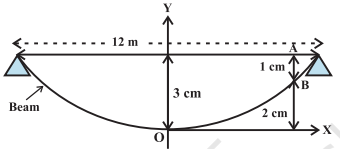
The equation of the parabola takes the form x2 = 4ay. Since it passes through
$\left(6, \frac{3}{100}\right)$ we have $(6)^{2}=4 a\left(\frac{3}{100}\right)$ , i.e., $a=\frac{36 \times 100}{12}=300 \mathrm{m}$ $\Rightarrow$ a = 300m
Let AB be the deflection of the beam which is $\frac{1}{100} \mathrm{m}$ Coordinates of B are $\left(x, \frac{2}{100}\right)$
Therefore $x^{2}=4 \times 300 \times \frac{2}{100}=24$
i.e. $x=\sqrt{24}=2 \sqrt{6}$ m
Question 203 Marks
The focus of a parabolic mirror as shown in is at a distance of 5 cm from its vertex. If the mirror is 45 cm deep, find the distance AB
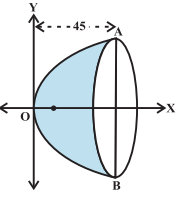
Answer
View full question & answer→Since the distance from the focus to the vertex is 5 cm. We have, a = 5. If the origin is taken at the vertex and the axis of the mirror lies along the positive x-axis, the equation of the parabolic section is
y2 = 4 (5) x = 20 x ==> required eqution of parabola y2 = 20x
Note that x = 45. Thus
y2 = 900
Therefore y = $\pm$ 30
Hence AB = 2y = 2 $\times$ 30 = 60 cm
y2 = 4 (5) x = 20 x ==> required eqution of parabola y2 = 20x
Note that x = 45. Thus
y2 = 900
Therefore y = $\pm$ 30
Hence AB = 2y = 2 $\times$ 30 = 60 cm
Question 213 Marks
Find the equation of the hyperbola where foci are (0, $\pm$12) and the length of the latus rectum is 36.
Answer
View full question & answer→We have given foci are (0, $\pm$12),
it follows that c = 12
Length of the latus rectum = $\frac{2 b^{2}}{a}$ = 36 or b2 = 18a
Therefore c2 = a2 + b2; gives
144 = a2 + 18a
i.e., a2 + 18a – 144 = 0,
So a = – 24, 6.
Since a cannot be negative, we take a = 6 and so b2 = 108
No, the equation of the hyperbola is $\frac{y^{2}}{36}-\frac{x^{2}}{108}=1, \text { i.e., } 3 y^{2}-x^{2}=108$
Hence, the equation of the hyperbola = $ 3 y^{2}-x^{2}=108$
it follows that c = 12
Length of the latus rectum = $\frac{2 b^{2}}{a}$ = 36 or b2 = 18a
Therefore c2 = a2 + b2; gives
144 = a2 + 18a
i.e., a2 + 18a – 144 = 0,
So a = – 24, 6.
Since a cannot be negative, we take a = 6 and so b2 = 108
No, the equation of the hyperbola is $\frac{y^{2}}{36}-\frac{x^{2}}{108}=1, \text { i.e., } 3 y^{2}-x^{2}=108$
Hence, the equation of the hyperbola = $ 3 y^{2}-x^{2}=108$
Question 223 Marks
Find the coordinates of the foci and the vertices, the eccentricity, the length of the latus rectum of the hyperbola: y2 – 16x2 = 16
Answer
View full question & answer→Dividing the equation by 16 on both sides, we have $\frac{y^{2}}{16}-\frac{x^{2}}{1}=1$
Comparing the equation with the standard equation $\frac{y^{2}}{a^{2}}-\frac{x^{2}}{b^{2}}=1$, we find that
a = 4, b = 1 and $c=\sqrt{a^{2}+b^{2}}=\sqrt{16+1}=\sqrt{17}$ ==> c = ae = $\sqrt 17$
Therefore, the coordinates of the foci are (0, $\pm$ $\sqrt{17}$ ) and that of the vertices are (0, $\pm$ 4). Also
The eccentricity $e=\frac{c}{a}=\frac{\sqrt{17}}{4}$. The length of latus rectum $=\frac{2 b^{2}}{a}=\frac{1}{2}$
Comparing the equation with the standard equation $\frac{y^{2}}{a^{2}}-\frac{x^{2}}{b^{2}}=1$, we find that
a = 4, b = 1 and $c=\sqrt{a^{2}+b^{2}}=\sqrt{16+1}=\sqrt{17}$ ==> c = ae = $\sqrt 17$
Therefore, the coordinates of the foci are (0, $\pm$ $\sqrt{17}$ ) and that of the vertices are (0, $\pm$ 4). Also
The eccentricity $e=\frac{c}{a}=\frac{\sqrt{17}}{4}$. The length of latus rectum $=\frac{2 b^{2}}{a}=\frac{1}{2}$
Question 233 Marks
Find the coordinates of the foci and the vertices, the eccentricity, the length of the latus rectum of the hyperbolas: $\frac{x^{2}}{9}-\frac{y^{2}}{16}=1$
Answer
View full question & answer→Comparing the equation $\frac{x^{2}}{9}-\frac{y^{2}}{16}=1$ with the standard equation $\frac{x^{2}}{a^{2}}-\frac{y^{2}}{b^{2}}=1$
Here, a = 3, b = 4 and c = $\sqrt{a^{2}+b^{2}}=\sqrt{9+16}=5$ ==> c = ae = 5
Therefore, the coordinates of the foci are ($\pm$ 5, 0) and that of vertices are (± 3, 0). Also,
The eccentricity $e=\frac{c}{a}=\frac{5}{3}$. The length oflatus rectum $=\frac{2 b^{2}}{a}=\frac{32}{3}$
Here, a = 3, b = 4 and c = $\sqrt{a^{2}+b^{2}}=\sqrt{9+16}=5$ ==> c = ae = 5
Therefore, the coordinates of the foci are ($\pm$ 5, 0) and that of vertices are (± 3, 0). Also,
The eccentricity $e=\frac{c}{a}=\frac{5}{3}$. The length oflatus rectum $=\frac{2 b^{2}}{a}=\frac{32}{3}$
Question 243 Marks
Find the equation of the ellipse, with major axis along the x-axis and passing through the points (4, 3) and (– 1,4).
Answer
View full question & answer→The standard form of the ellipse is $\frac{x^{2}}{a^{2}}+\frac{y^{2}}{b^{2}}=1$ Since the points (4, 3) and (–1, 4) lie on the ellipse, we have
$\frac{16}{a^{2}}+\frac{9}{b^{2}}=1$ ... equation(1)
and $\frac{1}{a^{2}}+\frac{16}{b^{2}}=1$ ….equation(2)
Solving equations (1) and (2), we find that $a^{2}=\frac{247}{7}$ and $b^{2}=\frac{247}{15}$.
Hence the required equation is $\frac{x^{2}}{\left(\frac{247}{7}\right)}+\frac{y^{2}}{(\frac{247}{15})}=1$, i.e., 7x2 + 15y2 = 247.
$\frac{16}{a^{2}}+\frac{9}{b^{2}}=1$ ... equation(1)
and $\frac{1}{a^{2}}+\frac{16}{b^{2}}=1$ ….equation(2)
Solving equations (1) and (2), we find that $a^{2}=\frac{247}{7}$ and $b^{2}=\frac{247}{15}$.
Hence the required equation is $\frac{x^{2}}{\left(\frac{247}{7}\right)}+\frac{y^{2}}{(\frac{247}{15})}=1$, i.e., 7x2 + 15y2 = 247.
Question 253 Marks
Find the equation of the ellipse, whose length of the major axis is 20 and foci are (0, $\pm$ 5).
Answer
View full question & answer→Since the foci are on the y-axis, the major axis is along the y-axis. So, the equation of the ellipse is of the form $\frac{x^{2}}{b^{2}}+\frac{y^{2}}{a^{2}}=1$
Given, length of the major axis is 20 and foci are (0, ± 5). ==> 2a = 20 and c = ae = 5
a = semi-major axis = $\frac{20}{2}$= 10
and the relation c2 = a2 – b2 gives
52 = 102 – b2 i.e., b2 = 75
Therefore, the equation of the ellipse is $\frac{x^{2}}{75}+\frac{y^{2}}{100}=1$
Given, length of the major axis is 20 and foci are (0, ± 5). ==> 2a = 20 and c = ae = 5
a = semi-major axis = $\frac{20}{2}$= 10
and the relation c2 = a2 – b2 gives
52 = 102 – b2 i.e., b2 = 75
Therefore, the equation of the ellipse is $\frac{x^{2}}{75}+\frac{y^{2}}{100}=1$
Question 263 Marks
Find the equation of the ellipse whose vertices are ($\pm$ 13, 0) and foci are ($\pm$ 5, 0).
Answer
View full question & answer→Since the vertices are on x-axis, the equation will be of the form $\frac{x^{2}}{a^{2}}+\frac{y^{2}}{b^{2}}=1$, where a is the semi-major axis.
Given that vertices are ($\pm$ 13, 0) and foci are ($\pm$ 5, 0) ==>> a = 13, c = ae = $\pm$5
Therefore, from the relation c2 = a2 – b2 , we get
25 = 169 – b2 , i.e., b = 12
Hence the equation of the ellipse is $\frac{x^{2}}{169}+\frac{y^{2}}{144}=1$
Given that vertices are ($\pm$ 13, 0) and foci are ($\pm$ 5, 0) ==>> a = 13, c = ae = $\pm$5
Therefore, from the relation c2 = a2 – b2 , we get
25 = 169 – b2 , i.e., b = 12
Hence the equation of the ellipse is $\frac{x^{2}}{169}+\frac{y^{2}}{144}=1$
Question 273 Marks
Find the coordinates of the foci, the vertices, the lengths of major and minor axes and the eccentricity of the ellipse 9x2 + 4y2 = 36.
Answer
View full question & answer→The given equation of the ellipse can be written in standard form as $\frac{x^{2}}{4}+\frac{y^{2}}{9}=1$
Since the denominator of $\frac{y^{2}}{9}$ is larger than the denominator of $\frac{x^{2}}{4}$ ,the major axis is along the y-axis. Comparing the given equation with the standard equation $\frac{x^{2}}{b^{2}}+\frac{y^{2}}{a^{2}}=1$, we have b = 2 and a = 3.
Also $c=\sqrt{a^{2}-b^{2}}=\sqrt{9-4}=\sqrt{5}$
and $e=\frac{c}{a}=\frac{\sqrt{5}}{3}$
Hence the foci are,$(0, \sqrt{5})$ & $(0,-\sqrt{5})$ vertices are (0,3) & (0, –3),
Since the denominator of $\frac{y^{2}}{9}$ is larger than the denominator of $\frac{x^{2}}{4}$ ,the major axis is along the y-axis. Comparing the given equation with the standard equation $\frac{x^{2}}{b^{2}}+\frac{y^{2}}{a^{2}}=1$, we have b = 2 and a = 3.
Also $c=\sqrt{a^{2}-b^{2}}=\sqrt{9-4}=\sqrt{5}$
and $e=\frac{c}{a}=\frac{\sqrt{5}}{3}$
Hence the foci are,$(0, \sqrt{5})$ & $(0,-\sqrt{5})$ vertices are (0,3) & (0, –3),
length of the major axis = 2a = 6 units
the length of the minor axis = 2b = 4 units and
the eccentricity of the ellipse = $\frac{\sqrt{5}}{3}$.