Questions

M.C.Q (1 Marks)

Take a timed test

10 questions · self-marked practice — reveal the answer and mark yourself.

Question 11 Mark
The eccentricity of the ellipse, if the distance between the foci is equal to the length of the latus-rectum, is:
  1. $\frac{\sqrt{5}-1}{2}$
  2. $\frac{\sqrt{5}+1}{2}$
  3. $\frac{\sqrt{5}-1}{4}$
  4. $\text{none of these}$
Answer
  1. $\text{e}=\frac{\sqrt{5}-1}{2}$

Solution:

According to the question, the distance between the foci is equal to the length of the latus rectum.

$\frac{2\text{b}^2}{\text{a}}=2\text{ae}$

$\Rightarrow\text{b}^2=\text{a}^2\text{e}$

Now, $\text{e}=\sqrt{1-\frac{\text{b}^2}{\text{a}^2}}$

$\Rightarrow\text{e}=\sqrt{1-\frac{\text{a}^2\text{e}}{\text{a}^2}}$

$\Rightarrow\text{e}=\sqrt{1-\text{e}}$

On squaring both sides, we get:

$\text{e}^2\text{e}-1=0$

$\Rightarrow\text{e}=\frac{-1\pm\sqrt{1+4}}{2}$

$\Rightarrow\text{e}=\frac{\sqrt{5}-1}{2}$ $(\because\text{e}\text{ cannot be negative}\big)$ 
View full question & answer
Question 21 Mark
The eccentricity of the conic $9\text{x}^2+25\text{y}^2=225$ is:
  1. $\frac{2}{5}$
  2. $\frac{4}{5}$
  3. $\frac{1}{3}$
  4. $\frac{1}{5}$
  5. $\frac{3}{5}$
Answer
  1. $\frac{4}{5}$

 $9\text{x}^2+25\text{y}^2=225$

Solution:

$\Rightarrow\frac{\text{x}^2}{25}+\frac{\text{y}^2}{9}=1$

Comparing it with $\Rightarrow\frac{\text{x}^2}{\text{a}^2}+\frac{\text{y}^2}{\text{b}^2}=1,$ we get:

$\text{a}=5$ and $\text{b}=3$

Here, a > b, so the major and the minor axes of the ellipse are along the x−axis and y−axis, respectively.

Now, $\text{e}=\sqrt{1-\frac{\text{b}^2}{\text{a}^2}}$

$\Rightarrow\text{e}=\sqrt{1-\frac{9}{25}}$

$\Rightarrow\text{e}=\sqrt{\frac{16}{25}}$

$\Rightarrow\text{e}=\frac{4}{5}$

View full question & answer
Question 31 Mark
The difference between the lengths of the major axis and the latus-rectum of an ellipse is
  1.  ae
  2.  2ae
  3. ae2
  4.  2ae2
Answer
  1. 2ae2

Solution:

 Length of the latus rectum $=\frac{2\text{b}^2}{\text{a}}$

and $\text{e}=\sqrt{1-\frac{\text{b}^2}{\text{a}^2}}$

$\text{a}^2\text{e}^2=\text{a}^2-\text{b}^2$

$\Rightarrow\text{b}^2=\text{a}^2-\text{a}^2\text{e}^2$

$\Rightarrow\text{b}^2=\text{a}^2(1-\text{e}^2)$

$\therefore\ $Length of the latus rectum $=\frac{2\text{a}^2(1-\text{e}^2)}{\text{a}}=2\text{a}(1-\text{e}^2)$

Length of the major axis = 2a

Difference between length of latus rectum and length of major axis $=2\text{a}-2\text{a}(1-\text{e}^2)$

$\\=2\text{a}-2\text{a}+2\text{ae}^2\\=2\text{ae}^2$

View full question & answer
Question 41 Mark
The equations of the tangents to the ellipse $9\text{x}^2+16\text{y}^2=144$ from the point (2, 3) are:
  1. y = 3, x = 5
  2. x = 2, y = 3
  3. x = 3, y = 2
  4. x + y = 5, y = 3
Answer
  1. x + y = 5, y = 3

 $9\text{x}^2+16\text{y}^2=144$

Solution:

$\Rightarrow\frac{\text{x}^2}{16}+\frac{\text{y}^2}{9}=1$

Equation of the tangent in case of an ellipse is given by 

$\text{y}=\text{mx}+\sqrt{\text{a}^2\text{m}^2+\text{b}^2}$

$\Rightarrow\text{y}=\text{mx}+\sqrt{16\text{m}^2+9}\ \dots(1)$

Substituting x = 2 and y = 3, we get:

$3=2\text{m}\pm\sqrt{16\text{m}^2+9}$

$\Rightarrow3-2\text{m}=\sqrt{16\text{m}^2+9}$

On squaring both sides, we get: 

$(3-2\text{m})^2=(16\text{m}^2+9)$

$\Rightarrow9+4\text{m}^2-12\text{m}=(16\text{m}^2+9)$

$\Rightarrow12\text{m}^2+12\text{m}=0$

$\Rightarrow12\text{m}(\text{m+1})=0$

$\Rightarrow\text{m}=0,-1$

Substituting values of m in eq. (1), we get: 

For $\text{m}=0,\ \text{y}=3$

For $\text{m}=-1,\ \text{y}=-\text{x}+5$ or $\text{x}+\text{y}=5$

View full question & answer
Question 51 Mark
The eccentricity of the ellipse $\frac{\text{x}^2}{\text{b}^2}+\frac{\text{y}^2}{\text{y}^2}=1$ if its latus rectum is equal to one half of its minor axis, is:
  1. $\frac{1}{\sqrt{2}}$
  2. $\frac{\sqrt{3}}{2}$
  3. $\frac{1}{2}$
  4. $\text{none of these}$
Answer
  1. $\text{e}=\frac{\sqrt{3}}{2}$

Solution: 

According to the question, the latus rectum is half its minor axis.

i.e. $\frac{2\text{b}^2}{\text{a}}=\frac{1}{2}\times2\text{b}$

$\Rightarrow2\text{b}^2=\text{ab}$

$\Rightarrow\text{a}=2\text{b}$

Now, $\text{e}\sqrt{1-\frac{\text{b}^2}{\text{a}^2}}$

$\Rightarrow\text{e}=\sqrt{1-\frac{\text{b}^2}{4\text{b}^2}}$

$\Rightarrow\text{e}=\sqrt{1-\frac{1}{4}}$

$\Rightarrow\text{e}=\frac{\sqrt{3}}{2}$

View full question & answer
Question 61 Mark
The equation of the circle drawn with the two foci of $\frac{\text{x}^2}{\text{a}^2}+\frac{\text{y}^2}{\text{b}^2}=1$ end-point of a diameter is 
  1. $\text{x}^2+\text{y}^2=\text{a}^2+\text{b}^2$
  2. $\text{x}^2+\text{y}^2=\text{a}^2$
  3. $\text{x}^2+\text{y}^2=2\text{a}^2$
  4. $\text{x}^2+\text{y}^2=\text{a}^2-\text{b}^2$
Answer
  1. $\text{x}^2+\text{y}^2=\text{a}^2-\text{b}^2$

solution: 

We have $\text{r}=\text{ae}$

Let the equation of the circle be  $\text{x}^2+\text{y}^2=\text{r}^2.$

Now, $\text{x}^2+\text{y}^2=\text{a}^2\text{e}^2$ $(\because\text{r}=\text{ae})$

$\Rightarrow\text{x}^2+\text{y}^2=\text{a}^2\Big(1-\frac{\text{b}^2}{\text{a}^2}\Big)$ $\bigg(\because\text{e}=\sqrt{1-\frac{\text{b}^2}{\text{a}^2}}\bigg)$

$\Rightarrow\text{x}^2+\text{y}^2=\text{a}^2-\text{b}^2$

$\therefore\ $The required equation of the circle $\text{x}^2+\text{y}^2=\text{a}^2-\text{b}^2.$

View full question & answer
Question 71 Mark
The eccentricity of the ellipse, if the minor axis is equal to the distance between the foci, is:
  1. $\frac{\sqrt{3}}{2}$
  2. $\frac{2}{\sqrt{3}}$
  3. $\frac{1}{\sqrt{2}}$
  4. $\frac{\sqrt{2}}{3}$
Answer
  1. $\frac{1}{\sqrt{2}}$

Solution:

 According to the question, the minor axis is equal to the distance between the foci.

i.e. $2\text{b}=2\text{ae}$

$\text{e}=\frac{\text{b}}{\text{a}}\ \dots(1)$

Now, $\text{e}=\sqrt{1-\frac{\text{b}^2}{\text{a}^2}}$

$\Rightarrow\text{e}=\sqrt{1-\text{e}^2}$ $\Big[\text{From}\ (1)\Big]$ 

On squaring both sides, we get:

$\text{e}^2=1-\text{e}^2$

$\Rightarrow2\text{e}^2=1$

$\Rightarrow\text{e}^2=\frac{1}{2}$

$\Rightarrow\text{e}=\frac{1}{\sqrt{2}}$

View full question & answer
Question 81 Mark
The latus-rectum of the conic $3\text{x}^2+4\text{y}^2-6\text{x}+8\text{y}-5=0$ is:
  1.  $3$
  2. $\frac{\sqrt{3}}{2}$
  3. $\frac{2}{\sqrt{3}}$
  4. $\text{none of these}$
Answer
  1. $3$

 $3\text{x}^2+4\text{y}^2-6\text{x}+8\text{y}-5=0$

Solution:

$\Rightarrow3(\text{x}^2-2\text{x})+4(\text{y}^2+2\text{y})=5$

$\Rightarrow3(\text{x}^2-2\text{x}+1)+4(\text{y}^2+2\text{y}+1)=5+3+4$

$\Rightarrow3(\text{x}-1)^2+4(\text{y}+1)^2=12$

$\frac{(\text{x-1})^2}{4}+\frac{(\text{y}+1)^2}{3}=1$

So, $\text{a}=2$ and $\text{b}=\sqrt{3}$

$\therefore\ $Latus rectum $=\frac{2\text{b}^2}{\text{a}}$

$\\=2\frac{\big[\sqrt{3}\big]^2}{2}\\=3$

View full question & answer
Question 91 Mark
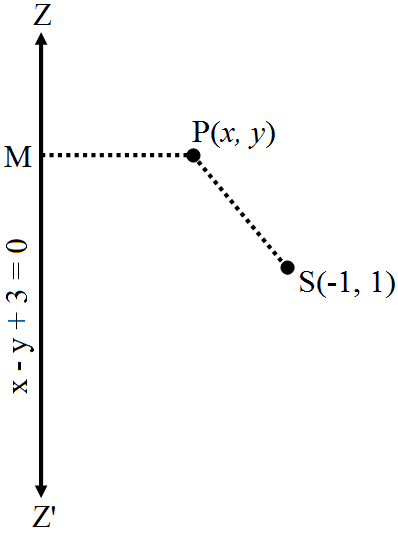
The equation of the ellipse with focus (-1, 1), directrix x - y + 3 = 0 and eccentricity $\frac{1}{2}$ is:
  1. $7\text{x}^2+2\text{xy}+7\text{y}^2+10\text{x}+10\text{y}+7=0$
  2. $7\text{x}^2+2\text{xy}+7\text{y}^2+10\text{x}-10\text{y}+7=0$
  3. $7\text{x}^2+2\text{xy}+7\text{y}^2+10\text{x}-10\text{y}-7=0$
  4. $\text{None of these}$
Answer
  1. $7\text{x}^2+7\text{y}^2+2\text{xy}-10\text{y}+10\text{x}+7=0$

Solution:

Let P(x,y) be any point on the ellipse whose focus and eccentricity are S(-1,1) and $\text{e}=\frac{1}{2},$respectively.Let PM be the perpendicular from P on the directrix.

Then $\text{SP}=\text{e}\times\text{PM}$

$\Rightarrow\text{SP}=\frac{1}{2}\times\text{PM}$

$\Rightarrow2\text{SP}=\text{PM}$

$\Rightarrow4(\text{SP})^2=\text{PM}^2$

$\Rightarrow4\Big[(\text{x}+1)^2+(\text{y}-1)^2\Big]=\bigg(\frac{\text{x}-\text{y}+3}{\sqrt{1^2+}(-1)^2}\bigg)^2$

$\Rightarrow4\big[\text{x}^2+1+2\text{x}+\text{y}^2+1-2\text{y}\big]\\=\frac{{\text{x}^2+\text{y}^2+9-2\text{xy}-6\text{y}+6\text{x}}}{2}$

$\Rightarrow8\text{x}^2+8+16\text{x}+8\text{y}^2+8-16\text{y}\\=\text{x}^2+\text{y}62+9-2\text{xy}-6\text{y}+6\text{x}$

$\therefore7\text{x}^2+7\text{y}^2+2\text{xy}-10\text{y}+10\text{x}+7=0$

This is the required equation of the ellipse.

View full question & answer
Question 101 Mark
For the ellipse $12\text{x}^2+4\text{y}^2+24\text{x}-16\text{y}+25=0$
  1. centre is (-1, 2)
  2. lengths of the axes are $\sqrt{3}$ and 1
  3. eccentricity $=\sqrt{\frac{2}{3}}$
  4. all of these.
Answer
Disclaimer : The equation should be $12\text{x}^2+4\text{y}^2+24\text{x}-16\text{y}+24=0$ instead of $12\text{x}^2+4\text{y}^2+24\text{x}-16\text{y}+25=0.$

  1. All of these

Solution:

$12\text{x}^2+4\text{y}^2+24\text{x}-16\text{y}+24=0$

$\Rightarrow12\big(\text{x}^2+2\text{x}\big)+4\big(\text{y}^2-4\text{y}\big)=-24$

$\Rightarrow12\big(\text{x}^2+2\text{x}+1\big)+4\big(\text{y}^2-4\text{y}+4\big)=-24+12+16$

$\Rightarrow12\big(\text{x}+1\big)^2+4\big(\text{y}-2\big)^2=4$

$\Rightarrow\frac{(\text{x}+1)^2}{3}+\frac{(\text{y}-2)^2}{1}=1$

So, the centre is a $(-1,\ 2).$

Here, $\text{a}=\sqrt{3}$ and $\text{b}=1$

The lengths of the axes are $\sqrt{3}$ and 1.

Now, $\text{e}=\sqrt{1-\frac{\text{b}62}{\text{a}^2}}$

$\text{e}=\sqrt{1-\frac{1}{3}}$

$\Rightarrow\text{e}=\sqrt{\frac{2}{3}}$

View full question & answer