Question 15 Marks
One side of equilateral triangle is 18 cm. The mid-points of its sides are joined to from another triangle whose mind-points, in turn, are joined to from still another triangle. the process is continued indefinitely. Find the sum of the (i) Perimeters of all the triangles. (ii) Areas of all triangles.
Answer
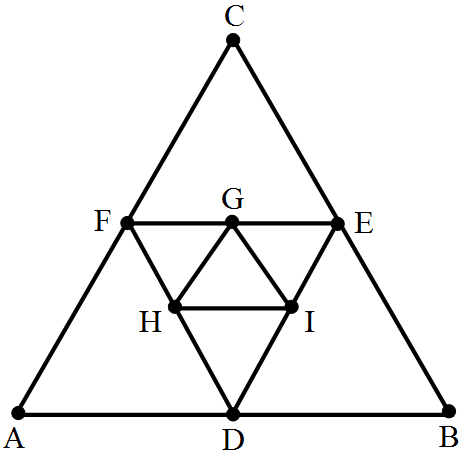
Side of triangle = 18cm.
AD = BD = 9cm.
DE = BD = 9cm.
$\text{GI} = \text{IF} = \frac{9}{2}\text{cm}.$
Sides of the triangles are $18, 9, \frac{9}{2}\dots$
(i) Sum of perimeters of the equilateral triangle $=\Big(54+27+\frac{27}{2}+\ \dots\Big)$
$=\frac{54}{1-\frac{1}{2}}$
$=54\times2$
Perimeter = 108cm.
(ii) Sum of area of equilateral triangle
$=\bigg[\frac{\sqrt{3}}{4}(18)^2+\frac{\sqrt{3}}{4}(9)^2+\frac{\sqrt{3}}{4}\Big(\frac{9}{2}\Big)^2+\dots\bigg]$
$=\frac{\sqrt{3}}{4}\Big[324+81+\frac{81}{4}+\dots\Big]$
$=\frac{\sqrt{3}}{4}\Bigg[\frac{324}{1-\frac14}\Bigg]$
$=\frac{\sqrt{3}}{4}\Big[\frac{324\times4}{3}\Big]$
$=\sqrt{3}(108)$
View full question & answer→Question 25 Marks
Find the 4th term from the end of the G.P. $\frac12,\frac16,\frac{1}{18}\frac{1}{54},\ \dots,\ \frac{1}{4374}.$
Answer$\frac12,\frac16,\frac{1}{18}\frac{1}{54},\ \dots,\ \frac{1}{4374}.$
$\text{a}=\frac{1}{2},\text{l}=\frac{1}{4374},\text{r}=\frac{\text{t}_{\text{n}-1}}{\text{t}_\text{n}}=\frac{\text{t}_2}{\text{t}_1}=\frac{\frac16}{\frac12}=\frac13$
Term from the end is:
$\text{a}_\text{n}=\text{l}\Big(\frac{1}{\text{r}}\Big)^{\text{n}-1}$
$\text{t}_4=\Big(\frac{1}{4374}\Big)(3)^{\text{n}-1}$
$=\frac{1}{4374}\times3^3$
$=\frac{1}{162}$
$\therefore$ 4th term from the end is $=\frac{1}{162}$
View full question & answer→Question 35 Marks
If one A.M., A and two geometric means G1 and G2 inserted between any two positive number, show that $\frac{\text{G}^2_1}{\text{G}_2}+\frac{\text{G}^2_2}{\text{G}_1}=2\text{A}.$
AnswerLet the two positive numbers be a and b.
a, A and b are in A.P.
$\therefore2\text{A}=\text{a}+\text{b }\cdots(\text{i})$
Also, a, G1, G2 and b are in G.P.
$\therefore\text{r}=\Big(\frac{\text{b}}{\text{a}}\Big)^{\frac{1}{3}}$
Also, G1 = ar and G2 = ar2. ...(ii)
Now, $\text{L.H.S}=\frac{\text{G}^2_1}{\text{G}_2}+\frac{\text{G}^2_2}{\text{G}_1}$
$=\frac{(\text{ar})^2}{\text{ar}^2}+\frac{\big(\text{ar}^2\big)^2}{\text{ar}}$ [Using (ii)]
$=\text{a}+\text{a}\Bigg(\Big(\frac{\text{b}}{\text{a}}\Big)^{\frac{1}{3}}\Bigg)^3$
$=\text{a}+\text{a}\Big(\frac{\text{b}}{\text{a}}\Big)$
$=\text{a}+\text{b}$
$=2\text{A}$
$=\text{R.H.S}$ [Using (i)]
View full question & answer→Question 45 Marks
Evaluate the following: $\sum_\limits{\text{k}=1}^{\text{n}}(2^\text{k}+3^{\text{k}-1})$
Answer$\sum_\limits{\text{k}=1}^{\text{n}}(2^\text{k}+3^{\text{k}-1})$
$=(2+3^0)+(2^2+3)+(2^3+3^2)+\ \dots\ +(2^\text{n}+3^{{\text{n}-}1})$
$(2+2^2+2^3+\ \dots\ +2^{\text{n}})+(3^0+3^1+3^2+\ \dots\ +3^{\text{n}-1})$
$=\text{S}_\text{n}+\text{S}_\text{m}$
$\text{S}_\text{n}\Rightarrow\text{a}=2,\text{n}=\text{n},\text{r}=\frac{2^2}{2}=2$
$\text{S}_\text{n}=\frac{\text{a}(\text{r}^\text{n}-1)}{\text{r}-1}=\frac{2(2^\text{n}-1)}{2-1}=2(2^\text{n}-1)$
Also,
$\text{S}_\text{m}=\text{S}_{\text{n}-1}$
$\text{a}=1,\text{r}=3,\text{n}=\text{n}-1$
$\text{S}_{\text{n}-1}=\frac{1(3^{\text{n}-1}-1)}{3-1}=\frac12(3^{\text{n}}-1)$
$\therefore\sum_\limits{\text{k}-1}^\text{n}(2^{\text{k}}+3^{\text{k}-1})=2(2^\text{n}-1)+\frac12(3^\text{n}-1)$
$=\frac12\big[2^{\text{n}+2}+3^\text{n}-4-1\big]$
$=\frac12\big[2^{\text{n}+2}+3^\text{n}-5\big]$
View full question & answer→Question 55 Marks
Find the rational number having the following decimal expansions: $0.\overline{68}$
AnswerThe rational number can be written as:
$0.\overline{68}=0.6+0.08+0.008+0.0008+\ \dots\infty$
$=\frac35+8[0.01+0.001+0.0001+0.00001+\ \dots\infty]$
$=\frac{3}{5}+8\Big[\frac{1}{100}+\frac{1}{100}+\dots\infty\Big]$
This is an infinite G.P. with first term $\frac{1}{100}$ and common ratio $\frac{1}{10}$
$=\frac{3}{5}+8\times\frac{1}{100}\times\frac{1}{1-\frac{1}{10}}$
$=\frac{3}{5}+\frac{4}{45}$
$=\frac{31}{45} $
View full question & answer→Question 65 Marks
If $\text{x}^{\text{a}}=\text{x}^{\frac{\text{b}}{2}}\text{z}^{\frac{\text{b}}{2}}=\text{z}^{\text{c}},$ then prove that $\frac{1}{\text{a}},\frac{1}{\text{b}},\frac{1}{\text{c}}$ are in A.P.
Answer$\text{x}^{\text{a}}=\text{x}^{\frac{\text{b}}{2}}\text{z}^{\frac{\text{b}}{2}}=\text{z}^{\text{c}}=\lambda(\text{ say})$
$\text{x}=\lambda^{\frac{1}{\text{a}}},\text{z}=\lambda^{\frac{1}{\text{c}}}$
$\text{x}^{\frac{\text{b}}{2}}\times\text{z}^{\frac{\text{b}}{2}}=\lambda$
$\lambda^{\frac{1}{\text{a}}\big(\frac{\text{b}}{2}\big)}\times\lambda^{\frac{\text{b}}{2}\times\frac{1}{\text{c}}}=\lambda$
$\lambda^{\frac{\text{b}}{2\text{a}}+\frac{\text{b}}{2\text{c}}}=\lambda^1$
$\frac{\text{b}}{2\text{a}}+\frac{\text{b}}{2\text{c}}=1$
$\frac{1}{\text{a}}+\frac{1}{\text{c}}=\frac{2}{\text{b}}$
$\Rightarrow\frac{1}{\text{a}},\frac{1}{\text{b}},\frac{1}{\text{c}}\text{ are in A.P.}$
View full question & answer→Question 75 Marks
The sum of first three terms of a G.P. is $\frac{39}{10}$ and their product is 1. Find the common ratio and the terms.
AnswerLet the terms of the G.P. be $\frac{\text{a}}{\text{r}},\text{a}$ and ar.
$\therefore$ Product of the G.P. = 1
$\Rightarrow\text{a}^3=1$
$\Rightarrow\text{a}=1$
Now, sum of the G.P. $=\frac{39}{10}$
$\Rightarrow\frac{\text{a}}{\text{r}}+\text{a}+\text{ar}=\frac{39}{10}$
$\Rightarrow\text{a}\Big(\frac{1}{\text{r}}+1+\text{r}\Big)=\frac{39}{10}$
$\Rightarrow1\Big(\frac{1}{\text{r}}+1+\text{r}\Big)=\frac{39}{10}$
$\Rightarrow10\text{r}^2-10\text{r}+10=39\text{r}$
$\Rightarrow10\text{r}^2-29\text{r}+10=0$
$\Rightarrow10\text{r}^2-25\text{r}-4\text{r}+10=0$
$\Rightarrow5\text{r}(2\text{r}-5)-2(2\text{r}-5)=0$
$\Rightarrow(5\text{r}-2)(2\text{r}-5)=0$
$\Rightarrow\text{r}=\frac{2}{5},\frac{5}{2}$
Hence, Putting the values of a and r, the required numbers are $\frac{5}{2},1,\frac25\text{ or }\frac{2}{5},1 \text{ and }\frac{5}{2}.$
View full question & answer→Question 85 Marks
A G.P. consits of an even number of terms. If the sum of all the terms is 5 times the sum of the terms occupying the odd places. Find the common ratio the G.P.
AnswerLet the G.P. be 2n, 2, 2n + 4, ... Then,
$\text{S}_\text{n}=\frac{\text{a}(\text{r}^\text{n}-1)}{\text{r}-1},\text{a}=2\text{n},\text{r}=2$ $\therefore\text{S}_\text{n}=\frac{2\text{n}(2^\text{n}-1)}{2-1}=2\text{n}^{\text{n}+1}-2\text{n}$
Then the G.P. of odd term
$\text{a}_1+\text{a}_3+\text{a}_5+\ ...\ \text{a}_{2\text{n}-1}$
Accourding to the question
Sum of all terms = 5(sum of terms occupying the odd places)
$\text{a}_1+\text{a}_2+\text{a}_3+\ ...\ +\text{a}_{2\text{n}}=5(\text{a}_1+\text{a}_3+\text{a}_5+\ ...\ +\text{a}_{2\text{n}-1})$
$\text{a}+\text{ar}+\text{ar}^2+\ ...\ +\text{ar}^{2\text{n}-1}=5\big(\text{a}+\text{ar}^2+\text{ar}^4+\ ...\ +\text{ar}^{2\text{n}-1}\big)$
$\frac{\text{a}(1-\text{r}^{2\text{n}})}{1-\text{r}}=5\Bigg(\frac{\text{a}\big(1-(\text{r})^2\big)^{\text{n}}}{1-\text{r}^2}\Bigg)$
$\frac{\text{a}}{1-\text{r}}$ is cancelled on both side
$1-\text{r}^{2\text{n}}=\frac{5\big(1-\text{r}^{2\text{n}}\big)}{1+\text{r}}$
$1+\text{r}-\text{r}^{2\text{n}}-\text{r}^{2\text{n}+1}=5-5\text{r}^{2\text{n}}$
$\text{r}^{2\text{n}-1}-4\text{r}^{2\text{n}}-\text{r}+4=0$
$\text{r}^{2\text{n}}(\text{r}-4)-1(\text{r}-4)=0$
$\text{r}^{2\text{n}}=1,\text{r}=4$
$\Rightarrow\text{r}=4$
View full question & answer→Question 95 Marks
If a, b, c, are in G.P., prove that the following are also in G.P.
$\text{a}^2,\text{b}^2,\text{c}^2$
Answera, b, c are in G.P. $\Rightarrow\text{b}^2=\text{ac }\cdots{(1)}$
$\big(\text{b}^2\big)=\big(\text{ac}\big)^2$
$\big(\text{b}^2\big)^2=\text{a}^2\text{c}^2$
$\Rightarrow\text{a}^2,\text{b}^2,\text{c}^2\text{ are in G.P.}$
View full question & answer→Question 105 Marks
If a, b, c are in G.P., prove that:
$\frac{1}{\text{a}^2-\text{b}^2}+\frac{1}{\text{b}^2}=\frac{1}{\text{b}^2-\text{c}^2}$
Answera, b, c are in G.P. a, b = ar, c = ar2
$\text{L.H.S}=\frac{1}{\text{a}^2-\text{b}^2}+\frac{1}{\text{b}^2}$
$=\frac{1}{\text{a}^2-\text{a}^2\text{r}^2}+\frac{1}{\text{a}^2\text{r}^2}$
$=\frac{1}{\text{a}^2}\Big[\frac{1}{1-\text{r}^2}+\frac{1}{\text{r}^2}\Big]$
$=\frac{1}{\text{a}^2}\Bigg[\frac{\text{r}^2+1-\text{r}^2}{\big(1-\text{r}^2\big)\text{r}^2}\Bigg]$
$=\frac{1}{\text{a}^2}\Big[\frac{1}{\text{r}^2-\text{r}^4}\Big]$
$=\frac{1}{(\text{ar})^2-(\text{ar}^2)^2}$
$=\frac{1}{\text{b}^2-\text{c}^2}$
$=\text{R.H.S}$
$\therefore\text{R.H.S}=\text{L.H.S}$
View full question & answer→Question 115 Marks
If the A.M. of two positive numbers a and b (a > b) is twice their geometric mean. Prove that: $\text{a} : \text{b} = \big(2 +\sqrt{3}\big):\big(2-\sqrt{3}\big).$
AnswerAM = 2GM
$\therefore\frac{\text{a}+\text{b}}{2}=2\sqrt{\text{ab}}$
$\Rightarrow\text{a}+\text{b}=4\sqrt{\text{ab}}$
Squaring both the sides:
$\Rightarrow(\text{a}+\text{b})^2=\big(4\sqrt{\text{ab}}\big)^2$
$\Rightarrow\text{a}^2+2\text{ab}+\text{b}^2=16\text{ab}$
$\Rightarrow\text{a}^2-14\text{ab}+\text{b}^2=0$
Using the quadratic formula:
$\Rightarrow\text{a}= {-(-14\text{b}) \pm \sqrt{(-14\text{b})^2-4\times1\times\text{b}^2} \over 2\times1}$ $[\because$ a is positive number$]$
$\Rightarrow\text{a}= {14\text{b} +2\text{b} \sqrt{49-1} \over 2}$
$\Rightarrow\text{a}=\text{b}\big(7+4\sqrt{3}\big)$
$\Rightarrow\frac{\text{a}}{\text{b}}=7+4\sqrt{3}$
$\Rightarrow\frac{\text{a}}{\text{b}}=4+3+2\times2\times\sqrt{3}$
$\Rightarrow\frac{\text{a}}{\text{b}}=\big(2+\sqrt{3}\big)^2$
$\Rightarrow\frac{\text{a}}{\text{b}}=\frac{\big(2+\sqrt{3}^2\big(2-\sqrt{3}\big)}{\big(2-\sqrt{3}\big)}$
$\Rightarrow\frac{\text{a}}{\text{b}}\frac{\big(2+\sqrt{3}\big)(4-3)}{\big(2-\sqrt{3}\big)}$
$\therefore\frac{\text{a}}{\text{b}}=\frac{\big(2+\sqrt{3}\big)}{\big(2-\sqrt{3}\big)}$
View full question & answer→Question 125 Marks
If a, b, c are in G.P., prove that:
$(\text{a}+2\text{b}+2\text{c})(\text{a}-2\text{b}+2\text{c})=\text{a}^2+4\text{c}^2$
Answera, b, c are in G.P. a, b = ar, c = ar2
$\text{L.H.S}=({\text{a}+2\text{b}+2\text{c})}{(\text{a}-2\text{ar}+2\text{c})}$
$=\big(\text{a}+2\text{ar}+2\text{ar}^2\big)\big(1-2\text{ar}+2\text{ar}^2\big)$
$=\text{a}^2\big(1+2\text{ar}+2\text{ar}^2\big)\big(1-2\text{r}+2\text{r}^2\big)$
$=\text{a}^2\Big[\big(1+2\text{r}^2\big)^2-\big(2\text{r}\big)^2\Big]$
$=\text{a}^2\big[1+4\text{r}^4+4\text{r}^2-4\text{r}^2\big]$
$=\text{a}^2\big[1+4\text{r}^4\big]$
$=\text{a}^2+4\big(\text{ar}^2\big)^2$
$=\text{a}^2+4\text{c}^2$
$=\text{R.H.S}$
$\therefore\text{R.H.S}=\text{L.H.S}$
View full question & answer→Question 135 Marks
If a, b, c, d are in G.P., prove that:
$\frac{\text{ab}-\text{cd}}{\text{b}^2-\text{c}^2}=\frac{\text{a}+\text{c}}{\text{b}}$
Answera, b, c are in G.P. $\therefore\text{b}^2=\text{ac }\cdots{1}$
$\text{L.H.S}={\text{a}\big(\text{b}^2+\text{c}^2\big)}$
$=\text{ab}^2+\text{ac}^2$
$=\text{a}(\text{ac})+\text{c}\big(\text{b}^2\big)$ $[\text{Using (1)}]$
$=\text{c}(\text{a}^2+\text{b}^2)$
$=\text{R.H.S}$
$\therefore\text{R.H.S}=\text{L.H.S}$
View full question & answer→Question 145 Marks
Find three numbers in G.P. whose sum is 38 and their product is 1728.
AnswerLet the three number be a, ar, ar2 in G.P., where a is first teror and r is the common ratio. Then,
$\text{a} + \text{ar} +\text{ar}^2 = 38$
$\text{a} (1 + \text{r} + \text{r}^2) = 38\cdots(\text{i})$
and
$\text{(a)}\text{(ar)}\text{(ar)}^2=1728$
$\text{a}^3\text{r}^3=1728=4^33^3=(12)^3$
$\text{a}^3=\frac{12^3}{\text{r}^3}\Rightarrow\frac{12}{\text{r}}=\text{a}$
Putting $\text{a}=\frac{12}{\text{r}}\text{ in }(\text{i})$
$\frac{12}{\text{r}}(1 + \text{r} + \text{r}^2)=38$
$12+12\text{r}+12\text{r}^2=38\text{r}$
$12\text{r}^2-26\text{r}+12=0$
$6\text{r}^2-13\text{r}+6=0$
$6\text{r}^2-9\text{r}-4\text{r}+6=0$
$3\text{r}(3\text{r}-3)-2(3\text{r}-3)=0$
$\text{r}=\frac{3}{2},\frac{2}{3}$
$\text{a}=\frac{12}{\frac{3}{2}}=8\text{ or }\frac{12}{\frac23}=18$
$\therefore$ G.P. is 8, 12, 18.
View full question & answer→Question 155 Marks
If S
1, S
2, ..., S
n are the sums of n terms of n G.P.'s whose first terms is 1 in each and common ratio are 1, 2, 3, ..., n respectively, then prove that
S1, + S2 + 2S3 + 3S4 + ... (n - 1) Sn = 1n + 2n + 3n + ... + nn.
AnswerS1, S2, ..., Sn are the sum of n terms of G.P. a = 1, r = 1, 2, 3, ..., n Then, S1 + S2 + 2S3 + 3S4 + ... + (n - 1)Sn
$\frac{1(1^\text{n}-1)}{1-1}+\frac{1(2^\text{n}-1)}{2-1}+\frac{2(3^\text{n}-1)}{3-1}+\ ... \ + (\text{n}-1)1\Big(\frac{1^\text{n}-1}{1-1}\Big)$
$=2^\text{n}-1+23^\text{n}-1+3.4^\text{n}-1+\ ...$
$=2^\text{n}+3^\text{n}+4^\text{n}+\ ...\ +\text{n}^\text{n}$
View full question & answer→Question 165 Marks
Find the rational number having the following decimal expansions: $3.\overline{52}$
Answer$3.\overline{52}=3+0.52222\ \dots$ $=3+0.5+0.02+0.002+0.0002+\ \dots$
$=3.5+\frac{2}{10^2}+\frac{2}{10^3}+\frac{2}{10^4}+\ \dots$
$=3.5+\frac{2}{10^2}\Big(1+\frac{1}{10}+\frac{1}{10^2}+\ \dots\Big)$
$=\frac{35}{10}+\frac{2}{100}\Bigg(\frac{1}{1-\frac{1}{10}}\Bigg)$
$=\frac{35}{10}+\frac{2}{100}\times\Big(\frac{10}{9}\Big)$
$=\frac{35}{10}+\frac{2}{90}$
$=\frac{315+2}{90}$
$3.\overline{52}=\frac{317}{90}$
View full question & answer→Question 175 Marks
If a, b, c, d are in G.P., prove that:
$\big(\text{a}^2+\text{b}^2+\text{c}^2\big),\big(\text{ab}+\text{bc}+\text{cd}\big),\big(\text{b}^2+\text{c}^2+\text{d}^2\big)\text{ are in G.P.}$
Answera, b, c, d are in G.P.
$\therefore\text{b}^2=\text{ac}$
$\text{ad}=\text{bc}$
$\text{c}^2=\text{bd}\cdots(1)$
$(\text{ab}+\text{bc}+\text{cd})^2=\big(\text{ab}\big)^2+\big(\text{bc}\big)^2+\big(\text{cd}\big)^2+2\text{ab}^2\text{c}+2\text{bc}^2\text{d}+2\text{abcd}$
$(\text{ab}+\text{bc}+\text{cd})^2=\text{a}^2\text{b}^2+\text{b}^2\text{c}^2+\text{c}^2\text{d}^2+\text{ab}^2\text{c}+\text{bc}^2\text{d}+\text{abcd}+\text{abcd}$
$\Rightarrow\big(\text{ab}+\text{bc}+\text{cd}\big)^2=\text{a}^2\text{b}^2+\text{b}^2\text{c}^2+\text{c}^2\text{d}^2+\text{b}^2\big(\text{b}^2\big)\\+\text{ac}(\text{ac})+\text{c}^2(\text{c})^2+\text{bd}(\text{bd})+\text{bc}(\text{bc})+\text{ad}(\text{ad})$
$$$\Rightarrow(\text{ab}+\text{bc}+\text{cd})^2=\text{a}^2\text{b}^2+\text{b}^2\text{c}^2+\text{a}^2\text{d}^2+\text{b}^4+\text{b}^2\text{c}^2+\text{b}^2\text{d}^2+\text{c}^2\text{b}^2+\text{c}^4+\text{c}^2\text{d}^2$
$\Rightarrow(\text{ab}+\text{bc}+\text{cd})^2=\text{a}^2\big(\text{b}^2+\text{c}^2+\text{d}^2\big)+\text{b}^2\big(\text{b}^2+\text{c}^2+\text{d}^2\big)+\text{c}^2\big(\text{b}^2+\text{c}^2+\text{d}^2\big)$
$\Rightarrow(\text{ab}+\text{bc}+\text{cd})^2=\big(\text{b}^2+\text{c}^2+\text{d}^2\big)\big(\text{a}^2+\text{b}^2+\text{c}^2\big)$
$\therefore\big(\text{a}^2+\text{b}^2+\text{c}^2\big),(\text{ab}+\text{bc}+\text{cd})\text{ and }\big(\text{b}^2+\text{c}^2+\text{d}^2\big)\text{ are also in G.P.}$
View full question & answer→Question 185 Marks
Find three numbers in G.P. whose sum is 65 and whose product is 3375.
AnswerLet the three number in G.P. be $\frac{\text{a}}{\text{r}},\text{a},\text{ar}$
Sum of these numbers = $\frac{\text{a}}{\text{r}}+\text{a}+\text{ar}=65$
3375 = Product of these numbers
$3375=\Big(\frac{\text{a}}{\text{r}}\Big)(\text{a})(\text{ar})=\text{a}^3$
$\text{a}^3=(5)^3\times(3)^3=(15)^3$
$\Rightarrow\text{a}=15$
$\text{a}\Big(\frac{1}{\text{r}}+1+\text{r}\Big)=65$
$15\Big(\frac{1}{\text{r}}+1+\text{r}\Big)=\frac{65}{15}=\frac{13}{3}$
$3+3\text{r}+3\text{r}^2=13\text{r}$
$3\text{r}^2-10\text{r}+3=0$
$3\text{r}^2-\text{r}-9\text{r}+3=0$
$\text{r}(3\text{r}-1)-3(3\text{r}-1)=0$
$\text{r}=3,\frac{1}{3}\ \text{r}=\frac{1}{3}\text{ or}\text{ r}=3$
$\therefore$ G.P. is a, ar, ar2
$\therefore$ G.P. is 45, 15, 5 or 5, 15, 45
View full question & answer→Question 195 Marks
If a, b, c, d are in G.P., prove that:
$(\text{a}+\text{b}+\text{c}+\text{d})^2=(\text{a}+\text{b}^2)+2(\text{b}+\text{c})^2+(\text{c}+\text{d})^2$
Answera, b and c are in G.P. $\therefore\text{b}^2=\text{ac }\cdots(1)$
$\text{L.H.S}=({\text{a}+\text{b}+\text{c}+\text{d})^2}$
$=(\text{a}+\text{b})^2+2(\text{a}+\text{b})(\text{c}+\text{d})+(\text{c}+\text{d})^2$
$=(\text{a}+\text{b})^2+2(\text{ac}+\text{ad}+\text{bc}+\text{bd})+(\text{c}+\text{d})^2$
$=(\text{a}+\text{b})^2+2(\text{b}^2+\text{bc}+\text{bc}+\text{c}^2)+(\text{c}+\text{d})^2$ $[\text{Using (1)}]$
$=(\text{a}+\text{b})^2+2(\text{b}+\text{c})^2+(\text{c}+\text{d})^2$
$=\text{R.H.S}$
$\therefore\text{R.H.S}=\text{L.H.S}$
View full question & answer→Question 205 Marks
The product of three numbers in G.P. is 216. If 2, 8, 6 be added to them, the results are in A.P. Find the numbers.
AnswerLet the number in G.P. are $\frac{\text{a}}{\text{r}},\text{a}\text{ and }\text{ar}.$
So,
$\frac{\text{a}}{\text{r}}\times\text{a}\times\text{ar}=216$
$\Rightarrow\text{a}^3=216$
$\Rightarrow\text{a}=6$
Again also given,
$\frac{\text{a}}{\text{r}}+2,\text{a}+8,\text{ar}+6$ are in A.P.
$ 2(\text{a}+8)=\Big(\frac{\text{a}}{\text{r}}+2\Big)+(\text{ar}+6)$
$\Rightarrow2(6+8)=\Big(\frac{6+2\text{r}}{\text{r}}\Big)+6\text{r}+6$
$\Rightarrow28\text{r}=6+2\text{r}+6\text{r}^2+6\text{r}$
$\Rightarrow6\text{r}^2-20\text{r}+6=0$
$\Rightarrow6\text{r}^2-18\text{r}-2\text{r}+6=0$
$\Rightarrow6\text{r}(\text{r}-3)-2(\text{r}-3)=0$
$\Rightarrow(\text{r}-3)(6\text{r}-2)=0$
$\text{r}=3,\text{r}=\frac{1}{3}$
So,
Required G.P. is 18, 6, 2, ...
Or, 2, 6, 18 ...
View full question & answer→Question 215 Marks
The sum of three numbers in G.P. is 14. If the first two terms are each increased by 1 and the third term decreased by 1, the resulting numbers A.P. Find the numbers.
AnswerLet the number are: $\frac{\text{a}}{\text{r}},\text{a}\text{ and }\text{ar}.$
Then,
$\frac{\text{a}}{\text{r}}+\text{a}+\text{ar}=14$
Again the numbers a + 1, ar + 1 and ar2 - 1 are in A.P.
$\therefore 2(\text{a}+1)=(\text{ar}-1)+\Big(\frac{\text{a}}{\text{r}}+1\Big)$
$ 2(\text{a}+1)=\text{ar}+\frac{\text{a}}{\text{r}}$
$2(\text{a}+1)=14-\text{a}$
$3\text{a}=12$
$\text{a}=4$
Now we have
$\frac{4}{\text{r}}+4+4\text{r}=14$
$2-5\text{r}+2\text{r}^2=0$
$2\text{r}^2-4\text{r}-\text{r}+2=0$
$2\text{r}(\text{r}-2)-1(\text{r}-2)=0$
$(\text{r}-2)(2\text{r}-1)=0$
$\text{r}=2,\frac12$
Thus the numbers are: 2, 4, 8 or 8, 4, 2.
View full question & answer→Question 225 Marks
Let an be the nth term of the G.P. of positive numbers. Let $\sum\limits_{\text{n}=1}^{100}\text{a}_{2\text{n}}=\alpha\text{ and}\sum\limits_{\text{n}=1}^{10}\text{a}_{2\text{n}-1}=\beta,$ such that $\alpha\neq\beta.$ Prove that the common ratio of the G.P. is $\frac{\alpha}{\beta}$
AnswerGiven: $\sum\limits_{\text{n}=1}^{100}\text{a}_{2\text{n}}=\alpha$ $\Rightarrow\text{a}_2+\text{a}_4+\text{a}_6+\ ...\ +\text{a}_{200}=\alpha\cdots(\text{i})$ Also, $\sum\limits_{\text{n}=1}^{10}\text{a}_{2\text{n}-1}=\beta,$ $\Rightarrow\text{a}_1+\text{a}_3+\text{a}_5+\ ...\ +\text{a}_{199}=\beta\cdots(\text{ii})$ Sum of G.P, $\text{S}_\text{n}=\frac{\text{a}(1-\text{r}^\text{n})}{1-\text{n}}$ $=\text{a}=\text{a}_2,\text{r}=\text{r}^2,\text{n}=100$ $\text{ar}+\text{ar}^3+\text{ar}^5+\ ...\ +\text{ar}^{199}=\alpha$ $\text{ar}\frac{\Big(1-\big(\text{r}^2\big)^{100}\Big)}{1-\text{r}^2}=\alpha\cdots(\text{iii})$ $\text{a}+\text{ar}^2+\text{ar}^4+\ ...\ +\text{ar}^{198}=\beta$ $\frac{\text{a}\Big(1-\big(\text{r}^2\big)^{100}\Big)}{1-\text{r}^{2}}=\beta\cdots(\text{iv})$ $\text{r}(\beta)=\alpha\cdots(\text{v})$ $\text{r}=\frac{\alpha}{\beta}$ [From (iv) and (v)]
View full question & answer→Question 235 Marks
The fifth term of a G.P. is 81 whereas its secound term is 24. Find the series and sum of its first eight terms.
AnswerFifth term of series is:
$\text{ar}^{5-1}=81\cdots(1)$
Second term of series is:
$\text{ar}=24\cdots(2)$
Deviding (2) by (1) we get,
$\frac{\text{ar}}{\text{ar}^4}=\frac{24}{81}=\frac{8}{27}$
$\text{r}^3=\frac{27}{8}$
$\text{r}=\frac32$
Substituting r in (2), we get,
$\text{a}=\frac{24\times2}{3}=16$
$\text{Sum}=\frac{16\Big[\big(\frac32\big)^8-1\Big]}{\frac32-1}$
$=\frac{16\big[3^8-2^8\big]}{2^7}$
$=\frac{6305}{8}$
View full question & answer→Question 245 Marks
If a, b, c, d are in G.P., prove that:
$(\text{b}+\text{c})(\text{b}+\text{d})=(\text{c}+\text{a})(\text{c}+\text{d})$
Answera, b and c are in G.P. $\therefore\text{b}^2=\text{ac }\cdots(1)$
$\text{L.H.S}=({\text{b}+\text{a})(\text{b}+\text{d})}$ $=\text{b}^2+\text{bd}+\text{bc}+\text{cd}$ $=\text{ac}+\text{c}^2+\text{ad}+\text{cd}$ $[\text{Using (1)}]$ $=\text{c}(\text{a}+\text{c})+\text{d}(\text{a}+\text{c})$ $=(\text{c}+\text{a})(\text{c}+\text{d})$ $=\text{R.H.S}$ $\therefore\text{R.H.S}=\text{L.H.S}$
View full question & answer→Question 255 Marks
In a G.P. the 3rd term is 24 and the 6th term is 192. Find the 10th term.
AnswerLet the first term is a and the common ratio of is r.
Then,
$\text{ar}^2=24\dots(1)$
and $\text{ar}^5=192\dots(2)$
(2) ÷ (1), we get
$\frac{\text{ar}^5}{\text{ar}^2}=\frac{192}{24}$
$\text{r}^3=8$
$\text{r}=2$
Now,
$\text{ar}^2=24$
$\text{a}\cdot2^2=24$
$\text{a}=6$
Thus the 10th term will be: $\text{ar}^9=6\cdot2^9=3072$
View full question & answer→Question 265 Marks
Show that in an infinite G.P. with common ratio $\text{r}\big(|\text{r}|<1\big),$ each terms bears a constant ratio to the sum of all terms that follow it.
AnswerLet a be first term and r be common ratio of G.P.
Here, $\frac{\text{a}_\text{n}}{\big(\text{a}_{\text{n}+1}+\text{a}_{\text{n}+2}+\ \dots\infty\big)}=\frac{\text{ar}^{\text{n}-1}}{\text{ar}^{\text{n}}+\text{ar}^{\text{n}+1}+\ \dots}$
$=\frac{\text{ar}^{\text{n}-1}}{\text{ar}^{\text{n}}\big(1+\text{r}+\text{r}^2+\ \dots\infty\big)}$
$=\frac{\text{ar}^{\text{n}-1}}{\text{ar}^{\text{n}}\Big(\frac{1}{1-\text{r}}\Big)}$
$=\Big(\frac{1-\text{r}}{\text{r}}\Big)$
Since r is a constant, so
$\Big(\frac{\text{a}_\text{n}}{\text{a}_{\text{n}+1}+\text{a}_{\text{n}+2}+\ \dots\infty}\Big)=\text{k}\ (\text{constant})$
Such that $\text{k}=\Big(\frac{1-\text{r}}{\text{r}}\Big)$
View full question & answer→Question 275 Marks
If a, b, c are three distinct real nimbers in G.P. and a + b + c = xb, then proved that either x < -1 or x > 3.
AnswerLet r be the common ratio of the given G.P.
$\therefore\text{b}=\text{ar} \text{ and } \text{c}=\text{ar}^2$
Now, $\text{a} + \text{b} + \text{c} = \text{bx}$
$\Rightarrow\text{a}+\text{ar}+\text{ar}^2=\text{arx}$
$\Rightarrow\text{r}^2+(1 - \text{x})\text{r}+1=0$
r is always a real number.
$\therefore\text{D}\geq0$
$\Rightarrow(1 -\text{x})^2-4\ge0$
$\Rightarrow\text{x}^2-2\text{x}-3\ge0$
$\Rightarrow(\text{x}-3)(\text{x}+1)\ge0$
$\Rightarrow\text{x}\ge3\text{ or }\text{x}<-1\text{ and }\text{x}\neq3\text{ or }-1$ $[\therefore$ a, b and c are distinct real numbers$]$
View full question & answer→Question 285 Marks
If the pth and qth terms of a G.P. and q and p respectively, show that (p + q)th term is $\Big(\frac{\text{q}^\text{p}}{\text{p}^\text{q}}\Big)^\frac{1}{\text{p}-\text{q}}.$
Answernth term of G.P. = arx-1
pth term = q = a.rp-1
qth term = p = a.rq-1
$\frac{\text{q}}{\text{p}}=\text{r}^{\text{r}-4}$
$\text{r}=\Big(\frac{\text{q}}{\text{p}}\Big)^\frac{1}{\text{r}-\text{q}}$
$\text{a}=\text{p}\Big(\frac{\text{p}}{\text{q}}\Big)^\frac{1-\text{q}}{\text{p}-\text{q}}$
$\text{p}+\text{q}^\text{th}\text{term}=\text{p}\Big(\frac{\text{q}}{\text{p}}\Big)^{\frac{1-\text{q}}{\text{p}-\text{q}}}\Big(\frac{\text{q}}{\text{p}}\Big)^{\frac{\text{p}+\text{q}-1}{\text{p}-\text{q}}}$
$=\text{p}\Big(\frac{\text{q}}{\text{p}}\Big)^{\frac{1-\text{q}+\text{p}+\text{q}-1}{\text{p}-\text{q}}}$
$=\text{p}\Big(\frac{\text{q}}{\text{p}}\Big)^{\frac{\text{p}}{\text{p}-\text{q}}}$
$=\frac{\text{q}^\frac{\text{p}}{\text{p}-\text{q}}}{\text{p}^{\frac{\text{q}}{\text{p}-\text{q}}-1}}$
$=\frac{\text{q}^\frac{\text{p}}{\text{p}-\text{q}}}{\text{p}^{\frac{\text{q}}{\text{p}-\text{q}}}}$
$=\Big(\frac{\text{q}^\text{p}}{\text{p}^\text{q}}\Big)^\frac{1}{\text{p}-\text{q}}$
View full question & answer→Question 295 Marks
If a, b, c are in G.P., prove that:
$\frac{\text{a}^2+\text{ab}+\text{b}^2}{\text{bc}+\text{ca}+\text{ab}}=\frac{\text{b}+\text{a}}{\text{c}+\text{b}}$
Answera, b, c are in G.P.
a, b = ar, c = ar2
$\frac{\text{a}^2+\text{ab}+\text{b}^2}{\text{bc}+\text{ca}+\text{ab}}=\frac{\text{b}+\text{a}}{\text{c}+\text{b}}$
$\frac{\text{a}^2+\text{a}(\text{ar})+\text{a}^2\text{r}^2}{(\text{ar})\big(\text{ar}^2\big)+\big(\text{ar}^2\big)\text{a}+\text{a}(\text{ar})}=\frac{\text{ar}+\text{a}}{\text{ar}^2+\text{ar}}$
$\frac{\text{a}^2\big(1+\text{r}+\text{r}^2\big)}{\text{a}^2(\text{r}^3+\text{r}^2+\text{r})}=\frac{1+\text{r}}{\text{r}(1+\text{r})}$
$\frac{1}{\text{r}}=\frac{1}{\text{r}}$
$\text{L.H.S}=\text{R.H.S}$
So,
$\frac{\text{a}^2+\text{ab}+\text{b}^2}{\text{bc}+\text{ca}+\text{ab}}=\frac{\text{b}+\text{a}}{\text{c}+\text{b}}$
View full question & answer→Question 305 Marks
If a and b are the roots of $\text{x}^2-3\text{x}+\text{p}=0$ and c, d are roots $\text{x}^2-12\text{x}+\text{q}=0,$ where a, b, c, d from a G.P. Prove that (q + p) : (q - p) = 17 : 15.
AnswerGiven,
a, b are roots of the equation $\text{x}^2-3\text{x}+\text{p}=0$
$\Rightarrow\text{a}+\text{b}=3,\text{ab}=\text{p}$
And c, d are roots of the equation $\text{x}^2-12\text{x}+\text{q}=0$
$\Rightarrow\text{c}+\text{d}=12, \text{cd}=\text{q}$
Let b = ar, c = ar2 and d = ar3, then a + b = 3 and c + d = 12
$\text{a}(1+\text{r})=3\text{ and ar}^2(1+\text{r})=12$
$\Rightarrow\frac{\text{ar}^2(1+\text{r})}{\text{a}(1+\text{r})}=\frac{12}{3}$
$\Rightarrow\text{r}=2$
And $\text{a}(\text{r}+2)=3$
$\Rightarrow\text{a}=1$
$\text{p}=\text{ab}$
$\text{p}=\text{a}\times\text{ar}$
$\text{p}=2$
$\text{q}=\text{cd}$
$=\text{ar}^2\times\text{ar}^3$
$\text{a}=32$
$\frac{\text{q}+\text{p}}{\text{q}-\text{p}}=\frac{32+2}{32-2}$
$=\frac{34}{30}$
$(\text{q}+\text{p}):(\text{q}-\text{p})=17:15$
View full question & answer→Question 315 Marks
The product of three numbers in G.P. is 125 and the sum of their products taken in pairs is $87\frac{1}{2}.$ Find them.
AnswerLet the three number in G.P. be $\frac{\text{a}}{\text{r}},\text{a},\text{ar}$ then product of these numbers $\Big(\frac{\text{a}}{\text{r}}\Big)(\text{a})(\text{ar})$
$\Rightarrow\text{a}^3=125=5^3$
$\text{a}=5$
Also, sum of these product in pair
$\Big(\frac{\text{a}}{\text{r}}\Big)(\text{a})+(\text{a})(\text{ar})+\Big(\frac{\text{a}}{\text{r}}\Big)(\text{ar})$
$=87\frac{1}{2}=\frac{195}{2}$
$=(5)^2\Big(\frac{1+\text{r}^2+\text{r}}{\text{r}}\Big)=\frac{195}{2}$
$1+\text{r}^2+\text{r}=\Big(\frac{195}{2\times25}\Big)^\text{r}$
$2(1+\text{r}^2+\text{r})=\frac{39}{5}\text{r}$
$10+10\text{r}^2+10\text{r}=39\text{r}$
$10\text{r}^2-25\text{r}-4\text{r}+10=0$
$5\text{r}(2\text{r}-5)-2(2\text{r}-5)=0$
$\text{r}=\frac{5}{2},\frac{2}{5}$
$\therefore\text{G.P. is }\frac{\text{a}}{\text{r}},\text{a},\text{ar}$
$10, 5,\frac{5}{2}, \ ... \text{or}\frac{5}{2},5,10\ ...$
View full question & answer→Question 325 Marks
If (a - b), (b - c), (c - a) are in G.P., then prove that:
$\big(\text{a}+\text{b}+\text{c}\big)^2=3\big(\text{ab}+\text{bc}+\text{ca}\big)$
Answer$(\text{a} - \text{b}), (\text{b} - \text{c}), (\text{c} - \text{a}) \text{ are in G.P.}$
$(\text{b} - \text{c})^2 = (\text{a} - \text{b}) (\text{c} - \text{a})$
$\text{b}^2 + \text{c}^2 - 2\text{bc} = \text{ac} - \text{a}^2 - \text{bc} + \text{ab}$
$\text{b}^2 + \text{c}^2 + \text{a}^2 = \text{ac} + \text{bc} + \text{ab}\cdots(\text{i})$
Now,
$(\text{a}+\text{b}+\text{c})^2=\text{a}^2+\text{b}^2+\text{c}^2+2\text{ab}+2\text{bc}+2\text{ca}$
$=\text{ac}+\text{bc}+\text{ab}+2\text{ab}+2\text{bc}+2\text{bc}+2\text{ca}$ [Using equation (1)]
$=3\text{ab}+3\text{bc}+3\text{ca}$
$(\text{a}+\text{b}+\text{c})^2=3(\text{ab}+\text{bc}+\text{ca})$
View full question & answer→Question 335 Marks
If a, b, c, are in G.P., prove that:
$\frac{1}{\text{a}^2+\text{b}^2},\frac{1}{\text{b}^2+\text{c}^2},\frac{1}{\text{c}^2+\text{d}^2}\text{ are in G.P.}$
Answera, b, c, d are in G.P. $\therefore\text{b}^2=\text{ac}$ $\text{ad}=\text{bc}$ $\text{c}^2=\text{bd}\cdots(1)$ $\Big(\frac{1}{\text{b}^2+\text{c}^2}\Big)^2=\Big(\frac{1}{\text{b}^2}\Big)^2+\frac{2}{\text{b}^2\text{c}^2}+\Big(\frac{1}{\text{c}^2}\Big)^2$ $\Rightarrow\Big(\frac{1}{\text{b}^2+\text{c}^2}\Big)^2=\Big(\frac{1}{\text{ac}}\Big)^2+\frac{1}{\text{b}^2\text{c}^2}+\frac{1}{\text{b}^2\text{c}^2}+\Big(\frac{1}{\text{bd}}\Big)^2$ [Using (1)] $\Rightarrow\Big(\frac{1}{\text{b}^2+\text{c}^2}\Big)^2=\frac{1}{\text{a}^2\text{c}^2}+\frac{1}{\text{a}^2\text{d}^2}+\frac{1}{\text{b}^2\text{c}^2}+\frac{1}{\text{b}^2\text{d}^2}$ [Using (1)] $\Rightarrow\Big(\frac{1}{\text{b}^2+\text{c}^2}\Big)^2=\frac{1}{\text{a}^2}\Big(\frac{1}{\text{c}^2}+\frac{1}{\text{d}^2}\Big)+\frac{1}{\text{b}^2}\Big(\frac{1}{\text{c}^2}+\frac{1}{\text{d}^2}\Big)$
$\Rightarrow\Big(\frac{1}{\text{b}^2+\text{c}^2}\Big)^2=\Big(\frac{1}{\text{a}^2+\text{b}^2}\Big)\Big(\frac{1}{\text{c}^2}+\frac{1}{\text{d}^2}\Big)$
$\therefore\Big(\frac{1}{\text{b}^2+\text{c}^2}\Big),\Big(\frac{1}{\text{c}^2+\text{d}^2}\Big)\text{ and are also in G.P.}$
View full question & answer→Question 345 Marks
If S1, S2, S3, be respectively the sums of n, 2n, 3n terms of a G.P., then prove that $\text{S}^2_1+\text{S}^2_2=\text{S}_1(\text{S}_2+\text{S}_3).$
AnswerS1 = sum of n terms,
S1 = sum of 2n terms,
S1 = sum of 3n terms.
Then, $\text{S}_1^2+\text{S}_2^2$
$=(\text{S}_\text{n})^2+(\text{S}_\text{2n})^2$
$=\Big(\frac{\text{a}(1-\text{r}^\text{n})}{1-\text{r}}\Big)^2+=\Big(\frac{\text{a}(1-\text{r}^\text{2n})}{1-\text{r}}\Big)^2$
$=\frac{\text{a}^2}{(1-\text{r})^2}\Big[\big(1-(\text{r})^\text{n})^2+(1-\text{r}^{2\text{n}})\Big]$
$=\frac{\text{a}^2}{(1-\text{r})^2}\Big[1+\text{r}^{2\text{n}}-2\text{r}^\text{n}+1+\text{r}^{4\text{n}}-2\text{r}^{2\text{n}}\Big]$
$=\frac{\text{a}^2}{(1-\text{r})^2}\Big[2-\text{r}^{2\text{n}}-2\text{r}^\text{n}+\text{r}^{4\text{n}}\Big]\cdots(\text{i})$
Also, $\text{S}_1(\text{S}_2+\text{S}_3)$
$=\frac{\text{a}^2}{(1-\text{r})^2}\Big(\frac{\text{a}(1-\text{r}^{2\text{n}})}{1-\text{r}}+\frac{\text{a}(1-\text{r}^{3\text{n}})}{1-\text{r}}\Big)$
$=\frac{\text{a}^2}{(1-\text{r})^2}\big[(1-\text{r})^\text{n}(1-\text{r}^{2\text{n}})+(1-\text{r}^{\text{n}})(1-\text{r}^{3\text{n}})\big]$
$=\frac{\text{a}^2}{(1-\text{r})^2}\big[1-\text{r}^{2\text{n}}-\text{r}^\text{n}+\text{r}^{3\text{n}}-\text{r}^{3\text{n}}-\text{r}^{\text{n}}+1+\text{r}^{4\text{n}}\big]$
$=\frac{\text{a}^2}{(1-\text{r})^2}\big[2-\text{r}^{2\text{n}}-2\text{r}^\text{n}+\text{r}^{4\text{n}}\big]\cdots(\text{ii})$
$(\text{i})=(\text{ii})\text{ Hence, }\text{S}^2_1+\text{S}^2_2=\text{S}_1(\text{S}_2+\text{S}_3)$
View full question & answer→Question 355 Marks
The sum of first two terms of an infinite G.P. is 5 and each term is three times the sum of the succeeding terms. Find the G.P.
Answer$\text{a}+\text{ar}=5$
$\text{a}(1+\text{r})=5\cdots(1)$
$\text{a}_\text{n}=3\big(\text{a}_{\text{n}+1}+\text{a}_{\text{n}+2}+\text{a}_{\text{n}+3}+\ \dots\big)$
$\text{ar}^{\text{n}-1}=3\big(\text{ar}^\text{n}+\text{ar}^{\text{n}+1}+\text{ar}^{\text{n}+2}+\dots\big)$
$\text{ar}^{\text{n}-1}=3\text{ar}^{\text{n}}\big(1+\text{r}+\text{r}^2+\dots\infty)$
$1=3\text{r}\Big(\frac{1}{1-\text{r}}\Big)$
$1-\text{r}=3\text{r}$
$1=4\text{r}$
$\text{r}=\frac14$
$\text{a}(1+\text{r})=5$
$\text{a}\Big(\frac{5}{4}\Big)=5$
$\text{a}=4$
$\text{G.P. is }1,\frac{1}{4},\frac{1}{16},\ \dots$
View full question & answer→Question 365 Marks
If pth, qth and rth terms of an A.P. and G.P. are both a, b and c respectively, show that ab-c bc-a ca-b = 1.
AnswerLet the A.P. be A, A + D, A + 2D, ... and G.P. be x, xR, xR2, ...then a = A + (p - 1)D, b = A + (q - 1)D, c = A + (r - 1)D ⇒ a - b = (p - q)D, b - c = (q - r)D, c - a - (r - p)D Also $\text{a} = \text{xR}^{\text{p}-1}, \text{b} = \text{xR}^{\text{q}-1}, \text{c} = \text{xR}^{\text{r}-1}$ Hence $\text{a}^{\text{b}-\text{c}}.\text{b}^{\text{c}-\text{a}}.\text{c}^{\text{a}-\text{b}} = \big(\text{xR}^{\text{p}-1}\big)^{(\text{q}-\text{r})}\text{D}.\big(\text{xR}^{\text{q}-1}\big)\text{D}.\big(\text{xR}^{\text{r}-1}\big)\big(\text{p}-\text{q}\big)\text{D}$ $= \text{x}^{(\text{q}-\text{r}+\text{r}-\text{p}+\text{p}-\text{q})\text{D}}.\text{R}^{\big[(\text{p}-1)(\text{q}-\text{r})+(\text{q}-1)(\text{r}-\text{1})+(\text{r}-1)(\text{p}-\text{q})\big]\text{D}}$ $=\text{x}0. \text{R}0 = 1.1 = 1$
View full question & answer→Question 375 Marks
Find the 4th term of the G.P. is 27 and the 7th term is 729, find the G.P.
Answert4 = 27
t7 = 729
We know that tn = arn - 1
t4 = ar3 = 27
t7 = ar6 = 729
Now,
$\frac{\text{t}_7}{\text{t}_4}=\frac{\text{ar}^6}{\text{ar}^3}=\text{r}^3=\frac{729}{27}$
$\text{r}^3=\Big(\frac{9}{3}\Big)^3$
$\text{r}^3=3^3$
$\text{r}=3$
$\text{t}_4=\text{ar}^3=27$
$\text{a}(3)^3=27$
$\text{a}(27)=27$
$\text{a}=1$
Now G.P. is a, ar, ar2, ...1, 3, 9, ...
View full question & answer→Question 385 Marks
The 4th term of a G.P. is square of its second term, and the first firm is -3. Find its 7th term.
AnswerLet r be the common ratio of the given G.P.
Than, $\text{a}_4=(a_2)^2$ [Given]
Now, $\text{ar}^3=\text{a}^2\text{r}^2$
$\Rightarrow\text{r}=\text{a}$.
$\Rightarrow\text{r}=-3$ [Putting a = -3]
$\therefore\text{a}_7=\text{ar}^6$
$\Rightarrow\text{a}_7=(-3)(-3)^6$ [Putting a = -3 and r = -3]
$\Rightarrow\text{a}_7=(-3)(-729)$
$\Rightarrow\text{a}_7=-2187$
Thus, the 7th term of the G.P. is -2187.
View full question & answer→Question 395 Marks
Find sum of these numbers in G.P. is 21 and the sum of their aquares is 189. Find the numbers.
AnswerLet the required numbers be a, ar, and ar2.
Sum of the numbers = 21
$\Rightarrow \text{a} + \text{ar} + \text{ar}^2=21$
$\Rightarrow \text{a} (1+ \text{r} + \text{r}^2)=21\dots(\text{i})$
Sum of the squares of the numbers = 189
$\Rightarrow\text{a}^2+(\text{a}\text{r})^2+(\text{a}\text{r})^2=189$
$\Rightarrow\text{a}^2+(1+\text{r}^2+\text{r}^4)=189\dots(\text{ii})$
Now, $\text{a}(1+\text{r}+\text{r}^2)=21$ [From (i)]
Squaring both the sides
$\Rightarrow\text{a}^2(1+\text{r}+\text{r}^2)=441$
$\Rightarrow\text{a}^2(1+\text{r}^2+\text{r}^4)+2\text{a}^2\text{r}(1+\text{r}+\text{r}^2)=441$
$\Rightarrow189+2\text{ar}\{\text{a}(1+\text{r}+\text{r}^2)\}=441$ [Using (ii)]
$\Rightarrow189+2\text{ar}\times21=441$ [Using (i)]
$\Rightarrow\text{ar}=6$
$\Rightarrow\text{a}=\frac{6}{\text{r}}\cdots(\text{iii})$
Putting $\text{a}=\frac{6}{\text{r}}\text{ in (i)}$
$\frac{6}{\text{r}}(1+\text{r}+\text{r}^2)=21$
$\Rightarrow\frac{6}{\text{r}}+6+6\text{r}=21$
$\Rightarrow6\text{r}^2+6\text{r}+6=21\text{r}$
$\Rightarrow6\text{r}^2-15\text{r}+6=0$
$\Rightarrow3(2\text{r}^2-5\text{r}+2)=0$
$\Rightarrow2\text{r}^2-5\text{r}+2=0$
$\Rightarrow(2\text{r}-1)(\text{r}-2)=0$
$\Rightarrow\text{r}=\frac12,2$
Putting $\text{r}=\frac12$ in $\text{a}=\frac{6}{\text{r}},$ we get a = 12.
So, the numbers are 12, 6 and 3.
Putting r = 2 in $\text{a}=\frac{6}{\text{r}},$ we get a = 3.
So, the Numbers are 3, 6 and 12.
Hence, the numbers that are in G.P. are 3, 6 and 12.
View full question & answer→Question 405 Marks
If a, b, c, are in G.P., prove that:
$(\text{a}^2+\text{b}^2),(\text{b}^2+\text{c}^2),(\text{c}^2+\text{d}^2)\text{ are in G.P.}$
Answera, b, c, d are in G.P.
$\therefore\text{b}^2=\text{ac}$
$\text{ab}=\text{bc}$
$\text{c}^2=\text{bd}\cdots(1)$
Now,
$(\text{b}^2+\text{c}^2)^2=\big(\text{b}^2\big)^22\text{b}^2\text{c}^2+\big(\text{c}^2\big)^2$
$\Rightarrow\big(\text{b}^2+\text{c}^2\big)^2=\big(\text{ac}\big)^2+\text{b}^2\text{c}^2+\text{b}^2\text{c}^2+\big(\text{bd}\big)^2$ [Using (1)]
$\Rightarrow\big(\text{b}^2+\text{c}^2\big)^2=\text{a}^2\text{c}^2+\text{a}^2\text{d}^2+\text{b}^2\text{c}^2+\text{b}^2\text{d}^2$ [Using (1)]
$\Rightarrow\big(\text{b}^2+\text{c}^2\big)^2=\text{a}^2\big(\text{c}^2+\text{d}^2\big)+\text{b}^2\big(\text{c}^2+\text{d}\big)^2$
$\Rightarrow\big(\text{b}^2+\text{c}^2\big)^2=\big(\text{a}^2+\text{b}^2\big)\big(\text{c}^2+\text{d}^2\big)$
$\therefore\big(\text{a}^2+\text{b}^2\big),\big(\text{c}^2+\text{d}^2\big)\text{ and }\big(\text{b}^2+\text{c}^2\big)\text{ are also in G.P.}$
View full question & answer→Question 415 Marks
If a, b, c, are in G.P., prove that the following are also in G.P.
$\text{a}^2+\text{b}^2,\text{ab}+\text{bc},\text{b}^2+\text{c}^2$
Answera, b, c are in G.P.
a, b = ar, c = ar2
$(\text{ab}+\text{bc})^2=\big(\text{a}^2+\text{b}^2\big)\big(\text{b}^2+\text{c}^2\big)$
$\Big(\text{a}\times\text{ar}+\text{ar}\times\text{ar}^2\big)^2\big(\text{a}^2+(\text{ar})^2\big)\big((\text{ar})^2+\big(\text{ar}^2\big)^2\Big)$
$\big(\text{a}^2\text{r}+\text{a}^2\text{r}^3\big)^2=\big(\text{a}^2+\text{a}^2\text{r}^2\big)\big(\text{a}^2\text{r}^2+\text{a}^2\text{r}^4\big)$
$\text{a}^4\big(\text{r}+\text{r}^3\big)^2=\text{a}^4\big(1+\text{r}^2\big)\big(\text{r}^2+\text{r}^4\big)$
$\text{a}^4\big(\text{r}+\text{r}^2\big)^2=\text{a}^4\big(1+\text{r}^2\big)\text{r}^2\big(1+\text{r}^2\big)$
$\text{a}^4\text{r}^2\big(1+\text{r}^2\big)^2=\text{a}^4\big(1+\text{r}^2\big)\text{r}^2\big(1+\text{r}^2\big)$
$\text{a}^4\text{r}^2\big(1+\text{r}^2\big)^2=\text{a}^4\text{r}^2\big(1+\text{r}^2\big)$
$\text{L.H.S}=\text{R.H.S}$
$\Rightarrow(\text{ab}+\text{bc})^2=\big(\text{a}^2+\text{b}^2\big)\big(\text{b}^2+\text{c}^2\big)$
$\Rightarrow\big(\text{a}^2+\text{b}^2\big),(\text{ab}+\text{bc}),\big(\text{b}^2+\text{c}^2\big)\text{ are in G.P.}$
View full question & answer→Question 425 Marks
Find the sum of the following geometric series: $(\text{x}+\text{y})+(\text{x}^2+\text{xy}+\text{y}^2)+(\text{x}^3+\text{x}^2\text{y}+\text{xy}^2+\text{y})+\ ...\text{ to n terms;}$
Answer$(\text{x}+\text{y})+(\text{x}^2+\text{xy}+\text{y}^2)+(\text{x}^3+\text{x}^2\text{y}+\text{xy}^2+\text{y})+\ ...\text{ to n terms;}$
$\text{S}_\text{n}=\text{x}(\text{x}+\text{y})+\text{x}^2(\text{x}^2+\text{y}^2)+\ ...\ +\text{x}^\text{n}(\text{x}^\text{n}+\text{y}^\text{n})$
$=(\text{x}^2+\text{xy})+(\text{x}^4+\text{x}^2\text{y}^2)+\ ...\ +(\text{x}^{2\text{n}}+\text{x}^\text{n}\text{y}^\text{n})$
$=(\text{x}^2+\text{x}^4+\ ...\ +\text{x}^{2\text{n}})+(\text{xy}+\text{x}^2\text{y}^2+\ ...\ +\text{x}^{\text{n}}\text{y}^\text{n})\cdots(1)$
First term of (1) is a G.P. with $\text{A}=\text{x}^2,\text{R}=\text{x}^2,\text{N}=\text{n}$
$\Rightarrow\text{S}_\text{n1}=\frac{\text{x}^2(1-\text{x}^{2\text{n}})}{1-\text{x}^2}\cdots(2)$
Second term of (1) is a G.P. with $\text{A}=\text{xy},\text{R}=\text{xy},\text{N}=\text{n}$
$\Rightarrow\text{S}_\text{n2}=\frac{\text{xy}(1-(\text{xy}^\text{n}))}{1-\text{xy}}\cdots(3)$
$\therefore\text{S}_\text{n}=\text{S}_\text{n1}+\text{S}_\text{n2}=\frac{\text{x}^2(1-\text{x}^{2\text{n}})}{1-\text{x}^2}+\frac{\text{xy}(1-(\text{xy})^\text{n})}{1-\text{xy}}$
$\Rightarrow\text{S}_\text{n}=\frac{\text{x}^2(1-\text{x}^{2\text{n}})}{1-\text{x}^2}+\frac{\text{xy}(1-\text{x}^\text{n}\text{y}^\text{n})}{1-\text{xy}}$
View full question & answer→Question 435 Marks
The 4th and 7th terms of G.P. are $\frac{1}{27}\text{ and }\frac{1}{729}$ respectively. Find the sum of n terms of the G.P.
Answer$\text{t}_4=\frac{1}{27},\text{t}_7=\frac{1}{729},\text{t}_\text{n}=\text{ar}^{\text{n}-1}$
Where tn = nth term, r = common difference, n = number of terms.
$\text{t}_4=\text{ar}^3=\frac{1}{27}\cdots{\text{(i})}$
$\text{t}_7=\text{ar}^6=\frac{1}{729}\cdots{\text{(ii})}$
Dividing (ii) by (i), we get
$\frac{\text{t}_7}{\text{t}_4}=\frac{\text{ar}^6}{\text{ar}^3}=\text{r}^3=\frac{27}{729}=\frac{1}{27},\text{r}=\frac13$
Sum of n term $=\text{S}_\text{n}=\frac{\text{a}(1-\text{r}^\text{n})}{1-\text{r}}\cdots{(\text{i})}$
When, $\text{r}=3, \text{t}_4=\text{ar}^3=\frac{1}{27}$
$\text{a}\Big(\frac13\Big)^3=\frac{1}{27}$
$\text{a}=1$
Substituting $\text{a}=1,\text{r}=\frac13\text{ in (i)}$
$\text{S}_\text{n}=\frac{1\Big(1-\big(\frac{1}{3}\big)^\text{n}\Big)}{1-\frac13}$
$=\frac{1-\big(\frac13\big)^\text{n}}{\frac23}$
$=\frac32\Big(1-\Big(\frac13\Big)^\text{n}\Big)$
View full question & answer→Question 445 Marks
If 5th, 8th and 11th term of G.P. are p, q and s respectively, prove that q2 = ps.
AnswerLet a be the first term and r be the common ratio of the given G.P.
$\therefore\text{p} = 5^{\text{th}} \text{ term}$
$\Rightarrow\text{p}=\text{ar}^4\dots(1)$
$\text{q}=8^\text{th}\text{ term}$
$\Rightarrow\text{q}=\text{ar}^7\dots(2)$
$\text{s}=11^\text{th}$
$\Rightarrow\text{s}=\text{ar}^{10}\dots(3)$
Now, $\text{q}^2=(\text{ar}^7)^2=\text{a}^2\text{r}^{14}$
$\Rightarrow(\text{ar}^4)(\text{ar}^{10})=\text{ps}$ [From (1) and (3)]
$\therefore\text{q}^2=\text{ps}$
View full question & answer→Question 455 Marks
If a, b, c are in A.P. and a, b, d are in G.P., then prove that a, a - b, d - c are in G.P.
AnswerHere, a, b, c are in A.P. 2b = a + c ....(i) And a, b, d are in G.P., so b2 = ad ...(ii) Now, (a - b)2 = a2 + b2 - 2ab = a2 + ad - a(a + c) Using equation (i) and (ii) = a2 + ad - a2 - ac = ad - ac (a - b)2 = a(d - c) $\frac{(\text{a}-\text{b})}{\text{a}}=\frac{(\text{d}-\text{c})}{(\text{a}-\text{b})}$ $\Rightarrow\text{a},(\text{a}-\text{b}),(\text{d}-\text{c})$ are in G.P.
View full question & answer→Question 465 Marks
If a, b, c are in A.P. b, c, d are in G.P. and $\frac{1}{\text{c}},\frac{1}{\text{d}},\frac{1}{\text{e}}$ are in A.P., prove that a, c, e are in G.P.
Answera, b, c are in A.P.
$\Rightarrow2\text{b}=\text{a}+\text{c }\cdots(\text{i})$
b, c, d are in G.P.
$\Rightarrow\text{c}^2-\text{bd }\cdots{\text{ii}}$
$\frac{1}{\text{c}},\frac{1}{\text{d}},\frac{1}{\text{e}}\text{ are in A.P.}$
$\Rightarrow\frac{2}{\text{d}}=\frac{1}{\text{c}}+\frac{1}{\text{e}}\cdots(\text{iii})$
We need to prove that
a, b, c are in G.P.
$\Rightarrow\text{c}^2=\text{ae}$
Now,
$\text{c}^2=\text{bd}=2\text{b}\times\frac{\text{d}}{2}$
$\Rightarrow\text{c}^2=(\text{a}+\text{c})\times\frac{\text{ce}}{\text{c}+\text{e}}$ $\Big[\because\frac{2}{\text{d}}=\frac{\text{e}+\text{c}}{\text{ce}}\Big]$
$\Rightarrow\text{c}^2=\frac{(\text{a}+\text{c})\text{ce}}{\text{c}+\text{e}}$
$\Rightarrow\text{c}^2(\text{c}+\text{e})=\text{ace}+\text{c}^2\text{e}$
$\Rightarrow\text{c}^3+\text{c}^2\text{e}=\text{ace}+\text{c}^2\text{e}$
$\Rightarrow\text{c}^3=\text{ace}$
$\Rightarrow\text{c}^2=\text{ae}$
Hence proved.
View full question & answer→Question 475 Marks
Find the sum of the following series:
9 + 99 + 999 + ... to n terms.
Answer$9 + 99 + 999 + ...\text{ to n terms}$
This can be written as
$\big(10-1\big)+\big(100-1\big)+\big(1000-1\big)+\dots\text{n terms}$
$\big(10+10^2+10^3+\dots\text{n terms}\big)-\text{n}$
$\Rightarrow\text{S}_\text{n}=\frac{\text{a}({\text{r}^\text{n}-1})}{\text{10}-1},\text{a}=10,\text{r}=10,\text{n}=\text{n}$
$=\frac{10(10^\text{n}-1)}{10-1}-\text{n}$
$=\frac{10}{9}(10^\text{n}-1)-\text{n}$
$=\frac19\big[10^{\text{n}+1}-10-9\text{n}\big]$
$=\frac{1}{9}\big[10^{\text{n}+1}-9\text{n}-10\big]$
View full question & answer→Question 485 Marks
The sum of first three term of a G.P. is $\frac{13}{12}$ and their product is $-1.$ Find the G.P.
AnswerLet the first three terms of G.P. are $\frac{\text{a}}{\text{r}},\text{a},\text{ar}$
Here,
$\frac{\text{a}}{\text{r}}+\text{a}+\text{ar}=\frac{13}{12}\cdots(\text{i})$
and $\frac{\text{a}}{\text{r}}\times\text{a}\times\text{ar}=-1$
$\Rightarrow\text{a}^3=-1$
$\Rightarrow\text{a}=-1$
Put a = -1 in equition (i),
$\frac{-1}{\text{r}}+(-1)-\text{r}=\frac{13}{12}$.
$\Rightarrow-1-\text{r}-\text{r}^2=\frac{13}{12}\text{r}$
$\Rightarrow-12-12\text{r}=12\text{r}^2=13\text{r}$
$\Rightarrow12\text{r}^2+12\text{r}+13\text{r}+12=0$
$\Rightarrow12\text{r}^2+25\text{r}+12=0$
$\Rightarrow12\text{r}^2+16\text{r}+9\text{r}+12=0$
$\Rightarrow4\text{r}(3\text{r}+4)+3(3\text{r}+4)=0$
$\Rightarrow(4\text{r}+3)(3\text{r}+4)=0$
$\text{r}=\frac{-3}{4},\frac{-4}{3}$
So,
Required G.P. is, $\frac{4}{3},-1,\frac{3}{4},\ ...$
or $\frac{3}{4},-1,\frac{4}{3},\ ...$
View full question & answer→Question 495 Marks
Prove that the product of n geometric means between two quantities is equal to the nth power of a geometric mean of those two quantities.
AnswerLet G1, G2, G3, G4, ..., Gn be n G.M. is between a and b.
Then, a, G1, G2, G3, G4, ..., Gn, b is a G.P.
Let r be the common ratio.
$\because\text{b}=\text{a}_{\text{n}+2}=\text{ar}^{(\text{n}+1)}$
$\Rightarrow\text{r}=\Big(\frac{\text{b}}{\text{a}}\Big)^{\frac{1}{(\text{n}+1)}}$
$\therefore\text{G}_1=\text{a}_2=\text{ar}$
$\text{G}_2=\text{a}_3=\text{ar}^2$
$\text{G}_3=\text{a}_4=\text{ar}^3$
.
.
.
$\text{G}_\text{n}=\text{a}_{(\text{n}+1)}=\text{ar}^{\text{n}}$
Also, let G be the G.M. between a and b.
$\therefore\text{G}^2=\text{ab}$
Now, G1 × G2 × G3 × G4 × G5 × ... × Gn = ar × ar2 × ar3 × ar4 × ... × arn
$=\text{a}^{\text{n}}\times\text{r}^{(1+2+3+4+ ... +\text{n})}$
$=\text{a}^{\text{n}}\times\text{r}^{\Big(\frac{\text{n}(\text{n}+1)}{2}\Big)}$
$=\text{a}^{\text{n}}\times\Bigg[\Big(\frac{\text{b}}{\text{a}}\Big)^{\frac{1}{(\text{n}+1)}}\Bigg]^{\Big(\frac{\text{n}(\text{n}+1)}{2}\Big)}$
$=\text{a}^{\text{n}}\times\Big(\frac{\text{b}}{\text{a}}\Big)^\frac{\text{n}}{2}$
$=\text{a}^{\frac{\text{n}}{2}}\times\text{b}^{\frac{\text{n}}{2}}$
$=(\text{ab})^{\frac{\text{n}}{2}}$
$=\Big(\sqrt{\text{ab}}\Big)^{\text{n}}$
$=\text{G}_\text{n}$
$\therefore\text{G}_1\times\text{G}_2\times\text{G}_3\times\text{G}_4\times\ ...\times\text{G}_\text{n}=\text{G}^{\text{n}}$
View full question & answer→Question 505 Marks
Find three numbers in G.P. whose Product is 729 and the sum of their products in pairs is 819.
AnswerLet the number in G.P. are $\frac{\text{a}}{\text{r}},\text{a}\text{ and }\text{ar}.$
Here,
$\frac{\text{a}}{\text{r}}\times\text{a}\times\text{ar}=729$
$\Rightarrow\text{a}^3=729$
$\Rightarrow\text{a}=9$
And,
$\Big(\frac{\text{a}}{\text{r}}\times\text{a}\Big)+(\text{a}\times\text{ar})+\Big(\frac{\text{a}}{\text{r}}\times\text{ar}\Big)=819$
$\Rightarrow\frac{81}{\text{r}}+81\text{r}+81=819$
$\Rightarrow\frac{9}{\text{r}}+9\text{r}+9=91$
$\Rightarrow9+9\text{r}^2+9\text{r}=91\text{r}$
$\Rightarrow9\text{r}^2-81\text{r}-\text{r}+9=0$
$\Rightarrow9\text{r}(\text{r}-9)-1(\text{r}-9)=0$
$\text{r}=9,\frac{1}{9}$
So, required G.P. are
81, 9, 1, ...
Or, 1, 9, 81, ...
View full question & answer→Question 515 Marks
Find the sum of 2n terms of the series whose every even term is 'a' times the term before it and every odd term is 'c' times the term before it, the first term being unity.
AnswerLet the series be a1 + a2 + a3 + ... +a2n
It is given that a1 = 1, a2, = a3 = ac, a4 = a2c, a5 = a2c2, ...
$\therefore$ Sum of 2n term
a1 + a2 + a3 + ... +a2n
= 1 + a + ac + a2c + a2c2 + ... + 2n term
= (1 + a) + ac(1 + a) + a2c2(1 + a) + ... + n term
$=(1 +\text{a})\frac{\big(1-(\text{ac})^{\text{n}}\big)}{1-\text{ac}}$
$=(\text{a}+1)\frac{\big((\text{ac})^{\text{n}}-1\big)}{\text{ac}-1}.$
View full question & answer→Question 525 Marks
If a, b, c, are in G.P., prove that the following are also in G.P.
$\text{a}^3,\text{b}^3,\text{c}^3$
Answera, b, c are in G.P.
a, b = ar, c = ar2
$\big(\text{b}^3\big)^2=\text{a}^3\text{c}^3$
$\big((\text{ar})^3\big)^2=\text{a}^3\big(\text{ar}^2\big)^3$
$\text{a}^6\text{r}^6=\text{a}^3\big(\text{a}^3\text{r}^6\big)$
$\text{a}^6\text{r}^6=\text{a}^6\text{r}^6$
$\text{L.H.S}=\text{R.H.S}$
$\Rightarrow\big(\text{b}^3\big)^2=\text{a}^3\text{c}^3$
So,
$\Rightarrow\text{a}^3,\text{b}^3,\text{c}^3\text{ are in G.P.}$
View full question & answer→Question 535 Marks
If the 4th, 10th and 16th terms of a G.P. are x, y and z respectiveiy. Prove that x, y, z are in G.P.
Answer$\text{a}_4=\text{x}$
$\Rightarrow\text{ar}^3=\text{x}$
Also, $\text{a}_{16}=\text{y}$
$\Rightarrow\text{ar}^9=\text{y}$
And, $\text{a}_{16}=\text{z}$
$\Rightarrow\text{ar}^{15}=\text{z}$
$\because\frac{\text{z}}{\text{x}}=\frac{\text{ar}^9}{\text{ar}^3}=\text{r}^6$
And, $\frac{\text{z}}{\text{y}}=\frac{\text{ar}^{15}}{\text{ar}^9}=\text{r}^6$
$\therefore\frac{\text{y}}{\text{x}}=\frac{\text{z}}{\text{y}}$
$\therefore\text{x},\text{y and z are in G.P.}$
View full question & answer→Question 545 Marks
If a, b, c, are in G.P., prove that:
$\big(\text{a}^2-\text{b}^2\big),\big(\text{b}^2-\text{c}^2\big),\big(\text{c}^2-\text{d}^2\big)\text{ are in G.P.}$
Answera, b, c, d are in G.P.
$\therefore\text{b}^2=\text{ac}$
$\text{ad}=\text{bc}$
$\text{c}^2=\text{bd}\cdots(1)$
Now,
$\big(\text{b}^2-\text{c}^2\big)^2=\big(\text{b}^2\big)-2\text{b}^2\text{c}^2+\big(\text{c}^2\big)^2$
$\Rightarrow\big(\text{b}^2-\text{c}^2\big)^2=\big(\text{ac}\big)^2-\text{b}^2\text{c}^2-\text{b}^2\text{c}^2+\big(\text{bd}\big)^2$ [Using (1)]
$\Rightarrow\big(\text{b}^2-\text{c}^2\big)^2=\text{a}^2\text{c}^2-\text{b}^2\text{c}^2-\text{a}^2\text{d}^2+\text{b}^2\text{d}^2$ [Using (1)]
$\Rightarrow\big(\text{b}^2-\text{c}^2\big)^2=\text{c}^2(\text{a}^2-\text{b}^2\big)-\text{d}^2\big(\text{a}^2-\text{b}^2\big)$
$\Rightarrow\big(\text{b}^2-\text{c}^2\big)^2=\big(\text{a}^2-\text{b}^2\big)\big(\text{c}^2-\text{d}^2\big)$
$\therefore\big(\text{a}^2-\text{b}^2\big),\big(\text{b}^2-\text{c}^2\big)\text{ and }\big(\text{c}^2-\text{d}^2\big)\text{ are also in G.P.}$
View full question & answer→Question 555 Marks
A Person has 2 parents, 4 grandparents, 8 great parents, and so on. Find the number of his ancestors during the generation preceding his own.
AnswerTo find number of ancestors, we will find the sum of 2, 22, 23, ...
Number of ancestors $=\frac{2(2^{10}-1)}{2-1}$
$=2(1024-1)$
$=2\times1023$
$=2046$
View full question & answer→Question 565 Marks
If A.M. and G.M. of roots of a quadratic equation are 8 and 5 respectively, then obtain the quadratic equation.
AnswerLet the roots of the quadratic equation be a and b.
AM = 8
$\therefore\ \frac{\text{a}+\text{b}}{2}=8$
$\Rightarrow\text{a}+\text{b}=16\ \cdots(\text{i})$
Also, G = 5
$\Rightarrow\sqrt{\text{ab}}=5$
$\Rightarrow\text{ab}=5^2$
$\Rightarrow\text{ab}=25\ \cdots(\text{ii})$
Now, the quadratic equition is given by
$\text{x}^2-(\text{a}+\text{b})\text{x}+\text{ab}=0$
$\Rightarrow\text{x}^2-16\text{x}+25=0$
View full question & answer→