Questions

2 Marks Questions

🎯

Test yourself on this topic

7 questions · timed · auto-graded

Question 12 Marks
Find the centroid of a triangle, the mid-point of whose sides are D(1, 2, -3), E(3, 0, 1) and F(-1, 1, -4).
Answer
Given that, mid-points of sides of $\triangle\text{ABC}$ are D(1, 2, -3), E(3, 0, 1) and F(-1 1,-4).
Now from the geometry of centroid,
we know that the centroid of $\triangle\text{DEF}$ is
same as the centroid of $\triangle\text{ABC}.$
$\therefore$ Centroid of $\triangle\text{ABC}$ is
$\text{G}\Big(\frac{1+3-1}{3},\frac{2+0+1}{3},\frac{-3+1-4}{3}\Big)$
$\equiv\text{G}(1,1,-2)$
View full question & answer
Question 22 Marks
Find the distance from the origin to (6, 6, 7).
Answer
Coordinates of the origin are (0, 0, 0)
$\therefore$ Distance from (0, 0, 0) to (6, 6, 7)
$=\sqrt{(6-0)^2+(6-0)^2+(7-0)^2}$
$=\sqrt{36+36+49}=\sqrt{121}$
= 11 units.
Hence, the required distance = 11 units.
View full question & answer
Question 32 Marks
If the origin is the centriod of a triangle ABC having vertices A(a, 1, 3), B(-2, b, -5) and C(4, 7, c), find the values of a, b, c.
Answer
Coordinates of the centroid G = (0, 0, 0)
$\therefore0=\frac{\text{x}_1+\text{x}_2+\text{x}_3}{3}\Rightarrow0=\frac{\text{a}-2+4}{3}\Rightarrow\text{a}=-2$
$0=\frac{\text{y}_1+\text{y}_2+\text{y}_3}{3}\Rightarrow0=\frac{1+\text{b}+7}{3}\Rightarrow\text{b}=-8$
and $0=\frac{\text{z}_1+\text{z}_2+\text{z}_3}{3}\Rightarrow0=\frac{3-5+\text{c}}{3}\Rightarrow\text{c}=2$
Hence, the reuired values are a = -2, b = -8 and c = 2.
View full question & answer
Question 42 Marks
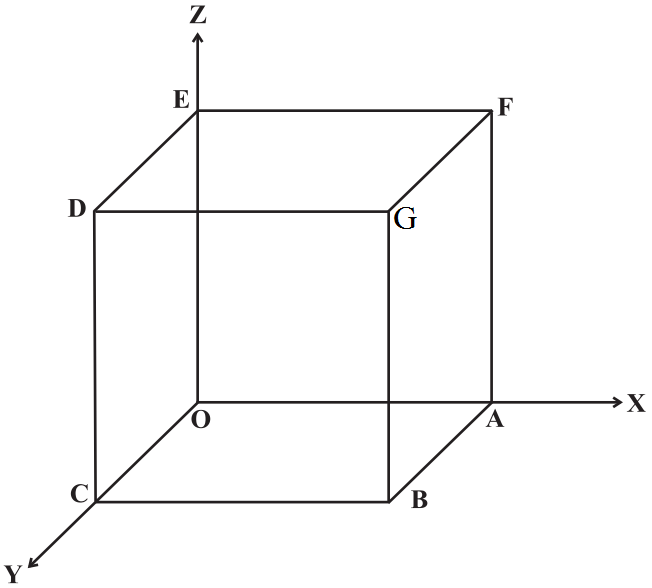
What are the coordinates of the vertices of a cube whose edge is 2 units, one of whose vertices coincides with the origin and the three edges passing through the origin, coincides with the positive direction of the axes through the origin?
Answer
Given that each edge of the cuboid is 2 units.
$\therefore$ coordinates of the vertices are

A(2, 0, 0), B(2, 2, 0), C(0, 2, 0), D(0, 2, 2), E(0, 0, 2), F(2, 0, 2), G(2, 2, 2), and O(0, 0, 0).
View full question & answer
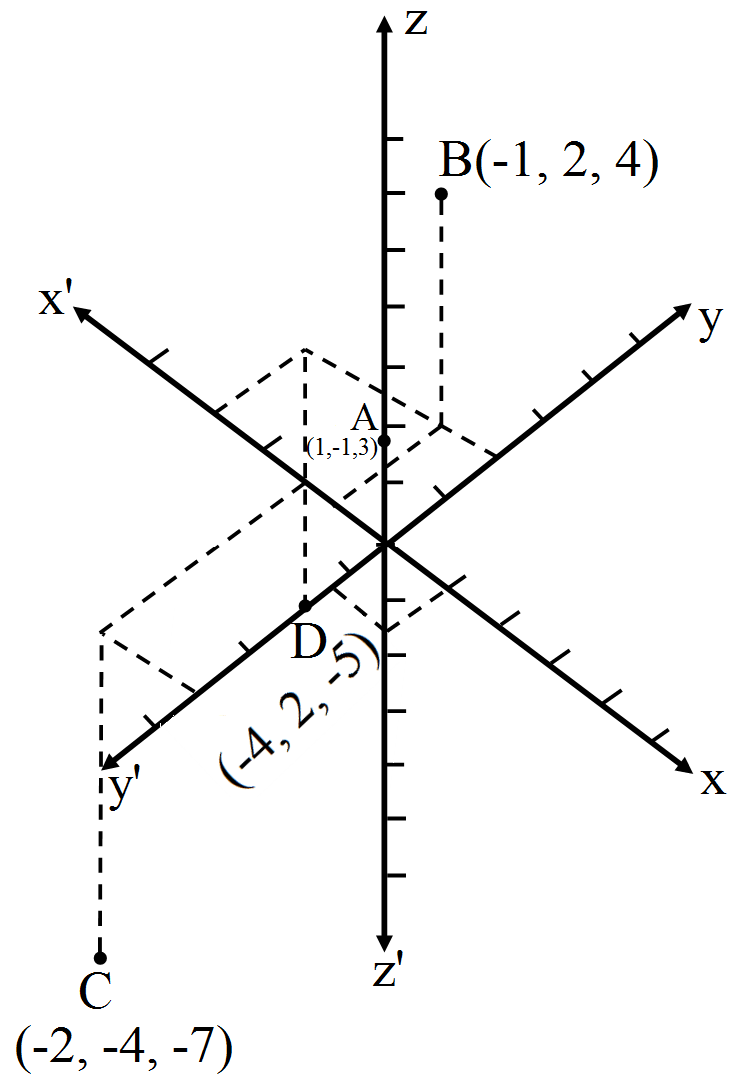
Question 52 Marks
Locate the following points:
  1. (1, -1, 3).
  2. (-1, 2, 4).
  3. (-2, -4, -7).
  4. (-4, 2, -5).
Answer
Given, coordinates:
  1. (1, -1, 3).
  2. (-1, 2, 4).
  3. (-2, -4, -7).
  4. (-4, 2, -5).
View full question & answer
Question 62 Marks
Show that if $\text{x}^2 + \text{y}^2 = 1,$ then the point $\Big(\text{x, y},\sqrt{1-\text{x}^2-\text{y}^2}\Big)$ is at a distance 1 unit from the origin.
Answer
Given that, $\text{x}^2 + \text{y}^2 = 1$
$\therefore$ Distance of the point $\Big(\text{x, y, }\sqrt{1-\text{x}^2-\text{y}^2}\Big)$ from origin is given as
$\text{d}=\sqrt{\text{x}^2+\text{y}^2+\big(\sqrt{1-\text{x}^2-\text{y}^2\big)^2}}$ $=\sqrt{\text{x}^2+\text{y}^2+1-\text{x}^2-\text{y}^2}=1$
View full question & answer
Question 72 Marks
Find the third vertex of triangle whose centroid is origin and two vertices are (2, 4, 6) and (0, -2, -5).
Answer
Let the third or unknown vertex of $\triangle\text{ABC}$ be A(x, y, z).
Other vertices of triangle are B(2,4, 6) and C(0, -2, -5).
The centroid is G(0, 0, 0).
$\therefore(0,0,0)=\Big(\frac{2+0+\text{x}}{3},\frac{4-2+\text{y}}{3},\frac{6-5+\text{z}}{3}\Big)$
On comparing coordinates, we get,
$\frac{2+\text{x}}{3}=0,\frac{2+\text{y}}{3}=0\ \text{and}\ \frac{1+\text{z}}{3}=0$
$\Rightarrow\text{x}=-2,\ \text{y}=-2\ \text{and}\ \text{z}=-1$
View full question & answer
2 Marks Questions - MATHS STD 11 Science Questions - Vidyadip