Questions

5 Marks Questions

Take a timed test

5 questions · self-marked practice — reveal the answer and mark yourself.

Question 15 Marks
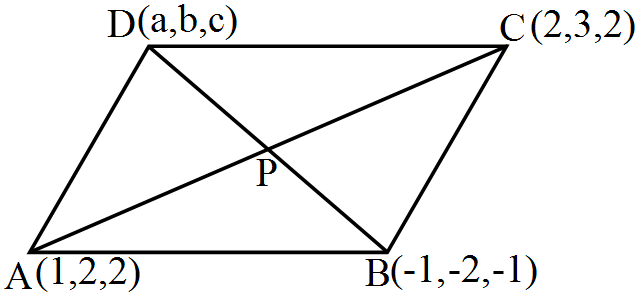
Three vertices of a Parallelogram ABCD are A(1, 2, 3), B(-1, -2, -1) and C(2, 3, 2). Find the fourth vertex D.
Answer
Let the coordinate of D be (a, b, c).

We know that the diagonals of a paralleogram bisect each other.
$\therefore$ Mid-point of AC i.e., $\text{O}=\Big(\frac{1+2}{2},\frac{2+3}{2},\frac{3+2}{2}\Big)$
$=\Big(\frac{3}{2},\frac{5}{2},\frac{5}{2}\Big)$
Mid-point of BD i.e., $\text{O}=\Big(\frac{\text{a}-1}{2},\frac{\text{b}-2}{2},\frac{\text{c}-1}{2}\Big)$
Euating the corresponding coordinate, we have
$\frac{\text{a}-1}{2}=\frac{3}{2}\Rightarrow\text{a}=4$
$\frac{\text{b}-2}{2}=\frac{5}{2}\Rightarrow\text{b}=7$
and $\frac{\text{c}-1}{2}=\frac{5}{2}\Rightarrow\text{c}=6$
Hence, the coordinates of D = (4, 7, 6).
View full question & answer
Question 25 Marks
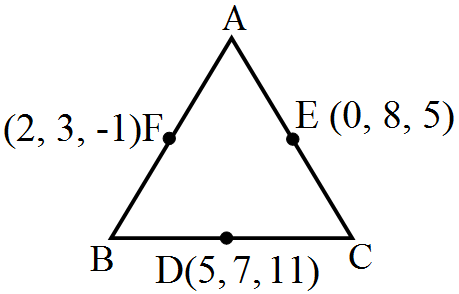
The mid-points of the sides of a triangle are (5, 7, 11), (0, 8, 5) and (2, 3, -1). Find its vertices.
Answer
Given that mid points of the sides of $\triangle\text{ABC}$ D(5, 7, 11), E(0, 8, 5) and F(2, 3, -1).

Let the vertices of triangle be $\text{A}(\text{x}_1, \text{y}_1, \text{z}_1), \text{B}(\text{x}_2, \text{y}_2, \text{z}_2), \text{C}(\text{x}_3, \text{y}_3, \text{z}_3)$.
Mid-point of AC is E.
$\therefore\Big(\frac{\text{x}_1+\text{x}_3}{2},\frac{\text{y}_1+\text{y}_3}{2},\frac{\text{z}_1+\text{z}_3}{2}\Big)\equiv(0,8,5)$
So, $\text{C}(\text{x}_3,\text{y}_3,\text{z}_3)\equiv\text{C}(-\text{x}_1,16-\text{y}_1,10-\text{z}_1)\ \ ..(\text{i})$
Mid-point of AB is F.
$\therefore\Big(\frac{\text{x}_1+\text{x}_2}{2},\frac{\text{y}_1+\text{y}_2}{2},\frac{\text{z}_1+\text{z}_2}{2}\Big)\equiv(2,3,-1)$
So, $\text{C}(\text{x}_2,\text{y}_2,\text{z}_2)\equiv\text{B}(4-\text{x}_1,6-\text{y}_1,-2-\text{z}_1)\ \ ..(\text{ii})$
Mid-point of BC is D
$\therefore\frac{-\text{x}_1+4-\text{x}_1}{2}=5,\ \frac{16-\text{y}_1+6-\text{y}_1}{2}=7,\ \frac{10-\text{z}_1-2-\text{z}_1}{2}=11$
$\Rightarrow\text{x}_1=-3,\text{y}_1=4$ and $\text{z}_1=-7$
$\therefore\text{A}\equiv(-3,4,-7)$
So, $\text{B}\equiv(7,2,5)\ \ [\text{Using (ii)]}$
and $\text{C}\equiv(3,12,17)\ \ [\text{Using (i)]}$
View full question & answer
Question 35 Marks
Match each item given under the column C1 to its correct answer given under column C2.
Column C1
Column C2
a.
In xy-plane.
i.
Ist octant.
b.
Point (2, 3, 4) lies in the.
ii.
yz-plane.
c.
Locus of the points having x coordinate 0 is.
iii.
z-coordinate is zero.
d.
A line is parallel to x-axis if and only.
iv.
z-axis.
e.
If x = 0, y = 0 taken together will represent the.
v.
plane parallel to xy-plane.
f.
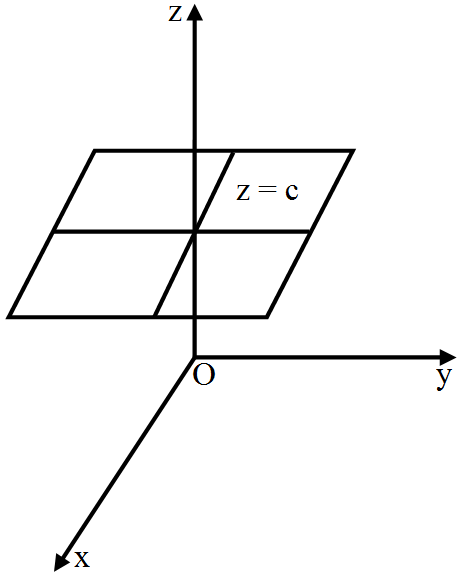
z = c represent the plane.
vi.
if all the points on the line have equal y and z-coordinates.
g.
Planes x = a, y = b represent the line.
vii.
from the point on the respective.
h.
Coordinates of a point are the distances from the origin to the feet of perpendiculars.
viii.
parallel to z-axis.
i.
A ball is the solid region in the space enclosed by a.
ix
disc.
j.
Region in the plane enclosed by a circle is known as a.
x.
sphere.
Answer
 
Column C1
 
Column C2
a.
In xy-plane.
iii.
z-coordinate is zero.
b.
Point (2, 3, 4) lies in the.
i.
1st octant.
c.
Locus of the points having x coordinate 0 is.
ii.
yz-plane.
d.
A line is parallel to x-axis if and only.
vi.
If all the points on the line have equal y and z-coordinates.
e.
If x = 0, y = 0 taken together will represent the.
iv.
z-axis.
f.
z = c represent the plane.
v.
Plane parallel to xy-plane.
g.
Planes x = a, y = b represent the line.
viii.
Parallel to z-axis.
h.
Coordinates of a point are the distances from the origin to the feet of perpendiculars.
vii.
From the point on the respective.
i.
A ball is the solid region in the space enclosed by a.
x
Sphere.
j.
Region in the plane enclosed by a circle is known as a.
ix.
Disc.
  1. In xy-plane, z-coordinate is zero.
  2. The point (2, 3, 4) lies in 1st octant.
  3. Locus of the points having x-coordinate zero is yz-plane.
  4. A line is parallel to x-axis if and only if all the points on the line have equal y and z-coordinates.
  5. x = 0, y = 0 represent z-axis
  6. z = c represents the plane parallel to xy-plane.

  1. The plane x = a is parallel to yz-plane.

Plane y = b is parallel to xz-plane. So, planes x = a and y = b is line of intersection of these planes. Now, line of intersection of yz-plane and xz-plane is z-axis. So, line of intersection of planes x = a andy = b is line parallel to z-axis.

  1. Coordinates of a point are the distances from the origin to the feet of perpendicular from the point on the respective axis.
  2. A ball is the solid region in the space enclosed by a sphere.
  3. The region in the plane enclosed by a circle is known as a disc.
View full question & answer
Question 45 Marks
Name the octant in which each of the following points lies:
  1. (1, 2, 3).
  2. (4, -2, 3).
  3. (4, -2, -5).
  4. (4, 2, -5).
  5. (-4, 2, 5).
  6. (-3, -1, 6).
  7. (2, -4, -7).
  8. (-4, 2, -5).
Answer
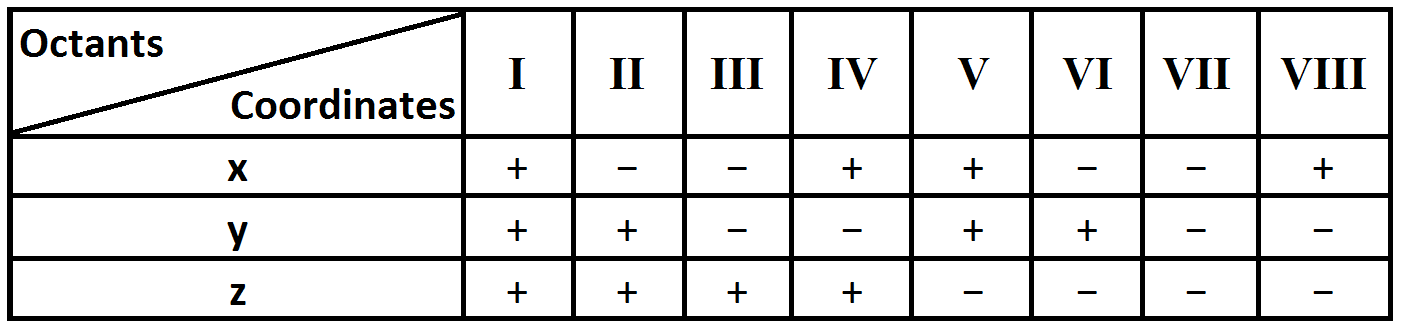
We know that the sign of the coordinates of a point determine the octant in which the point lies. The following table shows the signs of the coordinates in eight octants.
  1. (1, 2, 3) lies in first quadrant.
  2. (4, -2, 3) lies in fourth octant.
  3. (4, -2, -5) lies in eighth octant.
  4. (4, 2, -5) lies in fifth octant.
  5. (-4, 2, 5) lies in second octant.
  6. (-3, -1, 6) lies in third octant.
  7. (2, -4, -7) lies in eighth octant.
  8. (-4, 2, -5) lies in sixth octant.
View full question & answer
Question 55 Marks
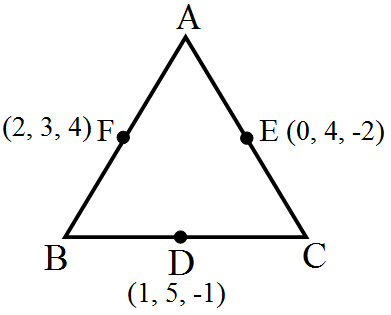
The mid-point of the sides of a triangle are (1, 5, -1), (0, 4, -2) and (2, 3, 4). Find its vertices. Also find the centriod of the triangle.
Answer
Given that mid-points of the sides of AABC are D(1, 5, -1), E(0, 4, -2) and F(2, 3, 4).

Let the vertices of triangle be A(x1, y1, z1), B(x2, y2, z2) and (x3, y3, z3)
Mid-point of AC is E.
$\therefore\Big(\frac{\text{x}_1+\text{x}_3}{2},\frac{\text{y}_1+\text{y}_3}{2},\frac{\text{x}_1+\text{z}_3}{2}\Big)\equiv(0,4,-2)$
So, $\text{C}(\text{x}_3,\text{y}_3,\text{z}_3)\equiv\text{C}(-\text{x}_1,8-\text{y}_1,-4-\text{z}_1)\ \ ...\text{(i})$
Mid-point of AB is F.
$\therefore\Big(\frac{\text{x}_1+\text{x}_2}{2},\frac{\text{y}_1+\text{y}_2}{2},\frac{\text{x}_1+\text{z}_2}{2}\Big)\equiv(2,3,4)$
So, $\text{B}(\text{x}_2,\text{y}_2,\text{z}_2)\equiv\text{B}(4-\text{x}_1,6-\text{y}_1,8-\text{z}_1)\ \ ...\text{(ii})$
Mid-point of BC is D.
$\therefore\frac{-\text{x}_1+4-\text{x}_1}{2}=1,\frac{8-\text{y}_1+6-\text{y}_1}{2}=5,\frac{-4-\text{z}_1+8-\text{z}_1}{2}=-1$
$\Rightarrow\text{x}_1=1,\text{y}_1=2$ and $\text{z}_1=3$
$\therefore\text{A}\equiv(1,2,3)$
So, $\text{B}\equiv(3,4,5)\ \ [\text{Using (ii)}]$
and $\text{C}\equiv(-1,6,-7)\ \ [\text{Using (i)}]$
Centroid, $\text{G}\equiv\Big(\frac{1+3-1}{3},\frac{2+4+6}{3},\frac{3+5-7}{3}\Big)\equiv\Big(1,4,\frac{1}{3}\Big)$
View full question & answer