Question 15 Marks
View full question & answer→Questions
5 Marks Questions
Take a timed test
6 questions · self-marked practice — reveal the answer and mark yourself.



Question 25 Marks
Find the equation of a circle concentric with the circle $x^2+y^2+4 x+6 y+11=0$ and passing through the point $(5,4)$.
Answer
View full question & answer→Here, the equation of circle is $x^2+y^2+4 x+6 y+11=0$
$\Rightarrow\left(x^2+4 x\right)+\left(y^2+6 y\right)=-11$
On adding 4 and 9 both sides to make perfect squares, we get
$\left(x^2+4 x+4\right)+\left(y^2+6 y+9\right)=-11+4+9$
$\Rightarrow( x +2)^2+( y +3)^2=(\sqrt{2})^2 \ldots( i )$
Its centre is (- 2, - 3)
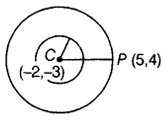
The required circle is concentric with circle 1, therefore its centre is (- 2 , - 3) . Since, it passes through (5, 4), therefore radius is
$\begin{array}{l} r = CP =\sqrt{(5+2)^2+(4+3)^2}\left[\because \text { distance }=\sqrt{\left(x_2-x_1\right)^2+\left(y_2-y_1\right)^2}\right] \\ =\sqrt{49+49}=7 \sqrt{2}\end{array}$
Hence, the equation of required circle having centre $(-2,-3)$ and radius $7 \sqrt{2}$ is,
$\begin{array}{l}(x+2)^2+(y+3)^2=(7 \sqrt{2})^2 \\ \Rightarrow x^2+4 x+4+y^2+6 y+9=98 \\ \Rightarrow x^2+4 x+y^2+6 y-85=0\end{array}$
$\Rightarrow\left(x^2+4 x\right)+\left(y^2+6 y\right)=-11$
On adding 4 and 9 both sides to make perfect squares, we get
$\left(x^2+4 x+4\right)+\left(y^2+6 y+9\right)=-11+4+9$
$\Rightarrow( x +2)^2+( y +3)^2=(\sqrt{2})^2 \ldots( i )$
Its centre is (- 2, - 3)
The required circle is concentric with circle 1, therefore its centre is (- 2 , - 3) . Since, it passes through (5, 4), therefore radius is
$\begin{array}{l} r = CP =\sqrt{(5+2)^2+(4+3)^2}\left[\because \text { distance }=\sqrt{\left(x_2-x_1\right)^2+\left(y_2-y_1\right)^2}\right] \\ =\sqrt{49+49}=7 \sqrt{2}\end{array}$
Hence, the equation of required circle having centre $(-2,-3)$ and radius $7 \sqrt{2}$ is,
$\begin{array}{l}(x+2)^2+(y+3)^2=(7 \sqrt{2})^2 \\ \Rightarrow x^2+4 x+4+y^2+6 y+9=98 \\ \Rightarrow x^2+4 x+y^2+6 y-85=0\end{array}$
Question 35 Marks
Prove that $\cos 12^{\circ}+\cos 60^{\circ}+\cos 84^{\circ}=\cos 24^{\circ}+\cos 48^{\circ}$
Answer
View full question & answer→LHS $=\cos 12^{\circ}+\cos 60^{\circ}+\cos 84^{\circ}$
$\begin{array}{l}=\cos 12^{\circ}+\left(\cos 84^{\circ}+\cos 60^{\circ}\right) \\ =\cos 12^{\circ}+\left[2 \cos \left(\frac{84^{\circ}+60^{\circ}}{2}\right) \times \cos \left(\frac{86^{\circ}-60^{\circ}}{2}\right)\right]\end{array}$
$\left[\because \cos x+\cos y=2 \cos \left(\frac{x+y}{2}\right) \cos \left(\frac{x-y}{2}\right)\right]$
$\begin{array}{l}=\cos 12^{\circ}+\left[2 \cos \frac{144^{\circ}}{2} \times \cos \frac{24^{\circ}}{2}\right] \\ =\cos 12^{\circ}+\left[2 \cos 72^{\circ} \times \cos 12^{\circ}\right]=\cos 12^{\circ}\left[1+2 \cos 72^{\circ}\right] \\ =\cos 12^{\circ}\left[1+2 \cos \left(90^{\circ}-18^{\circ}\right)\right] \\ =\cos 12^{\circ}\left[1+2 \sin 18^{\circ}\right]\left[\because \cos \left(90^{\circ}-\theta\right)=\sin \theta\right] \\ =\cos 12^{\circ}\left[1+2\left(\frac{\sqrt{5}-1}{4}\right)\right]\left[\because \sin 18^{\circ}=\frac{\sqrt{5}-1}{4}\right]\end{array}$
$=\left(1+\frac{\sqrt{5}-1}{2}\right) \cos 12^{\circ}=\left(\frac{\sqrt{5}+1}{2}\right) \cos 12^{\circ}$
RHS $=\cos 24^{\circ}+\cos 48^{\circ}$
$\begin{array}{l}=2 \cos \left(\frac{24^{\circ}+48^{\circ}}{2}\right) \cos \left(\frac{24^{\circ}-48^{\circ}}{2}\right)\left[\because \cos x+\cos y=2 \cos \left(\frac{x+y}{2}\right) \cos \left(\frac{x-y}{2}\right)\right] \\ =2 \cos 36^{\circ} \cos \left(-12^{\circ}\right) \\ =2 \cos 36^{\circ} \times \cos 12^{\circ}[\because \cos (-\theta)=\cos \theta] \\ =2 \times \frac{\sqrt{5}+1}{4} \times \cos 12^{\circ}=\frac{\sqrt{5}+1}{2} \times \cos 12^{\circ}\left[\because \cos 36^{\circ}=\frac{\sqrt{5}+1}{4}\right]\end{array}$
$\therefore$ LHS = RHS
Hence proved.
$\begin{array}{l}=\cos 12^{\circ}+\left(\cos 84^{\circ}+\cos 60^{\circ}\right) \\ =\cos 12^{\circ}+\left[2 \cos \left(\frac{84^{\circ}+60^{\circ}}{2}\right) \times \cos \left(\frac{86^{\circ}-60^{\circ}}{2}\right)\right]\end{array}$
$\left[\because \cos x+\cos y=2 \cos \left(\frac{x+y}{2}\right) \cos \left(\frac{x-y}{2}\right)\right]$
$\begin{array}{l}=\cos 12^{\circ}+\left[2 \cos \frac{144^{\circ}}{2} \times \cos \frac{24^{\circ}}{2}\right] \\ =\cos 12^{\circ}+\left[2 \cos 72^{\circ} \times \cos 12^{\circ}\right]=\cos 12^{\circ}\left[1+2 \cos 72^{\circ}\right] \\ =\cos 12^{\circ}\left[1+2 \cos \left(90^{\circ}-18^{\circ}\right)\right] \\ =\cos 12^{\circ}\left[1+2 \sin 18^{\circ}\right]\left[\because \cos \left(90^{\circ}-\theta\right)=\sin \theta\right] \\ =\cos 12^{\circ}\left[1+2\left(\frac{\sqrt{5}-1}{4}\right)\right]\left[\because \sin 18^{\circ}=\frac{\sqrt{5}-1}{4}\right]\end{array}$
$=\left(1+\frac{\sqrt{5}-1}{2}\right) \cos 12^{\circ}=\left(\frac{\sqrt{5}+1}{2}\right) \cos 12^{\circ}$
RHS $=\cos 24^{\circ}+\cos 48^{\circ}$
$\begin{array}{l}=2 \cos \left(\frac{24^{\circ}+48^{\circ}}{2}\right) \cos \left(\frac{24^{\circ}-48^{\circ}}{2}\right)\left[\because \cos x+\cos y=2 \cos \left(\frac{x+y}{2}\right) \cos \left(\frac{x-y}{2}\right)\right] \\ =2 \cos 36^{\circ} \cos \left(-12^{\circ}\right) \\ =2 \cos 36^{\circ} \times \cos 12^{\circ}[\because \cos (-\theta)=\cos \theta] \\ =2 \times \frac{\sqrt{5}+1}{4} \times \cos 12^{\circ}=\frac{\sqrt{5}+1}{2} \times \cos 12^{\circ}\left[\because \cos 36^{\circ}=\frac{\sqrt{5}+1}{4}\right]\end{array}$
$\therefore$ LHS = RHS
Hence proved.
Question 45 Marks
Prove that: $\sin 20^{\circ} \sin 40^{\circ} \sin 80^{\circ}=\frac{\sqrt{3}}{8}$
View full question & answer→Question 55 Marks
Find the equation of the hyperbola, the length of whose latus rectum is 4 and the eccentricity is 3.
Answer
View full question & answer→Given: The length of latus rectum is 4, and the eccentricity is 3
Let, the equation of the hyperbola be: $\frac{x^2}{a^2}-\frac{y^2}{b^2}=1$
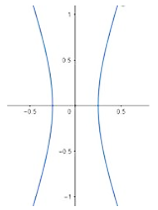
The length of the latus rectum is 4 units.
$\begin{array}{l}\Rightarrow \text { length of the latus rectum }=\frac{2 b^2}{a}=4 \\ \Rightarrow \frac{2 b^2}{a}=4 \Rightarrow b^2=2 a \ldots \text { (i) }\end{array}$
And also given, the eccentricity, e = 3
We know that, $e=\sqrt{1+\frac{b^2}{a^2}}$
$\begin{array}{l}\Rightarrow \sqrt{1+\frac{b^2}{a^2}}=3 \\ \Rightarrow 1+\frac{b^2}{a^2}=9[\text { Squaring both sides }] \\ \Rightarrow \frac{b^2}{a^2}=8 \\ \Rightarrow b^2=8 a ^2 \\ \Rightarrow 2 a =8 a ^2[\text { From (i) }] \\ \Rightarrow a=\frac{1}{4} \Rightarrow a ^2=\frac{1}{16}\end{array}$
From (i) $\Rightarrow b^2=2 a=2 \times \frac{1}{4}=\frac{1}{2} \Rightarrow b^2=\frac{1}{2}$
So, the equation of the hyperbola is,
$\begin{array}{l}\frac{x^2}{a^2}-\frac{y^2}{b^2}=1 \Rightarrow \frac{x^2}{1 / 16}-\frac{y^2}{1 / 2}=1 \\ \Rightarrow 16 x^2-2 y^2=1\end{array}$
Let, the equation of the hyperbola be: $\frac{x^2}{a^2}-\frac{y^2}{b^2}=1$
The length of the latus rectum is 4 units.
$\begin{array}{l}\Rightarrow \text { length of the latus rectum }=\frac{2 b^2}{a}=4 \\ \Rightarrow \frac{2 b^2}{a}=4 \Rightarrow b^2=2 a \ldots \text { (i) }\end{array}$
And also given, the eccentricity, e = 3
We know that, $e=\sqrt{1+\frac{b^2}{a^2}}$
$\begin{array}{l}\Rightarrow \sqrt{1+\frac{b^2}{a^2}}=3 \\ \Rightarrow 1+\frac{b^2}{a^2}=9[\text { Squaring both sides }] \\ \Rightarrow \frac{b^2}{a^2}=8 \\ \Rightarrow b^2=8 a ^2 \\ \Rightarrow 2 a =8 a ^2[\text { From (i) }] \\ \Rightarrow a=\frac{1}{4} \Rightarrow a ^2=\frac{1}{16}\end{array}$
From (i) $\Rightarrow b^2=2 a=2 \times \frac{1}{4}=\frac{1}{2} \Rightarrow b^2=\frac{1}{2}$
So, the equation of the hyperbola is,
$\begin{array}{l}\frac{x^2}{a^2}-\frac{y^2}{b^2}=1 \Rightarrow \frac{x^2}{1 / 16}-\frac{y^2}{1 / 2}=1 \\ \Rightarrow 16 x^2-2 y^2=1\end{array}$
Question 65 Marks
Find the mean deviation about the mean for the following data:
| xi | 3 | 5 | 7 | 9 | 11 | 13 |
| fi | 6 | 8 | 15 | 3 | 8 | 4 |
Answer
View full question & answer→We have
$\begin{array}{l}N=\sum_{i=1}^6 f_i=(6+8+15+3+8+4)=44 \\ \bar{x}=\frac{\sum_{i=1}^6 f_i x_i}{N}=\frac{(6 \times 3)+(8 \times 5)+(15 \times 7)+(3 \times 9)+(8 \times 11)+(4 \times 13)}{44} \\ =\frac{(18+40+105+27+88+52)}{44}=\frac{330}{44}=\frac{15}{2}=7.5\end{array}$
Here we have, N = 44, which is even.
Therefore, median $=\frac{1}{2} \cdot\left\{\frac{N}{2}\right.$ th observation $+\left(\frac{N}{2}+1\right)$ th observation $\}$
$\begin{array}{l}=\frac{1}{2}(22 \text { nd observation }+23 \text { rd observation }) \\ =\frac{1}{2}(7+7)=7\end{array}$
Thus, M = 7.
Now, we have:
$\begin{array}{l}\therefore \sum_{i=1}^6 f_i=44 \text { and } \sum_{i=1}^6 f_i\left|x_i-M\right|=102 \\ \therefore M D(\bar{x})=\frac{\sum_{i=1}^6 f_i\left|x_i-M\right|}{N}=\frac{102}{44}=2.32\end{array}$
$\begin{array}{l}N=\sum_{i=1}^6 f_i=(6+8+15+3+8+4)=44 \\ \bar{x}=\frac{\sum_{i=1}^6 f_i x_i}{N}=\frac{(6 \times 3)+(8 \times 5)+(15 \times 7)+(3 \times 9)+(8 \times 11)+(4 \times 13)}{44} \\ =\frac{(18+40+105+27+88+52)}{44}=\frac{330}{44}=\frac{15}{2}=7.5\end{array}$
| xi | 3 | 5 | 7 | 9 | 11 | 13 |
| fi | 6 | 8 | 15 | 3 | 8 | 4 |
| cf | 6 | 14 | 29 | 32 | 40 | 44 |
Therefore, median $=\frac{1}{2} \cdot\left\{\frac{N}{2}\right.$ th observation $+\left(\frac{N}{2}+1\right)$ th observation $\}$
$\begin{array}{l}=\frac{1}{2}(22 \text { nd observation }+23 \text { rd observation }) \\ =\frac{1}{2}(7+7)=7\end{array}$
Thus, M = 7.
Now, we have:
| $\left|x_i-M\right|$ | 4 | 2 | 0 | 2 | 4 | 6 |
| fi | 6 | 8 | 15 | 3 | 8 | 4 |
| $f_i\left|x_i-M\right|$ | 24 | 16 | 0 | 6 | 32 | 24 |